Health
Why do Weimaraners get more eye injuries?
Their history as fast-moving field dogs puts their eyes in regular contact with branches, thorns, and grasses during the activity this breed loves.

Quick answer
Why do Weimaraners get more eye injuries?
Their history as fast-moving field dogs puts their eyes in regular contact with branches, thorns, and grasses during the activity this breed loves.
A dog bred to run flat-out through fields, brambles, and tall brush chasing scent and movement is going to put its eyes closer to sharp branches and grass seeds than a dog that mostly walks calmly on sidewalks, and that difference in lifestyle carries a real, practical injury risk.
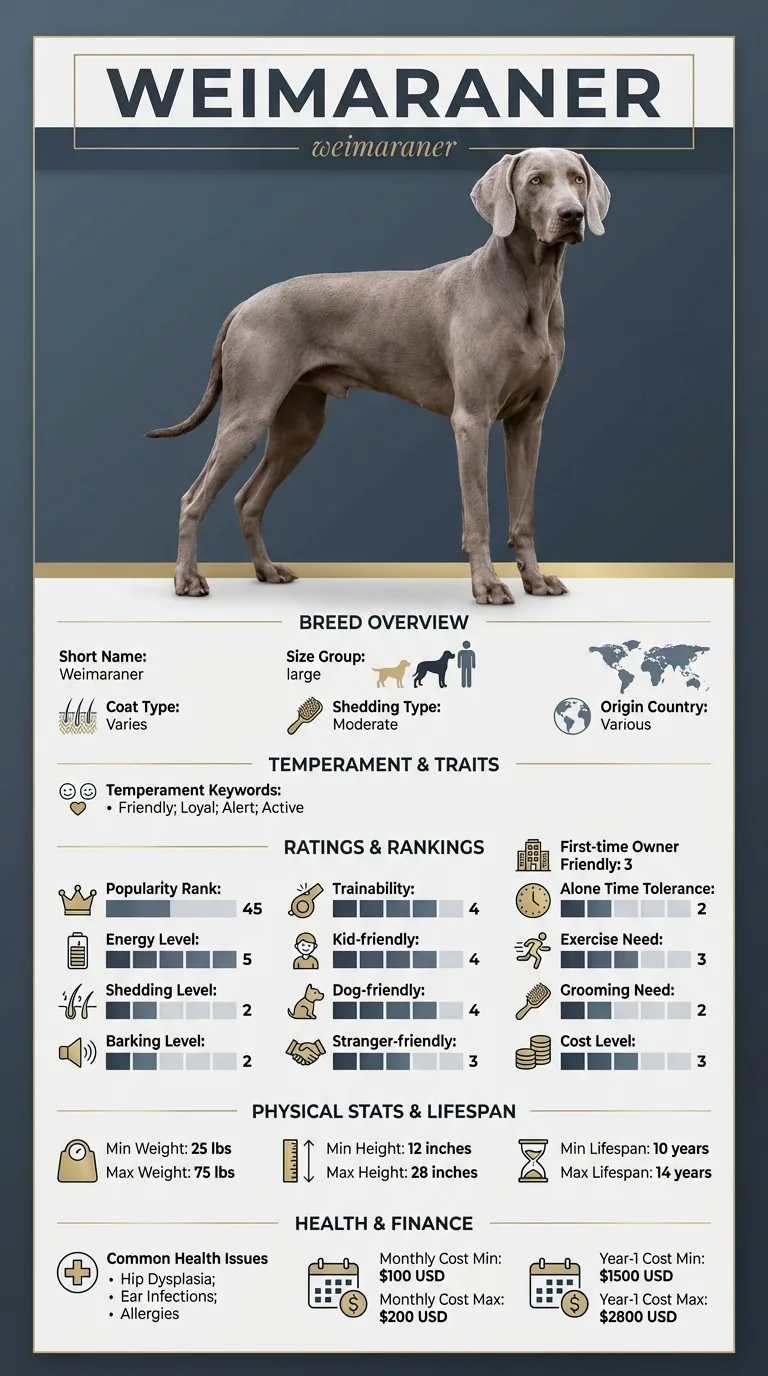
This affects owners who exercise their Weimaraner off-leash in fields, woods, or brush, and owners of dogs used for hunting or field trial work where the eyes are directly exposed to vegetation at speed.
This guide is not medical advice. If your dog shows pain, sudden behavior change, or worsening symptoms, consult a licensed veterinarian.
Some links may be affiliate links. We may earn a commission at no extra cost to you. We only suggest products we believe are helpful for dog owners.
Eye injuries in Weimaraners are largely a function of lifestyle: this breed's history as a fast, close-cover field and hunting dog puts its eyes in regular contact with branches, thorns, and grasses. Injuries range from minor corneal scratches to more serious ulcers, and all should be treated as urgent given how quickly corneal damage can progress.
Eye injuries are more common in field-active, outdoor-oriented dogs generally, and Weimaraners, given their history and continued popularity as active field and hunting companions, fall squarely into that higher-exposure group.
Weimaraners were developed for versatile, close-cover hunting work, meaning their eyes are regularly exposed to branches, thorns, and stiff vegetation during exactly the fast-paced activity this breed is built for and drawn to.
Time spent running through brush, woods, or tall grass at speed is the primary environmental driver of eye injury risk, along with rough multi-dog play and, less commonly, incidental contact with objects during ordinary outdoor activity.
Treat any sudden squinting, eye redness, tearing, or pawing at the eye as same-day urgent, especially following activity in brush or woods. A visibly cloudy cornea, a hard time keeping the eye open, or an eye that seems to be getting worse over hours needs immediate attention rather than a wait-and-see approach.
See all Weimaraner health problems, which breeds are prone to eye problems, or the full Weimaraner breed guide for temperament, exercise needs and ownership costs.
A mild corneal scratch typically heals within a few days to a week with appropriate treatment. A deeper ulcer can take one to several weeks and closer monitoring to fully resolve.
Success is quick recognition and same-day treatment that resolves the injury before it can progress to a more serious, vision-threatening problem.
Weimaraners were developed as versatile hunting dogs, prized for exactly the kind of high-speed, close-cover work that puts the face and eyes in direct contact with branches, thorns, and stiff grasses. A prominent, forward-facing eye position, useful for a dog that needs excellent vision while working, also means less bony or fatty tissue shielding the eye compared to some other facial structures.
The most common injuries in this context are corneal scratches or ulcers from a branch or grass seed, and less commonly, a grass awn or foreign body lodging under the eyelid, which can cause the same signs as a scratch, but recurring or worsening if the object isn't found and removed. Any of these can look deceptively minor at first, a bit of squinting or tearing, before rapidly worsening if the surface of the eye becomes infected.
Unlike many of the other eye conditions covered elsewhere, which are gradual or structural, an eye injury is by definition sudden and typically follows a specific activity, running through brush, playing rough with another dog, or an object flicking up during a walk. That sudden-onset, activity-linked pattern is the biggest clue that you're dealing with an injury rather than something slower-developing.
Speed matters more here than with almost any other eye condition, since untreated corneal damage can progress quickly.

During a morning run through a wooded trail, Colton's Weimaraner, Scout, suddenly started squinting and pawing at his right eye. Colton stopped the run immediately and checked, seeing redness and heavy tearing but no obvious debris. He got Scout to the vet that same afternoon, where an exam with a special dye revealed a corneal scratch, likely from a branch. Scout was started on medicated drops and wore an E-collar for a week to prevent him from rubbing at it. The scratch healed completely within eight days, with no lasting damage.
Key takeaway: Colton didn't wait to see if the squinting would pass on its own, which mattered given how quickly a corneal injury can worsen. Treating the sudden change as urgent, rather than assuming it was minor, is what kept it a quick, straightforward recovery.
Their history as fast-moving field and hunting dogs means their eyes are regularly exposed to branches, thorns, and stiff grasses during exactly the kind of activity this breed loves and needs, raising real injury risk compared to a dog that mostly walks on sidewalks.
Sudden squinting, excessive tearing, redness, and pawing at the eye are the classic signs, sometimes with visible cloudiness over the surface of the eye in more significant cases.
Treat any sudden eye pain, squinting, or injury as same-day urgent. Corneal damage can worsen quickly, and what looks minor at first can become a much more serious, vision-threatening problem within a day or two if untreated.
A brief, gentle look is reasonable, but avoid trying to flush or extract anything yourself beyond that; you risk pushing debris deeper or causing further corneal damage. This is a job for your vet.
Treatment depends on severity, ranging from medicated drops for a mild scratch to more involved care for a deeper ulcer or an object that needs to be removed under sedation.
You can't eliminate the risk entirely without limiting the activity this breed thrives on, but checking your dog's eyes after heavy-brush activity and addressing any squinting immediately reduces how much a minor injury can escalate.
A straightforward corneal scratch treated early is a relatively modest cost, while a deeper ulcer or one requiring specialist care can run considerably higher, which is part of why catching it early matters financially too.
Their history as fast-moving field dogs puts their eyes in regular contact with branches, thorns, and grasses during the activity this breed loves.
Sudden squinting, tearing, or pawing at one eye, typically right after field or brush activity.
Yes, treat any sudden eye pain or injury as same-day urgent, since corneal damage can worsen quickly.
Only a brief, gentle look; avoid flushing or extracting anything yourself, since this is best left to your vet.
A mild scratch treated early is relatively modest in cost; a deeper ulcer or specialist care runs considerably higher.
A one-page prep sheet for this condition: the signs, the questions to ask, what to get priced. Unlocks here.
You get: Vet visit prep sheet
No spam. One-click unsubscribe. See our privacy policy.
Preview page 1 before you decide.