Health
Is DCM a genetic risk for Weimaraners?
No, this breed isn't documented with a genetic predisposition to DCM; diet history is the more relevant consideration here.

Quick answer
Is DCM a genetic risk for Weimaraners?
No, this breed isn't documented with a genetic predisposition to DCM; diet history is the more relevant consideration here.
DCM has distinct, trackable stages long before a dog shows any outward symptom, which is exactly why an echocardiogram, not a wait-and-watch approach, is the tool that actually catches it early.
This affects owners with a specific reason to check for DCM, whether that's a diet history flagged in the FDA's grain-free investigation, or a vet who's picked up something worth investigating further on an exam.
This guide is not medical advice. If your dog shows pain, sudden behavior change, or worsening symptoms, consult a licensed veterinarian.
Some links may be affiliate links. We may earn a commission at no extra cost to you. We only suggest products we believe are helpful for dog owners.
Dilated cardiomyopathy is a specific heart muscle disease causing chamber enlargement and reduced pumping ability. Weimaraners fall outside the breeds with a documented genetic predisposition, making diet history and incidental findings the more relevant triggers for a workup in this breed.
DCM overall is uncommon in Weimaraners compared to breeds with a documented genetic predisposition. Diet-associated cases across all breeds increased during the years the FDA investigation was most active, though the condition remains uncommon overall in this breed.
Weimaraners are not part of the breed group with an established genetic DCM predisposition. Their relevance to this topic comes primarily through general large-breed diet patterns rather than an inherited cardiac risk.
A long-term diet heavy in legumes as a primary ingredient is the main environmental factor under investigation for diet-associated DCM. Age and general cardiovascular health also play a role in how any cardiac finding progresses over time.
Bring up a legume-heavy diet history proactively at a wellness visit, even without symptoms. See your vet promptly for reduced exercise stamina, a persistent cough, labored breathing, or any fainting or collapse episode, which should be treated as same-day rather than routine.
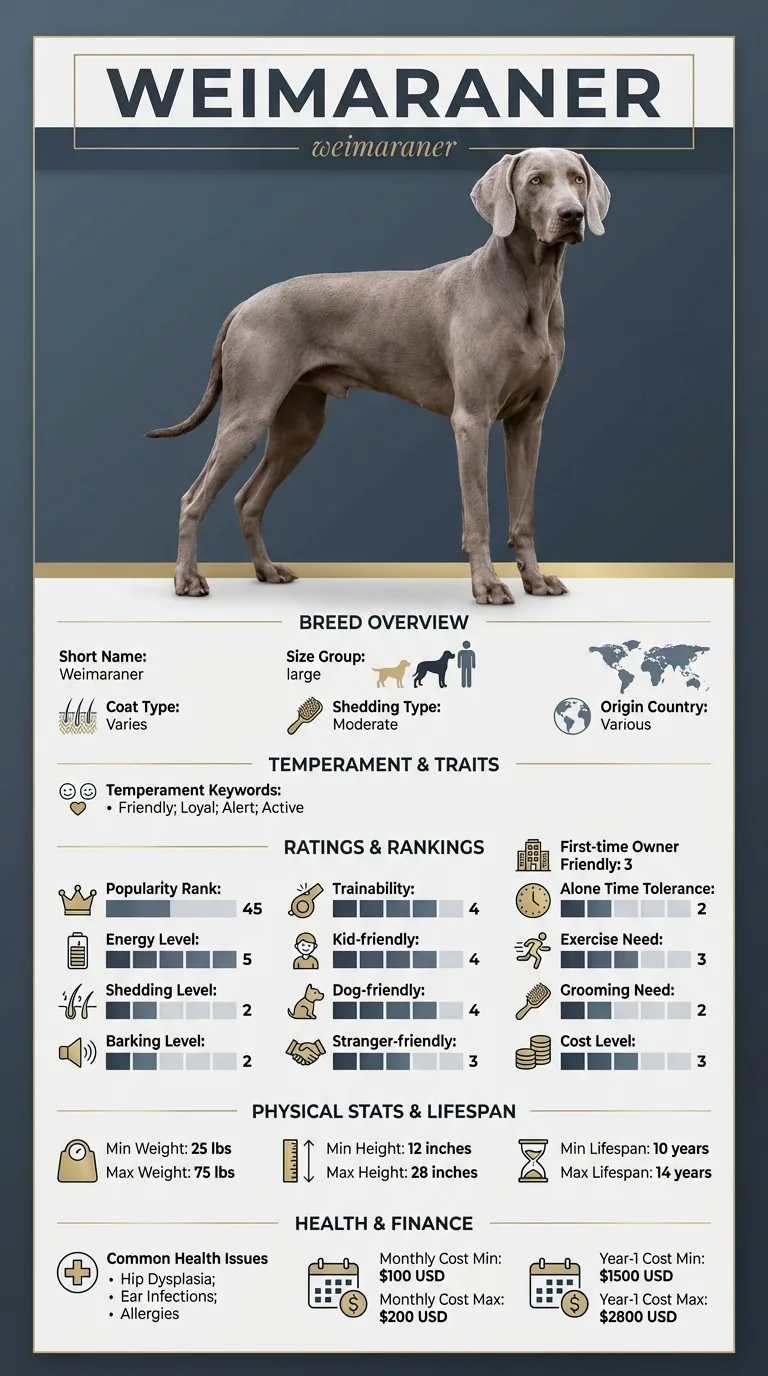
See all Weimaraner health problems, which breeds are prone to dilated cardiomyopathy dcm, or the full Weimaraner breed guide for temperament, exercise needs and ownership costs.
A full workup, including echocardiogram and possibly a Holter monitor, typically wraps up within a single visit to a few weeks depending on scheduling with a cardiologist. If DCM is diagnosed, management is ongoing with regular rechecks.
Success is either a clear baseline that puts diet-related concerns to rest, or, if something is found, catching it at an early, asymptomatic stage where management has the best chance of preserving heart function.
DCM in breeds with a known genetic predisposition is typically described in stages: an early, purely structural stage where the heart has started to enlarge but shows no outward symptoms and no rhythm abnormality; a stage where rhythm abnormalities appear without symptoms; and finally an overt stage where clinical signs like coughing, labored breathing, reduced stamina, or fainting appear. Weimaraners aren't part of the genetic-risk breed group this staging system was built around, but the diagnostic tools are the same regardless of genetics.
An echocardiogram is the central diagnostic tool: it directly measures the heart's chamber size and how effectively it's contracting, which is far more informative than listening for a murmur alone, since early DCM sometimes has no murmur at all. A Holter monitor, which records heart rhythm over 24 hours, can catch intermittent rhythm abnormalities that a single vet-visit ECG might miss entirely.
For a Weimaraner, the most likely reason to pursue this kind of workup is a documented history of a legume-heavy grain-free diet, given the broader diet-associated cardiomyopathy investigation that touched many breeds outside the traditional genetic-risk group, or a heart murmur or symptom picked up incidentally that warrants ruling DCM in or out specifically.
Knowing what each test measures helps you understand what your vet or cardiologist is actually looking for.

If you think your Weimaraner has dilated cardiomyopathy, the plan is three steps: write down what you have seen and when it started, book a veterinary appointment rather than waiting for the next flare, and take video of the behaviour or symptom before you go — the thing you are worried about rarely happens in the consulting room. Screening in the parents covers bloat (gdv), hip dysplasia, hypertrophic osteodystrophy.
What the vet visit should produce is a diagnosis and a written plan, not just reassurance: what is being ruled out, what the monitoring interval is, and which signs mean you come back sooner. Ask what the treatment costs across a year rather than per visit, because that is the number that decides whether you are managing this condition or reacting to it.
Between appointments, keep a short log — dates, what you saw, what changed. It is the single most useful thing an owner brings to a follow-up, and for dilated cardiomyopathy it is often what separates a clear pattern from a guess.
After hearing about the grain-free diet investigation from a friend, Desmond realized his seven-year-old Weimaraner, Ranger, had eaten the same pea-heavy grain-free formula for his entire adult life. At his next visit, his vet recommended a full cardiac workup given the extended diet history, including an echocardiogram and a 24-hour Holter monitor. The echocardiogram showed mild, early chamber enlargement without symptoms, an asymptomatic early stage. Desmond's vet switched him to a diet with a longer track record of feeding trials and scheduled a recheck echocardiogram in six months to track whether the change made a difference.
Key takeaway: Ranger showed no symptoms at all; the finding was only caught because Desmond connected his specific diet history to the broader FDA investigation and brought it up directly. Diet history is worth volunteering to your vet, not waiting to be asked about.
No, this breed is not among those with a documented genetic predisposition to DCM, unlike Doberman Pinschers or Great Danes. The more relevant risk factor for Weimaraners is diet-associated DCM, tied to certain grain-free foods.
DCM is a specific type of cardiomyopathy where the heart's chambers enlarge and the muscle weakens. Cardiomyopathy is the broader category; DCM is the most studied and most common form discussed in the context of diet.
An echocardiogram is the central diagnostic tool, directly measuring heart chamber size and contraction strength. A stethoscope exam alone can miss early DCM, since it doesn't always cause an audible murmur.
No, early stages can be entirely without symptoms, which is why imaging, not waiting for signs like coughing or fainting, is the more reliable way to catch it early if there's a specific reason for concern.
It's a portable device that records your dog's heart rhythm continuously over 24 hours, catching intermittent rhythm abnormalities that a brief in-office ECG could easily miss.
It's managed rather than cured, often with medication to support heart function prescribed and monitored by your vet or a veterinary cardiologist, alongside addressing any diet-related contributing factor.
An echocardiogram alone commonly runs several hundred dollars, more with a cardiologist; adding a Holter monitor and bloodwork increases the total, making a full workup a meaningful but often worthwhile expense for a specific concern.
No, this breed isn't documented with a genetic predisposition to DCM; diet history is the more relevant consideration here.
An echocardiogram, which directly measures heart chamber size and contraction strength, is the central diagnostic tool.
Yes, early stages often show no outward symptoms, which is why imaging is more reliable than waiting for signs.
It records heart rhythm over 24 hours, catching intermittent abnormalities a brief office visit could miss.
An echocardiogram alone typically runs several hundred dollars, with a full workup including a Holter monitor and bloodwork costing more.
A one-page prep sheet for this condition: the signs, the questions to ask, what to get priced. Unlocks here.
You get: Vet visit prep sheet
No spam. One-click unsubscribe. See our privacy policy.
Preview page 1 before you decide.