Health
Do Papillons commonly get hip dysplasia?
No. The breed's documented joint problem is patellar luxation, the slipping kneecap. Hip dysplasia occurs but is not typical.

Quick answer
Do Papillons commonly get hip dysplasia?
No. The breed's documented joint problem is patellar luxation, the slipping kneecap. Hip dysplasia occurs but is not typical.
Three different joints produce three different limps in this breed, and telling them apart from the sofa is easier than most owners think.
Owners whose Papillon has started hopping, skipping or holding a back leg up, and who have already been told by a groomer, a neighbour or the internet that it must be the hips.
This guide is not medical advice. If your dog shows pain, sudden behavior change, or worsening symptoms, consult a licensed veterinarian.
Some links may be affiliate links. We may earn a commission at no extra cost to you. We only suggest products we believe are helpful for dog owners.
Hip dysplasia describes a hip joint in which the ball and socket did not develop to fit each other, so the joint moves loosely and abrades itself into arthritis over the years. It is diagnosed most often in large fast growing breeds. A Papillon can have it, but an owner watching a hind leg misbehave should hold two other conditions higher on the list: a kneecap that slips out of its groove, and degeneration of the femoral head during puppyhood.
Registry data across breeds consistently shows the highest dysplasia rates in large and giant dogs, with toy breeds submitting fewer films and reporting far fewer clinically affected dogs. Papillon owners will meet a slipping kneecap many times more often than they meet a dysplastic hip, which is exactly why the misattribution is so frequent.
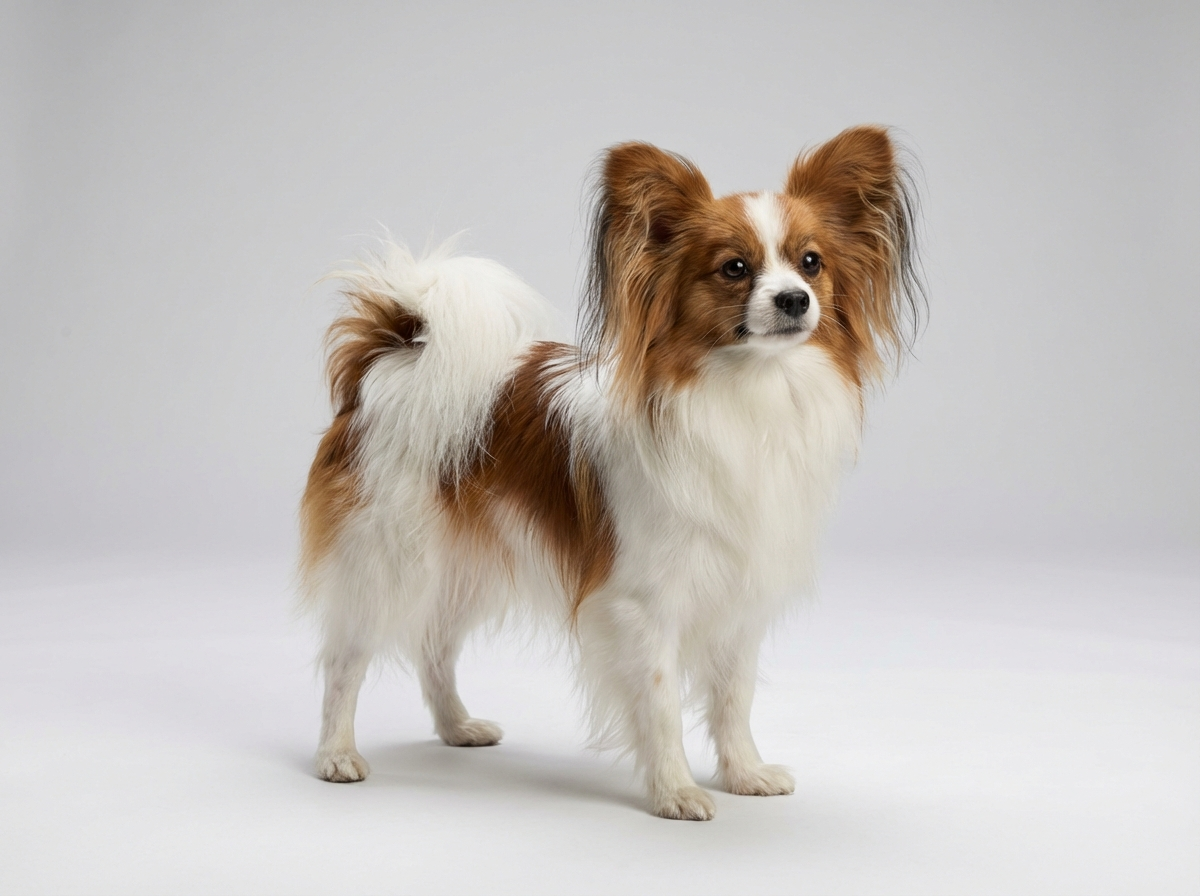
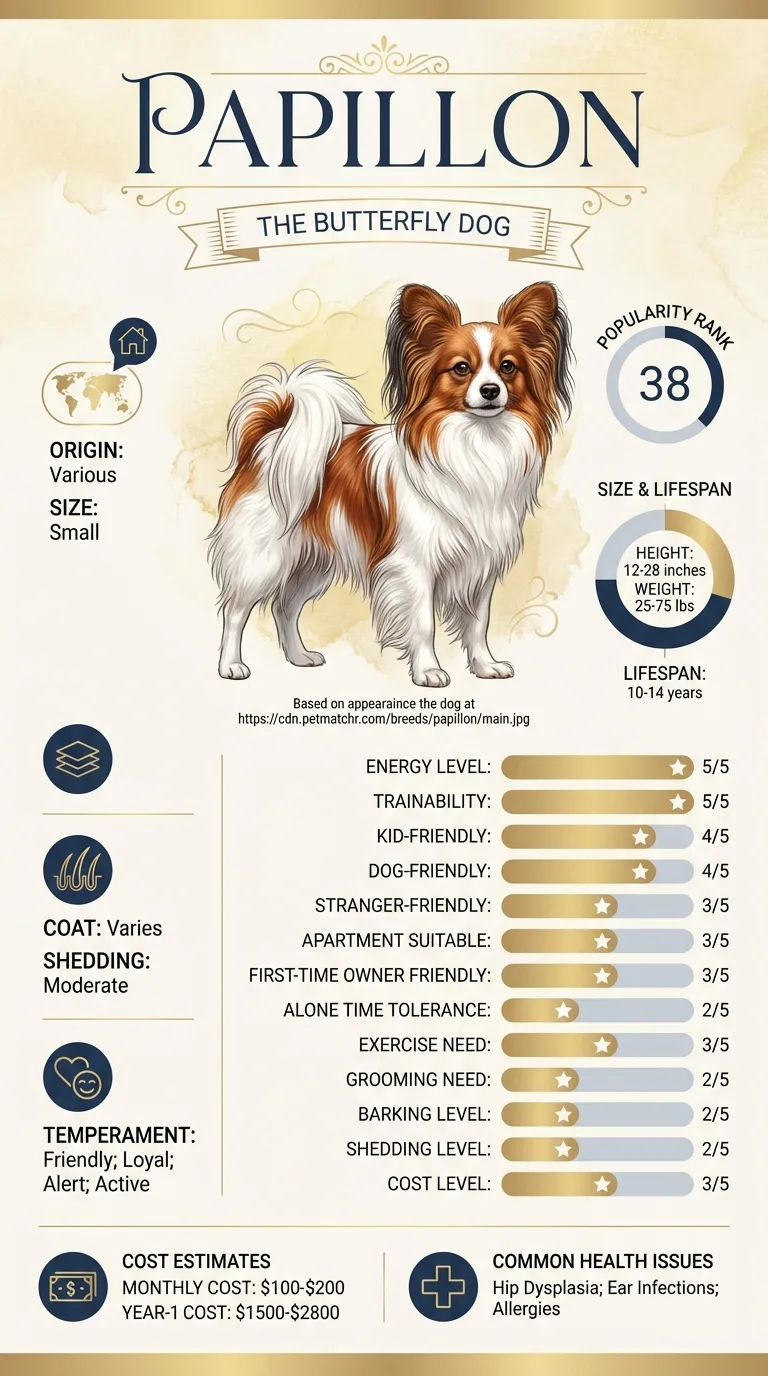
The Papillon is a fine boned dog of five to ten pounds standing eight to eleven inches tall, and its recognised orthopaedic weakness lies at the stifle, where a shallow groove lets the kneecap ride out of position. Hip development in a breed this small is not subjected to the growth rate and load that drive dysplasia in giant dogs, which is why the condition is uncommon here rather than absent. Where it does appear, it is usually inherited joint laxity rather than anything acquired.
Household surfaces do more damage to small dog joints than most owners realise. Laminate, tile and polished boards give no purchase to small paws, so every take off and landing involves a scrabble that loads the joint sideways. Repeatedly jumping down from a sofa is a proportionally enormous drop for a nine inch dog. Both accelerate wear in any hind limb joint, whatever the underlying diagnosis.
See a vet within a few days for any limp lasting more than forty eight hours, any change in how your Papillon rises from lying down, or any thigh that has become visibly thinner than the other. Go the same day if the leg is held completely off the ground, if the joint is hot or swollen, if the dog yelps on touch, or if the lameness followed a jump or a fall. A five to ten pound dog with fine bones can sustain a fracture from a height a larger dog would shrug off.
See all Papillon health problems, which breeds are prone to hip dysplasia, or the full Papillon breed guide for temperament, exercise needs and ownership costs.
Getting a correct diagnosis normally takes one appointment plus radiographs. If the answer is a hip, expect management rather than resolution, with improvement in comfort over four to eight weeks of weight loss, flooring changes and controlled exercise. Joint changes themselves do not reverse, and in a dog that lives fourteen to sixteen years the plan needs to be sustainable for a decade.
Success is a Papillon that still climbs into its bed unaided at twelve, keeps even muscle on both hind legs, and has a diagnosis on file that actually matches its x-rays rather than a guess made in a doorway.
A dysplastic hip produces a gait fault that involves both hind legs and worsens over years. The dog sits with its legs out to one side, struggles to rise from the floor, may bunny hop up stairs with both back feet together, and shows a rolling sway through the hindquarters at a trot. Discomfort builds gradually. It is a slow, symmetrical, wear and tear picture.
A luxating kneecap produces something completely different. The dog trots normally, then suddenly skips: it picks up one hind leg for two or three strides, carries it while it swings, then drops it and continues as if nothing happened. That skip is the kneecap slipping out of its groove and popping back in. It is the classic small breed gait and it is by far the likeliest explanation in a Papillon, since patellar luxation is one of the breed's documented issues.
Degeneration of the femoral head, seen in toy breeds during growth, gives a third pattern. It is almost always one sided, it begins between roughly five and eight months, and it gets steadily worse rather than coming and going. The giveaway is muscle: the thigh on the affected side visibly wastes, so one hind leg becomes noticeably thinner than the other.
Film your dog trotting away from you and toward you on a flat surface. The three signatures look nothing alike on video.

A Papillon in an exam room is excited, wriggly and unlikely to reproduce the limp. What you bring matters.
If you think your Papillon has hip dysplasia, the plan is three steps: write down what you have seen and when it started, book a veterinary appointment rather than waiting for the next flare, and take video of the behaviour or symptom before you go — the thing you are worried about rarely happens in the consulting room. Screening in the parents covers patellar luxation, progressive retinal atrophy, dental disease.
What the vet visit should produce is a diagnosis and a written plan, not just reassurance: what is being ruled out, what the monitoring interval is, and which signs mean you come back sooner. Ask what the treatment costs across a year rather than per visit, because that is the number that decides whether you are managing this condition or reacting to it.
Between appointments, keep a short log — dates, what you saw, what changed. It is the single most useful thing an owner brings to a follow-up, and for hip dysplasia it is often what separates a clear pattern from a guess.
Tomas took his three year old Papillon Odile in for a trim and was told by the groomer, with total confidence, that her back end movement meant hip dysplasia and that she would need surgery within the year. He spent a fortnight reading worst case outcomes. His vet asked him to film her trotting down the practice corridor. Odile went eight strides, hitched her left hind leg up for two, and carried on. No sway, no bunny hop, both thighs equal under Tomas's hands. Radiographs showed normal hips and a shallow trochlear groove on the left. The diagnosis was a grade two patellar luxation, managed with rugs on the hallway, a set of sofa steps, and holding her at six pounds twelve ounces. Four years later she has never needed surgery.
Key takeaway: Hind limb lameness in a Papillon is a knee until an x-ray says otherwise. Thirty seconds of video and a hand on each thigh will get you closer to the truth than any confident opinion offered across a grooming table.
Yes, it occurs in small breeds, though it is diagnosed far less often than in large ones and it is not among the Papillon's headline health issues. When it is present, a small dog often carries it more comfortably than a big dog simply because there is less bodyweight loading the badly fitting joint.
The pathology is the same but the consequences scale with load. Cartilage damage in a joint carrying seven pounds accumulates far more slowly than in one carrying eighty. Many small dogs with radiographically imperfect hips never show clinical signs and are only discovered incidentally on an unrelated x-ray.
By radiographs taken with the dog positioned properly, usually under sedation, and interpreted alongside a hands on orthopaedic exam. Palpation alone cannot separate hip dysplasia from a slipping kneecap reliably in a five to ten pound dog whose joints are small and whose muscles tense the moment you touch them.
Kneecaps and eyes are the priority screens for this breed, and any serious breeder should show you patellar and ophthalmic evaluations. Hip screening is less standard in toy breeds, so its absence is not a red flag in the way a missing patella evaluation would be.
Usually conservative management: strict weight control, sustained low impact exercise to hold muscle around the joint, non slip flooring, and pain management directed by your vet. Because bodyweight is low, many small dogs do well without surgery. Where surgery is needed, options exist but the decision belongs with an orthopaedic specialist.
A limp that develops gradually can wait for a normal appointment. Get seen urgently if the leg cannot bear any weight at all, if there is obvious swelling or heat, if the dog cries when the leg is touched, or if lameness follows a fall or a jump from furniture, since a fine boned toy dog can fracture where a larger dog would only bruise.
No. The breed's documented joint problem is patellar luxation, the slipping kneecap. Hip dysplasia occurs but is not typical.
Hips give a rolling, both sided sway that worsens slowly. A kneecap gives a sudden skip on one leg for a few strides, then normal walking again.
Wrap a hand around each thigh and compare bulk by feel. The long silky coat hides asymmetry that your fingers will find immediately.
Substantially. Going from seven to nine pounds adds nearly thirty percent to everything the joint carries, on every step, for the rest of a long life.
A one-page prep sheet for this condition: the signs, the questions to ask, what to get priced. Unlocks here.
You get: Vet visit prep sheet
No spam. One-click unsubscribe. See our privacy policy.
Preview page 1 before you decide.