Health
At what age does Legg-Calve-Perthes appear in a Papillon?
Usually between five and eight months, during growth. A persistent one sided hind limp in that window should be radiographed rather than rested.

Quick answer
At what age does Legg-Calve-Perthes appear in a Papillon?
Usually between five and eight months, during growth. A persistent one sided hind limp in that window should be radiographed rather than rested.
A one sided limp in a six month old toy breed puppy that gets steadily worse is this condition until proven otherwise.
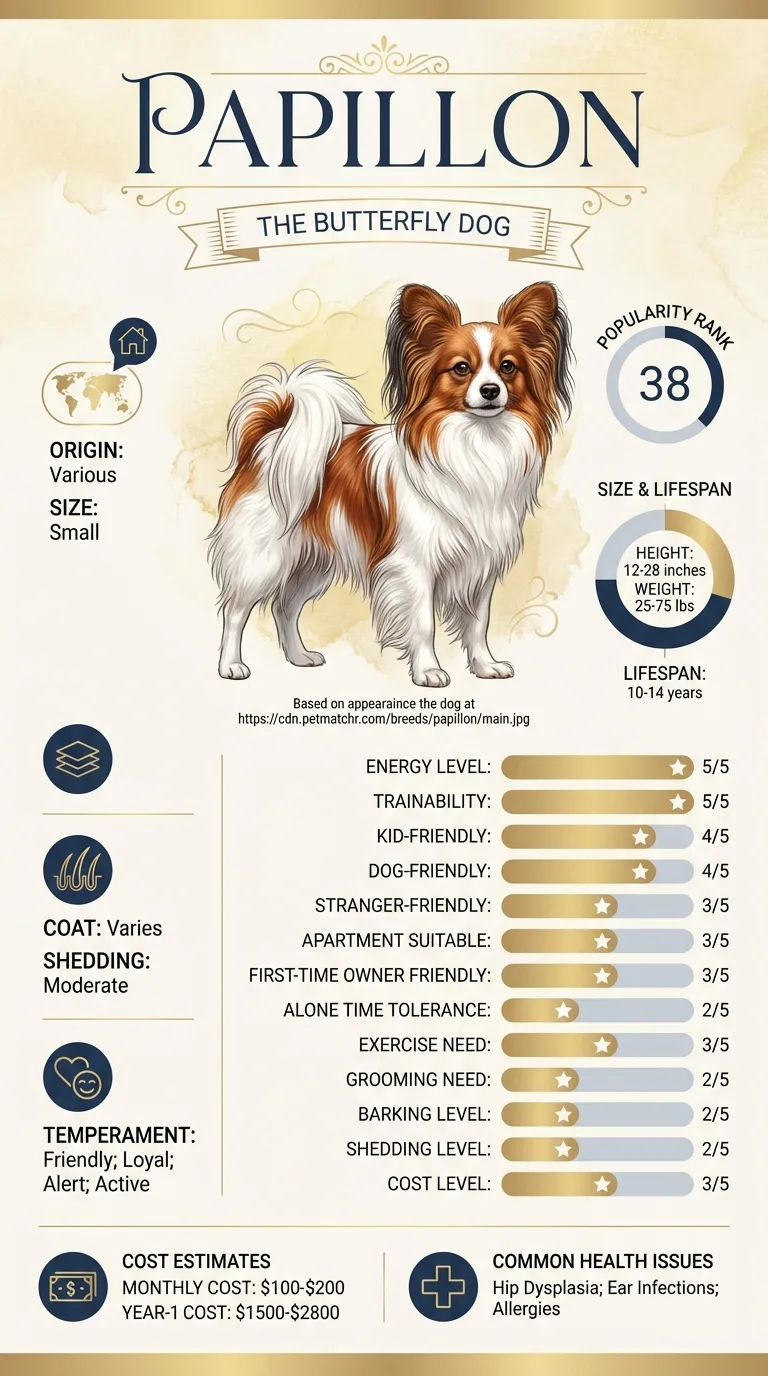
Owners of Papillon puppies between four and ten months who have watched a limp appear, refuse to resolve with rest, and start eating away at the muscle on one hind leg.
This guide is not medical advice. If your dog shows pain, sudden behavior change, or worsening symptoms, consult a licensed veterinarian.
Some links may be affiliate links. We may earn a commission at no extra cost to you. We only suggest products we believe are helpful for dog owners.
Legg-Calve-Perthes disease is the death of bone tissue in the femoral head of a growing toy breed dog, caused by loss of its blood supply. The weakened bone collapses under bodyweight, the joint surface deforms, and the dog develops a progressive one sided hind limb lameness with visible muscle wasting. It is a condition of puppies rather than adults, and it is treated surgically with generally excellent results in dogs of Papillon size.
It is uncommon in absolute terms but well recognised in toy and small terrier breeds, and it accounts for a meaningful share of persistent puppy lameness in dogs of this size. Most Papillon owners will never see it. Those who do usually spend weeks assuming a sprain first, which is the main reason for writing down the timing signature.
Size is the defining risk factor and the Papillon sits squarely in the affected range at five to ten pounds and eight to eleven inches. The blood supply to the femoral head in a growing dog of this size is limited and has no redundancy, so an interruption has no backup route. A familial tendency has been observed in affected breeds, which is why an affected dog would not be bred from, though the inheritance pattern is not simple.
There is no household cause and no diet that prevents this. What the environment influences is how quickly it is recognised and how much muscle is lost before treatment. A puppy whose limp is attributed to rough play and rested repeatedly for weeks arrives at diagnosis with a wasted thigh and more rehabilitation ahead of it than one whose owner asked for radiographs at week three.
Book an appointment for any hind limb limp in a Papillon puppy lasting more than a week, and ask specifically about radiographs if it is one sided and worsening rather than intermittent. Seek same day care if the puppy will not bear any weight at all, if the leg is swollen or hot, if it cries when the hip is moved, or if the lameness followed a fall, since a fine boned toy puppy can fracture from heights an adult dog would ignore. Do not accept months of rest as a plan without film.
See all Papillon health problems, which breeds are prone to legg calv perthes disease, or the full Papillon breed guide for temperament, exercise needs and ownership costs.
From surgery, expect gentle controlled use of the leg within days, comfortable walking within two to four weeks, and thigh muscle rebuilding over two to four months. Most dogs are back to unrestricted activity by three months. The wasted thigh is the last thing to catch up and it usually does.
Success is a grown Papillon that trots with no visible limp, has even muscle on both hind legs, jumps and plays without hesitation, and carries no arthritis into its second decade.
During growth, the femoral head is fed by vessels running along the neck of the bone, and it has no meaningful alternative supply. If those vessels are interrupted, the bone tissue they serve dies. It does not hurt at first, because dead bone has no nerves. Pain begins when the weakened structure starts to collapse under the puppy's weight and the joint surface deforms.
That sequence produces three features that together are close to diagnostic in a toy breed.
The first is timing. Onset clusters roughly between five and eight months, in the middle of the growth period. A limp that begins in that window in a Papillon deserves radiographs rather than a fortnight of rest.
The second is that it is almost always one sided. Bilateral cases exist but are the minority, so a puppy favouring the same leg every day, week after week, fits.
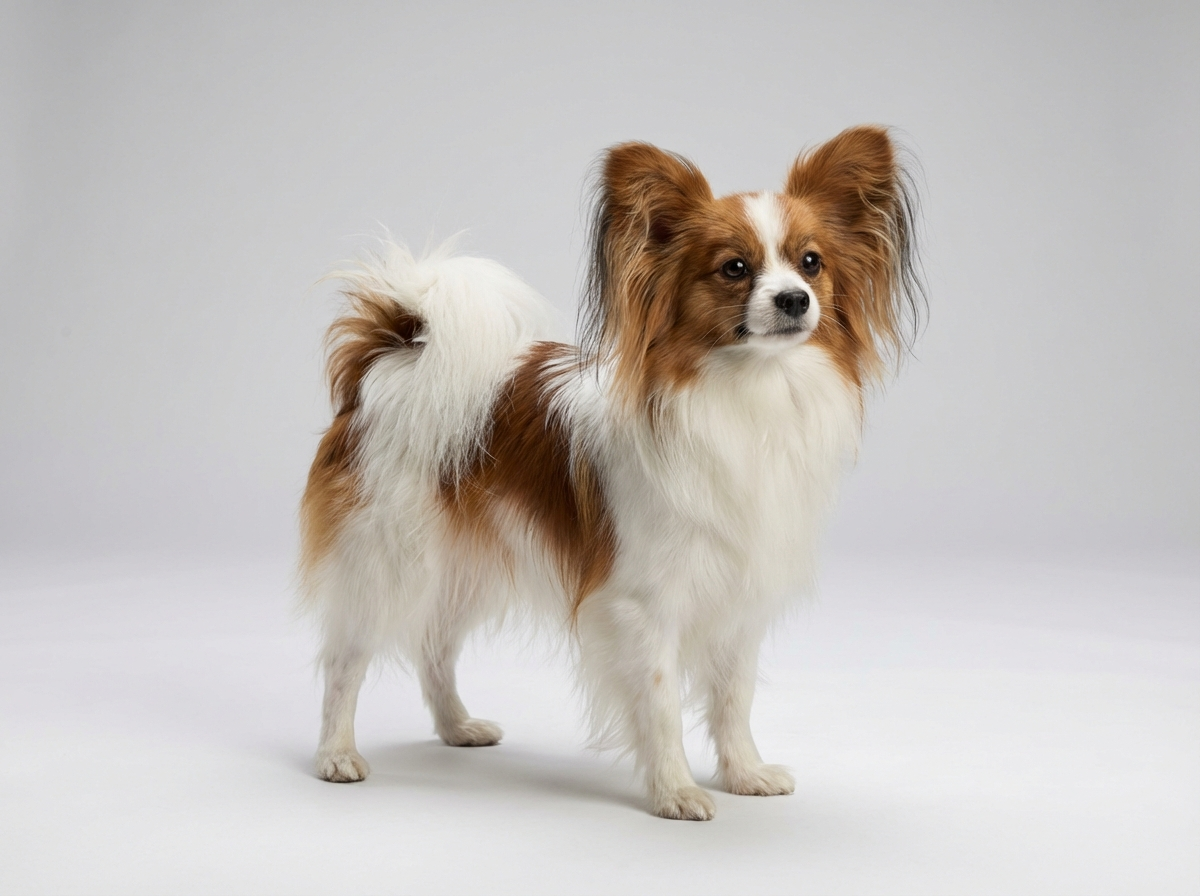
The third is muscle wasting. A puppy that has been offloading one hind leg for a month loses bulk in that thigh, and the difference becomes striking. Because a Papillon's long silky coat conceals body contours, you find this with your hands rather than your eyes: wrap a palm around each thigh and compare.
Progression separates it from a slipping kneecap, which comes and goes. This gets worse.

This is one of the more satisfying orthopaedic conditions in small dogs, because the standard operation converts a painful joint into a working one.
If you think your Papillon has legg-calvé-perthes disease, the plan is three steps: write down what you have seen and when it started, book a veterinary appointment rather than waiting for the next flare, and take video of the behaviour or symptom before you go — the thing you are worried about rarely happens in the consulting room. Screening in the parents covers patellar luxation, progressive retinal atrophy, dental disease.
What the vet visit should produce is a diagnosis and a written plan, not just reassurance: what is being ruled out, what the monitoring interval is, and which signs mean you come back sooner. Ask what the treatment costs across a year rather than per visit, because that is the number that decides whether you are managing this condition or reacting to it.
Between appointments, keep a short log — dates, what you saw, what changed. It is the single most useful thing an owner brings to a follow-up, and for legg-calvé-perthes disease it is often what separates a clear pattern from a guess.
Yusuf noticed his Papillon puppy Clementine favouring her right hind leg at six months. His vet suggested a strain and two weeks of quiet. She improved, then got worse again within days of resuming play. At the second visit Yusuf mentioned something he had found by accident while towelling her off: her right thigh felt distinctly thinner than her left. Radiographs under sedation showed a flattened, mottled right femoral head against a perfectly normal left one. Clementine had the femoral head removed at seven months. She was toe touching within four days and walking on it inside two weeks. Yusuf did the prescribed exercises twice daily for three months, mostly slow controlled walking and standing weight shifts. At a year old her thighs measured the same and she could out-sprint every dog at her local park.
Key takeaway: A hind limb limp in a Papillon puppy that keeps returning to the same leg, and that is taking muscle with it, needs radiographs rather than another fortnight of rest. Caught in the growth window, this is a fixable problem with a genuinely good ending.
It is overwhelmingly a small and toy breed condition, affecting dogs typically under about twenty five pounds, and it appears during growth rather than in adulthood. Terriers and toy breeds are the classic groups. A Papillon at five to ten pounds is in the right size category, and the condition belongs in the differential for any young Papillon with a persistent one sided hind limb limp.
The precise mechanism is not fully established. Contributing theories include an inherited vulnerability in the vascular supply, raised pressure within the bone, and hormonal influences during growth. There is a recognised familial tendency in affected breeds, which is why breeding from affected dogs is generally avoided. Nothing an owner did causes it.
By radiographs of the hips, ideally with the puppy sedated so positioning is accurate. The affected femoral head shows a characteristic mottled, flattened or fragmented appearance compared with the normal side, which is one reason imaging both hips matters. Physical examination will find pain on extension and the muscle asymmetry, but film confirms it.
Conservative management with restricted activity and pain control is sometimes attempted in very mild or early cases, but the collapsed bone does not remodel back into a smooth ball, so most dogs come to surgery eventually. Delaying often means more months of pain and more muscle loss to rebuild afterwards. Discuss the timing honestly with an orthopaedic surgeon.
Most small dogs return to full unrestricted activity with no visible limp, though the operated leg may always be very slightly shorter and the range of motion slightly reduced. Owners routinely report that the difference is invisible in daily life. The quality of the outcome tracks closely with how consistently rehabilitation was done.
Because the joint surface is removed rather than left to grind, this operation avoids the arthritis that would otherwise develop in a deformed hip. What matters long term is keeping the dog lean and keeping the surrounding muscle strong, which supports the false joint across what may be another fourteen years of life.
Usually between five and eight months, during growth. A persistent one sided hind limp in that window should be radiographed rather than rested.
A kneecap causes an intermittent skip that comes and goes. This causes a steadily worsening one sided limp with visible muscle loss in the affected thigh.
Small dogs generally do very well. A fibrous false joint supports a five to ten pound body effectively, and most Papillons return to normal activity.
It is a four figure procedure in most regions, plus rehabilitation. Against routine Papillon costs of eighty to one hundred fifty dollars monthly, it is a significant one off expense.
A one-page prep sheet for this condition: the signs, the questions to ask, what to get priced. Unlocks here.
You get: Vet visit prep sheet
No spam. One-click unsubscribe. See our privacy policy.
Preview page 1 before you decide.