Health
Is bloat an emergency in Golden Retrievers?
Yes — an immediate one. Unproductive retching plus restlessness in a deep-chested large breed means going to an emergency vet now, at any hour.

Quick answer
Is bloat an emergency in Golden Retrievers?
Yes — an immediate one. Unproductive retching plus restlessness in a deep-chested large breed means going to an emergency vet now, at any hour.
Bloat is the one problem on this breed's documented health list where the difference between a good outcome and a dead dog is measured in hours. The stomach fills with gas and then rotates on its own axis, sealing both ends, cutting off its blood supply and compressing the vessels that return blood to the heart. A Golden Retriever that looked normal after dinner can be in circulatory collapse before midnight.
Owners of deep-chested large breeds generally, and specifically anyone who has never seen bloat and is waiting for their dog to look dramatically unwell. The early picture is deceptively mild: restlessness, pacing, an attempt to vomit that produces nothing. Households that free-feed, that exercise hard right after meals, or that assume a dog who ate normally must be fine are the ones most likely to lose time.
This guide is not medical advice. If your dog shows pain, sudden behavior change, or worsening symptoms, consult a licensed veterinarian.
Some links may be affiliate links. We may earn a commission at no extra cost to you. We only suggest products we believe are helpful for dog owners.
We research and check what we publish, but we do not warrant that any figure, date, price, or statement is accurate, complete, or current, and we accept no liability for any loss, cost, injury, or other harm arising from the use of this site. Use it as one reference among several. You remain responsible for your own decisions and for your dog's care - confirm anything that matters with a licensed veterinarian or another qualified professional before you act on it. Full disclaimer.
Bloat is gas distension of the stomach, which may then twist on itself (volvulus) and cut off its own blood supply. It is a surgical emergency with a genuinely short window: outcomes depend heavily on how quickly the dog reaches a vet who can decompress the stomach and operate. It is listed among this breed's documented health risks.
Uncommon on any given day, but a well-recognised risk in large, deep-chested breeds, and one of the reasons Golden Retriever owners are advised to know their nearest 24-hour emergency clinic before they ever need it. Lifetime risk is meaningful enough that many owners of at-risk breeds elect a preventive gastropexy during another abdominal surgery.
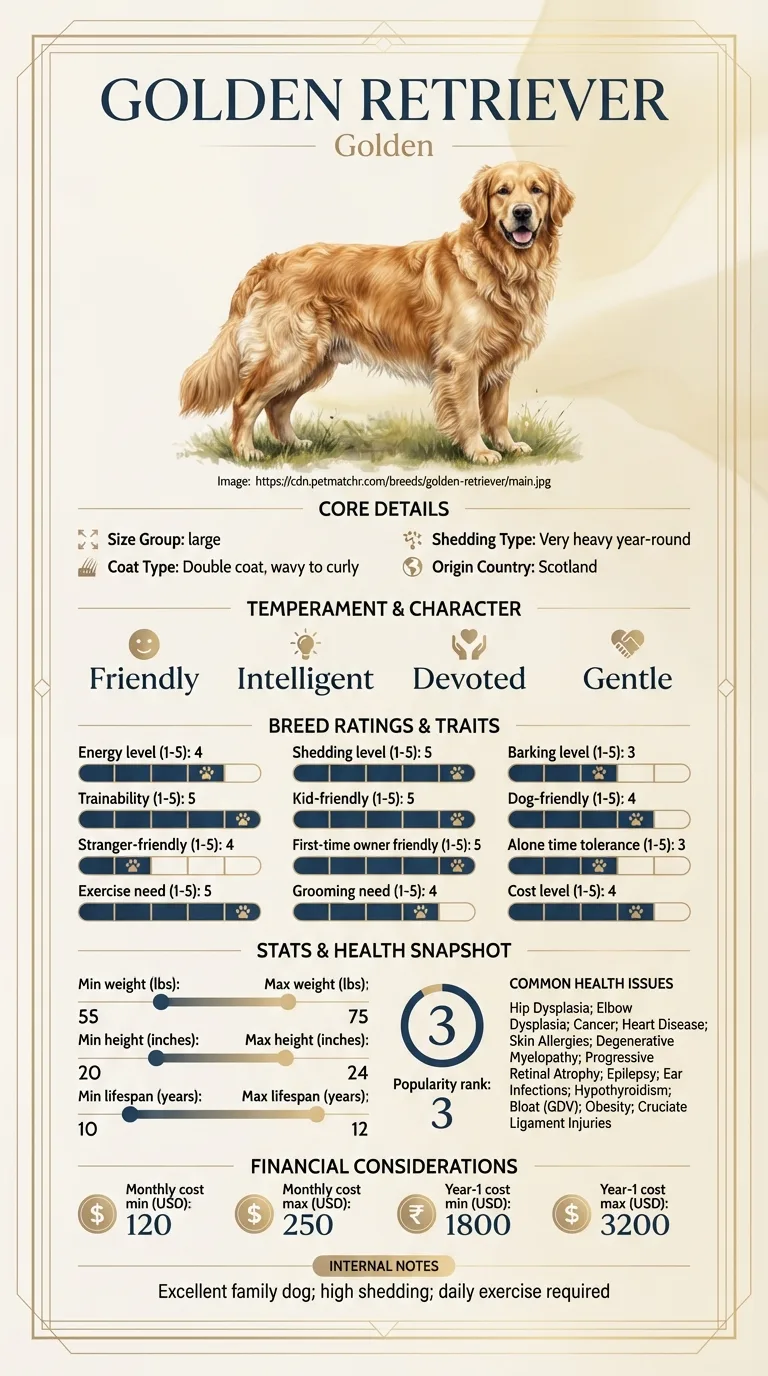
The deep-chested conformation typical of a 55-to-75-pound Golden Retriever gives the stomach room to distend and rotate. This breed's documented obesity risk adds abdominal load and often faster, more urgent eating. Documented Bloat (GDV) appears directly on the breed's health list, meaning it is a recognised breed-level risk rather than an incidental one.
Feeding practices are the main modifiable factor: one large daily meal rather than split meals, bowls that allow gulping, and food or water taken immediately before or after hard exercise. Multi-dog households where eating becomes competitive tend to produce faster eating. Stressful events and kennel stays are also commonly associated with episodes.
Unproductive retching, a swollen or tight abdomen, restlessness that will not settle, or drooling with obvious discomfort in a large deep-chested dog is an emergency — go immediately, at any hour, without waiting to see if it passes. Do not attempt to treat this at home and do not wait for a morning appointment. Separately and non-urgently, discuss preventive gastropexy with your vet: it is commonly performed at the same time as spay or neuter in at-risk breeds and it tacks the stomach so it cannot rotate, which does not prevent distension but does prevent the lethal twist.
Start here: Golden Retriever Most Common Genetic Disorders: Screening
See all Golden Retriever health problems, which breeds are prone to bloat gastric dilatation volvulusgdv, or the full Golden Retriever breed guide for temperament, exercise needs and ownership costs.
There is no recovery timeline to manage at home, because this is not a condition you manage at home. What you control is the response time. From the first unproductive retch to surgery, faster is categorically better. Dogs treated early, before circulatory collapse, generally do considerably better than those who arrive in shock. After successful surgery with gastropexy, most dogs go home within a few days and recover over several weeks with restricted activity.
Success is a household that never has to test its emergency plan — and, if it does, one that recognised the early signs and was on the road within minutes rather than debating it for an hour. It is also honest to name the ceiling: prevention measures reduce risk, they do not eliminate it. A gastropexy is the one intervention that reliably prevents the twist itself, and it is worth a real conversation with your vet rather than a search-engine decision.
The textbook image is a visibly swollen, drum-tight abdomen, and by the time you see that, a lot of damage is already done. Earlier and more useful: a dog who cannot settle. Standing up, lying down, standing again. Pacing. Looking at or nosing at their own flank. Drooling more than usual.
The single most specific early sign is unproductive retching — the dog goes through the full motion of vomiting and brings up nothing, or perhaps a little foam. In a normal upset stomach, something comes up. In a volvulus the stomach is sealed at both ends, so nothing can. A Golden Retriever doing that repeatedly is an emergency until a vet proves otherwise.
Later signs mean the dog is decompensating: pale or tacky gums, rapid shallow breathing, a weak fast pulse, collapse. Those are not the signs to wait for. They are the signs that say you are already behind.
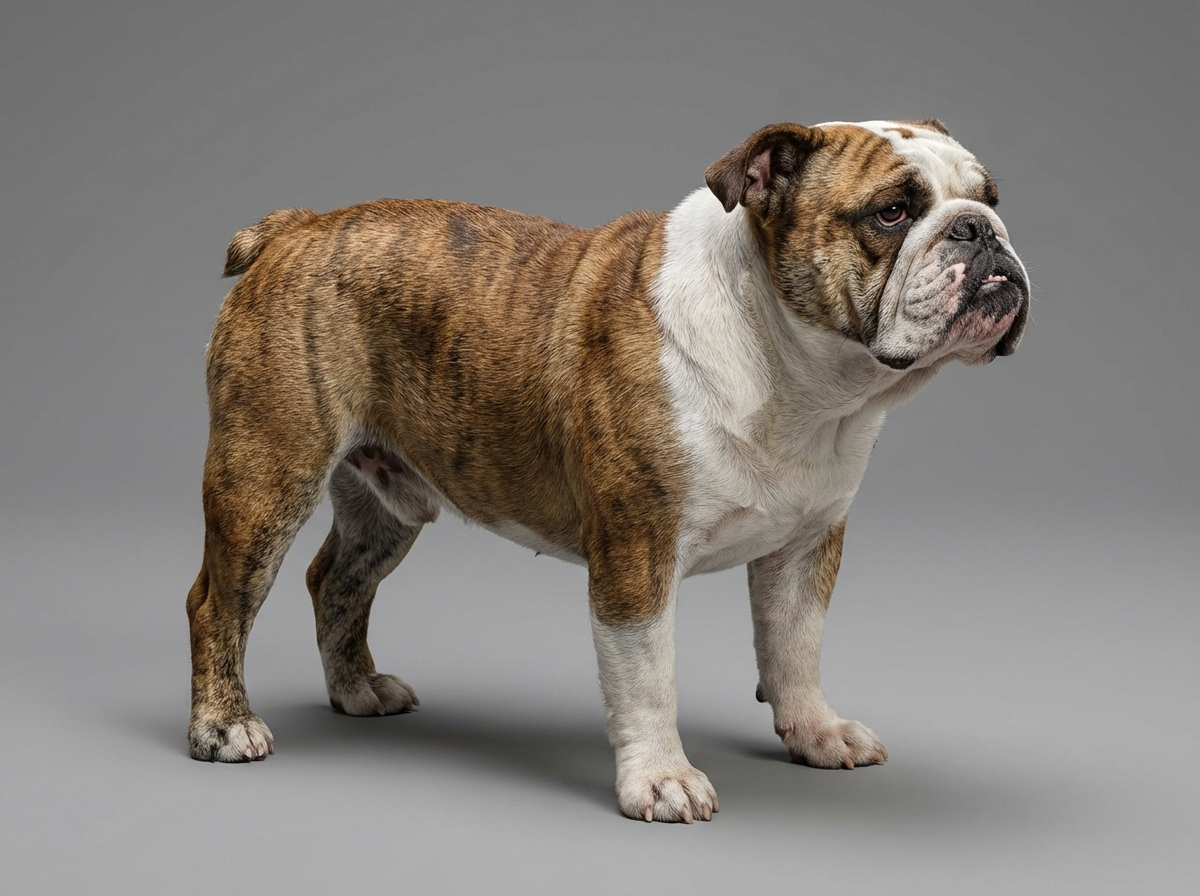
Owner conversations about bloat tend to focus almost entirely on food, and the anatomy deserves more weight than it usually gets. A deep, relatively narrow chest — the build this breed carries at 55 to 75 pounds — gives the stomach more vertical room and a longer axis to rotate around. That is a structural risk an owner cannot train away or feed away.
What you can influence is everything that inflates the stomach or makes it swing: how fast the dog eats, how much air is swallowed alongside the food, portion size in a single sitting, and how much vigorous movement happens on a full stomach. This breed's documented obesity risk compounds it, because a heavier dog carries more abdominal fat and, in practice, tends to eat with more urgency.
Age shifts the odds too. Risk rises as dogs get older, which means the prevention habits worth building at two matter more at eight.

A seven-year-old Golden Retriever ate his usual evening meal, then spent twenty minutes unable to settle — up, down, circling, nosing at his side. His owner assumed a sore stomach and watched. He tried to vomit four times and produced nothing but a little foam, and it was that detail, remembered from a breeder's warning years earlier, that finally got the family into the car. The emergency clinic was twenty-five minutes away. He was decompressed on arrival and in surgery within the hour for a confirmed volvulus, with a gastropexy done at the same time. He went home on day three. The surgeon's comment stayed with the family: another hour of watching and the conversation would have been a very different one.
Key takeaway: The retching that produces nothing is the tell. Everything else about that evening looked like an ordinary sore stomach.
Simple gas distension occasionally settles, but you cannot tell distension from a volvulus by looking, and a twisted stomach will not untwist itself. Treating it as survivable-if-you-wait is how dogs die of this. Go in.
Repeated retching that brings nothing up. In an ordinary upset stomach something comes out; in a twisted stomach nothing can, because both ends are sealed.
It was recommended for years, and the evidence has not supported it — some studies have associated raised bowls with increased risk in large breeds. A slow-feeder at floor level is the better-supported choice.
It is a legitimate conversation to have with your vet, particularly if the dog is already going under anaesthesia for spay or neuter. It does not stop the stomach filling with gas, but it prevents the rotation that makes bloat lethal.
Roughly an hour either side is the common practical guidance — no hard running right before a meal, and no hard running right after one.
Food type is less established than food behaviour. Eating quickly, eating one very large meal, and gulping air are the patterns most consistently associated with risk, whatever is in the bowl.
Without a gastropexy, recurrence is a real concern, which is why the procedure is usually performed during the emergency surgery itself. Ask your vet directly whether it was done.
No. An upset stomach produces vomit and the dog can usually settle. Bloat produces retching without result, and a dog who genuinely cannot get comfortable.
Yes — an immediate one. Unproductive retching plus restlessness in a deep-chested large breed means going to an emergency vet now, at any hour.
Their deep-chested conformation at 55 to 75 pounds gives the stomach room to distend and rotate, and Bloat appears on the breed's documented health list.
Split meals across the day, slow the eating with a slow-feeder or puzzle bowl, and leave about an hour between eating and vigorous exercise in both directions.
It prevents the stomach twisting, which is the lethal part. Gas distension can still occur, so it reduces the danger rather than removing the condition.
It helps. This breed carries a documented obesity risk, and excess weight adds abdominal load and tends to go with faster, more urgent eating.
A one-page prep sheet for this condition: the signs, the questions to ask, what to get priced. Unlocks here.
You get: Vet visit prep sheet
No spam. One-click unsubscribe. See our privacy policy.
Preview page 1 before you decide.