Living
Which breed is bigger?
The Old English Sheepdog, weighing up to 100 lbs versus the Golden's 55-75 lbs.

Quick answer
Which breed is bigger?
The Old English Sheepdog, weighing up to 100 lbs versus the Golden's 55-75 lbs.
Golden Retriever or Old English Sheepdog? On paper they differ most on good for first-time owners, and on the scales Old English Sheepdog is the heavier at 60–100 lbs. Here is how the two compare on everything that shapes an ordinary week.
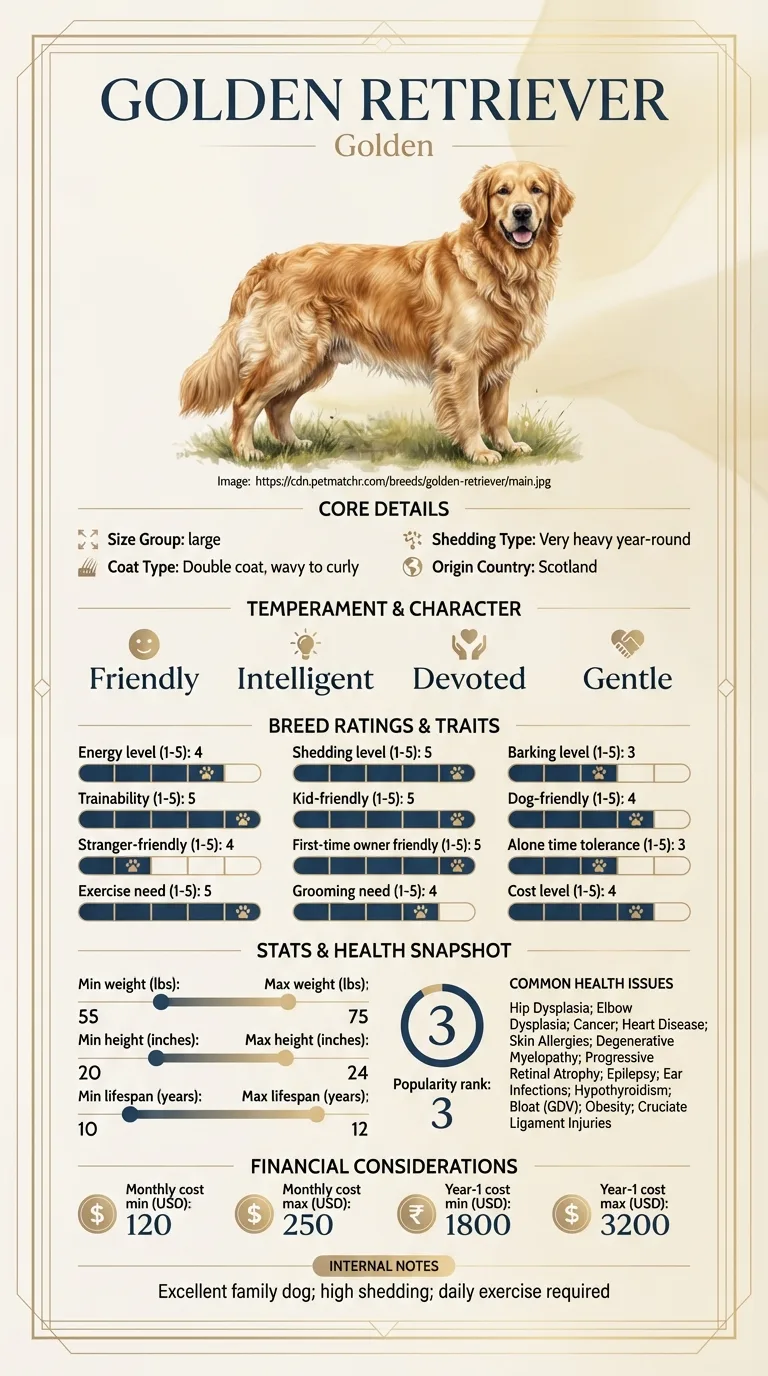
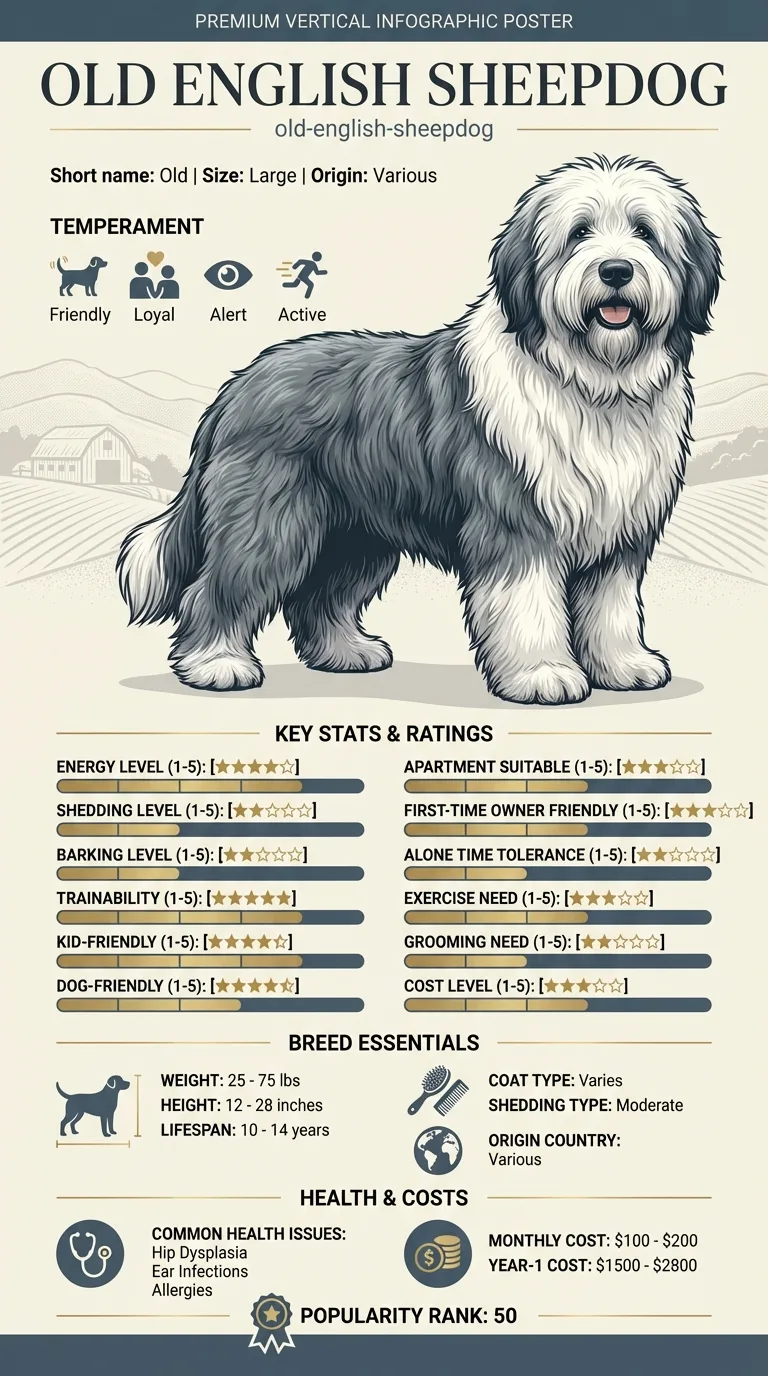
This is for someone already down to Golden Retriever and Old English Sheepdog and deciding between them. For this pair the decision usually turns on good for first-time owners and exercise need, so those are covered first and in most detail. Both rate 2/5 for flats, so housing does not settle this one. There is no origin story here — only what changes about your week.
Between Golden Retriever and Old English Sheepdog, good for first-time owners is what separates them, and Golden Retriever is the lower-effort dog of the two to keep.
Choose Golden Retriever if this is your first dog, you do not want a standing grooming appointment and the dog will be alone during the working day.
Choose Old English Sheepdog if shedding is a problem in your house and your walking routine is modest.
| Feature | golden retriever | old english sheepdog | Winner |
|---|---|---|---|
| Size class | large | large | Equal |
| Weight | 55–75 lbs | 60–100 lbs | Equal |
| Height | 20–24 in | 20–24 in | Equal |
| Lifespan | 10–12 years | 10–12 years | Equal |
| Exercise need | Very high (5/5) | Moderate (3/5) | old english sheepdog |
| Grooming need | High (4/5) | Very high (5/5) | golden retriever |
| Shedding | Very high (5/5) | High (4/5) | old english sheepdog |
| Energy level | High (4/5) | Moderate (3/5) | Equal |
| Barking | Moderate (3/5) | Moderate (3/5) | Equal |
| Apartment suitability | Low (2/5) | Low (2/5) | Equal |
| Good for first-time owners | Very high (5/5) | Low (2/5) | golden retriever |
| Tolerates being alone | Moderate (3/5) | Low (2/5) | golden retriever |
| Trainability | Very high (5/5) | Moderate (3/5) | golden retriever |
| Good with kids | Very high (5/5) | Very high (5/5) | Equal |
| Good with other dogs | High (4/5) | High (4/5) | Equal |
| Friendly to strangers | High (4/5) | High (4/5) | Equal |
| Cost level | High (4/5) | High (4/5) | Equal |
| Coat | Double coat, wavy to curly | Long, shaggy double coat | Equal |
| Origin | Scotland | Various | Equal |
| Typical monthly cost | $120–$250 | $110–$240 | Equal |
| Typical first-year cost | $1,800–$3,200 | $1,700–$3,200 | Equal |
Both dogs land in the same large-breed bracket, but the Old English Sheepdog carries more mass, weighing 60-100 lbs against the Golden Retriever's 55-75 lbs, while the two share an identical 20-24 in height range. That extra bulk on the Sheepdog comes wrapped in a long, shaggy double coat that visually exaggerates its size next to the Golden's sleeker, wavy-to-curly double coat. Both breeds finish out at 10-12 years, so lifespan doesn't factor into a size decision here. Anyone choosing between them should expect a Golden that reads as athletic and streamlined, versus a Sheepdog that reads as a bear-like, tousled bundle even though the actual footprint on the floor is similar.
Exercise need is where this pairing splits hardest: the Golden Retriever rates a full 5/5, while the Old English Sheepdog sits at a moderate 3/5. In practice that means the Golden wants a real daily job, jogging, swimming, or retrieving work, before it settles, while the Sheepdog is content with structured walks and yard time despite its herding-dog origins. Both are marked High or Moderate on general energy level, so neither is a couch potato, but the gap in raw exercise demand is the more useful number for planning a week. Households that can't commit to an hour-plus of active outlet daily will find the Sheepdog the easier day-to-day companion.
Grooming need actually favors the Golden here, 4/5 versus the Sheepdog's 5/5, because the OES's long shaggy double coat mats easily and typically needs brushing several times a week plus regular trims to avoid painful tangles near the skin. Shedding tips the other way: the Golden is rated a heavier 5/5 against the Sheepdog's still-high 4/5, so Golden owners will find more loose hair on furniture and clothing across the year. Neither coat is low-maintenance, and prospective owners should budget real weekly time for brushing regardless of which breed they pick, since both carry dense double coats built for cold-weather work rather than easy care.
Neither breed is built for compact living: both score a matching Low (2/5) on apartment suitability, and both carry a Moderate (3/5) barking tendency, so noise complaints aren't the deciding factor here. The real gap shows up in alone-time tolerance, where the Golden's Moderate (3/5) rating beats the Sheepdog's Low (2/5) — Old English Sheepdogs were bred to work closely with a shepherd and can become anxious or destructive when left solo for long stretches. A yard and a household with someone home most of the day suits both breeds far better than a small unit with long work hours.
The trainability gap is stark: the Golden Retriever rates Very High (5/5) and is also flagged Very High (5/5) for first-time owners, while the Old English Sheepdog rates only Moderate (3/5) on trainability and Low (2/5) for first-timers. That combination means a novice owner picking the Golden gets a dog that's genuinely forgiving of training mistakes, while the same novice with a Sheepdog may struggle with its independent, occasionally stubborn streak inherited from its herding background. Experienced owners who enjoy a dog with more of its own opinions may actually prefer the Sheepdog's personality, but the data clearly points beginners toward the Golden.
Both breeds score Very High on good-with-kids and High on both good-with-other-dogs and friendly-to-strangers, so on paper this is a near-tie for family life. Temperament words back that up: the Golden brings Friendly, Intelligent, Devoted, and Gentle, while the Sheepdog brings Adaptable, Gentle, Playful, and Watchful — that last word matters, since Sheepdogs retain a herding instinct that can show up as gentle nudging or circling of small children, which some families love and others find puzzling. Either dog does well in a busy household with visitors and other pets, provided the Sheepdog's watchfulness is understood as protective instinct rather than suspicion.
Both breeds share the same 10-12 year lifespan, but their health profiles diverge sharply in volume: the Golden Retriever's list runs to thirteen conditions, including Cancer, Heart Disease, Degenerative Myelopathy, and Progressive Retinal Atrophy alongside the more common Hip Dysplasia and Bloat (GDV), while the Old English Sheepdog's documented list is shorter at five — Hip Dysplasia, Cataracts, Hypothyroidism, Primary Ciliary Dyskinesia, and Bloat (GDV). Bloat and Hip Dysplasia overlap between the two, so both owners should learn the warning signs and consider raised feeding precautions. The Golden's longer list, especially the cancer risk, is worth discussing directly with a breeder or vet before committing.
Cost lands almost identically: both breeds carry a High (4/5) cost rating, with the Golden running $120-$250 monthly and $1,800-$3,200 in year one, against the Sheepdog's slightly lower $110-$240 monthly and $1,700-$3,200 first-year range. In practice the real cost driver won't be the sticker price of food or vet visits but grooming — the Sheepdog's shaggy coat often means professional grooming appointments every six to eight weeks if an owner isn't confident doing full de-matting at home, which can push its real-world cost above the Golden's despite the similar baseline figures. Budgeting for that grooming line item matters more than the headline numbers suggest.
Golden Retriever weighs 55–75 lbs and lives 10–12 years; Old English Sheepdog weighs 60–100 lbs and lives 10–12 years. The two diverge most on good for first-time owners, exercise need and trainability. They are level on apartment suitability, barking and cost level, so those cannot decide it. Where the table declares a winner it means less work for the owner, nothing more; descriptive rows are left as ties on purpose. The value here is in the differences between the two columns; treat any single score as approximate.

The Golden Retriever is the clearer choice for first-timers — it rates Very High (5/5) for first-time owners and Very High (5/5) trainability, while the Sheepdog rates only Low (2/5) and Moderate (3/5) on those same measures. The Sheepdog's independent, herding-bred temperament asks for more handling experience.
Slightly — the Sheepdog rates High (4/5) shedding compared to the Golden's Very High (5/5) — but both are heavy double-coated shedders and neither breed suits an owner hoping to avoid vacuuming.
The Golden Retriever, rated a full 5/5 on exercise need against the Sheepdog's Moderate 3/5. Golden owners should plan on real daily activity like fetch, swimming, or a long run, while a Sheepdog is satisfied with structured walks.
Neither is ideal, but the Golden tolerates it somewhat better, Moderate (3/5) versus the Sheepdog's Low (2/5). The Sheepdog's close-working herding heritage makes it more prone to separation-related stress.
Yes — both breeds rate Very High (5/5) for good-with-kids, though the Sheepdog's herding instinct can show up as gentle circling or nudging of small kids, a trait worth explaining to children in advance.
The Golden Retriever's documented list is longer and includes Cancer, Heart Disease, and Degenerative Myelopathy alongside thirteen total conditions, while the Sheepdog's five-condition list is comparatively shorter, led by Hip Dysplasia and Bloat (GDV).
By the numbers, yes — the Golden rates High (4/5) grooming need against the Sheepdog's Very High (5/5), since the Sheepdog's long shaggy coat mats easily and often needs professional attention.
The Old English Sheepdog, weighing up to 100 lbs versus the Golden's 55-75 lbs.
The Golden Retriever, rated Very High (5/5) versus the Sheepdog's High (4/5).
The Golden Retriever, rated Very High (5/5) trainability versus the Sheepdog's Moderate (3/5).
Neither — both average 10-12 years.
Secure checkout on Stripe. We never see your card.
7-day money-back guarantee. Instant access.

Health information here is general and is not veterinary advice. If your dog shows pain, sudden behaviour change, or worsening symptoms, consult a licensed veterinarian.
Some links on this site are affiliate links. We may earn a commission at no extra cost to you, and we only suggest products we believe are helpful for dog owners.
We research and check what we publish, but we do not warrant that any figure, date, price, or statement is accurate, complete, or current, and we accept no liability for any loss, cost, injury, or other harm arising from the use of this site. Use it as one reference among several. You remain responsible for your own decisions and for your dog's care - confirm anything that matters with a licensed veterinarian or another qualified professional before you act on it. Full disclaimer.
Match your lifestyle to the right dog.
Take quizNot sure which breed is right for you? Take our 2-minute quiz to find out.
Take the quiz