Health
What's the earliest sign of hip dysplasia in a Shar-Pei?
A bunny-hop gait when running, stiffness after rest, or reluctance to climb stairs or jump are typically the first visible clues.

Quick answer
What's the earliest sign of hip dysplasia in a Shar-Pei?
A bunny-hop gait when running, stiffness after rest, or reluctance to climb stairs or jump are typically the first visible clues.
A Shar-Pei's thick, wrinkled build can hide the early muscle loss that would tip off an owner to hip trouble in a smoother-coated dog.
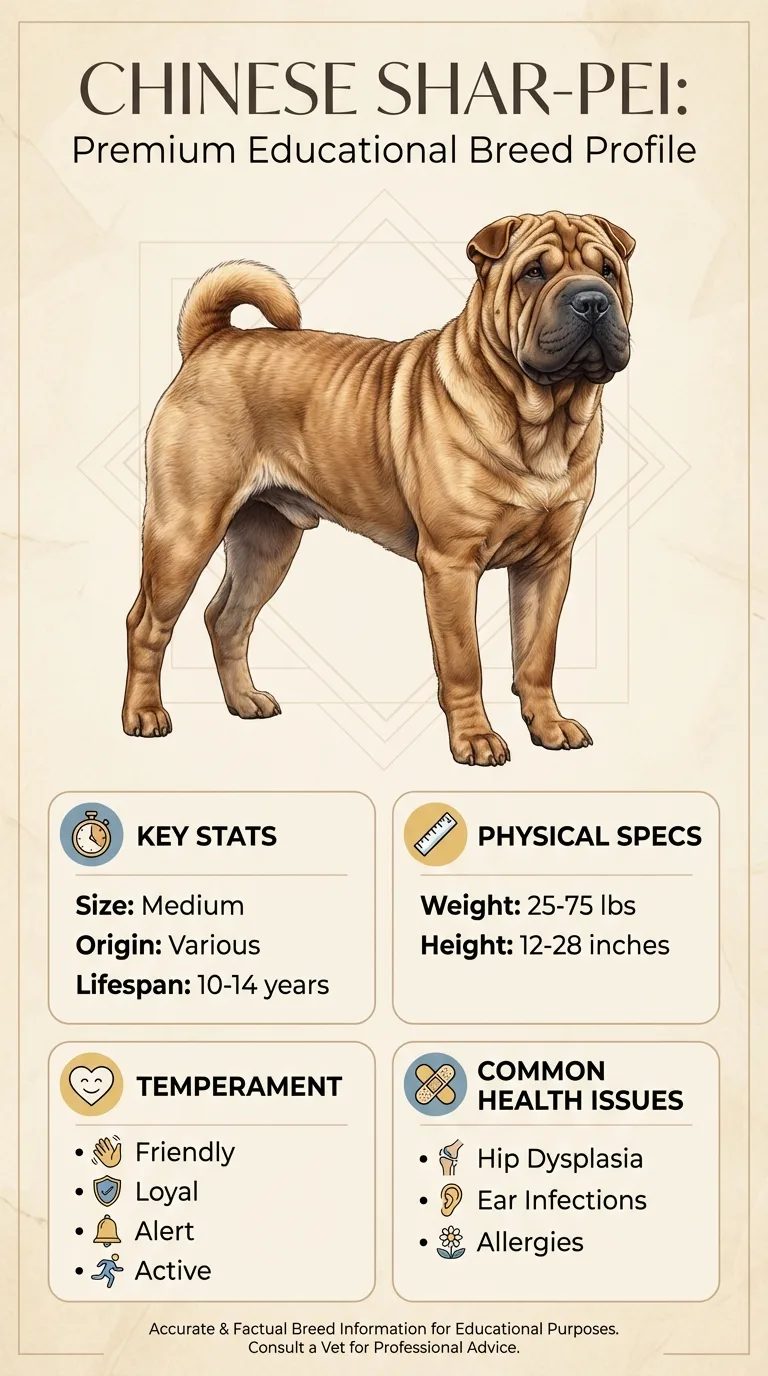
Owners of adult and senior Shar-Peis showing any change in gait, reluctance to jump or climb stairs, or a "bunny hop" running style.
This guide is not medical advice. If your dog shows pain, sudden behavior change, or worsening symptoms, consult a licensed veterinarian.
Some links may be affiliate links. We may earn a commission at no extra cost to you. We only suggest products we believe are helpful for dog owners.
We research and check what we publish, but we do not warrant that any figure, date, price, or statement is accurate, complete, or current, and we accept no liability for any loss, cost, injury, or other harm arising from the use of this site. Use it as one reference among several. You remain responsible for your own decisions and for your dog's care - confirm anything that matters with a licensed veterinarian or another qualified professional before you act on it. Full disclaimer.
Hip dysplasia is a malformation of the hip joint that causes progressive looseness, abnormal wear, and eventually arthritis. Though more associated with large and giant breeds, it can affect the medium-framed Chinese Shar-Pei as well, and the breed's dense build and wrinkled skin can make early muscle-wasting signs harder for owners to spot than in leaner breeds.
Hip dysplasia is not considered one of the Chinese Shar-Pei's defining conditions the way skin fold issues are, but it does occur across the breed population, and any consistent gait change in an adult Shar-Pei is worth evaluating rather than dismissing given the breed's size falls well within the range affected.
As a medium-sized, densely muscled breed, the Chinese Shar-Pei carries enough body mass on its hip joints for dysplasia-related wear to matter, while its thick, wrinkled build can obscure the visible muscle wasting that often serves as an early warning sign in leaner dogs.
Rapid growth during puppyhood, excess weight at any life stage, high-impact activity like repeated jumping, and slick indoor flooring that causes hips to slip and strain all accelerate wear on a joint that may already be structurally loose.
Schedule an evaluation if you notice a bunny-hop gait, reluctance to jump onto furniture or into the car, stiffness after rest that eases with movement, or any limping. Sudden severe lameness or apparent inability to bear weight on a hind leg warrants urgent same-day evaluation.
Start here: Chinese Shar-Pei Most Common Genetic Disorders: Screening
See all Chinese Shar PEI health problems, which breeds are prone to hip dysplasia, or the full Chinese Shar PEI breed guide for temperament, exercise needs and ownership costs.
Hip dysplasia is typically a slow, progressive condition, meaning diagnosis often comes months to years after the underlying joint looseness first developed. Management, once started, is generally lifelong rather than a fixed treatment course.
Success looks like a dog that stays mobile and comfortable through consistent weight control, appropriate exercise, and pain management, with X-rays showing slow rather than rapid arthritic progression over time.
Hip dysplasia develops when the ball-and-socket hip joint doesn't fit together tightly during growth, leaving the joint loose and unstable. Over time, that looseness causes abnormal wear between the bones, which the body responds to by building extra bone around the joint, arthritis, in an attempt to stabilize it. This is a slow, progressive process, not a single injury, and it can start subtly enough in a growing Shar-Pei puppy that the first visible signs, a bunny-hop gait when running, stiffness after rest, or reluctance to go up stairs, don't appear until arthritic changes are already underway. The breed's naturally dense muscle can also mask the muscle wasting around the hips that's often an early visual clue in leaner breeds, meaning owners sometimes don't notice anything until the dog is limping outright.
Diagnosis is confirmed with hip X-rays, sometimes sent for formal scoring through OFA or PennHIP evaluation, which measure joint looseness precisely rather than relying on symptoms alone. Treatment then depends heavily on severity and the dog's age: younger dogs with significant looseness may be candidates for a surgical procedure to reshape how the joint bears weight, while older dogs or milder cases are often managed with weight control, joint supplements, controlled exercise, and pain management as arthritis develops. Severe cases in dogs who aren't good surgical candidates sometimes progress to a hip replacement or a procedure that removes the damaged joint surface, both major decisions made jointly with an orthopedic specialist rather than a general practice vet alone.

Bella, a seven-year-old Shar-Pei on a small farm outside a rural Ohio town, had always run with what her owner fondly called her "bunny hop," assuming it was just a quirky gait. It wasn't until Bella started hesitating before jumping into the truck, something she'd done without thought for years, that her owner mentioned it at a vet visit. Hip X-rays showed moderate dysplasia with early arthritis in both hips. Rather than surgery, her vet recommended a joint supplement, a modest weight trim, and swapping some of her farm-chasing exercise for structured leash walks. A year later, Bella was jumping into the truck again, slower but without hesitation.
Key takeaway: A gait quirk that looked charming for years turned out to be the earliest visible sign of a joint problem, a reminder that this breed's dense build can make normal early symptoms easy to misread as personality.
It's not the breed's single most defining condition, but medium-sized breeds are not immune, and cases do occur. Any Shar-Pei showing a gait change, especially a bunny-hop run, should be evaluated for it.
Instead of moving the back legs independently at a run, a dog with hip dysplasia often moves both back legs together in a hopping motion, an adaptation that reduces pain from an unstable joint.
Yes, hip X-rays done around puppy growth checkpoints, or formal PennHIP evaluation done as early as four months old, can flag joint looseness well before arthritis or obvious limping develops.
Not necessarily. Surgery is typically reserved for younger dogs with significant looseness or older dogs with severe, pain-limiting arthritis. Many cases are managed successfully with weight control, exercise modification, and medication instead.
Extra weight adds direct mechanical stress to an already unstable joint, accelerating arthritis progression. Keeping a lean body weight is one of the most effective non-surgical tools for slowing the condition down.
High-impact activities like jumping and hard sprinting can accelerate wear on an unstable joint, while controlled, low-impact exercise like swimming or steady leash walks actually helps maintain muscle support around the joint.
It can be, particularly as arthritis develops, though this breed's reserved temperament means pain isn't always obvious. Subtle signs like reluctance to jump onto furniture or slower rising after rest are worth taking seriously.
A bunny-hop gait when running, stiffness after rest, or reluctance to climb stairs or jump are typically the first visible clues.
Through hip X-rays, sometimes formally scored via OFA or PennHIP evaluation, which measure joint looseness directly rather than relying on symptoms alone.
No, many cases are managed with weight control, joint supplements, and controlled exercise, with surgery reserved for more severe or younger cases.
Management costs vary widely, from ongoing supplements and pain medication to surgical procedures that can run into the thousands of dollars for severe cases.
Yes, controlled, low-impact activity is usually encouraged rather than restricted entirely, since it helps maintain the muscle support that stabilizes the joint.
A one-page prep sheet for this condition: the signs, the questions to ask, what to get priced. Unlocks here.
You get: Vet visit prep sheet
No spam. One-click unsubscribe. See our privacy policy.
Preview page 1 before you decide.