Living
Which is the better overall pick?
The Brittany for most households -- it's better with people and other dogs, though the Yorkie fits small apartments better.

Quick answer
Which is the better overall pick?
The Brittany for most households -- it's better with people and other dogs, though the Yorkie fits small apartments better.
Brittany Spaniel or Yorkshire Terrier? On paper they differ most on grooming need, and on the scales Brittany Spaniel is the heavier at 30–40 lbs. Here is how the two compare on everything that shapes an ordinary week.
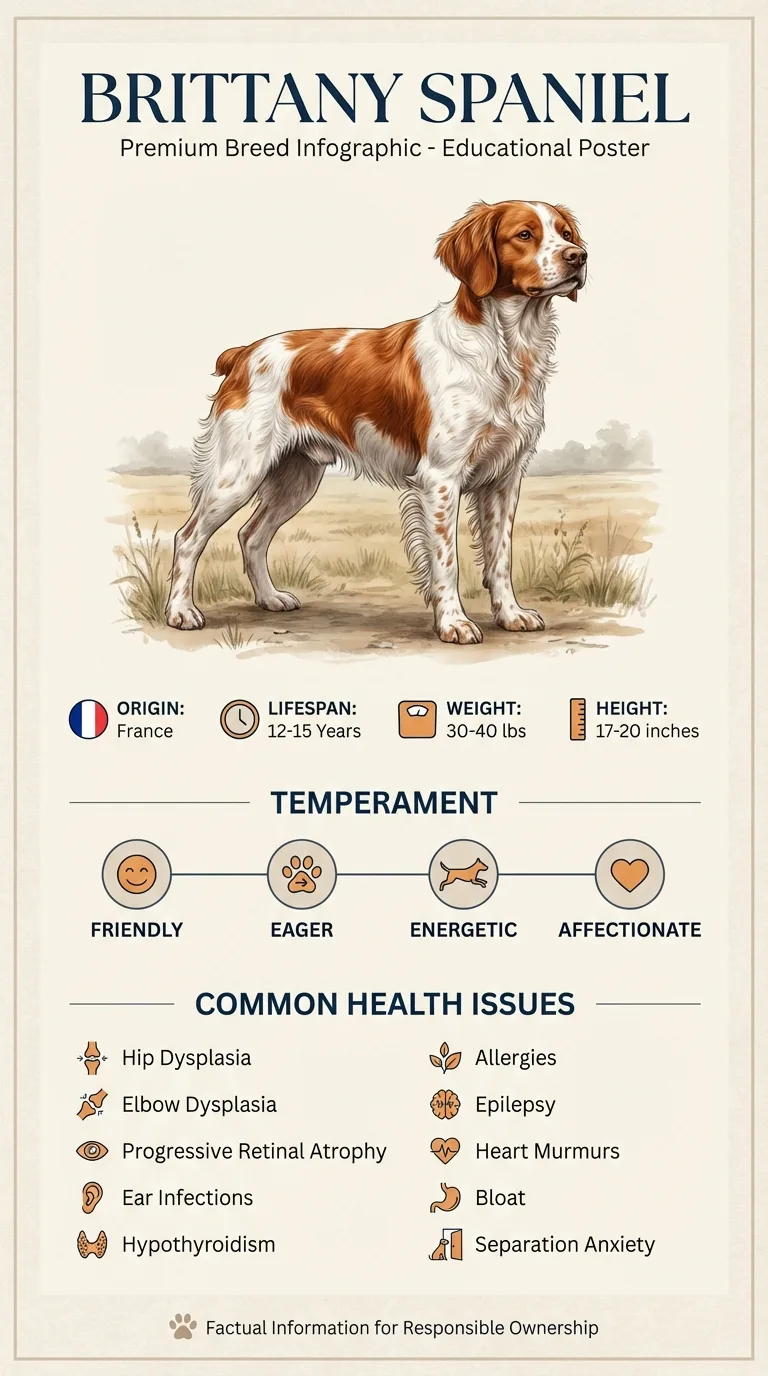
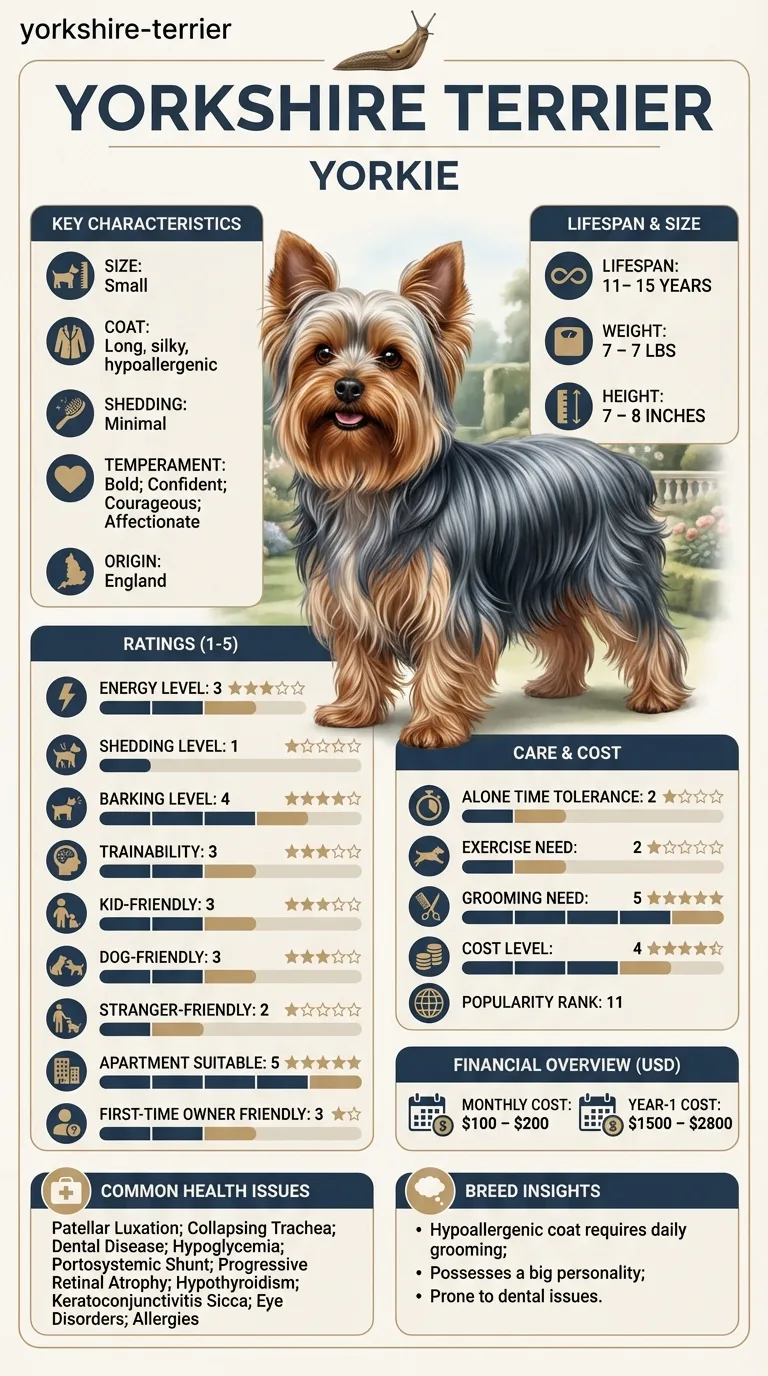
This is for someone already down to Brittany Spaniel and Yorkshire Terrier and deciding between them. For this pair the decision usually turns on grooming need and exercise need, so those are covered first and in most detail. Anyone choosing from a flat has a clear answer here: Yorkshire Terrier rates 5/5 against 3/5. Breed history is left out; what follows is what you will actually live with.
Between Brittany Spaniel and Yorkshire Terrier, grooming need is what separates them; neither is the lower-effort dog overall.
Choose Brittany Spaniel if this is your first dog, you do not want a standing grooming appointment and there are young children at home.
Choose Yorkshire Terrier if you are in a flat or a smaller home, shedding is a problem in your house and your walking routine is modest.
| Feature | brittany | yorkshire terrier | Winner |
|---|---|---|---|
| Size class | medium | small | Equal |
| Weight | 30–40 lbs | 4–7 lbs | Equal |
| Height | 17–20 in | 7–8 in | Equal |
| Lifespan | 12–15 years | 11–15 years | brittany |
| Exercise need | High (4/5) | Low (2/5) | yorkshire terrier |
| Grooming need | Low (2/5) | Very high (5/5) | brittany |
| Shedding | Moderate (3/5) | Very low (1/5) | yorkshire terrier |
| Energy level | High (4/5) | Moderate (3/5) | Equal |
| Barking | Low (2/5) | High (4/5) | brittany |
| Apartment suitability | Moderate (3/5) | Very high (5/5) | yorkshire terrier |
| Good for first-time owners | High (4/5) | Moderate (3/5) | brittany |
| Tolerates being alone | Low (2/5) | Low (2/5) | Equal |
| Trainability | Very high (5/5) | Moderate (3/5) | brittany |
| Good with kids | Very high (5/5) | Moderate (3/5) | brittany |
| Good with other dogs | Very high (5/5) | Moderate (3/5) | brittany |
| Friendly to strangers | High (4/5) | Low (2/5) | brittany |
| Cost level | Moderate (3/5) | High (4/5) | brittany |
| Coat | Medium, wavy coat | Long, silky, hypoallergenic | Equal |
| Origin | France | England | Equal |
| Typical monthly cost | $90–$180 | $100–$190 | Equal |
| Typical first-year cost | $1,300–$2,500 | $1,400–$2,900 | Equal |
This is one of the largest size gaps on the site: a Yorkshire Terrier weighs just 4-7 pounds and stands 7-8 inches, while the Brittany runs 30-40 pounds and 17-20 inches -- five to eight times the Yorkie's weight. A Yorkie is a true toy breed; the Brittany is not in the same conversation, size-wise.
The Brittany needs High (4/5) exercise against the Yorkie's Low (2/5) -- a gap that maps directly onto their size difference, though it's also a difference in job description: the Brittany was bred to work the field all day, the Yorkie to be a companion. Energy levels are closer than the exercise gap suggests, at High (4/5) versus Moderate (3/5).
The Yorkie demands serious coat care -- Very high (5/5) grooming against the Brittany's Low (2/5) -- but sheds very little in return, Very low (1/5) versus Moderate (3/5). Its long, silky coat is often marketed as hypoallergenic-adjacent for exactly this reason, though regular trims or a dedicated grooming routine are non-negotiable if you want to keep it manageable.
The Yorkie is built for small-space living: Very high (5/5) apartment suitability against the Brittany's Moderate (3/5). It does bark more, though -- High (4/5) against the Brittany's Low (2/5) -- a trait common in small terrier-type breeds and worth weighing if you share walls with neighbors.
The Brittany rates higher on both fronts: High (4/5) for first-time owners against Moderate (3/5), and Very high (5/5) trainability against Moderate (3/5). Yorkies carry real terrier stubbornness underneath the small, portable package, which can surprise owners expecting an easy training process to match the easy-to-carry size.
The Brittany leads across every household measure -- kids (5/5 vs. 3/5), other dogs (5/5 vs. 3/5), and strangers (High, 4/5, vs. Low, 2/5). Yorkies, despite their small size, often carry an outsized confidence that can read as reactivity around bigger dogs or unfamiliar people; that shows up clearly in these numbers.
Lifespans run close -- 12-15 years for the Brittany, 11-15 for the Yorkie. Both carry ten-condition health lists, with PRA, hypothyroidism, and allergies overlapping between them. The Yorkie's list adds several risks tied to its tiny size specifically: hypoglycemia (low blood sugar), collapsing trachea, and portosystemic shunt, a liver condition -- all more common in toy breeds generally.
The Yorkie costs slightly more to keep despite weighing a fraction of the Brittany: $100-$190 monthly and $1,400-$2,900 in year one, against the Brittany's $90-$180 and $1,300-$2,500. Grooming and the higher per-pound cost of specialized small-breed vet care both push its numbers up.
Brittany Spaniel weighs 30–40 lbs and lives 12–15 years; Yorkshire Terrier weighs 4–7 lbs and lives 11–15 years. The two diverge most on grooming need, exercise need and apartment suitability and 6 other rated axes. Almost every rated axis separates them at least slightly. The comparison marks an easier option only where one exists. Facts like weight and country of origin are not scored. Both dogs are rated from the same dataset, which is what makes the numbers comparable with each other even though any individual dog sits somewhere inside its breed's range.

Dramatically -- a Yorkie weighs just 4 to 7 pounds against the Brittany's 30 to 40, making it five to eight times lighter.
The Yorkie, rated Very low (1/5) against the Brittany's Moderate (3/5) -- though it needs Very high (5/5) grooming to stay that way.
The Brittany, rated High (4/5) against the Yorkie's Moderate (3/5) -- Yorkies carry more terrier stubbornness than their size suggests.
Very good on space -- Very high (5/5) -- but it barks more than the Brittany (High, 4/5, vs. Low, 2/5), which matters more in close quarters.
Mostly grooming and small-breed-specific vet care -- the Yorkie runs $100-$190 monthly against the Brittany's $90-$180, despite weighing far less.
Some -- PRA, hypothyroidism, and allergies appear on both lists. The Yorkie's list adds toy-breed-specific risks like hypoglycemia and collapsing trachea.
The Brittany, rated Very high (5/5) against the Yorkie's Moderate (3/5) -- a Yorkie's confidence can translate to reactivity around bigger dogs.
The Brittany for most households -- it's better with people and other dogs, though the Yorkie fits small apartments better.
Close, with the Yorkie slightly higher -- $100-$190 monthly against the Brittany's $90-$180, driven by grooming.
Roughly the same -- 12-15 years for the Brittany, 11-15 for the Yorkie.
The Yorkie, rated Low (2/5) against the Brittany's High (4/5) -- a difference that tracks closely with their size gap.
Secure checkout on Stripe. We never see your card.
7-day money-back guarantee. Instant access.
Health information here is general and is not veterinary advice. If your dog shows pain, sudden behaviour change, or worsening symptoms, consult a licensed veterinarian.
Some links on this site are affiliate links. We may earn a commission at no extra cost to you, and we only suggest products we believe are helpful for dog owners.
We research and check what we publish, but we do not warrant that any figure, date, price, or statement is accurate, complete, or current, and we accept no liability for any loss, cost, injury, or other harm arising from the use of this site. Use it as one reference among several. You remain responsible for your own decisions and for your dog's care - confirm anything that matters with a licensed veterinarian or another qualified professional before you act on it. Full disclaimer.
Match your lifestyle to the right dog.
Take quizNot sure which breed is right for you? Take our 2-minute quiz to find out.
Take the quiz