Health
What are the first signs of hip dysplasia in a small dog?
Reluctance to jump up, sitting down partway through walks, taking stairs one at a time, and thinning muscle over one or both thighs. Obvious limping often comes later.

Quick answer
What are the first signs of hip dysplasia in a small dog?
Reluctance to jump up, sitting down partway through walks, taking stairs one at a time, and thinning muscle over one or both thighs. Obvious limping often comes later.
A twenty pound dog with loose hips does not limp the way a ninety pound dog does. It quietly stops jumping onto the sofa, and nobody connects the two for a year.
Owners of Bostons who are slowing down earlier than expected, and anyone whose vet has mentioned hip laxity on an X-ray taken for some other reason.
This guide is not medical advice. If your dog shows pain, sudden behavior change, or worsening symptoms, consult a licensed veterinarian.
Some links may be affiliate links. We may earn a commission at no extra cost to you. We only suggest products we believe are helpful for dog owners.
Hip dysplasia describes a hip joint that formed with a shallow socket or a poorly seated ball, allowing abnormal movement between the two. That movement wears cartilage, and the body responds by laying down new bone, which is arthritis. In a Boston Terrier the process runs slowly and the signs are easy to attribute to age instead.
Considerably less common in Boston Terriers than in the large working and giant breeds that dominate hip dysplasia statistics. Screening databases show meaningfully lower affected rates across small breeds. It is not absent, however, and a Boston that is slowing down in the hind end deserves an examination rather than an assumption about age.
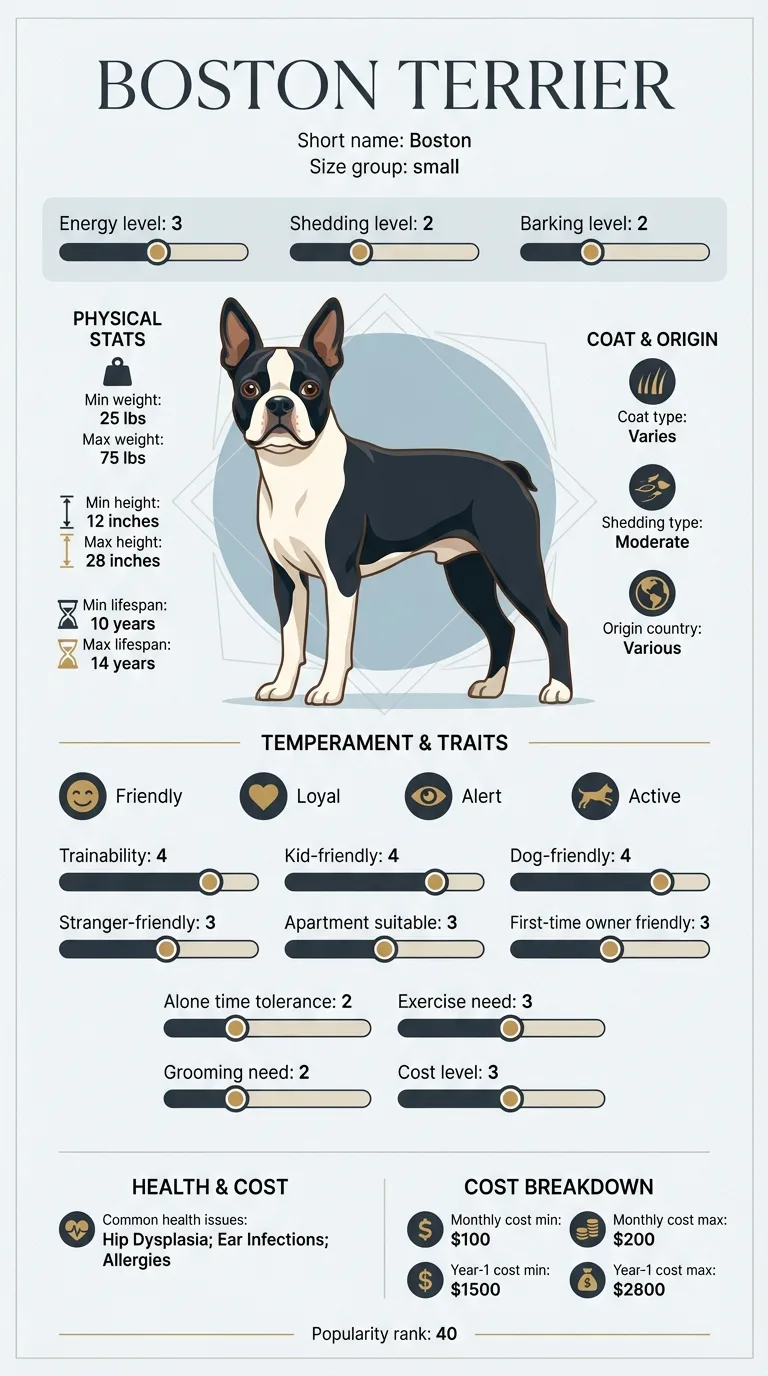
Hip conformation is inherited polygenically, and the Boston's compact build at 15 to 17 inches tall and 12 to 25 pounds means even a poorly shaped joint carries modest load. The breed was developed as a companion rather than for sustained athletic work, so selection pressure never favoured the deep, tightly fitted hips of a working breed, but the low body mass keeps most affected dogs comfortable for years.
Rapid growth and overfeeding in puppyhood increase how much secondary damage accumulates on top of the inherited conformation. Adult obesity is the dominant ongoing driver. Hard slippery floors force constant micro-corrections that a lax joint tolerates poorly. Repetitive high-impact activity, particularly jumping down onto tile or laminate, concentrates force in exactly the wrong place.
Book an appointment if your Boston is reluctant to rise after resting, has stopped jumping onto furniture it used to manage, holds a hind leg up, yelps when handled around the hips, or shows visible muscle loss on one side. Go urgently for a dog that suddenly cannot bear weight on a hind limb at all, since that pattern points toward acute injury such as a ligament rupture rather than gradual joint disease. Persistent hind limb pain in a small dog always warrants examination rather than watchful waiting.
See all Boston Terrier health problems, which breeds are prone to hip dysplasia, or the full Boston Terrier breed guide for temperament, exercise needs and ownership costs.
Weight loss and surface changes produce noticeable comfort improvements in four to eight weeks. Muscle building takes two to three months of consistent work. Arthritis already present does not reverse, so the aim is a slower curve rather than a return to a previous baseline.
A Boston who rises easily, completes its usual walks, and moves symmetrically. Success does not mean a normal X-ray, and rechecking radiographs in a comfortable dog rarely changes the plan. Function is the measure, not the image.
In large breeds, hip dysplasia often announces itself in adolescence with an obvious bunny-hopping gait and pain on manipulation. The forces across the joint are large, so the damage accumulates fast and the dog cannot hide it.
In a Boston Terrier at 12 to 25 pounds, the same laxity produces far less force per step. The joint still degenerates, but slowly, and the dog compensates well because it is light enough to redistribute weight without an obvious limp. What owners see instead is a set of small subtractions: a dog that used to leap onto the bed and now waits to be lifted, that sits down partway through a walk it used to finish, that takes stairs one at a time, or that has become reluctant about being picked up from behind.
The muscle picture is often the earliest objective clue. Compare the two hind legs from behind while the dog is standing square. Asymmetric thigh muscle, or thighs that look thin relative to a well-built chest, suggests a leg that is being used less than the other.
Because the signs are subtle, small-breed hip dysplasia is frequently found by accident on radiographs taken for a suspected back or knee problem. That is not a failure of anyone's attention. It is a consequence of how quietly a light dog can carry a bad joint.
One genuine complication in this breed: patellar luxation is a documented Boston Terrier problem, and a loose kneecap produces its own hind limb gait changes. A dog can have both. Sorting out which joint is causing which sign needs an orthopaedic examination rather than guesswork.

There is no cure for a badly formed joint. There are four levers that reliably change how much it bothers the dog.
If you think your Boston has hip dysplasia, the plan is three steps: write down what you have seen and when it started, book a veterinary appointment rather than waiting for the next flare, and take video of the behaviour or symptom before you go — the thing you are worried about rarely happens in the consulting room. Screening in the parents covers brachycephalic airway syndrome (boas), patellar luxation, cataracts.
What the vet visit should produce is a diagnosis and a written plan, not just reassurance: what is being ruled out, what the monitoring interval is, and which signs mean you come back sooner. Ask what the treatment costs across a year rather than per visit, because that is the number that decides whether you are managing this condition or reacting to it.
Between appointments, keep a short log — dates, what you saw, what changed. It is the single most useful thing an owner brings to a follow-up, and for hip dysplasia it is often what separates a clear pattern from a guess.
Ruby was seven and, as far as her owner Colin knew, entirely healthy. She had simply become a dog who waited at the bottom of the stairs to be carried. He put it down to laziness. A dental X-ray series is not where anyone expects to find a hip problem, but the pelvic view taken while she was already sedated showed shallow sockets on both sides with early arthritic change. Ruby had never limped once. Her vet did not prescribe anything at first. Colin got her from 24 pounds to 20 over four months, put a runner down the hallway, and started doing two twenty-minute walks a day on the grass verge instead of one long pavement loop. By the spring Ruby was walking up the stairs again. She still gets lifted down them, and Colin has stopped calling her lazy.
Key takeaway: In a small dog, hip dysplasia rarely shouts. The signal is usually a thing the dog quietly stopped doing, and the most powerful response is four pounds and a rug.
They can, though it is not one of the breed's headline problems. The Boston Terrier's documented health issues centre on brachycephalic airway syndrome, patellar luxation, cataracts, corneal ulcers and deafness. Hip dysplasia occurs at lower rates in small breeds generally, and in a Boston it is usually a milder, later-presenting version.
The underlying laxity is present from puppyhood, but small dogs often show no clinical signs until secondary arthritis has built up in middle age. That gap between the anatomy existing and the dog noticing is much longer in a 20 pound dog than in a 90 pound one.
By orthopaedic examination and radiographs taken with the dog properly positioned, which usually requires sedation. Some screening schemes measure joint laxity directly with a distraction technique. A casual X-ray of a badly positioned, awake dog can be misleading in either direction.
Sometimes, and small size actually widens the options. Femoral head removal, which relies on surrounding muscle forming a false joint, works notably well in light dogs and is far less viable in heavy ones. Total hip replacement exists for dogs too. Most Bostons, though, are managed without surgery.
No supplement rebuilds a malformed socket. Some owners report modest comfort benefits from omega-3 rich diets and joint products, and your vet may support trying one, but they belong alongside weight control and muscle work rather than instead of them.
No. Rest weakens the muscle that is holding the joint together. The change is in type rather than amount: steady lead walking most days, on grass and gentle slopes, instead of ball-chasing, jumping and unpredictable rough play with bigger dogs.
Reluctance to jump up, sitting down partway through walks, taking stairs one at a time, and thinning muscle over one or both thighs. Obvious limping often comes later.
The joint conformation is largely inherited, so it cannot be prevented outright. Keeping a growing puppy lean and avoiding repetitive high-impact jumping reduces how much damage develops on top of it.
Conservative management is mostly the cost of periodic vet visits and medication. Surgical options for a small dog run into several thousand dollars depending on procedure and region.
Going up is usually tolerated. Repeatedly coming down stairs or jumping off furniture generates the highest forces, so ramps and lifting help most there.
A one-page prep sheet for this condition: the signs, the questions to ask, what to get priced. Unlocks here.
You get: Vet visit prep sheet
No spam. One-click unsubscribe. See our privacy policy.
Preview page 1 before you decide.