Health
What is the first sign of a heart condition in a Bichon Frise?
Usually nothing you can see. It is a murmur found by a vet at a routine visit, months or years before any change in behaviour.

Quick answer
What is the first sign of a heart condition in a Bichon Frise?
Usually nothing you can see. It is a murmur found by a vet at a routine visit, months or years before any change in behaviour.
A Bichon lives 14 to 15 years, which is long enough for a slow valve problem to become the thing that eventually limits them. Catching it early is mostly a matter of showing up for the stethoscope.
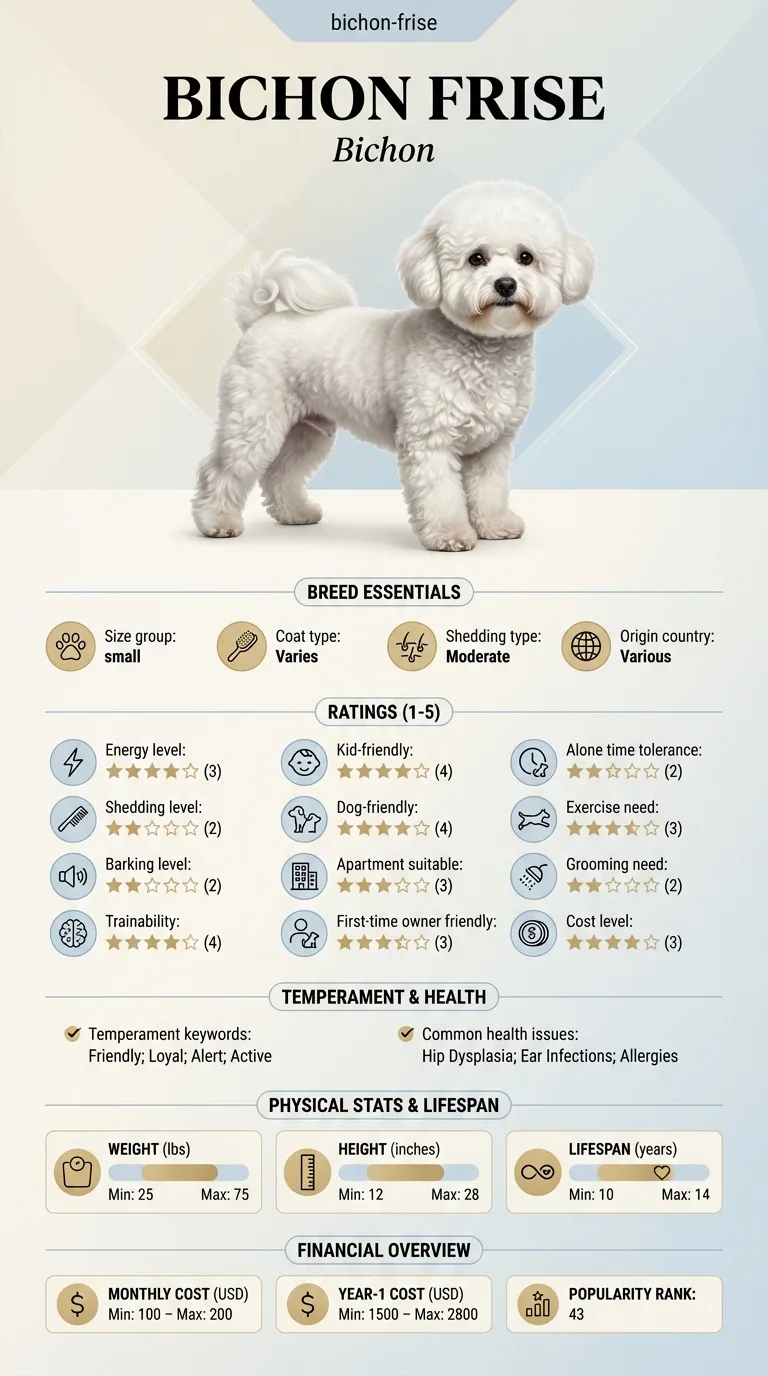
Owners who heard the word "murmur" at a routine visit and were sent home with no clear plan. Also owners of older Bichons who have started to notice a cough or a slower pace on walks and are not sure whether that is the heart or just fourteen years of living.
This guide is not medical advice. If your dog shows pain, sudden behavior change, or worsening symptoms, consult a licensed veterinarian.
Some links may be affiliate links. We may earn a commission at no extra cost to you. We only suggest products we believe are helpful for dog owners.
Cardiac findings in the Bichon Frise are usually discovered rather than reported — a vet hears something the owner never noticed. The realistic picture across the breed is a long healthy stretch, a possible murmur somewhere in the second half of life, and a smaller subset of dogs whose murmur eventually progresses to something that needs treatment. A minority of Bichons are diagnosed with a congenital defect as puppies.
Most Bichons reach ten with no cardiac diagnosis at all. Degenerative valve change becomes measurably more common across small breeds after that point, and because this breed routinely lives to fourteen or fifteen, a fair number of Bichons live long enough to acquire a murmur. Having one is not the same as being ill from one — many carry a stable murmur for years without medication.
Size and longevity are the two relevant Bichon traits. At 12 to 18 pounds this is a small dog, and small breeds as a group are prone to degenerative change in the mitral valve rather than to the muscle disease that troubles large breeds. Longevity compounds it: a breed that commonly reaches 14 or 15 years simply has more time on the clock for slow structural change to accumulate.
Excess weight is the environmental factor with real leverage. A Bichon's exercise need is low and its appetite is not, so a couple of extra pounds on an 15-pound frame is proportionally large and adds work for the heart. Untreated dental disease is the second: chronic oral inflammation is unwelcome in any dog with a compromised valve, and dental disease is already on this breed's standard health list.
Same-day care for collapse, fainting, blue or grey gums, open-mouth breathing at rest, or a sleeping breath rate that has climbed past roughly 40 a minute — those point to fluid on the lungs and are an emergency, not a wait-and-see. Within a week for a new persistent cough, obvious loss of stamina, a swollen abdomen, or restlessness at night in a dog that used to sleep through. At the next routine visit for anything you have simply noticed and want documented.
See all Bichon Frise health problems, which breeds are prone to heart conditions, or the full Bichon Frise breed guide for temperament, exercise needs and ownership costs.
Screening is a lifelong habit rather than a project with an end date. If a murmur is found, expect a re-check in six to twelve months to see whether it is stable. Dogs whose disease does progress typically do so over years, not weeks, and many Bichons diagnosed at nine are still comfortable at thirteen.
Success is a documented, tracked murmur that never turns into a crisis: a stable grade, a sleeping breath rate that stays in your dog's normal band, a lean body condition, and treatment that begins the moment imaging says it should rather than after an emergency admission.
Cardiac screening in a small companion breed is not one test repeated forever. What matters shifts as the dog ages, and knowing the sequence helps you ask better questions at each visit.
If your Bichon has any documented heart finding, the single most useful thing you can do at home is count sleeping respiratory rate. Watch the chest while the dog is genuinely asleep, count each rise as one breath, and count for a full minute. Write the number down a few times a week.
Most healthy small dogs sit comfortably under 30 breaths a minute asleep. What you are building is a personal baseline, because the number that matters is not a textbook figure — it is the drift away from your own dog's normal. A Bichon that has slept at 20 for six months and is now sleeping at 34 has told you something before any cough appears.

If you think your Bichon has heart conditions, the plan is three steps: write down what you have seen and when it started, book a veterinary appointment rather than waiting for the next flare, and take video of the behaviour or symptom before you go — the thing you are worried about rarely happens in the consulting room. Screening in the parents covers skin allergies, patellar luxation, bladder stones.
What the vet visit should produce is a diagnosis and a written plan, not just reassurance: what is being ruled out, what the monitoring interval is, and which signs mean you come back sooner. Ask what the treatment costs across a year rather than per visit, because that is the number that decides whether you are managing this condition or reacting to it.
Between appointments, keep a short log — dates, what you saw, what changed. It is the single most useful thing an owner brings to a follow-up, and for heart conditions it is often what separates a clear pattern from a guess.
Coco was eight when a locum vet mentioned a grade two murmur almost in passing. Her owner, Priya, wrote the grade on the back of the vaccination card and asked for it to be re-checked each year. At nine and ten it was unchanged. At eleven the grade had moved up, so their vet took chest radiographs and started Priya counting sleeping breaths. The number sat around 22 and stayed there. At thirteen the rate crept into the low thirties over about three weeks. Priya rang before any coughing started, imaging showed early changes, and medication began that week rather than during a midnight emergency. Coco kept her short morning walks for another eighteen months.
Key takeaway: The value was not in the diagnosis but in the record. One number written down each year turned a vague finding into a trend, and the trend bought time to act calmly.
They are not among the breeds flagged for early or aggressive cardiac disease. The standard Bichon health list centres on skin allergies, patellar luxation, bladder stones, cataracts and dental disease. Cardiac findings do appear, but usually as the ordinary age-related valve change seen across small breeds rather than something breed-specific.
Ask two things: what grade it is, and whether the dog has any symptoms. A soft, low-grade murmur in a symptom-free middle-aged Bichon with a normal breathing rate is genuinely reasonable to monitor. Ask for it to be re-graded at every visit so a change gets noticed.
Once a year through middle age, and every six months from about ten if anything has ever been documented. The examination itself is short. What makes it worthwhile is comparison across visits, which only works if the visits actually happen on schedule.
For most, no. A Bichon's exercise requirement is modest to begin with, and gentle daily walking supports muscle condition and weight. What you avoid is forcing a dog to keep going once it slows down or wants to stop. Let the dog set the pace and turn back early on warm days.
No, and assuming so causes real delays. A small fluffy dog coughing could equally be tracheal irritation, kennel cough, collar pressure or dental-related. The heart-related cough tends to be soft, worse at night and lying down, and paired with a rising sleeping breath rate.
General practice handles screening, monitoring and most routine cases well. A referral earns its cost when there is a loud murmur in a young dog, a fainting episode, an abnormal rhythm, or when treatment decisions depend on measuring chamber size accurately.
Usually nothing you can see. It is a murmur found by a vet at a routine visit, months or years before any change in behaviour.
Expect a few hundred dollars in most regions, more at a specialty centre. It is a one-off diagnostic rather than a recurring expense.
Do not overhaul the diet on your own. Ask your vet before making changes, and mention it if you feed grain-free or boutique formulations.
Almost always yes. Restricting a symptom-free dog is unnecessary and tends to cost muscle condition that the dog needs later.
Early on, no. Later you may see shorter interest in walks, restless positioning at night, or a reluctance to settle lying flat.
A one-page prep sheet for this condition: the signs, the questions to ask, what to get priced. Unlocks here.
You get: Vet visit prep sheet
No spam. One-click unsubscribe. See our privacy policy.
Preview page 1 before you decide.