Health
What causes chronic squinting in a Bichon Frise?
Often a mechanical cause — an inward-rolled eyelid or a misdirected eyelash rubbing the cornea — rather than allergies, and it needs a close lid-margin exam to confirm.

Quick answer
What causes chronic squinting in a Bichon Frise?
Often a mechanical cause — an inward-rolled eyelid or a misdirected eyelash rubbing the cornea — rather than allergies, and it needs a close lid-margin exam to confirm.
A Bichon that squints, holds one eye half-closed, or rubs at its face repeatedly is usually dealing with something physically irritating the surface of the eye, not a vague allergy.
Owners hit this when a dog's eye looks sore or watery on and off for weeks, drops seem to help a little and then stop working, and nobody has looked closely enough to see what is actually touching the eye.
This guide is not medical advice. If your dog shows pain, sudden behavior change, or worsening symptoms, consult a licensed veterinarian.
Some links may be affiliate links. We may earn a commission at no extra cost to you. We only suggest products we believe are helpful for dog owners.
Eyelid and eyelash disorders in the Bichon Frise are mechanical problems — a lid margin rolled the wrong way, or a lash growing toward the eye instead of away from it — that produce constant low-grade irritation and, left unaddressed, can wear through the cornea into an ulcer. They are a distinct issue from the breed's documented cataracts, sitting on the surface of the eye rather than inside the lens.
Mild eyelash and eyelid irritation is a frequent finding on close examination of small, coated breeds, though most cases stay low-grade and undiagnosed unless an owner or vet specifically checks the lid margin. Corneal ulcers as a consequence are less common but are the scenario that turns a cosmetic nuisance into an emergency.
The Bichon's dense curly coat and facial hair growth pattern make eyelash and lid-margin irritation easy to miss, since watering and mild squinting look similar to normal coat-related eye mess. The breed's small, forward-facing eyes sit close to the surrounding hair, giving misdirected lashes or rolled lid margins more opportunity for constant contact than in a dog with a flatter facial coat.
Ungroomed facial hair, dust, wind, and dry indoor heating all add irritation on top of an existing mechanical cause, making symptoms worse in some seasons than others even though the underlying eyelid or eyelash fault does not change.
Talk to a vet about any squinting, watering, or eye rubbing that persists beyond a couple of days, or recurs repeatedly. Treat an eye that is suddenly held shut, shows heavy discharge, or develops a visibly cloudy or dull patch as a same-day emergency, since these signs can mean a corneal ulcer progressing toward perforation.
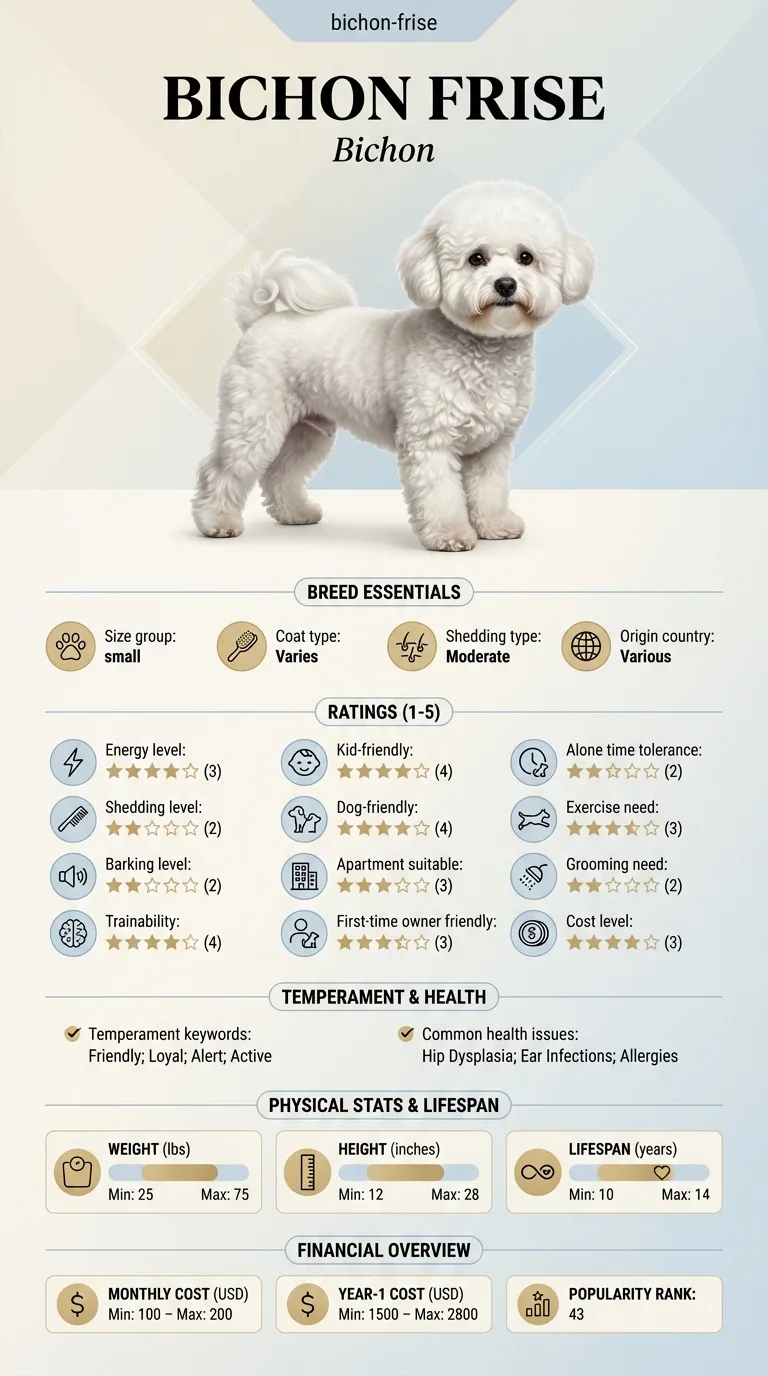
See all Bichon Frise health problems, which breeds are prone to eye disorders, or the full Bichon Frise breed guide for temperament, exercise needs and ownership costs.
Simple lash removal or lubrication for mild lid rolling often resolves symptoms within one to two weeks. Surgical correction for more significant eyelid faults typically needs several weeks of recovery before full improvement is clear.
Success is an eye that stays open and comfortable without recurring squinting, not just a temporary quiet period between flare-ups.
Two related conformational issues sit behind a lot of Bichon eye irritation. Eyelid faults such as entropion roll the lid margin inward so that the haircoat and lid skin brush the cornea with every blink. Eyelash faults such as distichiasis produce extra lashes growing from an abnormal point on the lid margin, aimed at the eye rather than away from it, or trichiasis, where normally placed facial hair curves back into contact with the surface.
Neither of these is dramatic to look at. A dog can have distichiasis for months with nothing more than intermittent squinting and a bit of extra tearing, because the irritation is low-grade and constant rather than acute. That is exactly why it gets missed — the dog adapts, the owner assumes allergies or dust, and the actual mechanical cause never gets identified without a vet examining the lid margin directly, sometimes with magnification.
Constant mechanical contact wears down the cornea's outer layer, and once that layer breaks, the result is a corneal ulcer — a genuine, time-sensitive problem rather than a cosmetic one. An eye that goes from occasionally squinty to held shut, weeping heavily, or cloudy in one spot has likely crossed that line. Deep ulcers can progress toward perforation within a day or two if untreated, which is why any sudden worsening of a chronically irritated eye needs same-day veterinary attention rather than another week of watching.

Cataracts are the eye condition actually documented on this breed's health record, and they sit deep inside the lens rather than on the surface. Eyelid and eyelash disorders are a separate mechanical problem that can affect any dog regardless of lens health, and one does not predict the other. A Bichon can have healthy lenses and troublesome lashes, or the reverse, so an owner managing one should not assume it explains symptoms that actually belong to the other.
If you think your Bichon has eye disorders, the plan is three steps: write down what you have seen and when it started, book a veterinary appointment rather than waiting for the next flare, and take video of the behaviour or symptom before you go — the thing you are worried about rarely happens in the consulting room. Screening in the parents covers skin allergies, patellar luxation, bladder stones.
What the vet visit should produce is a diagnosis and a written plan, not just reassurance: what is being ruled out, what the monitoring interval is, and which signs mean you come back sooner. Ask what the treatment costs across a year rather than per visit, because that is the number that decides whether you are managing this condition or reacting to it.
Between appointments, keep a short log — dates, what you saw, what changed. It is the single most useful thing an owner brings to a follow-up, and for eye disorders it is often what separates a clear pattern from a guess.
Coco's left eye had been a bit watery for close to two months. Her owner assumed it was seasonal, wiped the corner each morning, and tried an over-the-counter drop that seemed to help for a few days before the squinting came back. At a routine grooming appointment, the groomer noticed Coco flinching when her left cheek hair was brushed and suggested a vet check the eye specifically rather than treating it as general irritation. Under magnification, the vet found a single misdirected eyelash making contact with the cornea on every blink. Removing the lash follicle took a short outpatient procedure. Within ten days, Coco's eye stayed open and dry for the first time in two months, and the watering that had been dismissed as normal simply stopped.
Key takeaway: Chronic mild eye irritation in this breed is often mechanical rather than allergic, and it can take someone deliberately looking at the lid margin, not just the eye's surface, to find the actual cause.
Intermittent squinting in one eye often points to a mechanical irritant — an inward-rolled eyelid or a misdirected eyelash touching the cornea — rather than allergies. A vet examining the lid margin closely, sometimes with magnification, can usually identify it.
Distichiasis is an extra eyelash growing from an abnormal point on the eyelid margin, aimed at the eye's surface. It causes low-grade, constant irritation rather than sudden pain, and can go unnoticed for a long time because the dog adapts to it.
A shift from occasional squinting to the eye being held shut, heavy weeping, or a visibly cloudy or dull spot on the cornea suggests an ulcer has formed. That level of change warrants a same-day vet visit.
No. Cataracts affect the lens deep inside the eye and are the condition actually documented for this breed. Eyelid and eyelash disorders are a separate, mechanical, surface-level issue, and a dog can have one without the other.
For eyelash problems, removing the follicle producing the misdirected hair can be permanent. For eyelid rolling, surgical correction is available for confirmed, significant cases, though mild cases are sometimes managed with lubrication alone.
Yes, squinting is a pain response even when mild. A dog does not squint out of habit — it is protecting an eye that is uncomfortable, so ongoing squinting always deserves an exam rather than being written off as a quirk.
Lubricating or anti-inflammatory drops can mask low-grade mechanical irritation temporarily, but they do not remove a misplaced lash or correct a rolled lid. If the underlying contact continues, symptoms typically return once the drops' effect wears off.
Often a mechanical cause — an inward-rolled eyelid or a misdirected eyelash rubbing the cornea — rather than allergies, and it needs a close lid-margin exam to confirm.
Yes. A cloudy spot, heavy weeping, or an eye held shut can progress toward perforation within a day or two if untreated, so same-day veterinary care is warranted.
No, they are unrelated conditions in different parts of the eye. A dog can have healthy lenses and still have troublesome eyelashes, or the reverse.
Yes, in confirmed cases the abnormal lash follicle can be surgically removed, which prevents that particular lash from regrowing and recurring irritation.
An eye suddenly held shut, heavy discharge, visible cloudiness, or obvious pain when touched near the face are same-day signs, not wait-and-watch ones.
A one-page prep sheet for this condition: the signs, the questions to ask, what to get priced. Unlocks here.
You get: Vet visit prep sheet
No spam. One-click unsubscribe. See our privacy policy.
Preview page 1 before you decide.