Belgian Malinois vs Yorkshire Terrier: Which Suits Your Home?
Quick answer
Malinois or Yorkie, how different are these dogs really?
About as different as two dogs on this site get, size, exercise need, and apartment suitability all point opposite directions. This comparison usually comes down to lifestyle, not a close call on temperament.
Belgian Malinois or Yorkshire Terrier? On paper they differ most on apartment suitability, and on the scales Belgian Malinois is the heavier at 55–65 lbs. Here is how the two compare on everything that shapes an ordinary week.
This is for someone already down to Belgian Malinois and Yorkshire Terrier and deciding between them. For this pair the decision usually turns on apartment suitability and exercise need, so those are covered first and in most detail. Anyone choosing from a flat has a clear answer here: Yorkshire Terrier rates 5/5 against 1/5. It is written for the decision rather than the breed history.
Quick verdict
Between Belgian Malinois and Yorkshire Terrier, apartment suitability is what separates them, and Yorkshire Terrier is the lower-effort dog of the two to keep.
Choose belgian malinois if...
Choose Belgian Malinois if you do not want a standing grooming appointment, you want a dog that picks up training quickly and you want a dog that can keep up with an active routine.
Choose yorkshire terrier if...
Choose Yorkshire Terrier if you are in a flat or a smaller home, this is your first dog and shedding is a problem in your house.
Head-to-head comparison
Feature
belgian malinois
yorkshire terrier
Winner
Size class
large
small
Equal
Weight
55–65 lbs
4–7 lbs
Equal
Height
22–26 in
7–8 in
Equal
Lifespan
11–15 years
11–15 years
Equal
Exercise need
Very high (5/5)
Low (2/5)
yorkshire terrier
Grooming need
Low (2/5)
Very high (5/5)
belgian malinois
Shedding
Moderate (3/5)
Very low (1/5)
yorkshire terrier
Energy level
Very high (5/5)
Moderate (3/5)
Equal
Barking
Moderate (3/5)
High (4/5)
belgian malinois
Apartment suitability
Very low (1/5)
Very high (5/5)
yorkshire terrier
Good for first-time owners
Very low (1/5)
Moderate (3/5)
yorkshire terrier
Tolerates being alone
Very low (1/5)
Low (2/5)
yorkshire terrier
Trainability
Very high (5/5)
Moderate (3/5)
belgian malinois
Good with kids
Moderate (3/5)
Moderate (3/5)
Equal
Good with other dogs
Moderate (3/5)
Moderate (3/5)
Equal
Friendly to strangers
Low (2/5)
Low (2/5)
Equal
Cost level
High (4/5)
High (4/5)
Equal
Coat
Short, dense
Long, silky, hypoallergenic
Equal
Origin
Belgium
England
Equal
Typical monthly cost
$120–$250
$100–$190
Equal
Typical first-year cost
$1,800–$3,500
$1,400–$2,900
Equal
Deep dive
Size and build
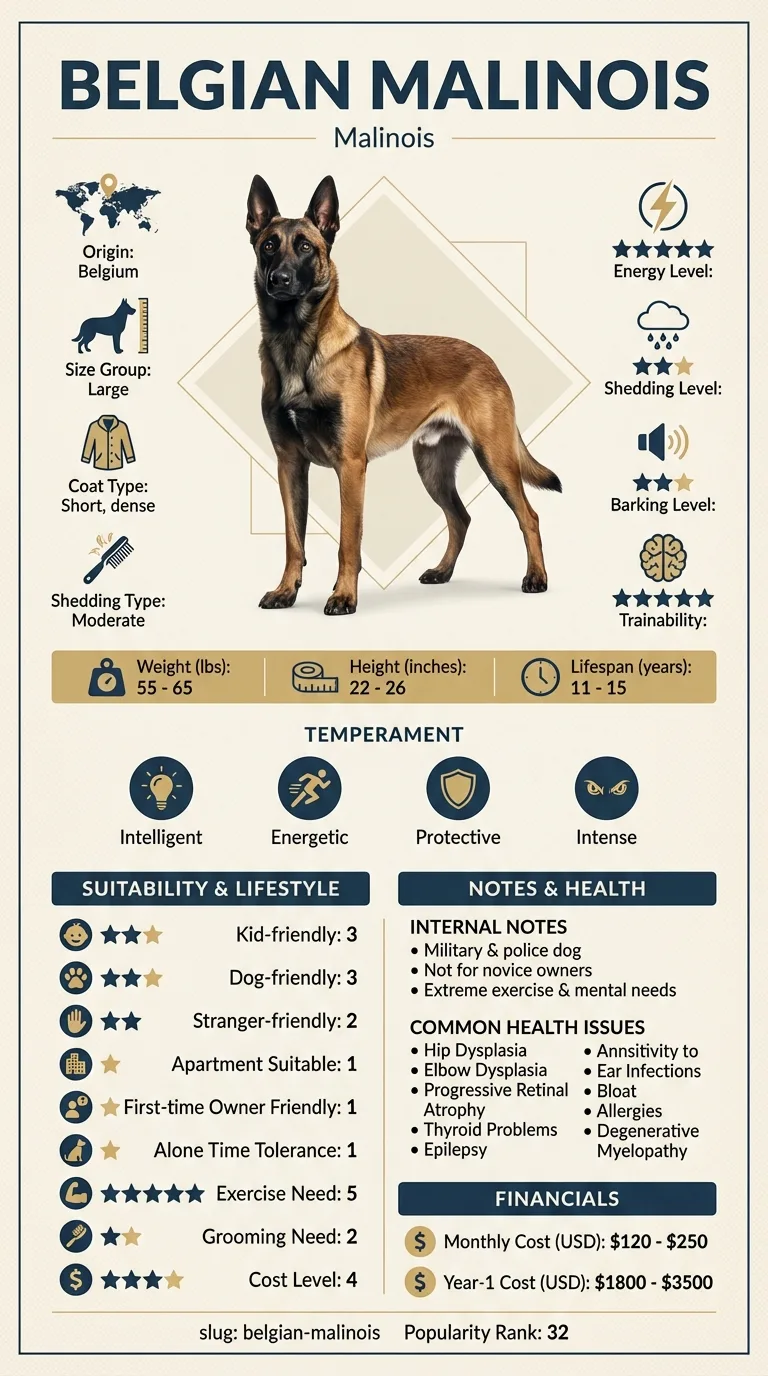
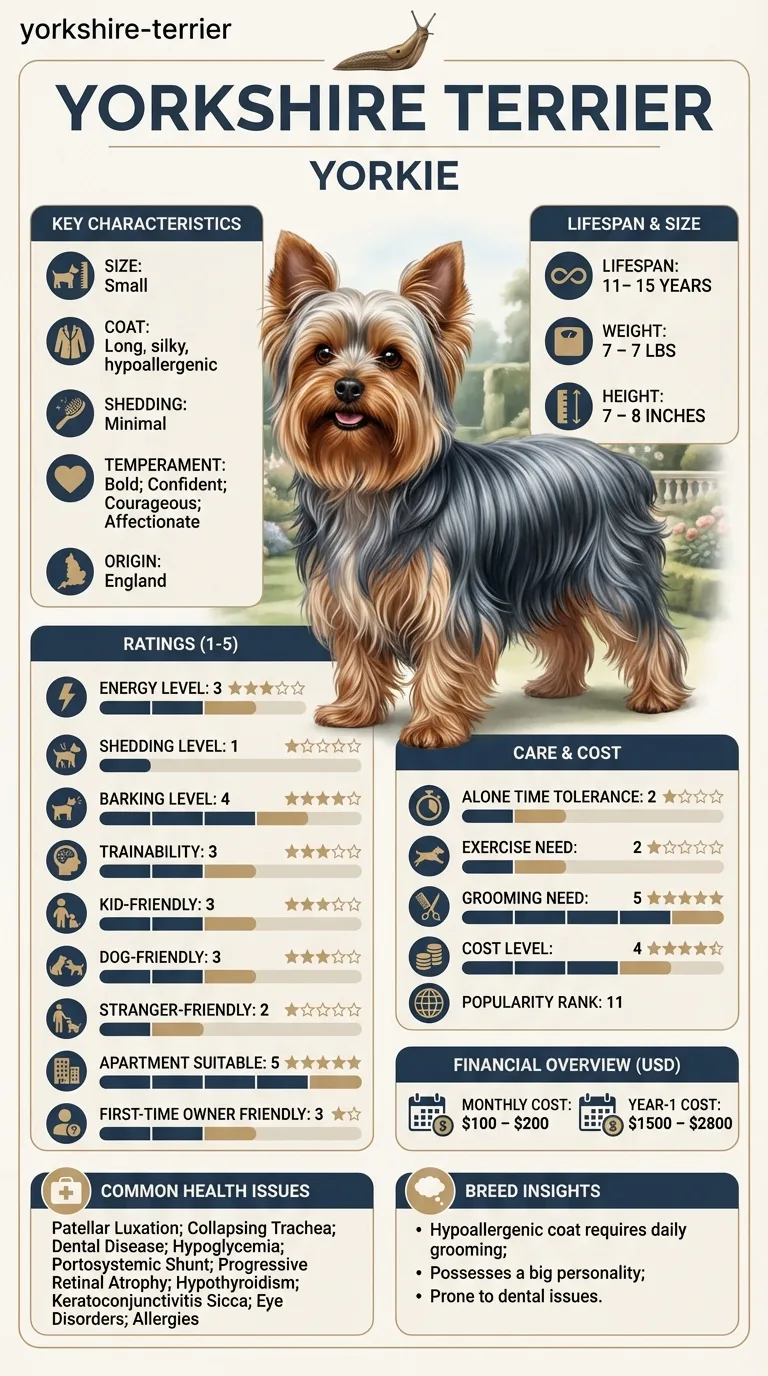
There's no meaningful comparison here on size. The Malinois weighs 55 to 65 pounds and stands 22 to 26 inches, while the Yorkshire Terrier weighs 4 to 7 pounds and stands 7 to 8 inches. A Malinois can weigh close to fifteen times what a Yorkie does. If you're choosing based on how much dog you physically want in your house, this comparison answers itself before you reach any other row.
Energy and exercise
The Malinois demands 5 out of 5 on exercise need; the Yorkie sits at 2 out of 5. That's not a small difference. The Malinois needs sustained physical and mental work daily, while a Yorkie's exercise needs can largely be met with shorter walks and indoor play. Anyone weighing this matchup is very likely choosing based on how much daily activity they're actually prepared to provide.
Grooming and shedding
Here the Malinois has the easier coat: 2 out of 5 for grooming against the Yorkie's 5 out of 5. The Yorkie's long, silky coat needs regular brushing and often professional trimming to avoid matting, though it does shed far less, 1 out of 5 versus the Malinois's 3 out of 5, and is often marketed as hypoallergenic. It's a genuine trade-off, less hair on the couch, more time with a brush or at a groomer.
Apartment living, noise and time alone
The Yorkie is built for small spaces in a way the Malinois simply isn't: 5 out of 5 for apartment suitability against the Malinois's 1 out of 5. It does bark more, 4 out of 5 versus 3 out of 5, which matters in thin-walled buildings, but tolerates being alone somewhat better, 2 out of 5 versus 1 out of 5. For anyone in an apartment, the Malinois is realistically off the table.
Training and owner experience
The Malinois again posts the higher trainability score, 5 out of 5 against the Yorkie's 3 out of 5. That doesn't mean the Yorkie is untrainable, 3/5 is a respectable middle score, but it's a smaller, more independent-minded breed not built for the same precision work. First-time owners score better with the Yorkie regardless, 3/5 versus the Malinois's 1/5, largely because the consequences of an untrained Yorkie are far smaller.
Kids, other dogs and visitors
The two tie on several social measures: good with kids (3/5 each), good with other dogs (3/5 each), and friendly to strangers (2/5 each), a bit surprising given how differently sized they are. What that tells you is size alone doesn't predict temperament here; both breeds carry some wariness a family should plan around, whether that means supervising a toddler around a small, easily injured Yorkie or a powerful, protective Malinois.
Health and lifespan
Lifespan is a tie at 11 to 15 years for both. Health-wise the overlap is thin, progressive retinal atrophy and allergies show up on both ten-condition lists, but otherwise they diverge sharply. The Malinois's risks lean toward joints and working-dog conditions like degenerative myelopathy; the Yorkie's lean toward small-breed issues like collapsing trachea, patellar luxation, and portosystemic shunt, worth specifically screening for in a Yorkie puppy.
Cost to keep
Cost is a rare tie between these two very differently sized dogs, both rated 4 out of 5 on the site's scale. The dollar ranges are close too: $120 to $250 a month for the Malinois against $100 to $190 for the Yorkie, and $1,800 to $3,500 versus $1,400 to $2,900 in the first year. The Yorkie's smaller food bill gets offset by grooming and the higher per-visit cost of small-breed veterinary care.
Belgian Malinois vs Yorkshire Terrier at a glance
Belgian Malinois weighs 55–65 lbs and lives 11–15 years; Yorkshire Terrier weighs 4–7 lbs and lives 11–15 years. The two diverge most on apartment suitability, exercise need and grooming need and 4 other rated axes. They are level on cost level, good with other dogs and good with kids, so those cannot decide it. In the table, a "winner" means easier for an ordinary household — not better. Size, coat and origin are recorded without a verdict. Because both breeds are scored the same way, the gaps are reliable even where the absolute numbers are rough.
Belgian Malinois vs Yorkshire Terrier: Which Suits Your Home? - Belgian Malinois vs Yorkshire Terrier at a glance
Frequently asked questions
How much bigger is a Malinois than a Yorkie?
Dramatically bigger. The Malinois weighs 55 to 65 pounds against the Yorkie's 4 to 7 pounds, roughly a tenfold-to-fifteenfold difference, with height following the same pattern (22-26 in versus 7-8 in).
Which needs less exercise?
The Yorkie, by a lot, 2 out of 5 against the Malinois's 5 out of 5. A Yorkie's exercise needs can be met with shorter walks and play sessions; a Malinois needs sustained daily work.
Which is easier for a first-time owner?
The Yorkie, clearly. It scores 3 out of 5 for first-time owners against the Malinois's 1 out of 5, and the practical stakes of an undertrained Yorkie are much lower than an undertrained Malinois.
Is a Yorkie good for apartments?
Yes, it scores 5 out of 5 for apartment suitability, the top of the scale, against the Malinois's 1 out of 5. It does bark more, though, at 4 out of 5 versus the Malinois's 3 out of 5.
What's the cost comparison?
Closer than you'd expect given the size gap, both rated 4 out of 5 on cost, with the Malinois running $120 to $250 monthly and the Yorkie $100 to $190. The Yorkie's grooming needs help close what would otherwise be a bigger gap.
Do they share any health risks?
A little, progressive retinal atrophy and allergies appear on both lists. Beyond that their risks are largely breed-size-specific: joint and working-dog conditions for the Malinois, small-breed issues like collapsing trachea and patellar luxation for the Yorkie.
Which lives longer?
Neither has an edge, both are rated 11 to 15 years.
Malinois or Yorkie, how different are these dogs really?
About as different as two dogs on this site get, size, exercise need, and apartment suitability all point opposite directions. This comparison usually comes down to lifestyle, not a close call on temperament.
Costs
Which costs more to keep monthly?
The Malinois, slightly, $120 to $250 versus the Yorkie's $100 to $190, though both land at the same 4 out of 5 cost rating overall.
Living
Which needs more daily exercise?
The Malinois, by a wide margin, 5 out of 5 versus the Yorkie's 2 out of 5. This is usually the single biggest factor in choosing between them.
Health
Do they live equally long?
Yes, both are rated 11 to 15 years.
Related DogBreedCompass guides
Belgian Malinois breed guide – Readers comparing the two usually want the full profile of Belgian Malinois before deciding.
Yorkshire Terrier breed guide – The same for Yorkshire Terrier, so the comparison can be checked against the detail.
Belgian Malinois vs German Shorthaired Pointer – German Shorthaired Pointer is the closest breed to Belgian Malinois on the measured axes, so it is the natural next comparison.
Health information here is general and is not veterinary advice. If your dog shows pain, sudden behaviour change, or worsening symptoms, consult a licensed veterinarian.
Some links on this site are affiliate links. We may earn a commission at no extra cost to you, and we only suggest products we believe are helpful for dog owners.
We research and check what we publish, but we do not warrant that any figure, date, price, or statement is accurate, complete, or current, and we accept no liability for any loss, cost, injury, or other harm arising from the use of this site. Use it as one reference among several. You remain responsible for your own decisions and for your dog's care - confirm anything that matters with a licensed veterinarian or another qualified professional before you act on it. Full disclaimer.