Behavior
Which needs more exercise?
The Welsh Springer Spaniel, rated high (4/5) for exercise need versus the Yorkshire Terrier's low (2/5).

Quick answer
Which needs more exercise?
The Welsh Springer Spaniel, rated high (4/5) for exercise need versus the Yorkshire Terrier's low (2/5).
Welsh Springer Spaniel or Yorkshire Terrier? On paper they differ most on apartment suitability, and on the scales Welsh Springer Spaniel is the heavier at 35–55 lbs. Here is how the two compare on everything that shapes an ordinary week.
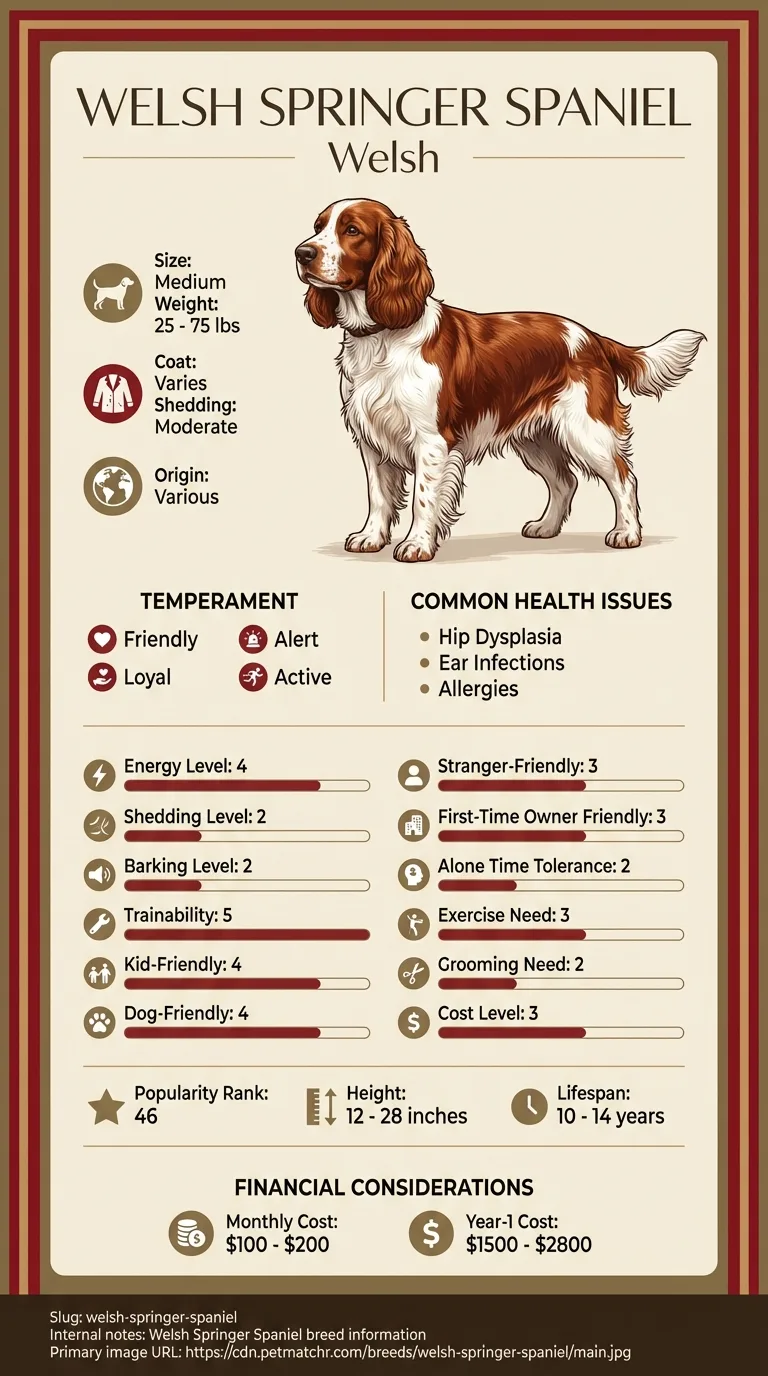
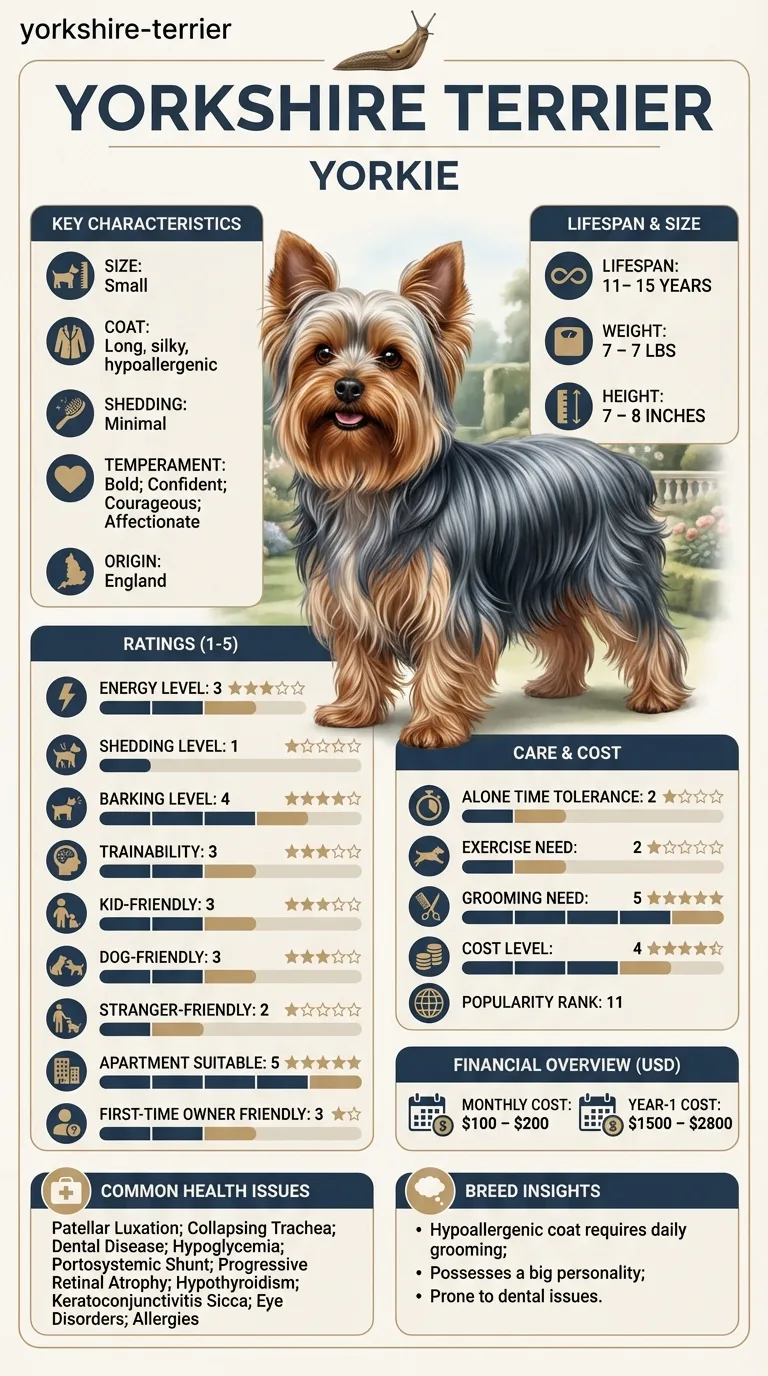
This is for someone already down to Welsh Springer Spaniel and Yorkshire Terrier and deciding between them. For this pair the decision usually turns on apartment suitability and exercise need, so those are covered first and in most detail. Anyone choosing from a flat has a clear answer here: Yorkshire Terrier rates 5/5 against 2/5. Breed history is left out; what follows is what you will actually live with.
Between Welsh Springer Spaniel and Yorkshire Terrier, apartment suitability is what separates them, and Yorkshire Terrier is the lower-effort dog of the two to keep.
Choose Welsh Springer Spaniel if you do not want a standing grooming appointment, there are young children at home and you already have another dog.
Choose Yorkshire Terrier if you are in a flat or a smaller home, shedding is a problem in your house and your walking routine is modest.
| Feature | welsh springer spaniel | yorkshire terrier | Winner |
|---|---|---|---|
| Size class | medium | small | Equal |
| Weight | 35–55 lbs | 4–7 lbs | Equal |
| Height | 17–19 in | 7–8 in | Equal |
| Lifespan | 12–15 years | 11–15 years | welsh springer spaniel |
| Exercise need | High (4/5) | Low (2/5) | yorkshire terrier |
| Grooming need | Moderate (3/5) | Very high (5/5) | welsh springer spaniel |
| Shedding | Moderate (3/5) | Very low (1/5) | yorkshire terrier |
| Energy level | High (4/5) | Moderate (3/5) | Equal |
| Barking | Moderate (3/5) | High (4/5) | welsh springer spaniel |
| Apartment suitability | Low (2/5) | Very high (5/5) | yorkshire terrier |
| Good for first-time owners | Moderate (3/5) | Moderate (3/5) | Equal |
| Tolerates being alone | Low (2/5) | Low (2/5) | Equal |
| Trainability | High (4/5) | Moderate (3/5) | welsh springer spaniel |
| Good with kids | High (4/5) | Moderate (3/5) | welsh springer spaniel |
| Good with other dogs | High (4/5) | Moderate (3/5) | welsh springer spaniel |
| Friendly to strangers | Moderate (3/5) | Low (2/5) | welsh springer spaniel |
| Cost level | Moderate (3/5) | High (4/5) | welsh springer spaniel |
| Coat | Medium, straight and water-resistant | Long, silky, hypoallergenic | Equal |
| Origin | Various | England | Equal |
| Typical monthly cost | $100–$200 | $100–$190 | Equal |
| Typical first-year cost | $1,400–$2,900 | $1,400–$2,900 | Equal |
The Welsh Springer Spaniel stands 17-19 inches at the shoulder and weighs 35-55 lbs, a solidly built medium sporting dog, while the Yorkshire Terrier tops out around 7-8 inches and 4-7 lbs — small enough to fit in a carry bag. A Welsh Springer can outweigh a Yorkie by roughly seven to ten times, and its longer legs and deeper chest reflect a dog bred to cover ground in the field, not curl up on a lap. Anyone choosing between them should think less about splitting the difference and more about which end of the size spectrum actually fits their home and lifestyle.
Exercise need separates these two clearly: the Welsh Springer Spaniel rates a high 4/5 for both exercise and energy level, a legacy of its flushing-and-retrieving field heritage, while the Yorkshire Terrier sits at a low 2/5 for exercise and a moderate 3/5 for energy. In practice, the Welsh Springer wants a real daily outing — a long walk, a hike, or off-leash time — and tends to get restless without it, whereas a Yorkie's energy burns off in short bursts of indoor play plus a modest walk. Owners weighing these two are essentially choosing between a hiking companion and a low-key lap dog.
Coat care doesn't follow the size difference here. The Welsh Springer Spaniel's medium, straight, water-resistant coat needs only moderate upkeep — 3/5 for both grooming and shedding — occasional brushing plus attention to its feathering. The Yorkshire Terrier's long, silky, hypoallergenic coat scores far higher on grooming demand at 5/5, even though its actual shedding is very low at 1/5; that coat requires regular brushing and trims to avoid mats, and many owners use a professional groomer. So the larger, sportier dog is actually the easier one to keep looking presentable day to day.
The Welsh Springer Spaniel scores low, 2/5, for apartment suitability, consistent with a medium sporting breed that wants space and daily exercise to stay settled indoors. The Yorkshire Terrier scores very high, 5/5, making it the far more natural fit for small-space or city living. Interestingly, both breeds tie at low (2/5) for tolerating time alone, so neither is a dog you can leave for a full workday without a plan. Barking differs more: the Yorkshire Terrier is rated high (4/5) against the Welsh Springer's moderate (3/5), so noise-sensitive neighbors may notice the smaller dog more, even though it's the better apartment fit overall.
Both breeds are pegged at a moderate 3/5 for suitability with first-time owners, but they get there differently. The Welsh Springer Spaniel's high 4/5 trainability score pairs with an even-tempered, loyal temperament, making obedience work relatively straightforward once its exercise needs are met — an under-exercised Welsh Springer, though, gets harder to focus. The Yorkshire Terrier's trainability sits at a more moderate 3/5, and its bold, confident, courageous personality means a new owner can end up training a very small dog with a very large opinion of itself. Consistency matters more than size for either breed.
The Welsh Springer Spaniel outperforms the Yorkshire Terrier on nearly every household-fit measure: high 4/5 with kids versus the Yorkie's moderate 3/5, and high 4/5 with other dogs versus moderate 3/5. Its temperament profile lists it as reserved with strangers, and its moderate 3/5 friendliness-to-strangers score reflects a dog that warms up rather than greets everyone instantly. The Yorkshire Terrier scores lower still with strangers, low 2/5, in keeping with its bold but somewhat guarded nature toward unfamiliar people. For a busy household with kids, other pets, and regular visitors, the data points toward the Welsh Springer as the steadier fit.
The Welsh Springer Spaniel actually edges out the Yorkshire Terrier on lifespan, 12-15 years against 11-15, while carrying half as many documented health issues — five, versus the Yorkie's ten. The Welsh Springer's list covers Hip Dysplasia, Ear Infections (a real concern with its drop ears), Epilepsy, Glaucoma, and Hypothyroidism. The Yorkshire Terrier's longer list includes Patellar Luxation, Collapsing Trachea, Dental Disease, Hypoglycemia, Portosystemic Shunt, Progressive Retinal Atrophy, Hypothyroidism, Keratoconjunctivitis Sicca, Eye Disorders, and Allergies — several of which are known small-breed vulnerabilities tied to its tiny size. Hypothyroidism shows up on both lists, worth flagging to a vet regardless of which breed you choose.
Cost level rates the Welsh Springer Spaniel moderate (3/5) against the Yorkshire Terrier's high (4/5), yet the dollar figures nearly mirror each other: the Welsh Springer runs $100-$200 monthly and $1,400-$2,900 in year one, while the Yorkie runs $100-$190 monthly and an identical $1,400-$2,900 first-year range. The gap in cost rating despite similar dollar ranges likely reflects the Yorkshire Terrier's heavier grooming schedule and its longer list of chronic health conditions driving more frequent vet visits, even when the raw numbers land in the same bracket as the larger, lower-maintenance-coated Welsh Springer.
Welsh Springer Spaniel weighs 35–55 lbs and lives 12–15 years; Yorkshire Terrier weighs 4–7 lbs and lives 11–15 years. The two diverge most on apartment suitability, exercise need and grooming need and 1 other rated axes. They are level on tolerates being alone and good for first-time owners, so those cannot decide it. The comparison marks an easier option only where one exists. Facts like weight and country of origin are not scored. Both dogs are rated from the same dataset, which is what makes the numbers comparable with each other even though any individual dog sits somewhere inside its breed's range.

Not really — it rates low (2/5) for apartment suitability, well below the Yorkshire Terrier's very high (5/5), reflecting its need for daily outdoor exercise and space to move.
The Welsh Springer Spaniel, at moderate (3/5), is friendlier to strangers than the Yorkshire Terrier's low (2/5), though its temperament is still described as reserved with strangers rather than outgoing.
Yes — both tie at a low (2/5) score for tolerating time alone, so neither breed is a good match for owners who need to leave a dog unsupervised for a full workday.
The Welsh Springer Spaniel sheds moderately (3/5) with its water-resistant coat, while the Yorkshire Terrier sheds very little (1/5) despite needing far more grooming attention.
Yes — it rates high (4/5) on both measures, ahead of the Yorkshire Terrier's moderate (3/5) for each, making it a strong fit for multi-pet, kid-heavy households.
The Welsh Springer Spaniel has a slightly longer typical lifespan, 12-15 years, compared to the Yorkshire Terrier's 11-15 years.
Only partially — Hypothyroidism appears on both breeds' health lists, but otherwise their conditions differ: the Welsh Springer's profile includes Epilepsy and Glaucoma, while the Yorkshire Terrier's longer list includes Collapsing Trachea and Portosystemic Shunt, both more common in tiny breeds.
The Welsh Springer Spaniel, rated high (4/5) for exercise need versus the Yorkshire Terrier's low (2/5).
The Welsh Springer Spaniel, rated moderate (3/5) for grooming against the Yorkshire Terrier's very high (5/5).
The Welsh Springer Spaniel, rated high (4/5) with kids versus the Yorkshire Terrier's moderate (3/5).
The Welsh Springer Spaniel, rated moderate (3/5) for barking against the Yorkshire Terrier's high (4/5).
Secure checkout on Stripe. We never see your card.
7-day money-back guarantee. Instant access.
Health information here is general and is not veterinary advice. If your dog shows pain, sudden behaviour change, or worsening symptoms, consult a licensed veterinarian.
Some links on this site are affiliate links. We may earn a commission at no extra cost to you, and we only suggest products we believe are helpful for dog owners.
We research and check what we publish, but we do not warrant that any figure, date, price, or statement is accurate, complete, or current, and we accept no liability for any loss, cost, injury, or other harm arising from the use of this site. Use it as one reference among several. You remain responsible for your own decisions and for your dog's care - confirm anything that matters with a licensed veterinarian or another qualified professional before you act on it. Full disclaimer.
Match your lifestyle to the right dog.
Take quizNot sure which breed is right for you? Take our 2-minute quiz to find out.
Take the quiz