Behavior
Which should most people choose?
Depends entirely on activity level. An active household with a yard and time for daily exercise should look at the husky; a lower-energy household in a smaller space fits the chow better.

Quick answer
Which should most people choose?
Depends entirely on activity level. An active household with a yard and time for daily exercise should look at the husky; a lower-energy household in a smaller space fits the chow better.
Chow Chow or Siberian Husky? On paper they differ most on exercise need, and on the scales Chow Chow is the heavier at 45–70 lbs. Here is how the two compare on everything that shapes an ordinary week.
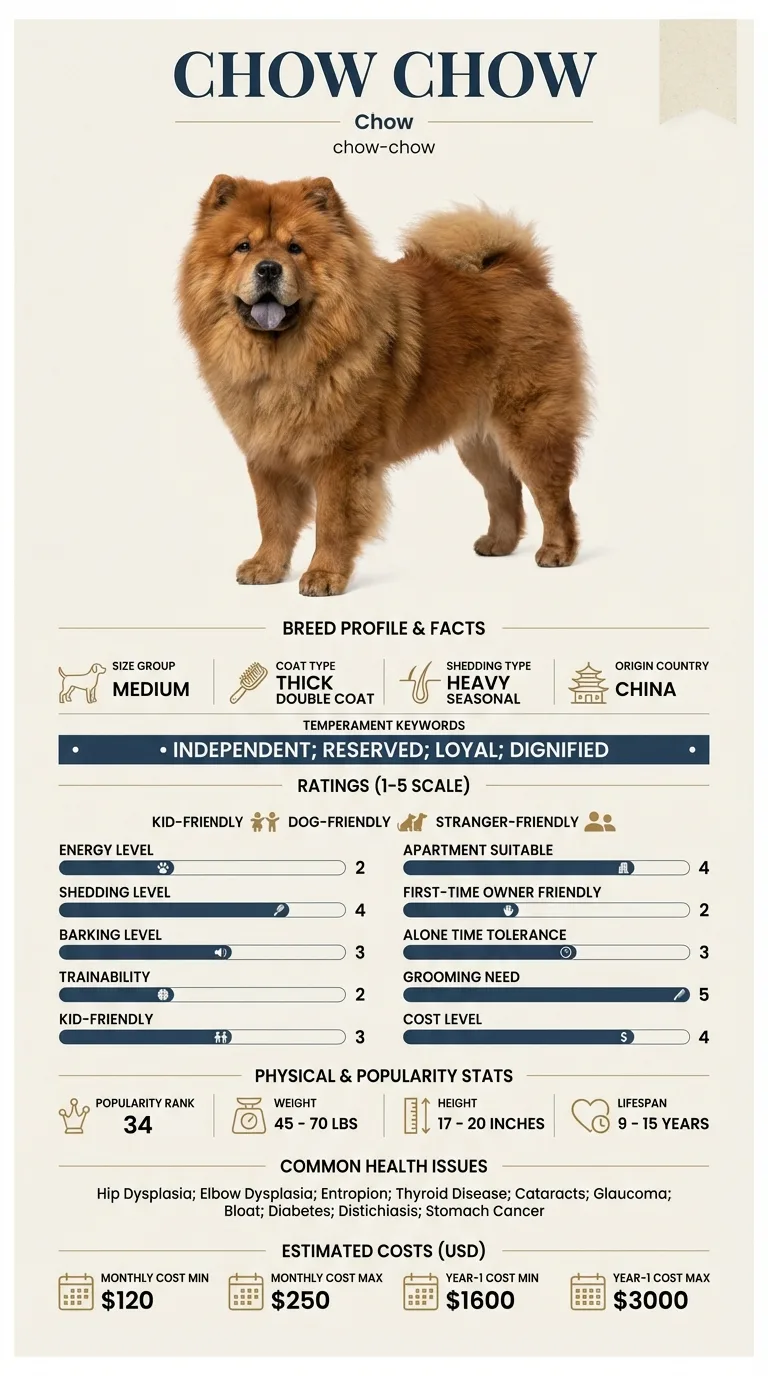
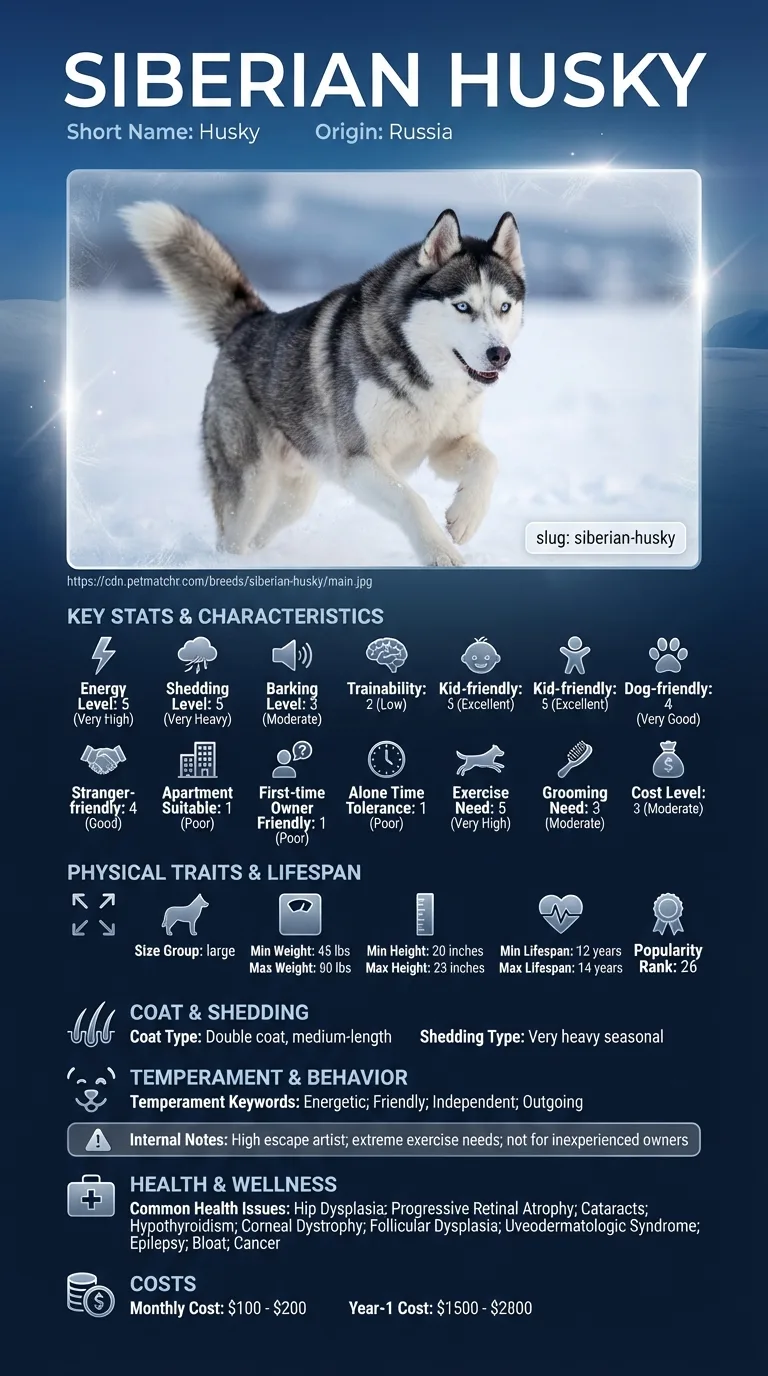
This is for someone already down to Chow Chow and Siberian Husky and deciding between them. For this pair the decision usually turns on exercise need and energy level, so those are covered first and in most detail. Anyone choosing from a flat has a clear answer here: Chow Chow rates 4/5 against 1/5. It is written for the decision rather than the breed history.
Between Chow Chow and Siberian Husky, exercise need is what separates them, and Chow Chow is the lower-effort dog of the two to keep.
Choose Chow Chow if you are in a flat or a smaller home, shedding is a problem in your house and your walking routine is modest.
Choose Siberian Husky if you do not want a standing grooming appointment, there are young children at home and you already have another dog.
| Feature | chow chow | siberian husky | Winner |
|---|---|---|---|
| Size class | medium | large | Equal |
| Weight | 45–70 lbs | 45–60 lbs | Equal |
| Height | 17–20 in | 20–23 in | Equal |
| Lifespan | 9–15 years | 12–14 years | siberian husky |
| Exercise need | Low (2/5) | Very high (5/5) | chow chow |
| Grooming need | Very high (5/5) | Moderate (3/5) | siberian husky |
| Shedding | High (4/5) | Very high (5/5) | chow chow |
| Energy level | Low (2/5) | Very high (5/5) | Equal |
| Barking | Moderate (3/5) | Moderate (3/5) | Equal |
| Apartment suitability | High (4/5) | Very low (1/5) | chow chow |
| Good for first-time owners | Low (2/5) | Very low (1/5) | chow chow |
| Tolerates being alone | Moderate (3/5) | Very low (1/5) | chow chow |
| Trainability | Low (2/5) | Low (2/5) | Equal |
| Good with kids | Moderate (3/5) | Very high (5/5) | siberian husky |
| Good with other dogs | Low (2/5) | High (4/5) | siberian husky |
| Friendly to strangers | Low (2/5) | High (4/5) | siberian husky |
| Cost level | High (4/5) | Moderate (3/5) | siberian husky |
| Coat | Thick double coat | Double coat, medium-length | Equal |
| Origin | China | Russia | Equal |
| Typical monthly cost | $120–$250 | $100–$200 | Equal |
| Typical first-year cost | $1,600–$3,000 | $1,500–$2,800 | Equal |
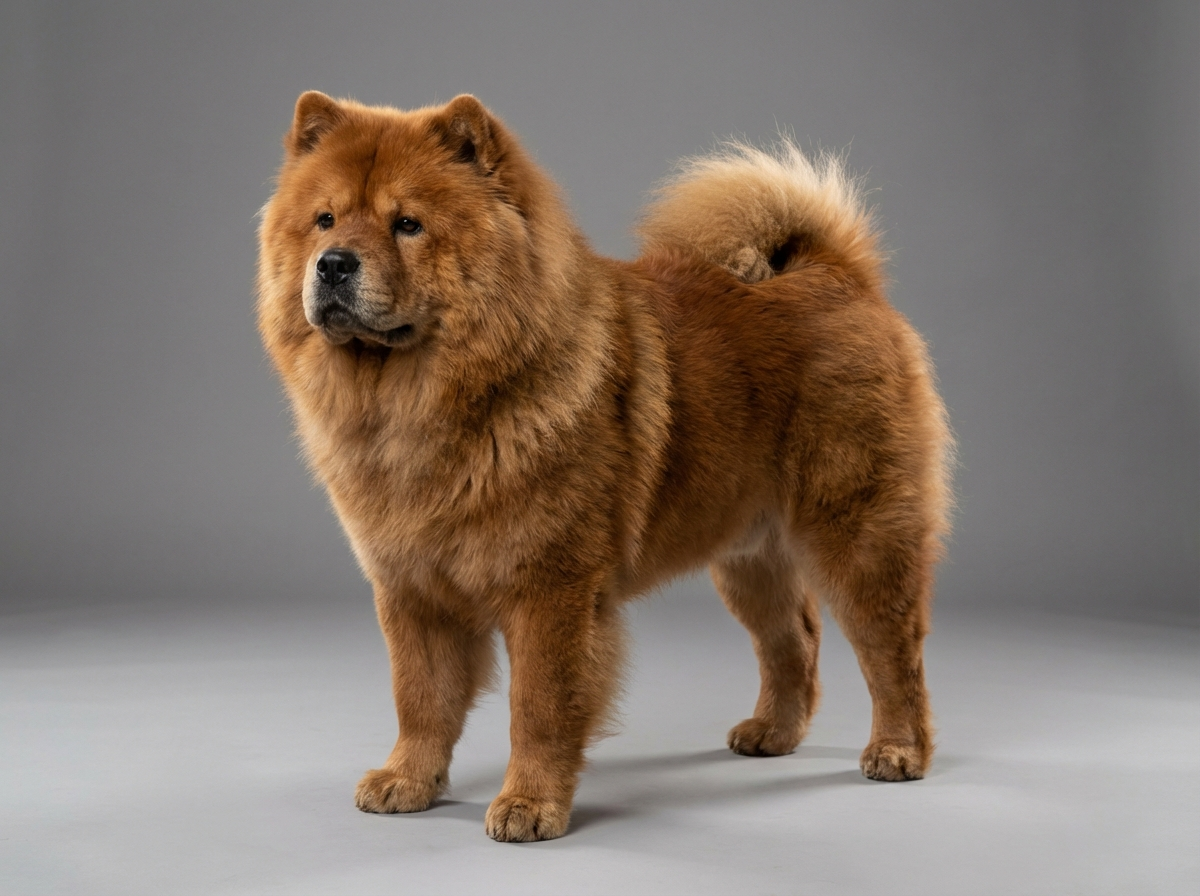
Husky stands taller (20-23 in vs the chow's 17-20) but the weight ranges nearly overlap, 45-60 lbs against the chow's 45-70. Size class still separates them -- husky large, chow medium -- mostly because of that height and the husky's leaner, more athletic frame versus the chow's stockier build. A husky in motion looks bigger than its weight suggests; a chow at rest looks bigger than its height suggests.
This is the sharpest split in the whole comparison. Husky rates very high (5/5) on exercise need -- it's a sled dog, bred to run for hours -- while the chow sits at low (2/5). A husky under-exercised becomes a problem; a chow under-exercised is just a chow. If your schedule can't support daily serious activity, the husky is the wrong dog here, regardless of anything else.
Chow needs more hands-on grooming, very high (5/5) versus the husky's moderate (3/5), but the husky actually sheds more, very high (5/5) against the chow's high (4/5). The husky's coat mostly maintains itself between blowouts, while the chow's dense coat mats and needs regular brushing even in the quiet months. When a husky does blow its coat, expect a genuinely dramatic couple of weeks of daily brushing.
Chow rates high (4/5) on apartment suitability; husky rates very low (1/5), the worst score in this data set. Barking is a tie at moderate (3/5) for both, but the husky's exercise needs and its very low (1/5) tolerance for being alone make it a poor apartment fit almost regardless of noise concerns. A house with a securely fenced yard is closer to what this breed actually needs.
Both rate low (2/5) on trainability -- neither is an easy obedience student. But first-time-owner fit tells a sharper story: chow rates low (2/5), husky rates very low (1/5), the bottom of the scale. Huskies are notorious escape artists and independent thinkers; a beginner is signing up for a steep learning curve with either breed, steeper with the husky, whose recall issues alone catch most new owners off guard.
Husky pulls ahead here -- very high (5/5) with kids against the chow's moderate (3/5), high (4/5) with other dogs against low (2/5), and high (4/5) with strangers against low (2/5). The temperament words fit: husky reads friendly and outgoing, chow reads reserved and independent. Just don't expect that sociable husky to thrive left alone in a small space, no matter how well it gets along with everyone in the room.
Husky lives a bit longer on average, 12-14 years against the chow's wider 9-15 range. The two share more health overlap than most pairings here: hip dysplasia, cataracts, and bloat risk appear on both lists, so a deep-chested-breed vet familiar with bloat symptoms is worth having either way. Husky adds epilepsy and cancer to its sheet; chow adds thyroid disease, diabetes and stomach cancer.
Husky costs a little less to keep -- cost level moderate (3/5) against the chow's high (4/5), monthly $100-200 versus $120-250, first-year $1,500-2,800 versus $1,600-3,000. That's before factoring in a husky's higher potential vet bills if its exercise needs go unmet and destructive habits set in. The chow's number is steadier and more predictable, mostly because its grooming cost doesn't fluctuate with how active you've been that week.
Chow Chow weighs 45–70 lbs and lives 9–15 years; Siberian Husky weighs 45–60 lbs and lives 12–14 years. The two diverge most on exercise need, energy level and apartment suitability and 5 other rated axes. They are level on barking and trainability, so those cannot decide it. In the table, a "winner" means easier for an ordinary household — not better. Size, coat and origin are recorded without a verdict. Because both breeds are scored the same way, the gaps are reliable even where the absolute numbers are rough.

The husky, by far -- very high (5/5) exercise need against the chow's low (2/5). Huskies were bred to pull sleds for hours; this isn't a dog you can satisfy with a short walk.
The husky, despite needing less hands-on grooming overall -- shedding rates very high (5/5) for the husky against high (4/5) for the chow. Husky grooming need is only moderate (3/5) because the coat self-maintains between seasonal blowouts.
Not really -- chow rates low (2/5), husky rates very low (1/5), the lowest score in this comparison. Huskies especially are known for escaping fenced yards and ignoring recall, which catches new owners off guard.
The chow, clearly -- high (4/5) apartment suitability against the husky's very low (1/5). The husky's exercise needs and its very low (1/5) tolerance for being left alone make small-space living genuinely difficult.
The husky -- very high (5/5) with kids and high (4/5) with strangers, against the chow's moderate (3/5) and low (2/5). Huskies are typically too friendly to be good watchdogs; chows are typically too reserved to be easy with visitors.
Yes -- hip dysplasia, cataracts, and bloat appear on both breeds' risk lists. The husky additionally carries epilepsy and cancer risk; the chow adds thyroid disease and diabetes.
The husky's range is tighter and shifted higher -- 12-14 years against the chow's 9-15. The chow can outlive a husky at the very top of its range, but its floor is also lower.
Depends entirely on activity level. An active household with a yard and time for daily exercise should look at the husky; a lower-energy household in a smaller space fits the chow better.
About $20 apart at each end -- chow runs $120-250, husky $100-200.
Husky needs very high (5/5) daily exercise; chow needs low (2/5). This is the single biggest difference between the two breeds.
The husky's range (12-14 years) is more consistent, though the chow can reach 15 years at its ceiling.
Secure checkout on Stripe. We never see your card.
7-day money-back guarantee. Instant access.
Health information here is general and is not veterinary advice. If your dog shows pain, sudden behaviour change, or worsening symptoms, consult a licensed veterinarian.
Some links on this site are affiliate links. We may earn a commission at no extra cost to you, and we only suggest products we believe are helpful for dog owners.
We research and check what we publish, but we do not warrant that any figure, date, price, or statement is accurate, complete, or current, and we accept no liability for any loss, cost, injury, or other harm arising from the use of this site. Use it as one reference among several. You remain responsible for your own decisions and for your dog's care - confirm anything that matters with a licensed veterinarian or another qualified professional before you act on it. Full disclaimer.
Match your lifestyle to the right dog.
Take quizNot sure which breed is right for you? Take our 2-minute quiz to find out.
Take the quiz