Costs
Chow Chow cost in Kansas City
About $128–$250/month, $1,650–$3,050 for year one — a genuinely average market, though the city's barbecue culture deserves real caution given this breed's diabetes risk.

See Chow Chow price across all cities →
Quick answer
Chow Chow cost in Kansas City
About $128–$250/month, $1,650–$3,050 for year one — a genuinely average market, though the city's barbecue culture deserves real caution given this breed's diabetes risk.
A Chow Chow in Kansas City costs about $128–$250 a month, with the first year around $1,650–$3,050 — a genuinely average market, in a city whose signature food culture is worth real caution with this breed.
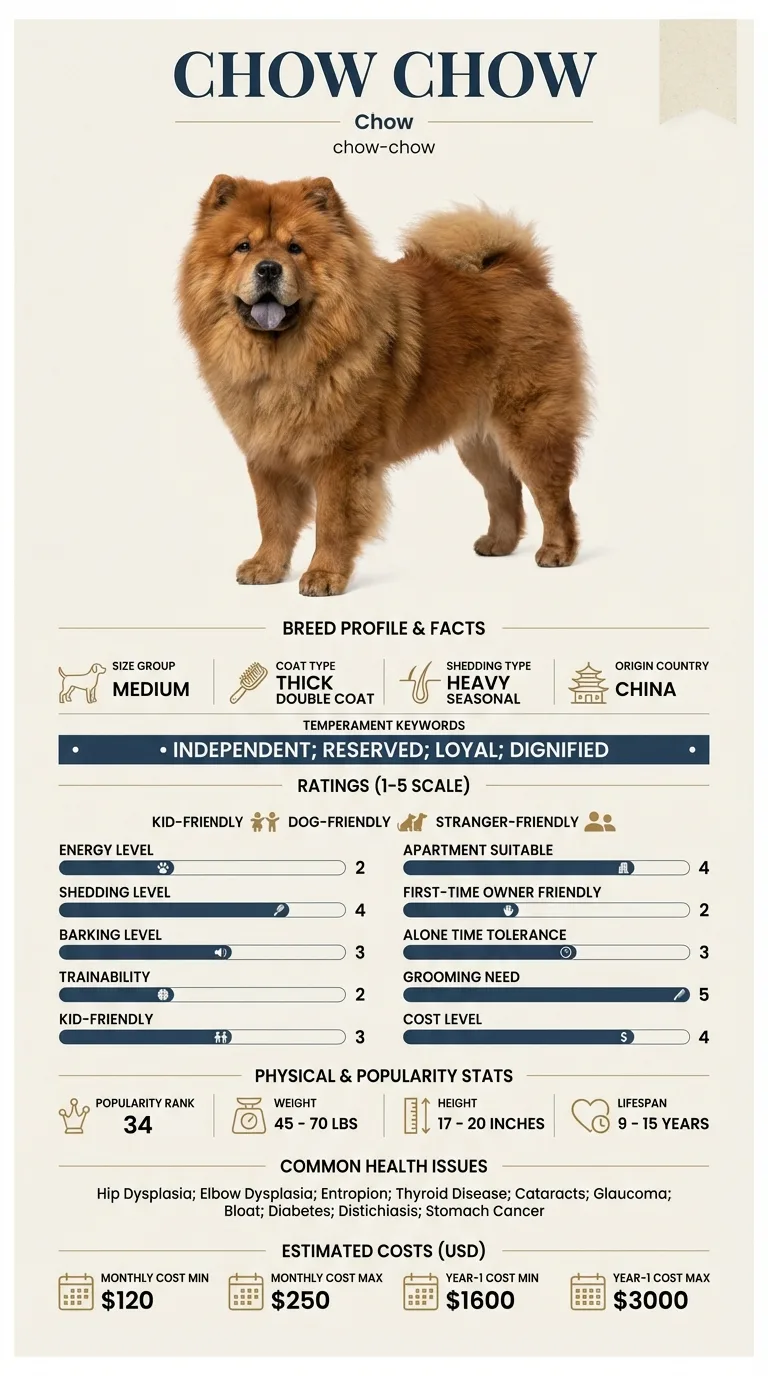
Entropion, an inward-rolling eyelid, is common enough in this breed to often require corrective surgery rather than just monitoring. Bloat is the separate, sudden emergency risk given this breed's deep chest — no warning, immediate surgery needed.
These figures reflect Kansas City's genuinely average general pricing, with a note that this breed's documented diabetes risk makes portion control worth real discipline in the city's food-heavy social culture.
Estimate · source: estimation · confidence: medium · updated 2026-09-05 · not a quote
| Item | Cost range |
|---|---|
One-time setup (initial vet visit, spay/neuter, gear) Covers the first exam, vaccinations, spay/neuter if needed, and gear sized for this breed's medium-large adult weight. | $355 - $600 |
| Item | Cost range |
|---|---|
Food Close to the national average for a medium-large breed; a consistent, portion-controlled diet matters given this breed's documented diabetes risk. | $48 - $78 |
Professional grooming (heavy double coat) This breed's dense double coat and heavy seasonal shedding make regular professional grooming a genuinely common cost. | $55 - $110 |
Flea & tick prevention Clearly seasonal given the metro's real four-season Midwest climate. | $9 - $18 |
Each range starts from a national baseline for this breed's size class and is then adjusted for local cost of living and veterinary pricing. The baselines, and the source each one came from, are listed on our sources page (dataset 2026.09). Two inputs, the purchase price and the emergency reserve, have no published national figure we could verify, so we leave them to you rather than invent them.
These are planning estimates, not quotes. Your own numbers will move with the individual dog, your vet and your insurer. Build a budget with your own figures.
For a Chow Chow in Kansas City, insurance is worth taking seriously given the breed's documented entropion, bloat and diabetes risk, independent of the metro's genuinely average general pricing.
This breed's well-documented entropion, bloat and diabetes risk make insurance worth locking in early — a policy bought before any diagnosis covers costs a self-funded emergency fund alone often can't stretch to match.
For owners who'd rather self-insure, the key is having the reserve actually set aside and untouched — not just a hypothetical willingness to cover a bill if one comes up.
Kansas City already offers a genuinely average cost base for this breed; the real, non-negotiable discipline here is resisting the local barbecue-sharing culture.
Kansas City's identity runs deep on barbecue, and the culture of sharing fatty brisket ends, rib trimmings and rich sides with a begging dog at a backyard cookout is genuinely common here. For most breeds, an occasional indulgence is a minor issue. For this breed specifically, with its documented elevated diabetes risk, regular fatty treats are a real, cumulative health concern worth taking more seriously than the casual local food culture might suggest.
A consistent, portion-controlled diet and genuinely occasional, vet-approved treats matter more here than in a city with less of a shared-food culture built around grilling and smoking.
Outside of that specific dietary consideration, Kansas City is otherwise a genuinely average-cost Midwest metro across nearly every category this site tracks, and the region's real four-season winters suit this breed's coat comfortably.

A Kansas City Chow Chow owner had gotten into the habit of sharing brisket trimmings with their dog at nearly every summer cookout, not realizing how much it added up over a season. A routine vet visit flagged early signs of insulin resistance, and the family switched to a strict no-table-scraps policy, with the dog's follow-up bloodwork improving significantly within months of the change.
Key takeaway: In a barbecue-centric city like Kansas City specifically, this breed's documented diabetes risk makes the local food-sharing culture worth resisting more deliberately than most owners initially realize.
About $128–$250, close to the national average, consistent with Kansas City's genuinely middle-of-the-road cost profile.
Roughly $1,650–$3,050, including the initial vet exam, spay/neuter if needed, and gear on top of ongoing monthly costs.
Genuinely worth caution — this breed carries a documented elevated diabetes risk, and the local culture of sharing fatty barbecue scraps with a begging dog is a real, cumulative health concern worth resisting more than the casual local norm suggests.
Genuinely average — Kansas City is a middle-of-the-road Midwest metro across nearly every category this site tracks, without a single dramatic factor pushing prices sharply in either direction.
Worth pricing out given the breed's documented entropion, bloat and diabetes risk, bought while the dog is young and before anything is on record.
Around $750 covers a typical significant vet visit in this market, reflecting Kansas City's near-national-average general pricing.
About $128–$250/month, $1,650–$3,050 for year one — a genuinely average market, though the city's barbecue culture deserves real caution given this breed's diabetes risk.
This guide is not medical advice. If your dog shows pain, sudden behavior change, or worsening symptoms, consult a licensed veterinarian.
Some links may be affiliate links. We may earn a commission at no extra cost to you. We only suggest products we believe are helpful for dog owners.
We research and check what we publish, but we do not warrant that any figure, date, price, or statement is accurate, complete, or current, and we accept no liability for any loss, cost, injury, or other harm arising from the use of this site. Use it as one reference among several. You remain responsible for your own decisions and for your dog's care - confirm anything that matters with a licensed veterinarian or another qualified professional before you act on it. Full disclaimer.
One sheet with every line item, the emergency fund and when insurance pays off - unlocks on this page.
You get: 12-month budget sheet
No spam. One-click unsubscribe. See our privacy policy.
Preview page 1 before you decide.