Living
Which is the better overall pick?
If you're an experienced owner with room to run a versatile hunting dog, the GWP delivers. Otherwise the Boston's low exercise and space needs make it the more forgiving choice.

Quick answer
Which is the better overall pick?
If you're an experienced owner with room to run a versatile hunting dog, the GWP delivers. Otherwise the Boston's low exercise and space needs make it the more forgiving choice.
Boston Terrier or German Wirehaired Pointer? On paper they differ most on apartment suitability, and on the scales German Wirehaired Pointer is the heavier at 60–70 lbs. Here is how the two compare on everything that shapes an ordinary week.
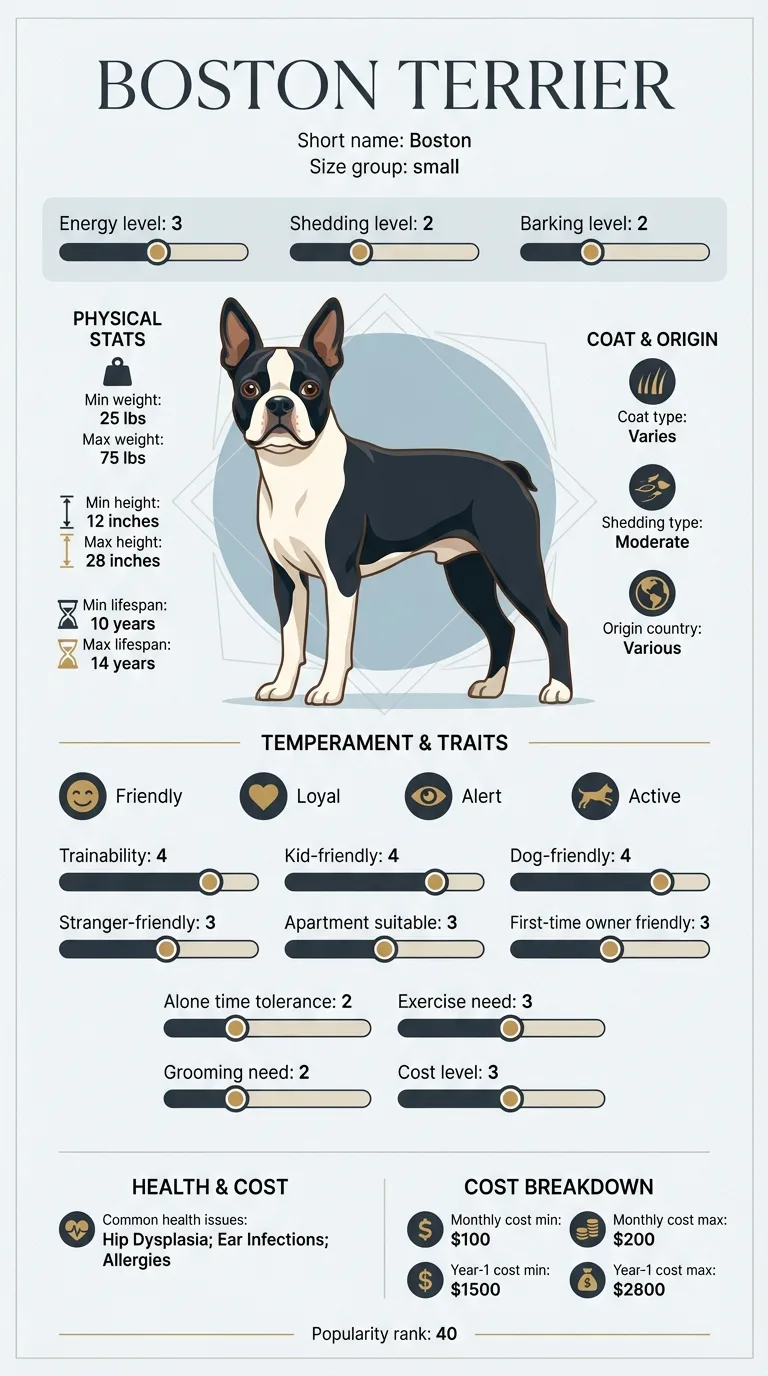
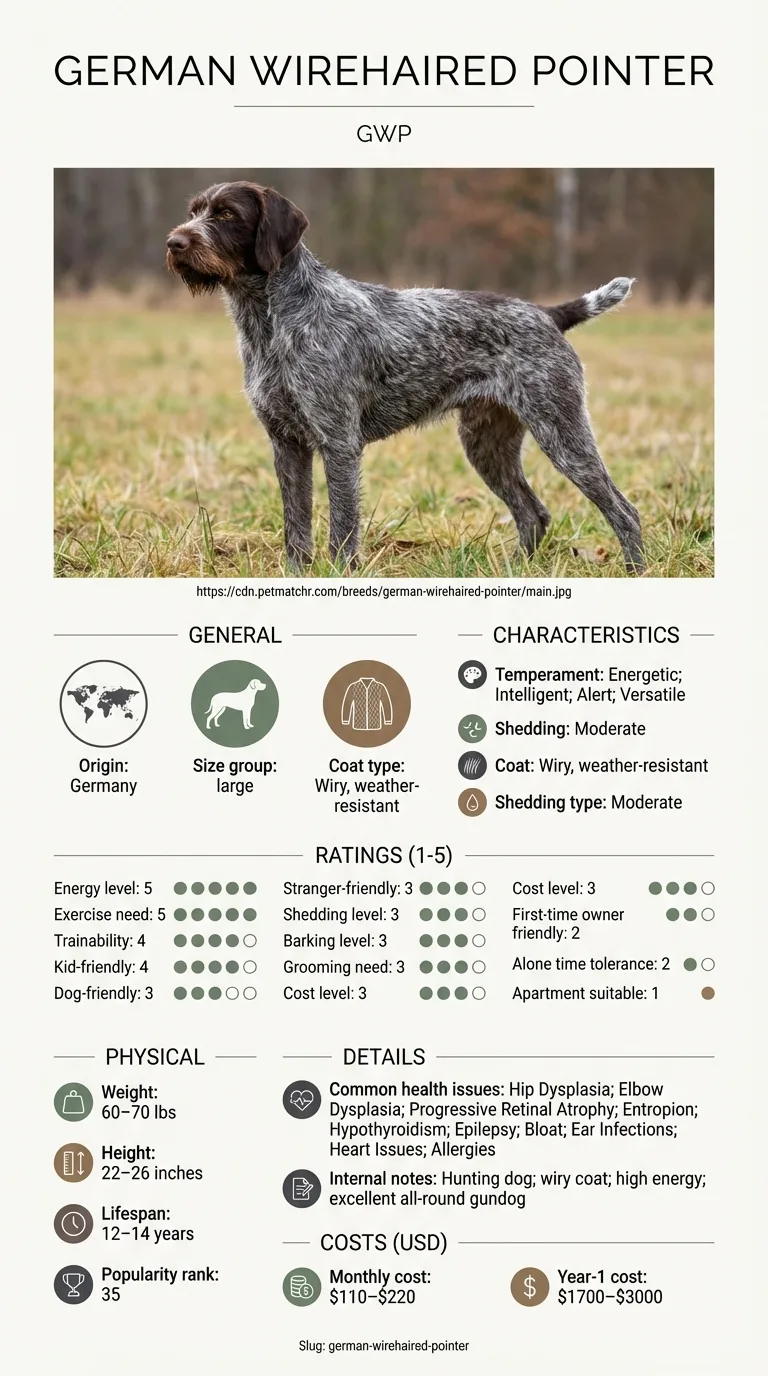
This is for someone already down to Boston Terrier and German Wirehaired Pointer and deciding between them. For this pair the decision usually turns on apartment suitability and exercise need, so those are covered first and in most detail. Anyone choosing from a flat has a clear answer here: Boston Terrier rates 5/5 against 1/5. There is no origin story here — only what changes about your week.
Between Boston Terrier and German Wirehaired Pointer, apartment suitability is what separates them, and Boston Terrier is the lower-effort dog of the two to keep.
Choose Boston Terrier if you are in a flat or a smaller home, this is your first dog and you do not want a standing grooming appointment.
Choose German Wirehaired Pointer if you want a dog that can keep up with an active routine and you want a dog that is more watchful with visitors.
| Feature | boston terrier | german wirehaired pointer | Winner |
|---|---|---|---|
| Size class | small | large | Equal |
| Weight | 12–25 lbs | 60–70 lbs | Equal |
| Height | 15–17 in | 22–26 in | Equal |
| Lifespan | 11–13 years | 12–14 years | german wirehaired pointer |
| Exercise need | Low (2/5) | Very high (5/5) | boston terrier |
| Grooming need | Very low (1/5) | Moderate (3/5) | boston terrier |
| Shedding | Low (2/5) | Moderate (3/5) | boston terrier |
| Energy level | Moderate (3/5) | Very high (5/5) | Equal |
| Barking | Low (2/5) | Moderate (3/5) | boston terrier |
| Apartment suitability | Very high (5/5) | Very low (1/5) | boston terrier |
| Good for first-time owners | Very high (5/5) | Low (2/5) | boston terrier |
| Tolerates being alone | Moderate (3/5) | Low (2/5) | boston terrier |
| Trainability | High (4/5) | High (4/5) | Equal |
| Good with kids | Very high (5/5) | High (4/5) | boston terrier |
| Good with other dogs | High (4/5) | Moderate (3/5) | boston terrier |
| Friendly to strangers | High (4/5) | Moderate (3/5) | boston terrier |
| Cost level | Moderate (3/5) | Moderate (3/5) | Equal |
| Coat | Short and smooth | Wiry, weather-resistant | Equal |
| Origin | Various | Germany | Equal |
| Typical monthly cost | $80–$150 | $110–$220 | Equal |
| Typical first-year cost | $1,100–$2,300 | $1,700–$3,000 | Equal |
The Boston weighs 12-25 lbs and stands 15-17 inches; the GWP weighs 60-70 lbs and stands 22-26 inches, a size difference measured in multiples, not increments. The GWP's frame is built for rough terrain and cold water work, with a heavier, more rugged structure than its shorthaired cousin, while the Boston stays compact and light throughout.
Exercise need rates very high (5/5) for the GWP against low (2/5) for the Boston, and energy level splits the same way, very high versus moderate. The GWP was bred as an all-around hunting dog for tracking, pointing, and retrieving in difficult conditions, and that drive needs a genuine outlet, a bored GWP is a handful in ways a bored Boston simply isn't.
The GWP's wiry, weather-resistant coat needs moderate upkeep (3/5) including occasional hand-stripping, versus the Boston's very low 1/5. Shedding leans moderate for the GWP and low for the Boston. Owners who show or hunt with a GWP often hand-strip the coat a couple of times a year to maintain its texture, a step the Boston's coat never requires.
The Boston rates 5/5 for apartment living; the GWP rates a very low 1/5, tied for the bottom of the scale. Both breeds bark low to moderate (2/5 and 3/5), so it's not a noise problem, it's that a GWP's exercise and space needs are simply incompatible with small-unit living in most cases, regardless of how quiet it is once it's tired.
Trainability ties at high (4/5) for both breeds, which is unusual for this kind of size mismatch. But first-time-owner suitability doesn't tie, very high (5/5) for the Boston, low (2/5) for the GWP. Matched trainability doesn't offset the GWP's exercise and space demands for someone without prior experience managing a large, driven working breed, and that gap is worth weighing seriously before bringing one home as a first dog.
The Boston edges the GWP with kids (5/5 vs 4/5), other dogs (4/5 vs 3/5), and strangers (4/5 vs 3/5), a consistent, if modest, lead across the board. Temperament lists diverge in purpose rather than friendliness: the Boston is friendly, lively, comical, adaptable, while the GWP is energetic, intelligent, alert, versatile, a dog built to work rather than to lounge.
The GWP actually outlives the Boston here, 12-14 years versus 11-13. Its health list runs ten conditions, though, hip and elbow dysplasia, progressive retinal atrophy, entropion, hypothyroidism, epilepsy, bloat, and more, against the Boston's five, which stay concentrated on its flat face and eyes. Longer life doesn't mean fewer things to watch for with this breed.
Both breeds land at a moderate 3/5 for overall cost, with monthly ranges close, $80-$150 for the Boston, $110-$220 for the GWP, and first-year totals of $1,100-$2,300 versus $1,700-$3,000. Given the GWP's longer health list and bigger size, expect food and potential vet costs to run higher over the dog's life than the sticker numbers alone imply.
Boston Terrier weighs 12–25 lbs and lives 11–13 years; German Wirehaired Pointer weighs 60–70 lbs and lives 12–14 years. The two diverge most on apartment suitability, exercise need and good for first-time owners and 2 other rated axes. They are level on cost level and trainability, so those cannot decide it. Where the table declares a winner it means less work for the owner, nothing more; descriptive rows are left as ties on purpose. The value here is in the differences between the two columns; treat any single score as approximate.

Considerably, 60-70 lbs versus 12-25 lbs, and 22-26 inches tall versus 15-17. The GWP can outweigh a Boston by close to five times.
Moderately, with a 3/5 grooming need for its wiry coat versus the Boston's 1/5. Occasional hand-stripping keeps the texture right, something the Boston's coat never needs.
No, it rates very low (1/5), the bottom of the scale, against the Boston's 5/5. Its exercise needs make small-space living a poor fit regardless of noise level.
It's rated low (2/5) for first-time owners versus very high (5/5) for the Boston, even though both breeds train equally well (4/5). Exercise and space demands are the deciding factor, not trainability.
The GWP, slightly, 12-14 years versus 11-13 for the Boston.
The GWP's list is longer, at ten conditions including hip and elbow dysplasia and bloat, versus five for the Boston concentrated on its face and eyes.
If you're an experienced owner with room to run a versatile hunting dog, the GWP delivers. Otherwise the Boston's low exercise and space needs make it the more forgiving choice.
$80-$150 for the Boston, $110-$220 for the GWP, both moderate.
Very high, 5/5. It's an all-around hunting breed built for sustained outdoor work.
The GWP, by about a year, 12-14 years versus 11-13 for the Boston.
Secure checkout on Stripe. We never see your card.
7-day money-back guarantee. Instant access.
Health information here is general and is not veterinary advice. If your dog shows pain, sudden behaviour change, or worsening symptoms, consult a licensed veterinarian.
Some links on this site are affiliate links. We may earn a commission at no extra cost to you, and we only suggest products we believe are helpful for dog owners.
We research and check what we publish, but we do not warrant that any figure, date, price, or statement is accurate, complete, or current, and we accept no liability for any loss, cost, injury, or other harm arising from the use of this site. Use it as one reference among several. You remain responsible for your own decisions and for your dog's care - confirm anything that matters with a licensed veterinarian or another qualified professional before you act on it. Full disclaimer.
Match your lifestyle to the right dog.
Take quizNot sure which breed is right for you? Take our 2-minute quiz to find out.
Take the quiz