Behavior
Bloodhound or German Shorthaired Pointer overall?
Pick the GSP if you can commit to daily hard exercise and want a highly trainable dog; pick the Bloodhound if you want a calmer, nose-driven companion and can tolerate its stubborn streak.

Quick answer
Bloodhound or German Shorthaired Pointer overall?
Pick the GSP if you can commit to daily hard exercise and want a highly trainable dog; pick the Bloodhound if you want a calmer, nose-driven companion and can tolerate its stubborn streak.
Bloodhound or German Shorthaired Pointer? On paper they differ most on trainability, and on the scales Bloodhound is the heavier at 90–110 lbs. Here is how the two compare on everything that shapes an ordinary week.
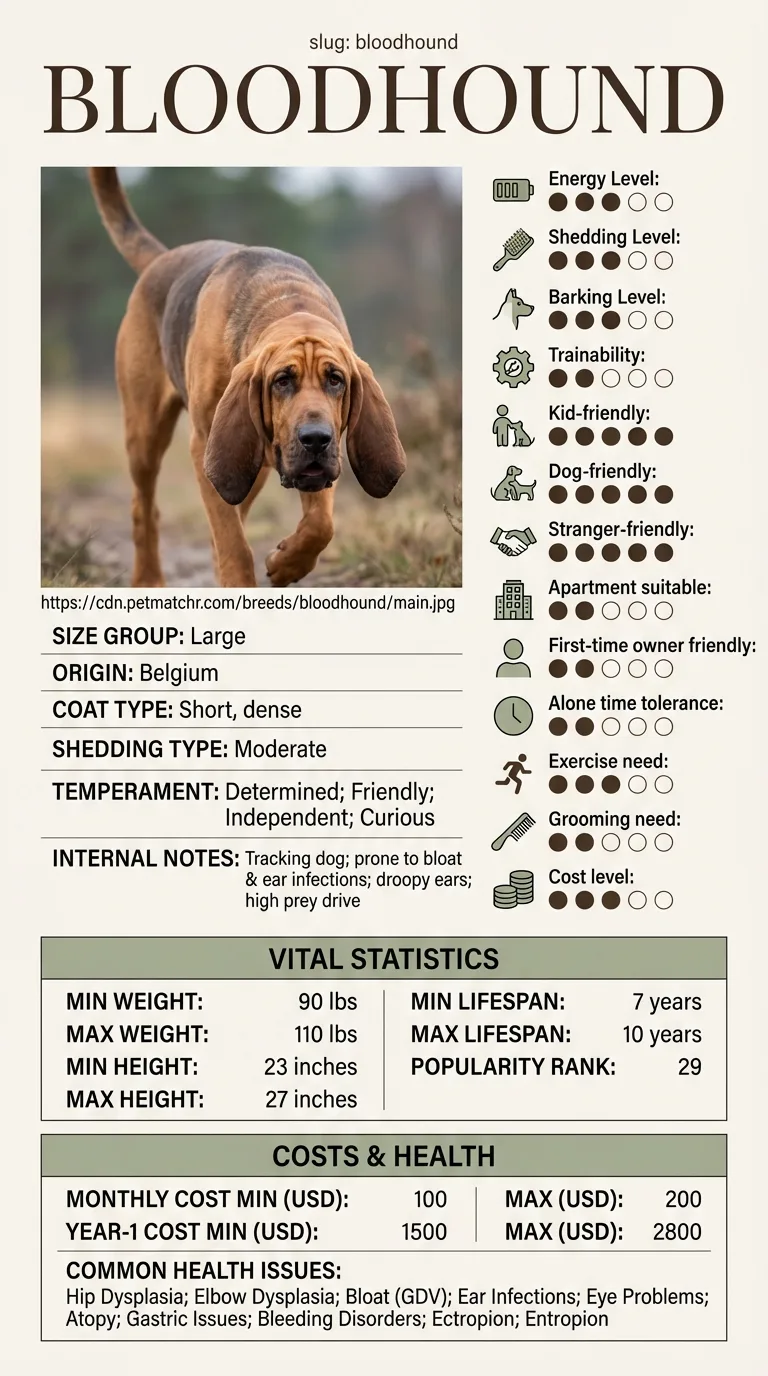
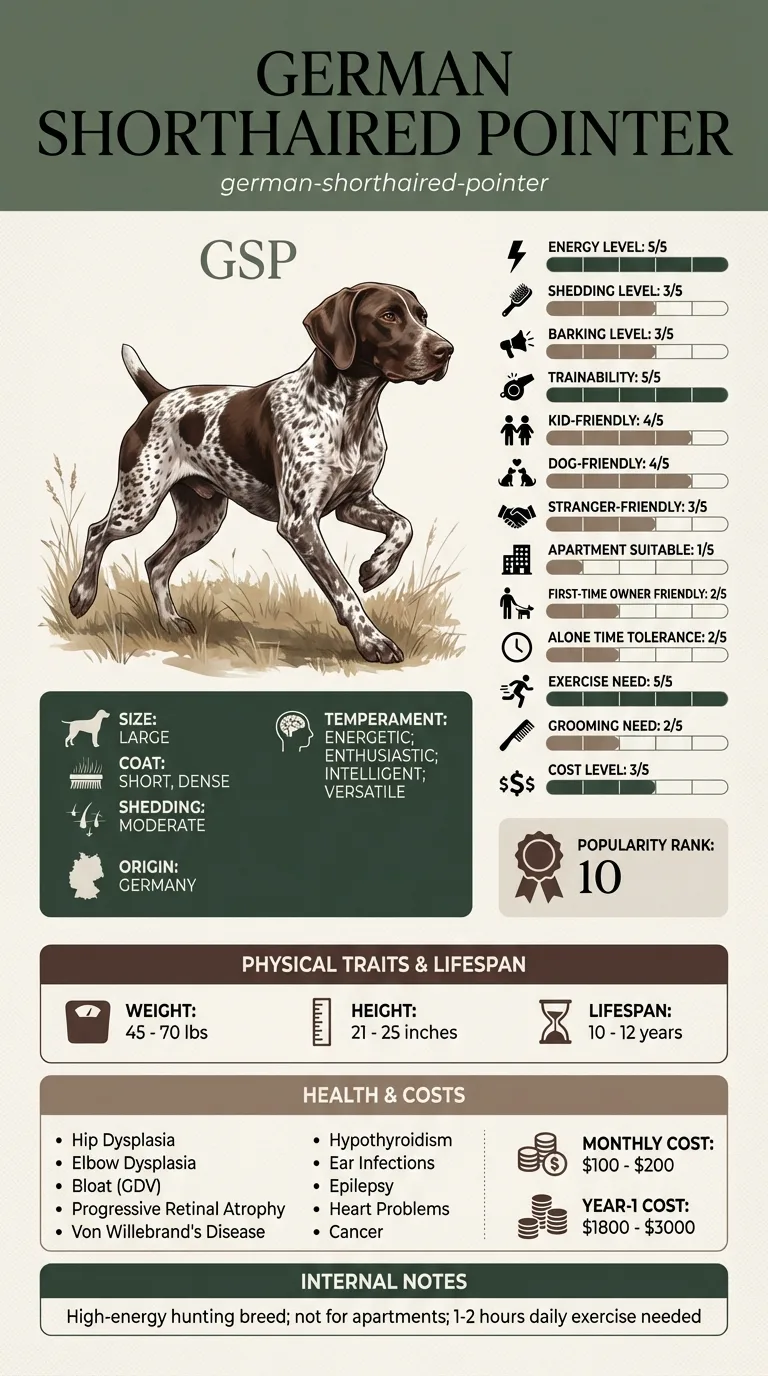
This is for someone already down to Bloodhound and German Shorthaired Pointer and deciding between them. For this pair the decision usually turns on trainability and exercise need, so those are covered first and in most detail. Anyone choosing from a flat has a clear answer here: Bloodhound rates 2/5 against 1/5. There is no origin story here — only what changes about your week.
Between Bloodhound and German Shorthaired Pointer, trainability is what separates them, and Bloodhound is the lower-effort dog of the two to keep.
Choose Bloodhound if your walking routine is modest.
Choose German Shorthaired Pointer if you want a dog that picks up training quickly, a smaller dog suits your car, your home or your back and you want a dog that can keep up with an active routine.
| Feature | bloodhound | german shorthaired pointer | Winner |
|---|---|---|---|
| Size class | large | large | Equal |
| Weight | 90–110 lbs | 45–70 lbs | Equal |
| Height | 23–27 in | 21–25 in | Equal |
| Lifespan | 7–10 years | 10–12 years | german shorthaired pointer |
| Exercise need | Moderate (3/5) | Very high (5/5) | bloodhound |
| Grooming need | Low (2/5) | Low (2/5) | Equal |
| Shedding | Moderate (3/5) | Moderate (3/5) | Equal |
| Energy level | Moderate (3/5) | Very high (5/5) | Equal |
| Barking | Moderate (3/5) | Moderate (3/5) | Equal |
| Apartment suitability | Low (2/5) | Very low (1/5) | bloodhound |
| Good for first-time owners | Low (2/5) | Low (2/5) | Equal |
| Tolerates being alone | Low (2/5) | Low (2/5) | Equal |
| Trainability | Low (2/5) | Very high (5/5) | german shorthaired pointer |
| Good with kids | High (4/5) | High (4/5) | Equal |
| Good with other dogs | High (4/5) | High (4/5) | Equal |
| Friendly to strangers | High (4/5) | Moderate (3/5) | bloodhound |
| Cost level | Moderate (3/5) | Moderate (3/5) | Equal |
| Coat | Short, dense | Short, dense | Equal |
| Origin | Belgium | Germany | Equal |
| Typical monthly cost | $100–$200 | $100–$200 | Equal |
| Typical first-year cost | $1,500–$2,800 | $1,800–$3,000 | Equal |
A full-grown Bloodhound can weigh nearly double a German Shorthaired Pointer - 90 to 110 lbs against 45 to 70 lbs - even though the height gap is only a couple of inches (23-27 in versus 21-25 in). That extra mass is mostly loose skin, bone and a deep chest built for endurance tracking, not speed. The GSP carries its weight lean and athletic, built more like a runner than a hauler. If floor space and furniture durability matter, plan around the Bloodhound's bulk more than its height.
The GSP rates a 5 out of 5 for exercise need; the Bloodhound sits at a 3. That's not a small gap - GSPs were bred to hunt birds across open ground for hours and get destructive without a serious daily outlet. A Bloodhound still needs real walks, but its drive channels into nose-down tracking rather than nonstop running. Give the GSP fewer than 60-90 minutes of hard activity a day and expect problems; the Bloodhound is more forgiving, though still not a couch dog.
Both breeds keep grooming simple: short, dense coats and a 2 out of 5 grooming score apiece. Shedding lands at a matching moderate 3 out of 5 for both, so weekly brushing handles loose hair on either dog without a trip to a professional groomer. There's no real winner here - whichever breed you pick, you're looking at the same basic coat-care routine and a similar amount of hair on the couch.
Neither dog is an apartment natural. The Bloodhound scores low (2/5) on apartment suitability; the GSP scores even lower, a 1 out of 5 - its exercise needs alone make small spaces a poor match. Barking sits at a moderate 3/5 for both, so noise complaints aren't the main issue; space and energy burn are. Both also tolerate being alone poorly (2/5), so plan on companionship or a dog walker either way.
Trainability is where these two split hard: the GSP rates 5/5, the Bloodhound just 2/5. A Bloodhound's nose can override any command once it locks onto a scent, and its independent streak makes recall unreliable without serious work. The GSP is sharp and eager to please but channels that intelligence into non-stop activity, which trips up owners who aren't ready for it. Both land at 2/5 for first-time owners - for different reasons.
With kids, the two are evenly matched at 4/5, and both score 4/5 with other dogs. The gap shows up with strangers: the Bloodhound rates 4/5 friendliness to new people, the GSP a more reserved 3/5. If you host often or live somewhere with regular foot traffic, that difference in how each dog greets an unfamiliar face is worth weighing alongside the size of your yard.
The GSP typically lives 10 to 12 years; the Bloodhound's range runs shorter, 7 to 10. Both share hip dysplasia, elbow dysplasia, bloat and ear infections as risks. Past that overlap, their profiles diverge - the Bloodhound also faces eye problems, atopy, gastric issues, bleeding disorders, ectropion and entropion, while the GSP's list adds progressive retinal atrophy, von Willebrand's disease, hypothyroidism, epilepsy, heart problems and cancer. Neither is a low-maintenance breed medically.
Monthly costs land in the same $100-200 band for both breeds, and both carry a moderate 3/5 cost rating. First-year costs diverge slightly: $1,500-2,800 for the Bloodhound versus $1,800-3,000 for the GSP, largely reflecting the GSP's higher activity-related expenses like training classes and gear. Budget-wise, there's not much daylight between them once you're past the first year, though the GSP's early costs run a bit higher if you invest in structured training or hunting gear.
Bloodhound weighs 90–110 lbs and lives 7–10 years; German Shorthaired Pointer weighs 45–70 lbs and lives 10–12 years. The two diverge most on trainability, exercise need and energy level. They are level on tolerates being alone, barking and cost level, so those cannot decide it. Where the table declares a winner it means less work for the owner, nothing more; descriptive rows are left as ties on purpose. The value here is in the differences between the two columns; treat any single score as approximate.

Considerably. A Bloodhound can weigh up to 110 lbs, roughly 40-65 lbs more than a GSP's 45-70 lb range, despite standing only a couple inches taller at the shoulder. The Bloodhound's frame is heavier and looser-skinned; the GSP is lean muscle.
Neither has an edge - both rate a moderate 3 out of 5 for shedding and score identically low (2/5) on grooming demands. Expect similar amounts of loose hair and a similar weekly brushing routine with either breed.
Not really - both score a low 2 out of 5 for first-time owner suitability, though for different reasons. The Bloodhound's independence and scent-driven focus make training difficult, while the GSP's very high exercise and trainability needs demand an owner ready to keep pace daily.
Barely, and the GSP is worse off. It scores just 1 out of 5 for apartment suitability against the Bloodhound's still-low 2 out of 5. Both need more room and outdoor time than a typical apartment provides.
Both fall in the same $100-200 monthly range, with a moderate 3/5 cost rating each. First-year costs are close too - $1,500-2,800 for the Bloodhound and $1,800-3,000 for the GSP.
Yes - hip dysplasia, elbow dysplasia, bloat and ear infections show up on both lists. Beyond that they split: the Bloodhound is more prone to eye and skin issues, the GSP to heart problems, epilepsy and cancer.
The GSP, by a couple of years on average - its lifespan runs 10 to 12 years compared to the Bloodhound's 7 to 10. That gap is worth factoring in if longevity matters to your decision.
Pick the GSP if you can commit to daily hard exercise and want a highly trainable dog; pick the Bloodhound if you want a calmer, nose-driven companion and can tolerate its stubborn streak.
Essentially none - both typically run $100-200 a month to keep.
The GSP by a wide margin, rating 5/5 versus the Bloodhound's 3/5.
The German Shorthaired Pointer, at 10-12 years versus the Bloodhound's 7-10.
Secure checkout on Stripe. We never see your card.
7-day money-back guarantee. Instant access.
Health information here is general and is not veterinary advice. If your dog shows pain, sudden behaviour change, or worsening symptoms, consult a licensed veterinarian.
Some links on this site are affiliate links. We may earn a commission at no extra cost to you, and we only suggest products we believe are helpful for dog owners.
We research and check what we publish, but we do not warrant that any figure, date, price, or statement is accurate, complete, or current, and we accept no liability for any loss, cost, injury, or other harm arising from the use of this site. Use it as one reference among several. You remain responsible for your own decisions and for your dog's care - confirm anything that matters with a licensed veterinarian or another qualified professional before you act on it. Full disclaimer.
Match your lifestyle to the right dog.
Take quizNot sure which breed is right for you? Take our 2-minute quiz to find out.
Take the quiz