Living
Bloodhound or Border Collie for a first-time owner?
Neither is ideal, but the Bloodhound edges slightly ahead at 2/5 versus the Border Collie's 1/5.

Quick answer
Bloodhound or Border Collie for a first-time owner?
Neither is ideal, but the Bloodhound edges slightly ahead at 2/5 versus the Border Collie's 1/5.
Bloodhound or Border Collie? On paper they differ most on trainability, and on the scales Bloodhound is the heavier at 90–110 lbs. Here is how the two compare on everything that shapes an ordinary week.
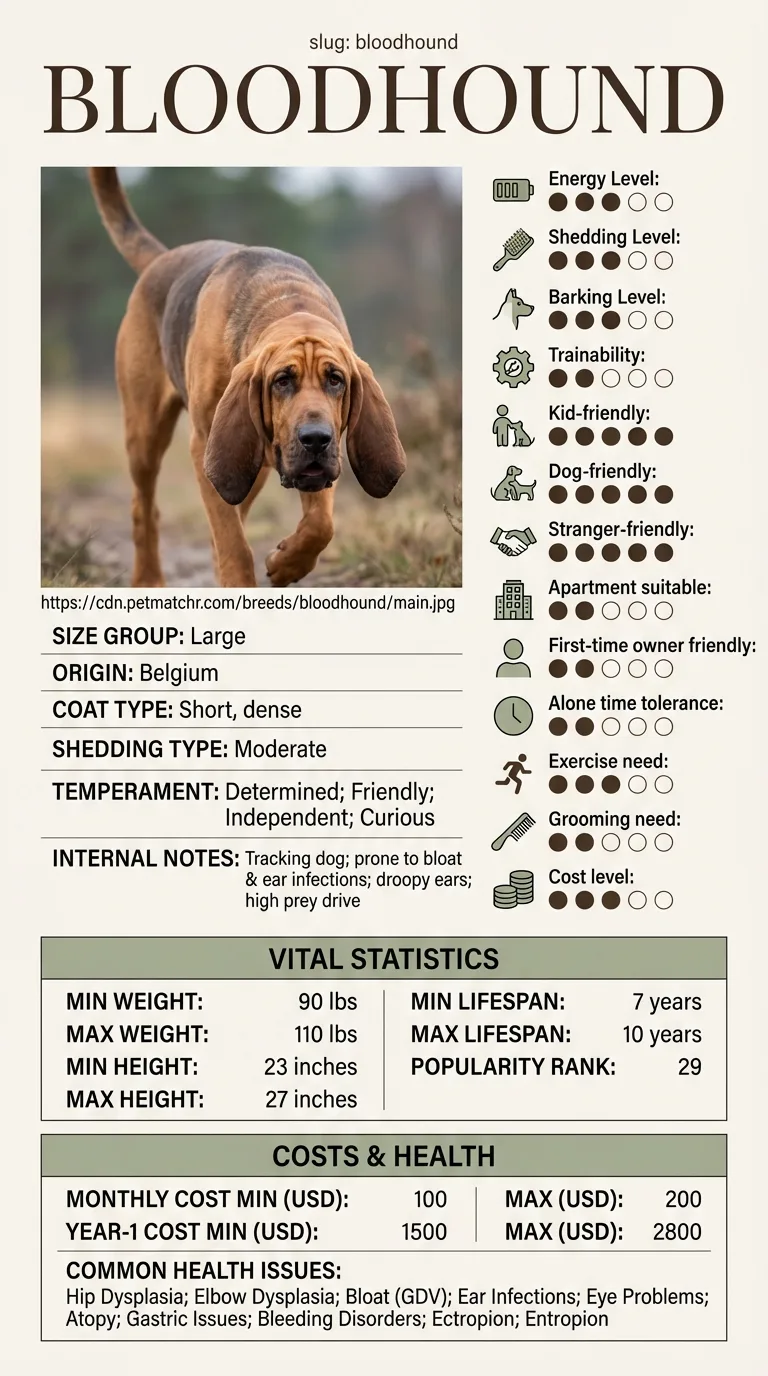
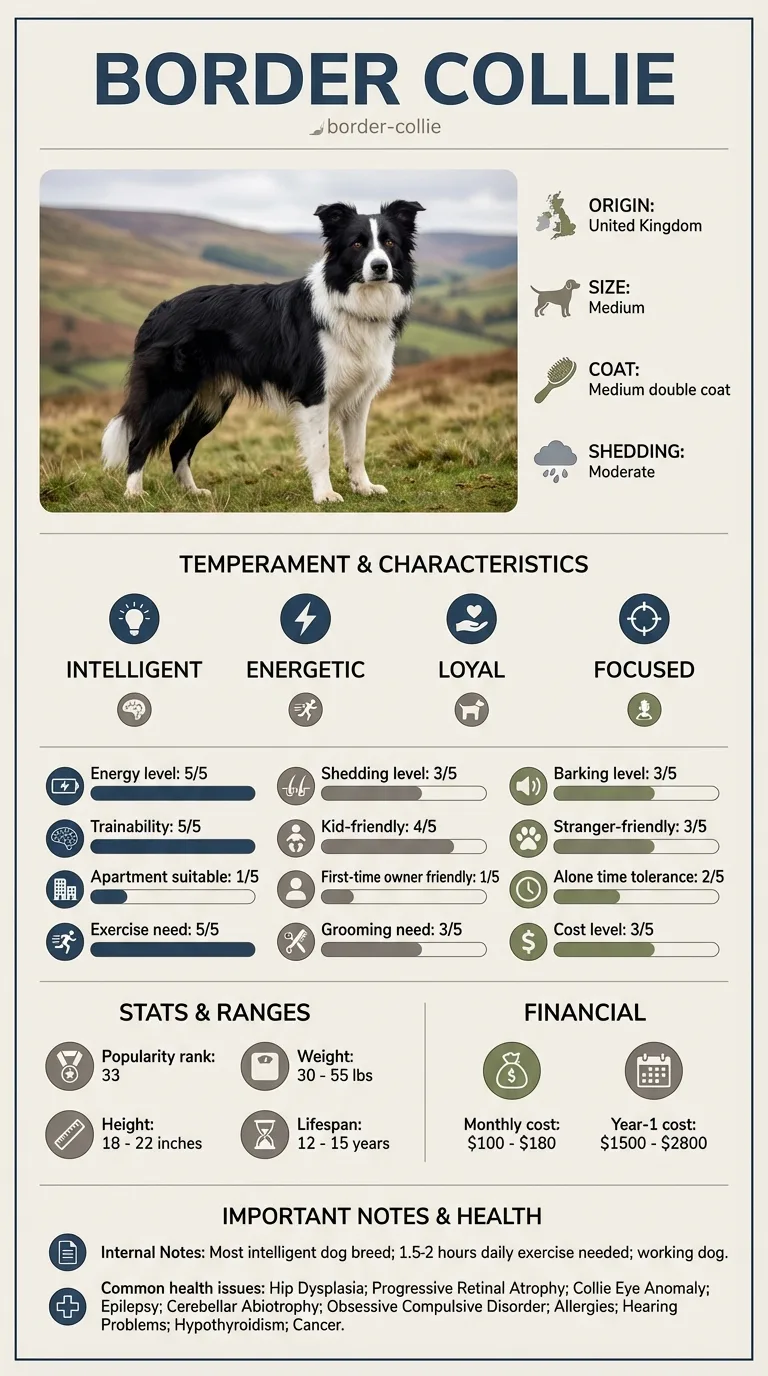
This is for someone already down to Bloodhound and Border Collie and deciding between them. For this pair the decision usually turns on trainability and exercise need, so those are covered first and in most detail. Anyone choosing from a flat has a clear answer here: Bloodhound rates 2/5 against 1/5. Breed history is left out; what follows is what you will actually live with.
Between Bloodhound and Border Collie, trainability is what separates them, and Bloodhound is the lower-effort dog of the two to keep.
Choose Bloodhound if you do not want a standing grooming appointment and your walking routine is modest.
Choose Border Collie if you want a dog that picks up training quickly, a smaller dog suits your car, your home or your back and you want a dog that can keep up with an active routine.
| Feature | bloodhound | border collie | Winner |
|---|---|---|---|
| Size class | large | medium | Equal |
| Weight | 90–110 lbs | 30–55 lbs | Equal |
| Height | 23–27 in | 18–22 in | Equal |
| Lifespan | 7–10 years | 12–15 years | border collie |
| Exercise need | Moderate (3/5) | Very high (5/5) | bloodhound |
| Grooming need | Low (2/5) | Moderate (3/5) | bloodhound |
| Shedding | Moderate (3/5) | Moderate (3/5) | Equal |
| Energy level | Moderate (3/5) | Very high (5/5) | Equal |
| Barking | Moderate (3/5) | Moderate (3/5) | Equal |
| Apartment suitability | Low (2/5) | Very low (1/5) | bloodhound |
| Good for first-time owners | Low (2/5) | Very low (1/5) | bloodhound |
| Tolerates being alone | Low (2/5) | Low (2/5) | Equal |
| Trainability | Low (2/5) | Very high (5/5) | border collie |
| Good with kids | High (4/5) | High (4/5) | Equal |
| Good with other dogs | High (4/5) | High (4/5) | Equal |
| Friendly to strangers | High (4/5) | Moderate (3/5) | bloodhound |
| Cost level | Moderate (3/5) | Moderate (3/5) | Equal |
| Coat | Short, dense | Medium double coat | Equal |
| Origin | Belgium | United Kingdom | Equal |
| Typical monthly cost | $100–$200 | $100–$180 | Equal |
| Typical first-year cost | $1,500–$2,800 | $1,500–$2,800 | Equal |
A Bloodhound at 90-110 lbs and 23-27 inches dwarfs a Border Collie's 30-55 lbs and 18-22 inches, roughly double the weight in a similar height range, which tells you the Bloodhound carries a much heavier, more massive frame. The Bloodhound's short, dense coat and famously loose, wrinkled skin contrast with the Border Collie's medium double coat built for weatherproofing during long hours of outdoor work. Both are working breeds at heart, one a scent hound built for tracking, the other a herding dog built for speed and agility, and their builds reflect those very different jobs.
The Border Collie's exercise need rates very high (5/5) against the Bloodhound's moderate (3/5), and its energy level matches at very high (5/5). This is widely considered one of the most work-driven breeds that exists, described here as intelligent, energetic and focused, and it genuinely needs a job, not just a walk. The Bloodhound's moderate exercise need still means real daily activity, tracking work or long walks suit it well, but it's a fundamentally lower-intensity companion than a Border Collie that will pace and problem-solve its way into trouble without a serious outlet.
Grooming need favors the Bloodhound, low (2/5), against the Border Collie's moderate (3/5), and both share the same moderate (3/5) shedding rating, so brushing routines land somewhere in the middle for either dog. The Bloodhound's short coat needs little beyond regular baths and, notably, careful cleaning of its deep facial wrinkles and long ears to prevent skin and ear problems. The Border Collie's double coat blows out seasonally and needs more frequent brushing during those periods, but neither breed demands the intensive coat care seen in curly or silky-coated companion breeds.
Neither breed suits apartment life well: the Bloodhound rates low (2/5) and the Border Collie rates even lower at very low (1/5), driven by its 5/5 exercise need and famously high drive to work. Barking ties at moderate (3/5) for both. Alone time is a shared weak point too, both rated low (2/5) for tolerating solitude, and a bored Border Collie left alone is especially prone to destructive, obsessive behaviors given its listed trait risk for obsessive compulsive disorder. Both breeds do best with a yard and an owner home most of the day.
The gap here is enormous: Border Collie trainability rates very high (5/5), often called the most trainable breed in existence, while the Bloodhound rates low (2/5), a scent hound famous for following its nose over any command. First-time-owner suitability reflects that split, low (2/5) for the Bloodhound and very low (1/5) for the Border Collie, though for opposite reasons, the Bloodhound because it's stubborn and hard to recall, the Border Collie because its intelligence demands constant mental engagement that overwhelms an inexperienced owner.
Both breeds tie at high (4/5) with kids and high (4/5) with other dogs, making either workable in a multi-pet, multi-child household with proper supervision. Strangers split them apart: the Bloodhound rates high (4/5) friendly to strangers, fitting its described friendly, curious nature, while the Border Collie rates only moderate (3/5), tending to be more reserved and focused around unfamiliar people, consistent with its herding-dog instinct to watch and assess rather than immediately socialize.
Lifespan is a major differentiator: the Bloodhound averages just 7-10 years against the Border Collie's notably longer 12-15 years. The Bloodhound's ten-item health list includes bloat (GDV), ectropion and entropion tied to its deep chest and loose facial skin, alongside hip and elbow dysplasia common in large breeds. The Border Collie's list centers more on neurological and genetic conditions, including collie eye anomaly, epilepsy and cerebellar abiotrophy, plus obsessive compulsive disorder linked to its intense drive. Both lists run to ten items, but the underlying risks differ substantially.
Costs land almost identically: $100-200 monthly for the Bloodhound against $100-180 for the Border Collie, and first-year costs tie exactly at $1,500-2,800 for both. Despite the shared moderate cost tier, the money goes toward different things, larger food portions and potential bloat-related emergency care for the Bloodhound, versus enrichment toys, training classes, and activities like agility or herding trials that a Border Collie's high drive practically demands to stay balanced and happy.
Bloodhound weighs 90–110 lbs and lives 7–10 years; Border Collie weighs 30–55 lbs and lives 12–15 years. The two diverge most on trainability, exercise need and energy level. They are level on tolerates being alone, barking and cost level, so those cannot decide it. The comparison marks an easier option only where one exists. Facts like weight and country of origin are not scored. Both dogs are rated from the same dataset, which is what makes the numbers comparable with each other even though any individual dog sits somewhere inside its breed's range.

The Border Collie by a wide margin, rated very high (5/5) trainability against the Bloodhound's low (2/5), which tends to follow its nose over commands.
Border Collies live considerably longer, 12-15 years on average, compared to the Bloodhound's 7-10 years.
No, it rates very low (1/5) for first-time owners due to its intense exercise and mental-stimulation needs; the Bloodhound also rates low (2/5), so neither is ideal for a novice.
The Border Collie, rated very high (5/5) exercise need against the Bloodhound's moderate (3/5).
Yes, bloat (GDV) is on the Bloodhound's health list, a serious risk for its large, deep-chested build that owners should learn to recognize quickly.
Not quite; the Bloodhound rates high (4/5) friendly to strangers while the more watchful, herding-minded Border Collie sits at moderate (3/5).
The Border Collie, rated moderate (3/5) grooming need against the Bloodhound's low (2/5), largely due to seasonal coat blowout.
Neither is ideal, but the Bloodhound edges slightly ahead at 2/5 versus the Border Collie's 1/5.
A large one: the Border Collie rates 5/5 on trainability, often called the most trainable breed there is, against the Bloodhound's low 2/5.
The Border Collie, at 12-15 years versus the Bloodhound's 7-10 years.
The Bloodhound, rated 4/5 friendly to strangers versus the Border Collie's 3/5.
Secure checkout on Stripe. We never see your card.
7-day money-back guarantee. Instant access.
Health information here is general and is not veterinary advice. If your dog shows pain, sudden behaviour change, or worsening symptoms, consult a licensed veterinarian.
Some links on this site are affiliate links. We may earn a commission at no extra cost to you, and we only suggest products we believe are helpful for dog owners.
We research and check what we publish, but we do not warrant that any figure, date, price, or statement is accurate, complete, or current, and we accept no liability for any loss, cost, injury, or other harm arising from the use of this site. Use it as one reference among several. You remain responsible for your own decisions and for your dog's care - confirm anything that matters with a licensed veterinarian or another qualified professional before you act on it. Full disclaimer.
Match your lifestyle to the right dog.
Take quizNot sure which breed is right for you? Take our 2-minute quiz to find out.
Take the quiz