Training
Which is more trainable?
The Standard Schnauzer, rated Very high (5/5).

Quick answer
Which is more trainable?
The Standard Schnauzer, rated Very high (5/5).
Bichon Frise or Schnauzer (Standard)? On paper they differ most on exercise need, and on the scales Schnauzer (Standard) is the heavier at 26–50 lbs. Here is how the two compare on everything that shapes an ordinary week.
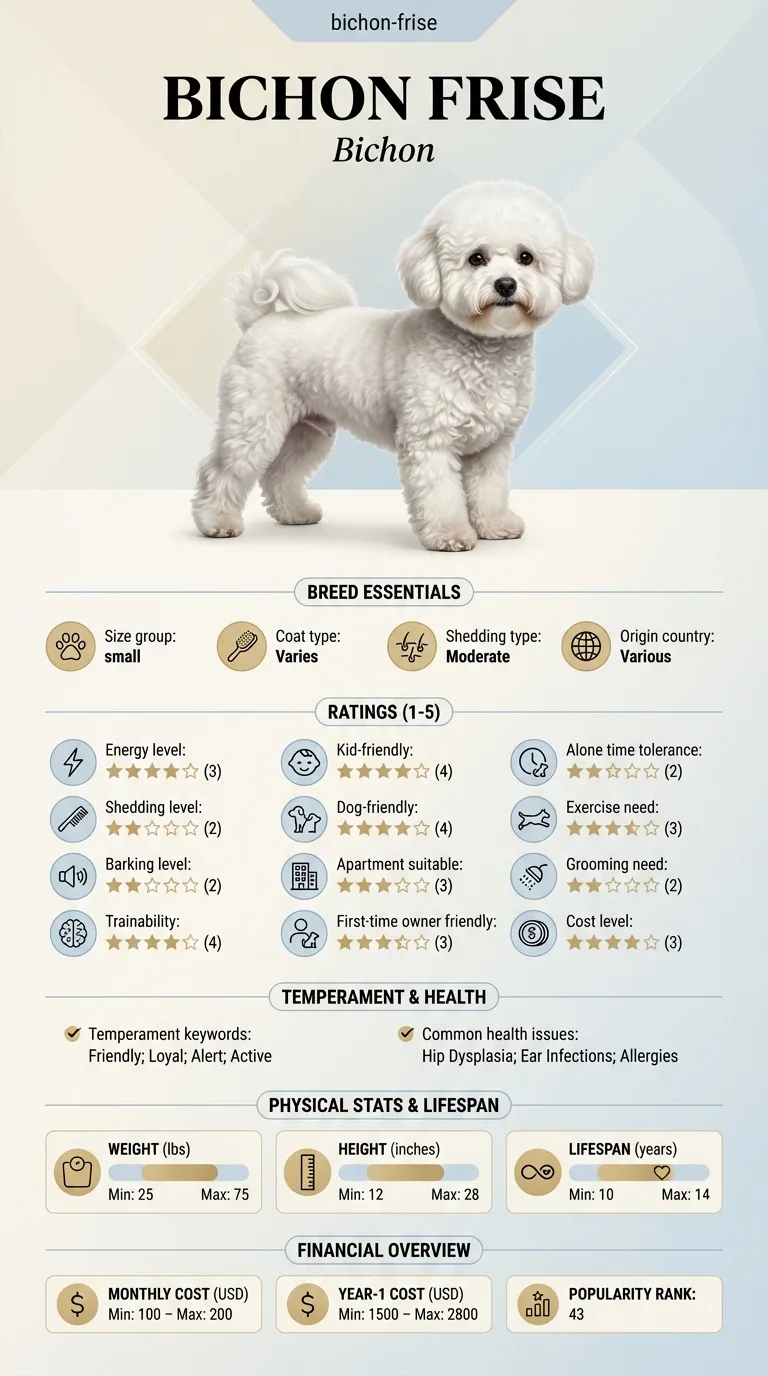
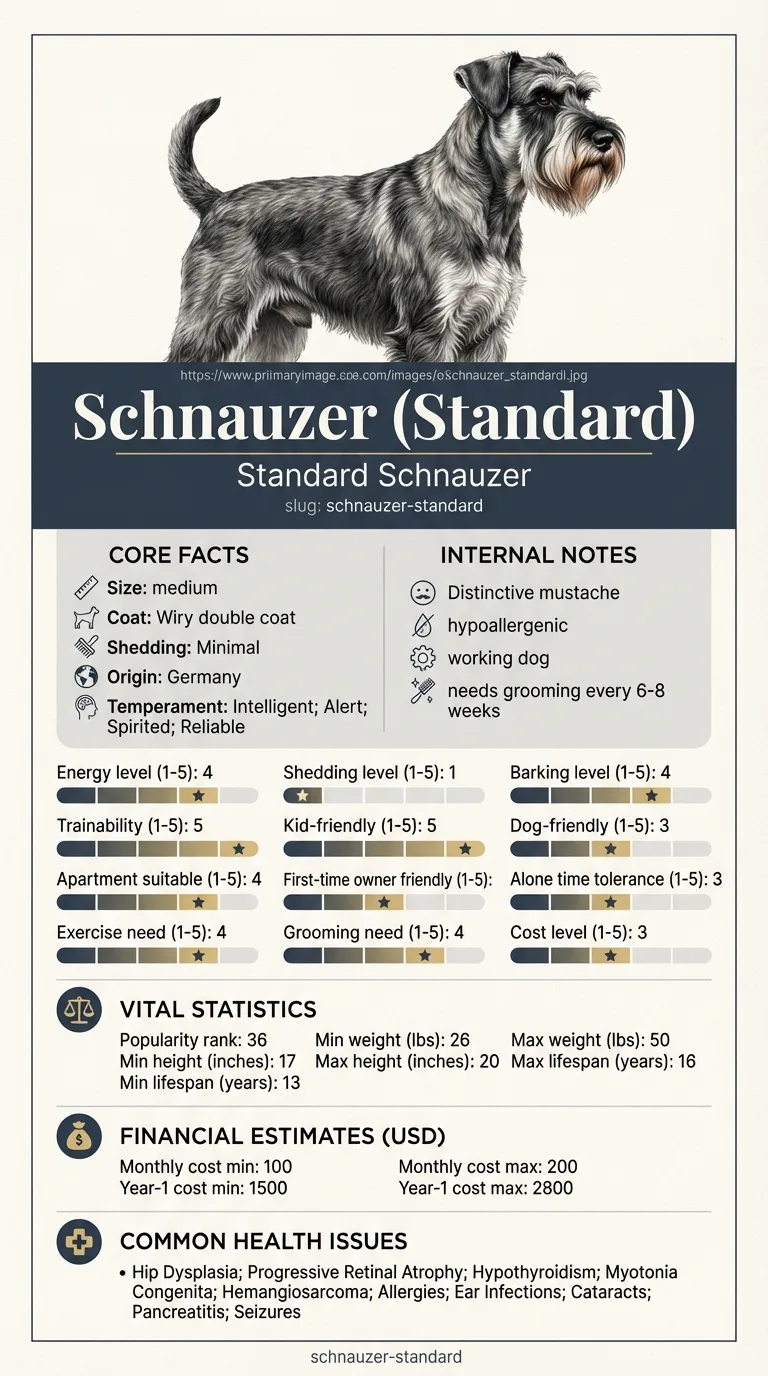
This is for someone already down to Bichon Frise and Schnauzer (Standard) and deciding between them. For this pair the decision usually turns on exercise need and trainability, so those are covered first and in most detail. Anyone choosing from a flat has a clear answer here: Bichon Frise rates 5/5 against 4/5. There is no origin story here — only what changes about your week.
Between Bichon Frise and Schnauzer (Standard), exercise need is what separates them, and Bichon Frise is the lower-effort dog of the two to keep.
Choose Bichon Frise if you are in a flat or a smaller home, this is your first dog and your walking routine is modest.
Choose Schnauzer (Standard) if you do not want a standing grooming appointment, the dog will be alone during the working day and there are young children at home.
| Feature | bichon frise | schnauzer standard | Winner |
|---|---|---|---|
| Size class | small | medium | Equal |
| Weight | 12–18 lbs | 26–50 lbs | Equal |
| Height | 9–12 in | 17–20 in | Equal |
| Lifespan | 14–15 years | 13–16 years | Equal |
| Exercise need | Low (2/5) | High (4/5) | bichon frise |
| Grooming need | Very high (5/5) | High (4/5) | schnauzer standard |
| Shedding | Very low (1/5) | Very low (1/5) | Equal |
| Energy level | Moderate (3/5) | High (4/5) | Equal |
| Barking | Moderate (3/5) | High (4/5) | bichon frise |
| Apartment suitability | Very high (5/5) | High (4/5) | bichon frise |
| Good for first-time owners | High (4/5) | Moderate (3/5) | bichon frise |
| Tolerates being alone | Low (2/5) | Moderate (3/5) | schnauzer standard |
| Trainability | Moderate (3/5) | Very high (5/5) | schnauzer standard |
| Good with kids | High (4/5) | Very high (5/5) | schnauzer standard |
| Good with other dogs | High (4/5) | Moderate (3/5) | bichon frise |
| Friendly to strangers | High (4/5) | Moderate (3/5) | bichon frise |
| Cost level | Moderate (3/5) | Moderate (3/5) | Equal |
| Coat | Curly, dense double coat | Wiry double coat | Equal |
| Origin | Various | Germany | Equal |
| Typical monthly cost | $80–$150 | $100–$200 | Equal |
| Typical first-year cost | $1,100–$2,300 | $1,500–$2,800 | Equal |
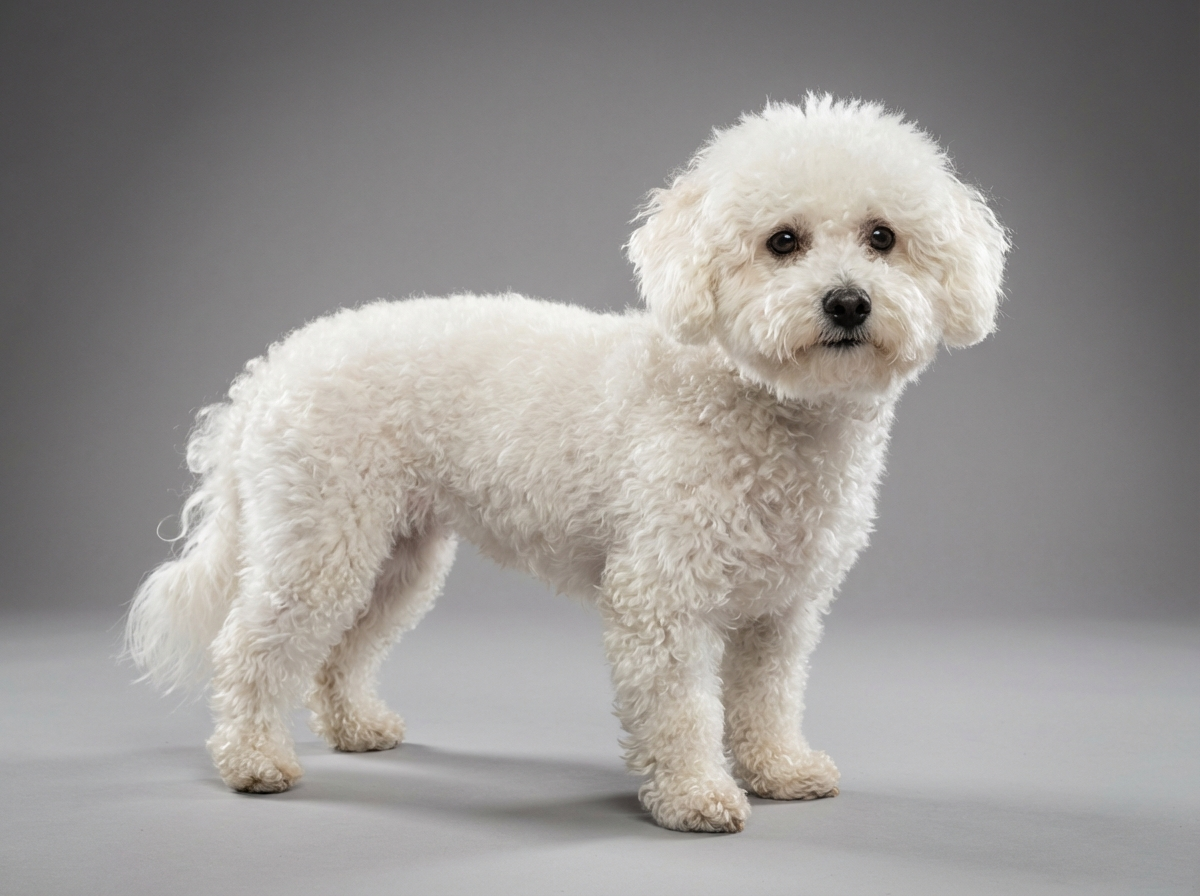
The Standard Schnauzer sits solidly in medium territory at 26–50 lbs and 17–20 inches, roughly double the Bichon Frise's 12–18 lbs and 9–12 inch frame without approaching large-breed scale. Coat texture is the more distinctive contrast: the Bichon's curly, dense double coat gives it a soft, rounded look, while the Schnauzer's wiry double coat produces the breed's signature bushy eyebrows and beard. Both are manageable in size for most households, but the Schnauzer's build carries more of the Alert, working-dog musculature its heritage as a German ratter and guard dog would suggest.
Exercise need favors the Bichon at Low (2/5) against the Schnauzer's High (4/5), even though energy level is scored a tie, Moderate (3/5) versus High (4/5) — the Spirited Schnauzer simply needs more structured daily outlet to match its drive. A Standard Schnauzer bred originally for active farm work does best with real exercise: brisk walks, play sessions, or a job to do, while the Bichon's Cheerful, Curious energy is satisfied with shorter, lower-intensity activity, making it the lighter lift for anyone without an hour or more of daily exercise time to spare.
Both breeds carry a Very low (1/5) shedding rating, so hair on the floor isn't a differentiator, but grooming need is high across the board — Very high (5/5) for the Bichon versus High (4/5) for the Schnauzer. The Bichon's rounded, powder-puff shape requires frequent trims to maintain, while the Schnauzer's wiry coat is typically hand-stripped or clipped and needs regular beard and leg-furnishing maintenance to stay clean and tangle-free. Neither is a wash-and-go breed; both call for a grooming budget and routine.
Apartment suitability favors the Bichon, Very high (5/5) against the Schnauzer's still-solid High (4/5), and barking tells a similar story — Moderate (3/5) for the Bichon versus High (4/5) for the Schnauzer, whose Alert, watchful nature makes it quicker to sound off at noises and visitors. Tolerating time alone actually favors the Schnauzer, Moderate (3/5) versus the Bichon's Low (2/5), so a Schnauzer may cope somewhat better with a longer solo stretch during the workday despite its more vocal tendencies.
Trainability strongly favors the Schnauzer, Very high (5/5) against the Bichon's Moderate (3/5) — an Intelligent, Reliable breed that was originally selected for working closely with handlers. Yet the Bichon still rates higher for first-time owners, High (4/5) versus Moderate (3/5), because the Schnauzer's higher exercise needs and more Alert, Spirited temperament ask more of a novice owner's time and consistency even when the dog itself learns quickly. An experienced handler looking for a sharp working partner gets more from the Schnauzer; a first-timer gets an easier overall package from the Bichon.
The Schnauzer edges ahead with kids, Very high (5/5) versus the Bichon's High (4/5), reflecting its Reliable, steady family reputation, but the Bichon pulls ahead everywhere else social — High (4/5) with other dogs against the Schnauzer's Moderate (3/5), and High (4/5) friendliness to strangers versus the Schnauzer's Moderate (3/5). A household that hosts often or has other resident dogs may find the Cheerful, Affectionate Bichon the more naturally sociable of the two, while the Schnauzer's more Alert, discerning nature suits a quieter household.
Lifespan ties between the two breeds, both landing in the mid-to-high teens range, but the health profiles diverge sharply in scope. The Bichon's five listed concerns are typical small-breed issues, while the Schnauzer's list runs to ten, including Hemangiosarcoma, a serious and often aggressive cancer, alongside Myotonia Congenita, Pancreatitis, and Seizures. Prospective Schnauzer owners should factor in a longer list of conditions to monitor for, even with a comparable overall life expectancy to the Bichon.
Cost level ties at Moderate (3/5) for both breeds, but the dollar ranges still separate them modestly: $80–$150 monthly and $1,100–$2,300 in year one for the Bichon versus $100–$200 monthly and $1,500–$2,800 for the Schnauzer. The gap likely reflects the Schnauzer's larger size driving up food and medication costs, plus the added expense of hand-stripping or specialized wiry-coat grooming that some groomers price at a premium over routine trims.
Bichon Frise weighs 12–18 lbs and lives 14–15 years; Schnauzer (Standard) weighs 26–50 lbs and lives 13–16 years. The two diverge most on exercise need and trainability. They are level on cost level and shedding, so those cannot decide it. Where the table declares a winner it means less work for the owner, nothing more; descriptive rows are left as ties on purpose. The value here is in the differences between the two columns; treat any single score as approximate.

The Schnauzer, rated High (4/5) versus the Bichon's Moderate (3/5), consistent with its Alert, watchful temperament.
Yes, rated Very high (5/5) trainability versus the Bichon's Moderate (3/5) — the Schnauzer's Intelligent, working-dog background makes it quick to pick up commands.
The Bichon Frise, rated High (4/5) versus the Schnauzer's Moderate (3/5), mainly because it asks less in daily exercise and handling experience.
The data lists ten conditions for the Schnauzer, including the cancer Hemangiosarcoma, versus five for the Bichon, despite both breeds sharing a comparable lifespan.
Neither sheds much — both are rated Very low (1/5) — so grooming routine, not shedding, is the real differentiator.
It's rated Moderate (3/5), somewhat lower than the Bichon's High (4/5), so early socialization matters more in a multi-dog household.
About $400–$500 more in the first year, reflecting its larger size and coat-maintenance needs.
The Standard Schnauzer, rated Very high (5/5).
The Bichon Frise, rated Moderate (3/5) versus High (4/5).
The Standard Schnauzer, at 26–50 lbs versus 12–18 lbs.
The Bichon Frise, rated High (4/5) versus Moderate (3/5).
Secure checkout on Stripe. We never see your card.
7-day money-back guarantee. Instant access.
Health information here is general and is not veterinary advice. If your dog shows pain, sudden behaviour change, or worsening symptoms, consult a licensed veterinarian.
Some links on this site are affiliate links. We may earn a commission at no extra cost to you, and we only suggest products we believe are helpful for dog owners.
We research and check what we publish, but we do not warrant that any figure, date, price, or statement is accurate, complete, or current, and we accept no liability for any loss, cost, injury, or other harm arising from the use of this site. Use it as one reference among several. You remain responsible for your own decisions and for your dog's care - confirm anything that matters with a licensed veterinarian or another qualified professional before you act on it. Full disclaimer.
Match your lifestyle to the right dog.
Take quizNot sure which breed is right for you? Take our 2-minute quiz to find out.
Take the quiz