Behavior
Is there a clear winner between these two?
Not on temperament or drive - they're near-identical on exercise, energy, apartment fit, and shedding. The Wirehaired Pointer scores slightly friendlier with kids and strangers.

Quick answer
Is there a clear winner between these two?
Not on temperament or drive - they're near-identical on exercise, energy, apartment fit, and shedding. The Wirehaired Pointer scores slightly friendlier with kids and strangers.
Belgian Malinois or German Wirehaired Pointer? On paper they differ most on grooming need, and on the scales German Wirehaired Pointer is the heavier at 60–70 lbs. Here is how the two compare on everything that shapes an ordinary week.
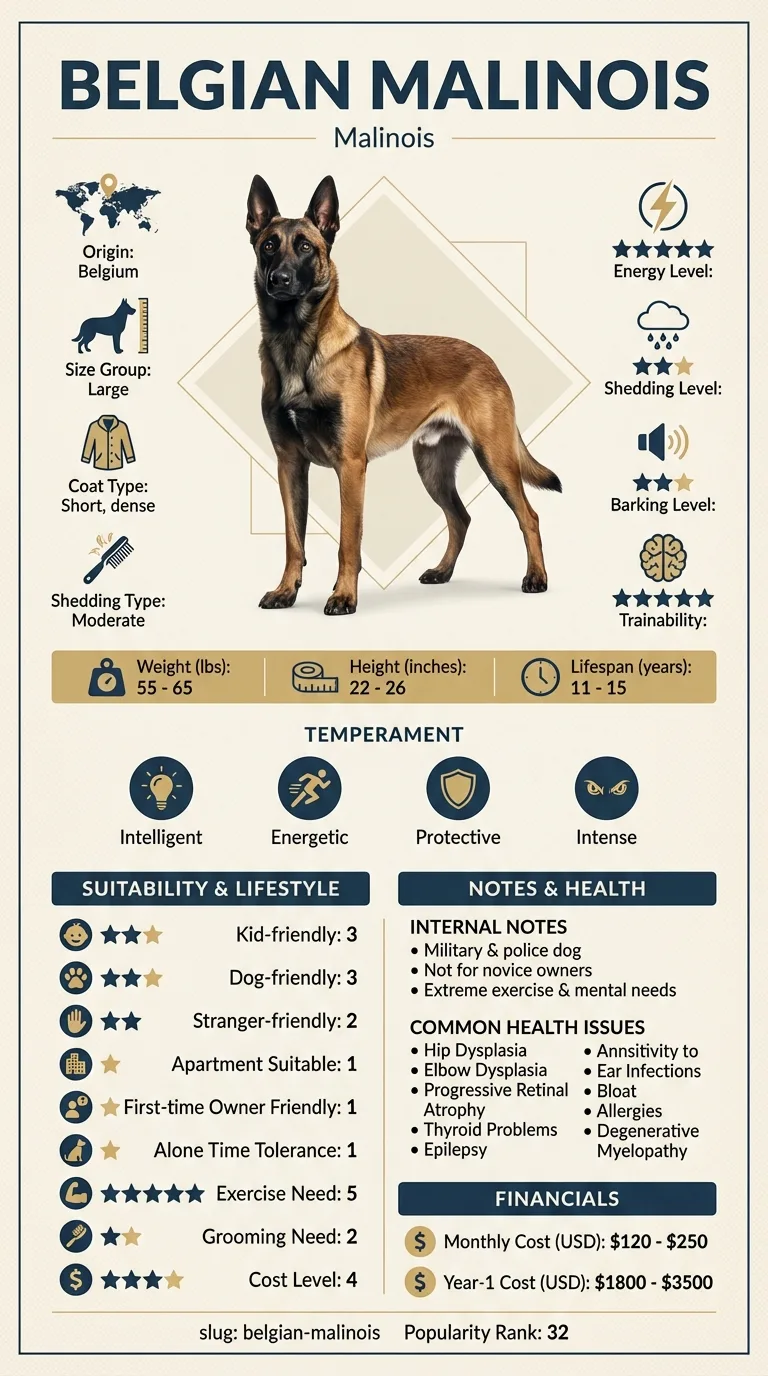
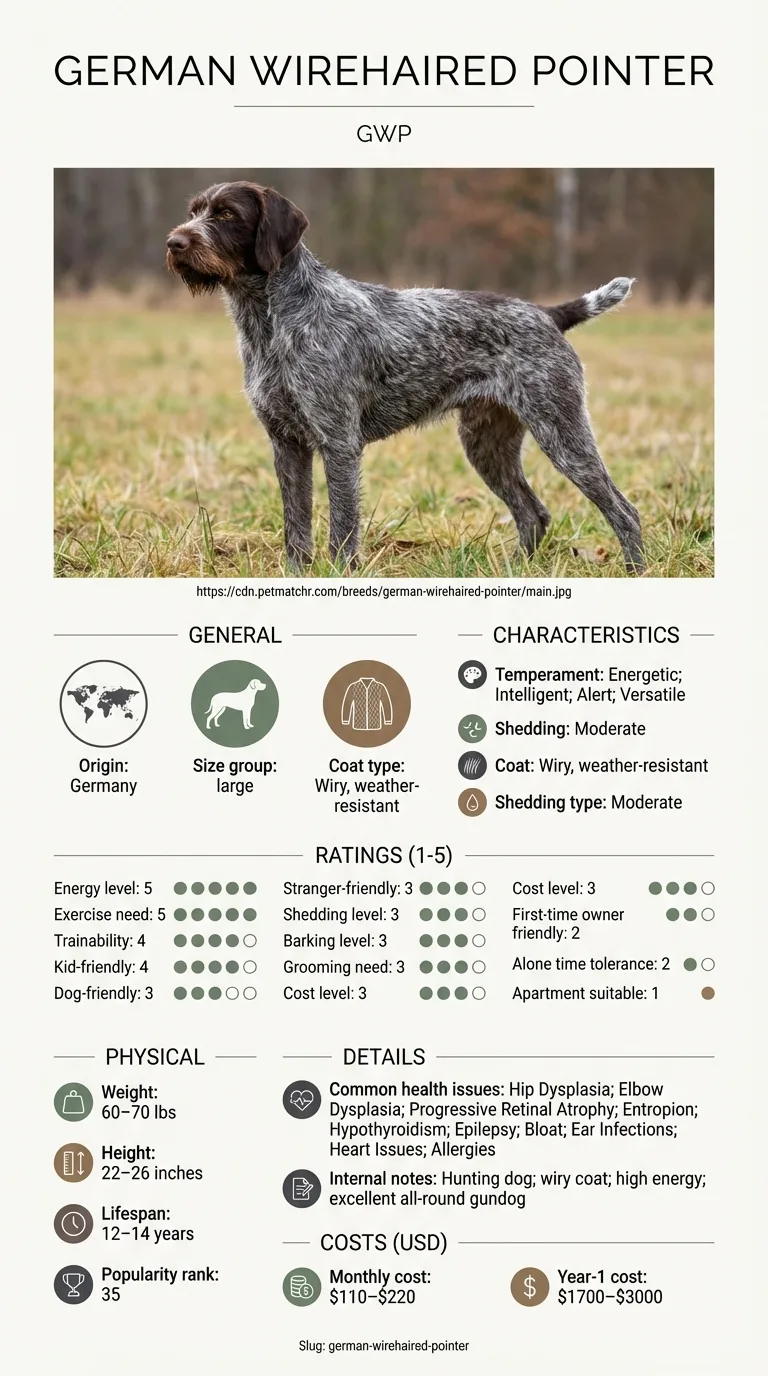
This is for someone already down to Belgian Malinois and German Wirehaired Pointer and deciding between them. Because the two are so evenly matched, the page works through every axis rather than leading with one. Both rate 1/5 for flats, so housing does not settle this one. There is no origin story here — only what changes about your week.
Between Belgian Malinois and German Wirehaired Pointer, they are closer than most pairings, and the choice comes down to temperament, and German Wirehaired Pointer is the lower-effort dog of the two to keep.
Choose Belgian Malinois if you do not want a standing grooming appointment, you want a dog that picks up training quickly and a smaller dog suits your car, your home or your back.
Choose German Wirehaired Pointer if there are young children at home.
| Feature | belgian malinois | german wirehaired pointer | Winner |
|---|---|---|---|
| Size class | large | large | Equal |
| Weight | 55–65 lbs | 60–70 lbs | Equal |
| Height | 22–26 in | 22–26 in | Equal |
| Lifespan | 11–15 years | 12–14 years | Equal |
| Exercise need | Very high (5/5) | Very high (5/5) | Equal |
| Grooming need | Low (2/5) | Moderate (3/5) | belgian malinois |
| Shedding | Moderate (3/5) | Moderate (3/5) | Equal |
| Energy level | Very high (5/5) | Very high (5/5) | Equal |
| Barking | Moderate (3/5) | Moderate (3/5) | Equal |
| Apartment suitability | Very low (1/5) | Very low (1/5) | Equal |
| Good for first-time owners | Very low (1/5) | Low (2/5) | german wirehaired pointer |
| Tolerates being alone | Very low (1/5) | Low (2/5) | german wirehaired pointer |
| Trainability | Very high (5/5) | High (4/5) | belgian malinois |
| Good with kids | Moderate (3/5) | High (4/5) | german wirehaired pointer |
| Good with other dogs | Moderate (3/5) | Moderate (3/5) | Equal |
| Friendly to strangers | Low (2/5) | Moderate (3/5) | german wirehaired pointer |
| Cost level | High (4/5) | Moderate (3/5) | german wirehaired pointer |
| Coat | Short, dense | Wiry, weather-resistant | Equal |
| Origin | Belgium | Germany | Equal |
| Typical monthly cost | $120–$250 | $110–$220 | Equal |
| Typical first-year cost | $1,800–$3,500 | $1,700–$3,000 | Equal |
The German Wirehaired Pointer is, if anything, the larger dog here: 60-70 lbs against the Malinois's 55-65, with height matching almost exactly at 22-26 inches for both. This is the one comparison in the batch where the other breed isn't smaller than the Malinois - plan your space and gear for two genuinely big dogs.
Both breeds max out at 5/5 for exercise need and 5/5 for energy level. The Wirehaired Pointer was developed as an all-weather hunting companion meant to work full days outdoors, so its drive is every bit as real as the Malinois's. Don't pick this breed expecting a calmer alternative - on paper, it isn't one.
The Wirehaired Pointer needs slightly more coat care, 3/5 versus the Malinois's 2/5, owing to its wiry, weather-resistant coat, which benefits from hand-stripping a couple of times a year. Shedding is tied at moderate (3/5) for both. It's a modest difference, not a high-maintenance one.
Both breeds bottom out at 1/5 for apartment suitability, and both tolerate being alone poorly, 1/5 for the Malinois and 2/5 for the Wirehaired Pointer. Barking sits at moderate (3/5) for both. If small-space living is part of your decision, this pairing gives you two dogs equally unsuited to it.
The Malinois trains slightly sharper, 5/5 versus the Wirehaired Pointer's 4/5, but both score low for first-time owners - 1/5 and 2/5 respectively. Neither breed is forgiving of an inexperienced or inconsistent handler, and both need daily structured outlets beyond basic obedience.
The Wirehaired Pointer rates a bit friendlier with kids (4/5 vs 3/5) and strangers (3/5 vs 2/5); the two are even with other dogs at a middling 3/5. Its alert, versatile temperament still runs more reserved than a typical family retriever - this isn't a soft, laid-back breed either, just a step less intense than the Malinois.
The Wirehaired Pointer actually edges out the Malinois on lifespan, 12-14 years versus 11-15 - close enough to call even. Health overlap is heavy: hip dysplasia, elbow dysplasia, progressive retinal atrophy, thyroid-related conditions, epilepsy, bloat, ear infections, and allergies show up on both ten-item lists. The Wirehaired Pointer's distinct risks are entropion and heart issues; the Malinois's are anesthesia sensitivity and degenerative myelopathy.
Costs sit close together: $120-250 monthly for the Malinois versus $110-220 for the Wirehaired Pointer, and $1,800-3,500 versus $1,700-3,000 in the first year. Both carry a cost-level rating in the middle-to-high range (4/5 and 3/5), consistent with two large, active breeds that eat and exercise on a similar scale.
Belgian Malinois weighs 55–65 lbs and lives 11–15 years; German Wirehaired Pointer weighs 60–70 lbs and lives 12–14 years. No rated axis separates them by more than a single point, which makes this one of the closer pairings on the site. They are level on apartment suitability, barking and good with other dogs, so those cannot decide it. Where the table declares a winner it means less work for the owner, nothing more; descriptive rows are left as ties on purpose. The value here is in the differences between the two columns; treat any single score as approximate.

They're close, and the Wirehaired Pointer can actually outweigh the Malinois - 60-70 lbs versus 55-65 lbs - though height matches almost exactly at 22-26 inches for both.
No - it matches the Malinois at 5/5 for both exercise need and energy level. It was bred for full-day outdoor hunting work and needs comparable daily activity.
The Wirehaired Pointer, slightly - 3/5 versus the Malinois's 2/5, due to its wiry coat, which benefits from occasional hand-stripping. Shedding itself is tied at moderate for both.
No - both rate 1/5 for apartment suitability and score low on tolerating time alone. This is a pairing of two dogs that need space and company, not a choice between an apartment breed and a house breed.
A great deal - eight of the ten conditions on each list overlap, including hip dysplasia, elbow dysplasia, bloat, epilepsy, and allergies. Distinct risks are narrow: entropion and heart issues for the Wirehaired Pointer, anesthesia sensitivity and degenerative myelopathy for the Malinois.
The Wirehaired Pointer has a slightly higher floor, 12-14 years versus the Malinois's 11-15, though the ranges overlap almost entirely.
Small - $120-250 monthly for the Malinois against $110-220 for the Wirehaired Pointer, with first-year costs $1,800-3,500 versus $1,700-3,000.
Not on temperament or drive - they're near-identical on exercise, energy, apartment fit, and shedding. The Wirehaired Pointer scores slightly friendlier with kids and strangers.
$120-250 for the Malinois, $110-220 for the Wirehaired Pointer - a small, consistent gap.
Both need the maximum on this scale - 5/5 exercise need, 5/5 energy level. Neither is a low-activity breed.
They're essentially tied - Wirehaired Pointer at 12-14 years, Malinois at 11-15 - with heavy overlap in shared health risks too.
Secure checkout on Stripe. We never see your card.
7-day money-back guarantee. Instant access.
Health information here is general and is not veterinary advice. If your dog shows pain, sudden behaviour change, or worsening symptoms, consult a licensed veterinarian.
Some links on this site are affiliate links. We may earn a commission at no extra cost to you, and we only suggest products we believe are helpful for dog owners.
We research and check what we publish, but we do not warrant that any figure, date, price, or statement is accurate, complete, or current, and we accept no liability for any loss, cost, injury, or other harm arising from the use of this site. Use it as one reference among several. You remain responsible for your own decisions and for your dog's care - confirm anything that matters with a licensed veterinarian or another qualified professional before you act on it. Full disclaimer.
Match your lifestyle to the right dog.
Take quizNot sure which breed is right for you? Take our 2-minute quiz to find out.
Take the quiz