DogBreedCompass

Pit Bull or Boston Terrier: The Same Cross, Bred Down and Indoors

Both of these breeds trace back to bulldog-and-terrier crosses, and both rate 1/5 for grooming — the lowest maintenance available. One was kept working; the other was bred smaller, flatter-faced and firmly indoors.

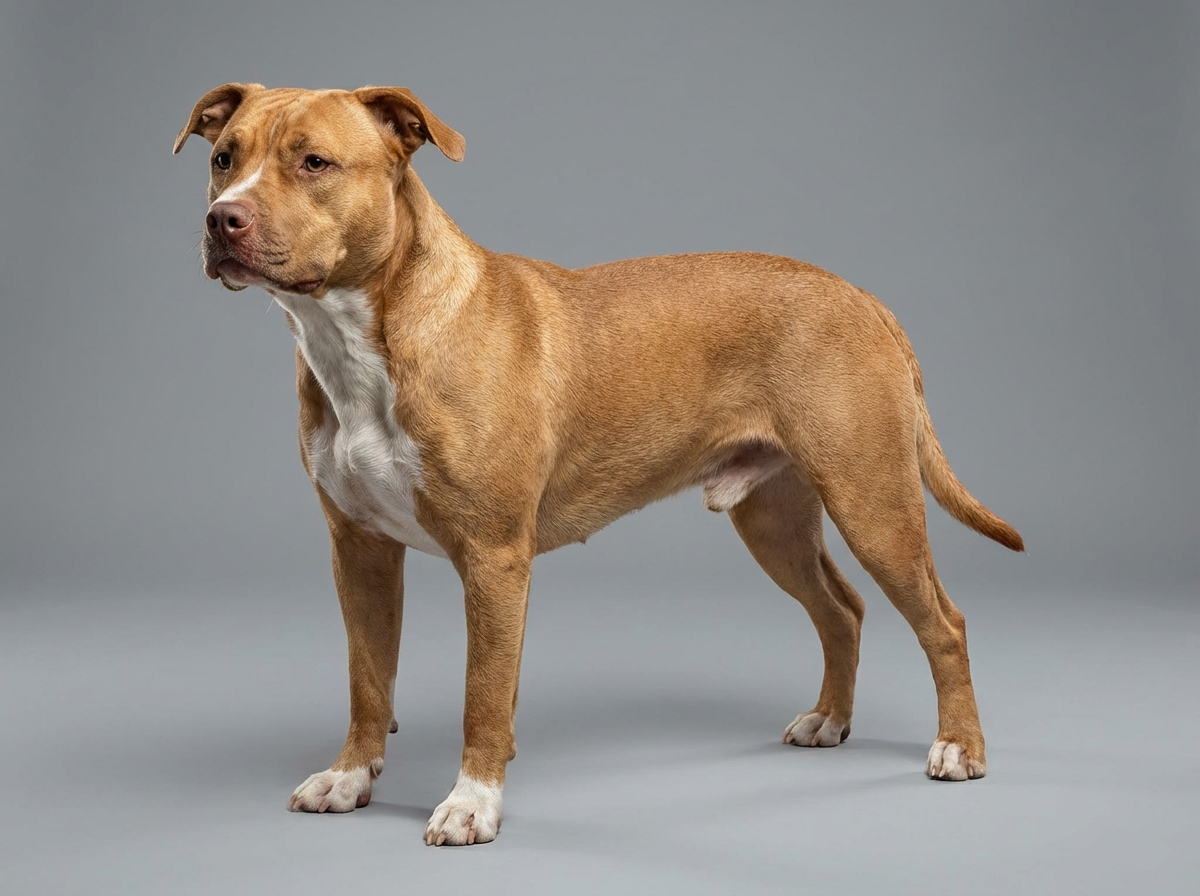
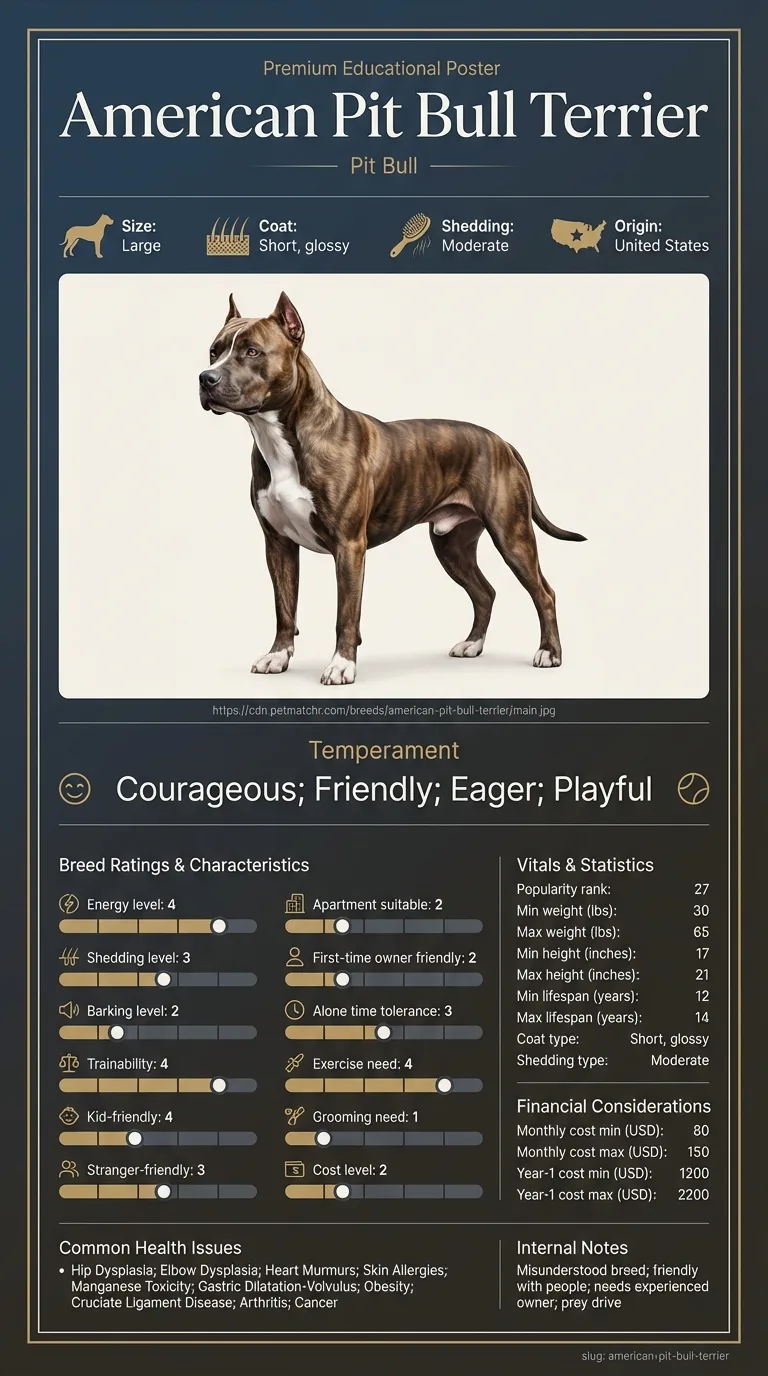
american pit bull terrier infographic
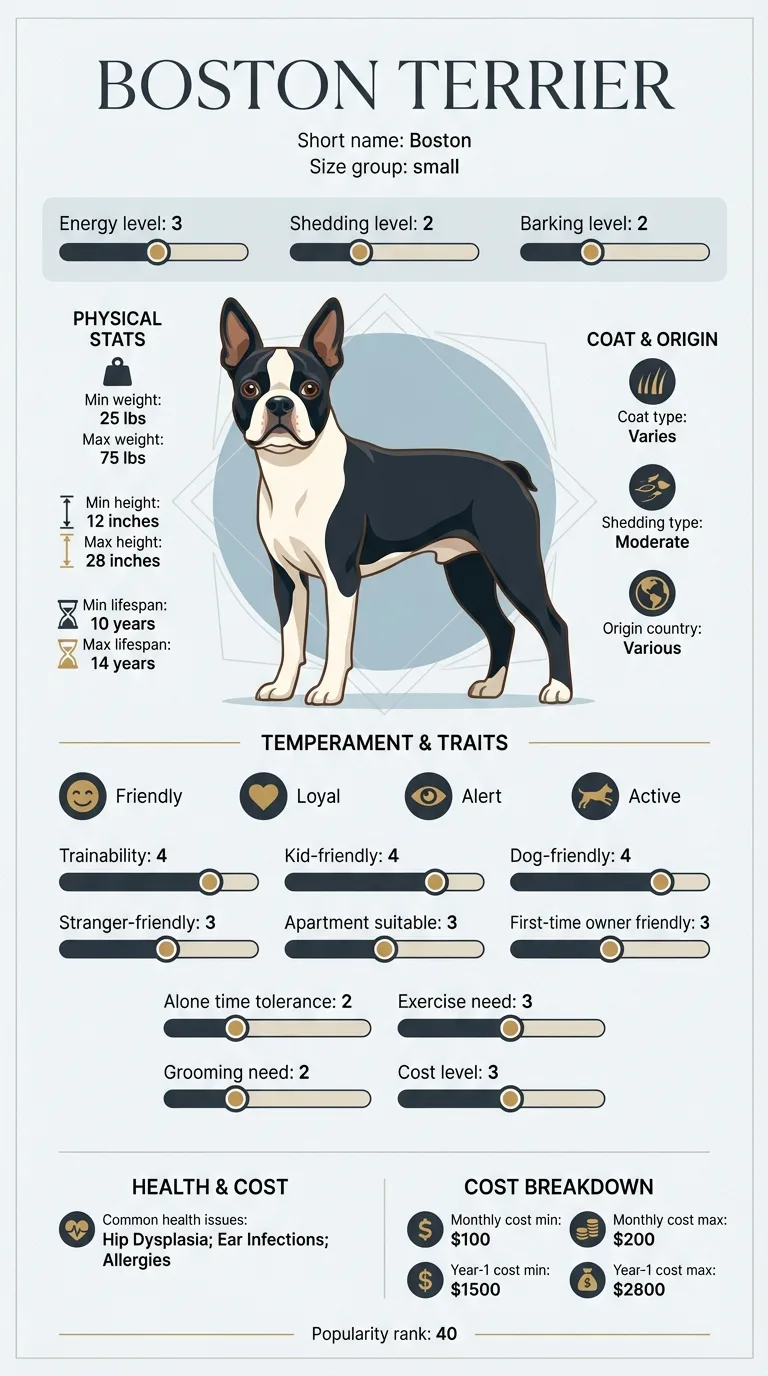
boston terrier infographic

This page is for someone weighing two dogs from the same family tree at very different scales, and wanting to know what the small one gained and what it gave up.

Quick verdict

The Boston is the easier dog in almost every household respect — flats, beginners, other dogs, exercise — and it pays for that with a shortened airway, prominent eyes and a shorter life.

Choose american pit bull terrier if...

Choose the American Pit Bull Terrier if you want an athletic, long-lived dog for an hour a day of real activity, and you can manage careful introductions to other dogs and check local restrictions on bully-type breeds.

Choose boston terrier if...

Choose the Boston Terrier if you want a comical, sociable house dog that fits a flat at 5/5 and suits a beginner at 5/5, and you will manage heat, weight and the breathing that comes with a short muzzle.

Head-to-head comparison

Featureamerican pit bull terrierboston terrierWinner
Weight30–65 lbs12–25 lbsEqual
Height17–21 in15–17 inEqual
Lifespan12–14 years11–13 yearsamerican pit bull terrier
CoatShort, glossyShort and smoothEqual
Grooming need1/51/5Equal
Shedding3/5 — moderate2/5 — lowboston terrier
Energy level4/53/5boston terrier
Exercise need4/52/5boston terrier
Trainability4/54/5Equal
Barking2/52/5Equal
Good with kids4/55/5boston terrier
Good with other dogs2/54/5boston terrier
Friendly to strangers3/54/5boston terrier
Apartment suitability2/55/5boston terrier
Good for first-time owners2/55/5boston terrier
Tolerates being alone3/53/5Equal
Typical monthly cost$80–150$80–150Equal
Typical first-year cost$1,200–2,200$1,100–2,300Equal

Deep dive

Two branches of the same nineteenth-century cross

Both breeds descend from crosses between bulldog types and terriers, made in the nineteenth century for reasons that no longer apply. What happened next is the whole story of this comparison.

In America, one line of that stock stayed close to its working form: substantial, athletic, hard-muscled, kept for farm work and catch work and general utility. That line became the American Pit Bull Terrier and, on a separate registry path, the American Staffordshire Terrier.

In Boston, another line went a different way. Breeders took bull-and-terrier dogs and refined them down — smaller, tidier, more compact, with a shortened muzzle, a smooth coat and a distinctive tuxedo marking. The result was a dog developed explicitly as a companion rather than a worker, and it was one of the first breeds developed in the United States to be recognised as such.

The traces of the shared origin are still visible in the ratings. Both are 1/5 for grooming, 4/5 for trainability, 2/5 for barking and 3/5 for tolerating time alone. Both are people-oriented, both are sturdy and physical in play, and both have a comic streak.

Where they diverge is everything downstream of size and skull shape. The Boston's 2/5 exercise requirement against 4/5, its 5/5 apartment rating against 2/5, and its 5/5 for first-time owners against 2/5 all follow from being bred into a house rather than out of one.

So does its health list, which is entirely different from the Pit Bull's and is largely a list of consequences of the shortened face and the prominent eyes.

The short muzzle: a milder version of a real problem

Brachycephalic airway syndrome heads the Boston Terrier's health list, and it deserves proportionate treatment — this is a moderately shortened breed rather than an extremely flat-faced one, and the range between individuals is wide.

The mechanism is the same at any degree. A shortened skull compresses the nose and throat without proportionally shrinking the soft tissue inside, so nostrils can be narrow and the soft palate can be long, and moving air takes more effort. Because dogs cool by panting, a dog that cannot move air well cannot shed heat well.

What that means in practice for a Boston: walk early and late in warm weather, use a harness rather than a collar so nothing presses on the throat, never leave one in a car or a conservatory even briefly, keep the dog lean because excess weight worsens the breathing directly, and treat noisy laboured breathing at rest as a veterinary conversation rather than a breed characteristic.

It also means the individual dog matters enormously. A Boston with open nostrils and a visible muzzle, from parents that breathe quietly, is a very different animal from one bred for an extremely flat face. Ask a breeder what the parents are like on a warm day, look at the nostrils, and ask whether any dog in the line has needed airway surgery. Anaesthesia also needs a practice set up for brachycephalic patients.

Corneal ulcers are the related risk. Shallow eye sockets leave the eyes prominent and exposed, so scratches and knocks are more likely. A Boston squinting, weeping or pawing at an eye needs seeing the same day, because a superficial ulcer can deteriorate quickly.

The Pit Bull has a normal muzzle and none of this. Its heat limitation is ordinary, and its eyes are unremarkable.

Deafness, patellas and a test worth asking about

Deafness sits on the Boston's health list and is worth understanding, because it connects to the coat pattern that defines the breed.

Congenital deafness in dogs is associated with the genetics of white pigmentation, particularly the piebald pattern that produces the Boston's white blaze, chest and collar. Dogs with more white on the head, and especially those with white around one or both ears, carry a higher risk. It can affect one ear or both, and unilateral deafness is easy to miss entirely — a dog that hears on one side behaves almost normally and simply seems poor at locating sound.

The test is BAER — brainstem auditory evoked response — a painless electrical hearing test that can be done on puppies. Responsible breeders in high-risk breeds use it, and asking whether a litter has been BAER-tested is a fair question.

A deaf dog is not a tragedy; plenty live full lives with hand-signal training and sensible management around traffic. But it should be a known fact rather than a discovery at eight months.

Patellar luxation is the other structural entry — a kneecap slipping out of its groove, showing as a skipping stride where the dog hops for a step and carries on. Mild cases are managed with weight control and muscle condition; severe ones are surgical. Cataracts complete the list, and eye certification of breeding stock is standard in the breed.

The Pit Bull's list is entirely different in character: hip and elbow dysplasia, skin allergies, heart murmurs, bloat, obesity, cruciate ligament disease, arthritis and cancer. Skin allergies are its most common day-to-day complaint, and cruciate disease its most likely orthopaedic emergency — both strongly helped by keeping the dog lean.

Lifespan slightly favours the Pit Bull at 12 to 14 years against 11 to 13.

Where the Boston wins outright

On household fit the Boston's numbers are close to ideal: 5/5 for apartments, 5/5 for first-time owners, 5/5 with children, 4/5 with other dogs, 4/5 with strangers, 2/5 barking and 2/5 exercise.

That combination is genuinely rare. It is a dog that needs about half an hour of walking plus indoor play, is quiet enough for a flat, gets on with everybody, is sturdy enough for children to handle, and at 4/5 trainability learns readily. Its keywords — friendly, lively, comical, adaptable — are accurate, and adaptable is the useful one.

The Pit Bull's household profile is warm but narrower. It is excellent with people at 4/5 with children and 3/5 with strangers, and its 2/5 with other dogs is a permanent management task: no dog parks, no on-lead greetings with unknown dogs, careful neutral-ground introductions, and awareness that tolerance can decline at social maturity between eighteen months and three years.

It also carries an administrative layer the Boston never encounters. Bully-type dogs are frequently restricted in tenancy agreements, housing association rules and insurance policies, often on the basis of appearance rather than pedigree. A Boston Terrier is functionally the same ancestry in a smaller package and is essentially never restricted.

Both cost $80 to $150 a month and both are 1/5 for grooming, so the running costs and the daily maintenance are effectively identical. The Boston's veterinary spending is more likely to involve eyes, breathing and knees; the Pit Bull's skin, joints and cruciates.

Where the Pit Bull wins is stamina and durability — it will hike, run, do weight pull or agility, and it is not weather-limited in the way a flat-faced breed is.

Choosing well, in either direction

For a Boston, the whole decision sits at the point of purchase, and the questions are specific. What do the parents' nostrils look like — open, or pinched to slits? Is there a visible muzzle? Do the adults breathe quietly at rest and walk briskly without noisy effort? Has any dog in the line needed airway surgery? Has the litter been BAER hearing-tested? Have the parents' knees been evaluated and their eyes certified?

A breeder producing moderate, functional Bostons will answer all of that comfortably. A breeder selling extreme faces will not, and the dog you get from them will spend its summers indoors.

For a Pit Bull, the decision sits more in the environment than in the dog. Check breed restrictions where you live and where you might move, in writing. Read your insurance exclusions. Then plan the dog-dog management honestly: which walks, at what times, with what equipment, and what happens when a loose dog approaches.

If you are adopting rather than buying — which is how most dogs of this type are acquired — a rescue that has genuinely assessed the adult is worth more than any pedigree. Ask how it behaves when another dog passes on a lead, whether it has lived with children, and how it copes with being left.

Both breeds are people-friendly, both are low-maintenance in coat, both are cheap to run, and both are physical, comic and affectionate. If you have an hour a day and no restrictions to navigate, the Pit Bull is the more capable animal. If you have a flat, a beginner's experience and a busy social life, the Boston is one of the easiest dogs on this site.

American Pit Bull Terrier vs Boston Terrier at a glance

Both of these breeds trace back to bulldog-and-terrier crosses, and both rate 1/5 for grooming — the lowest maintenance available on this site. One was kept working and stayed athletic; the other was bred smaller, flatter-faced, and firmly indoors.

The Boston is the easier dog in almost every household respect: it fits a flat, suits a beginner, gets on with other dogs, and needs far less exercise than the Pit Bull. It pays for that with a shortened airway, prominent eyes that are easily injured, and a shorter expected life.

Choose the American Pit Bull Terrier if you want an athletic, long-lived dog for an hour a day of real activity, and you can manage careful introductions to other dogs and check local restrictions on bully-type breeds. Choose the Boston Terrier if you want a comical, sociable house dog that fits a flat and suits a beginner, and you will manage heat, weight, and its breathing.

Frequently asked questions

Are Boston Terriers related to Pit Bulls?

Distantly, yes. Both descend from nineteenth-century bulldog-and-terrier crosses. The Boston was bred down into a smaller, flatter-faced companion in the United States, while the Pit Bull line kept the working build and athletic requirement.

How serious is the Boston's breathing problem?

It varies enormously between individuals. This is a moderately shortened breed rather than an extremely flat-faced one, and a dog with open nostrils and a visible muzzle from quietly breathing parents is a very different animal from one bred for an extreme face.

Why are Boston Terriers prone to deafness?

Congenital deafness is associated with the genetics of white pigmentation, particularly around the ears. It can affect one ear or both, and one-sided deafness is easy to miss. A BAER hearing test on the litter is the answer.

Which is better for a flat?

The Boston at 5/5 against 2/5. It needs about half an hour of walking plus indoor play, rates 2/5 for barking and is small enough to be unobtrusive. The Pit Bull is quiet too but needs an hour or more of real activity.

Do they cost the same to keep?

Yes — both run $80 to $150 a month and both rate 1/5 for grooming. The difference is what the money is spent on: eyes, breathing and knees for the Boston, skin, joints and cruciates for the Pit Bull.

Which is better for a first-time owner?

The Boston at 5/5 against 2/5. It is adaptable, forgiving and easy in public. The Pit Bull's difficulties are dog-dog management and the legal and insurance landscape rather than temperament.

What eye signs are urgent in a Boston Terrier?

Squinting, weeping, holding an eye closed or pawing at the face means a same-day appointment. Prominent eyes in shallow sockets are more exposed to scratches, and a superficial corneal ulcer can deteriorate quickly.

Quick answers

View more answers
Living

Pit Bull or Boston Terrier: which should I choose?

The Boston for a flat, a beginner or a busy social life — 5/5 for apartments, beginners and children. The Pit Bull if you want an athletic, long-lived dog for an hour a day and can manage introductions to other dogs.

Costs

Which is cheaper to keep?

Neither — both run $80 to $150 a month with 1/5 grooming. Insurance is the main variable, and it works against the Pit Bull rather than the Boston.

Health

What should I ask a Boston Terrier breeder?

What the parents' nostrils look like, whether they breathe quietly at rest, whether any dog in the line needed airway surgery, and whether the litter has been BAER hearing-tested. Then knees and eye certification.

Behavior

Which is better with other dogs?

The Boston at 4/5 against 2/5. The Pit Bull needs planned introductions on neutral ground and can become less tolerant at social maturity between eighteen months and three years.

Related DogBreedCompass guides

  • American Pit Bull Terrier breed guideThe Pit Bull profile covers temperament, exercise and the practical realities of ownership.
  • Boston Terrier breed guideThe Boston profile covers the breed's development, airway health and household fit.
  • common genetic disorders in Boston TerriersThe breed's inherited risks follow from its skull shape and its white markings.
  • cataracts in Pit Bull TerriersCataracts appear on both lists and are picked up through routine eye certification.
  • American Pit Bull Terrier vs BulldogThe bulldog side of the shared ancestry shows what an extreme short face costs.
  • American Pit Bull Terrier vs American Staffordshire TerrierThe closest relative on the working side of the family tree is worth comparing directly.

Related guides

Important reminder

Health information here is general and is not veterinary advice. Airway assessment, hearing testing and anaesthetic risk should be discussed with your own veterinarian.

Some links on this site are affiliate links. We may earn a commission if you buy through them, at no additional cost to you.

Find Your Perfect Breed

Match your lifestyle to the right dog.

Take quiz

Find your match

Not sure which breed is right for you? Take our 2-minute quiz to find out.

Take the quiz