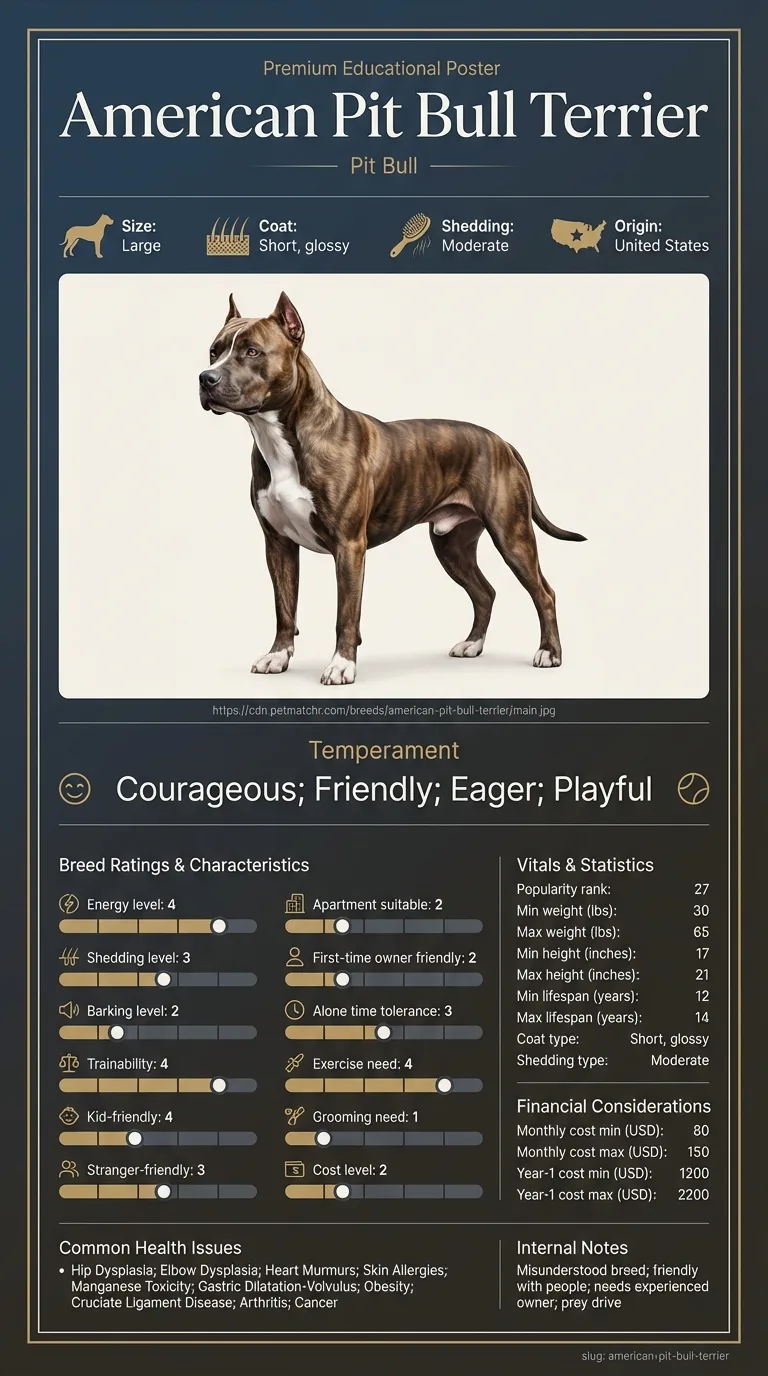
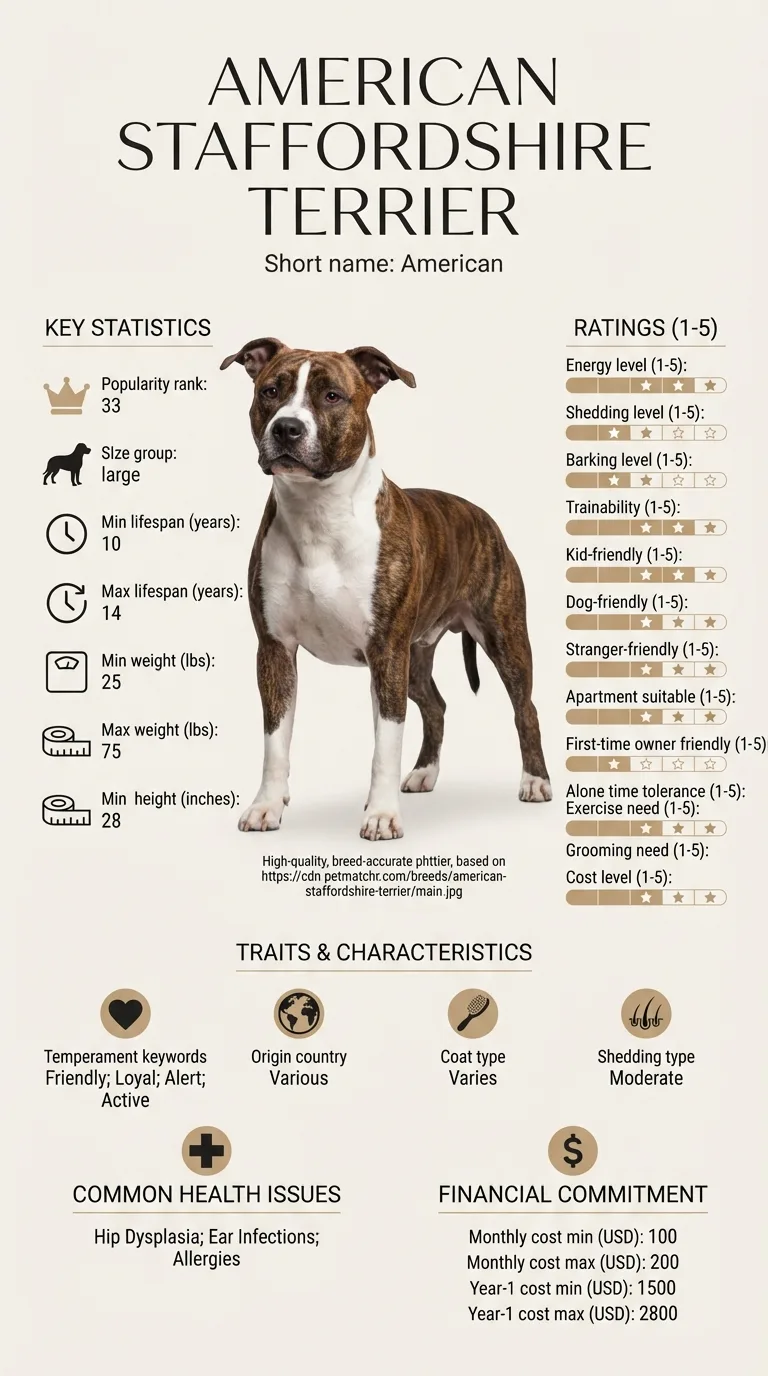
Both breeds are about as low-maintenance as dogs get on grooming: 1/5, with 3/5 moderate shedding. A rubber curry mitt once a week and a bath when needed is the whole routine. There is no matting, no seasonal blow, no professional appointment and no equipment beyond a mitt. The short stiff hairs do work into fabric, so neither is hair-free, but the time cost is close to zero.
Cost is where the two separate most clearly: the Pit Bull at cost level 2/5, $80–150 a month and $1,200–2,200 in the first year, against the AmStaff at 3/5, $100–200 and $1,400–2,900. Some of that is size and some is acquisition — rescue adoption fees are a fraction of a show-breeder puppy price. Neither figure includes the insurance premium, which for both breeds is where the real variation lives.
Exercise is 4/5 for both: an hour to ninety minutes daily with content in it. These are strong, athletic, driven dogs that take well to structured work — obedience, weight pull, agility, scent work, spring pole and flirt pole play — and at 4/5 trainability both respond quickly and enjoy the process. An under-exercised dog of either breed becomes destructive, mouthy and harder to manage around other dogs.
Both tolerate a working day reasonably at 3/5, which is better than most working breeds.
Apartment suitability is 2/5 and 3/5 respectively, and in practice both live perfectly well in flats where the rules allow it — they are quiet at 2/5 barking and settle indoors. The limiting factor is almost never the dog. It is the building's policy.
For a first-time owner the AmStaff's 3/5 against 2/5 reflects predictability rather than an easier temperament. Both need an owner who will do the socialisation and the management properly.