DogBreedCompass

Malamute or Rottweiler: The Working Guardian and the Working Hauler

Six ratings match exactly: energy 4/5, barking 3/5, other dogs 3/5, first-time owners 2/5, time alone 2/5 and cost 4/5. The two that matter most do not — strangers 2/5 against 4/5, and a lifespan that differs by up to six years.

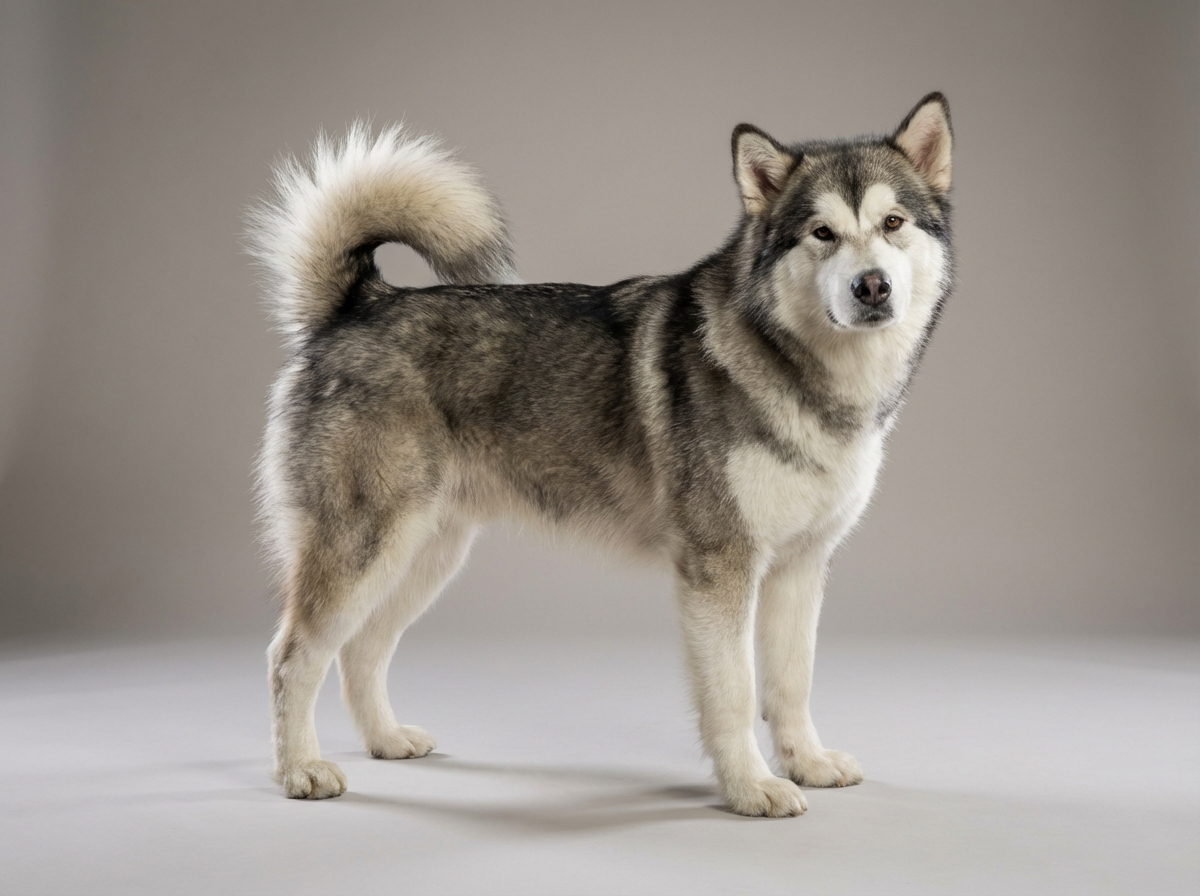
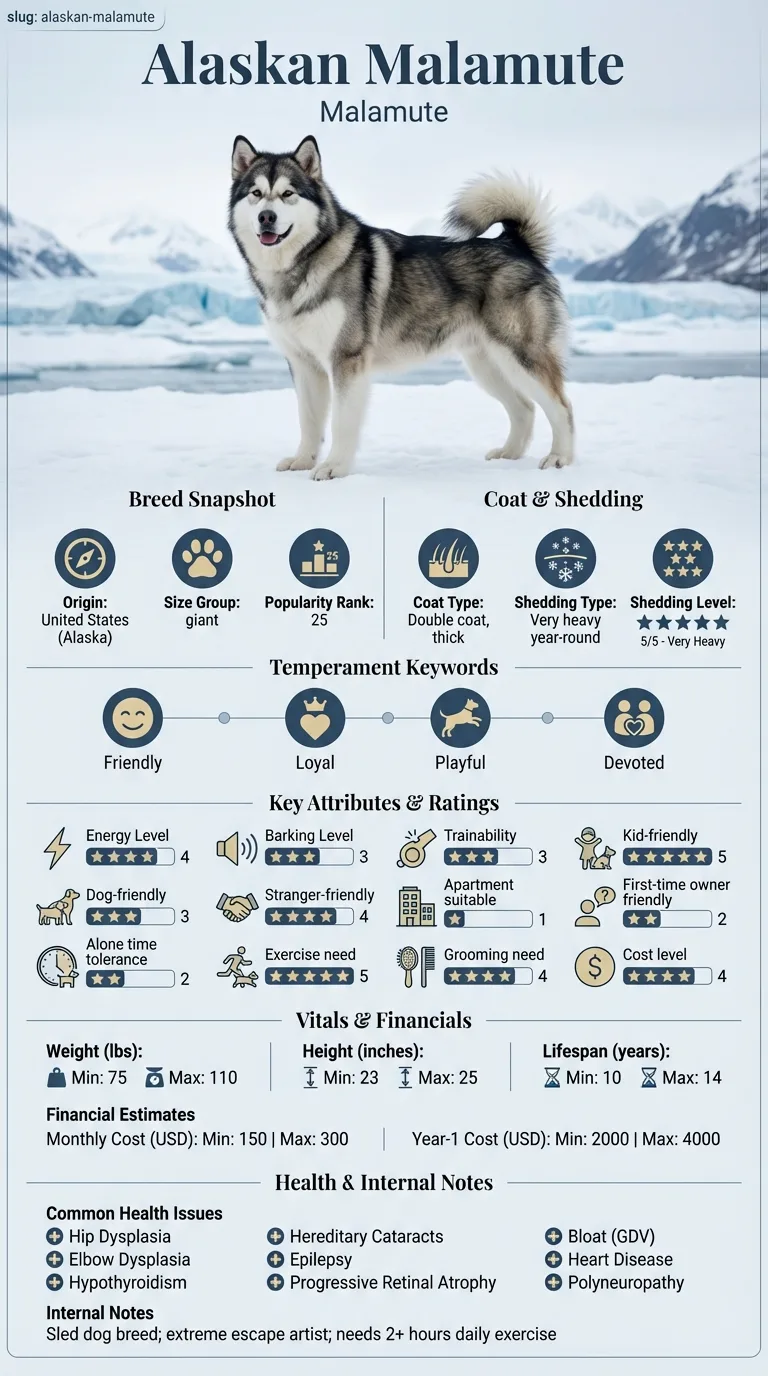
alaskan malamute infographic
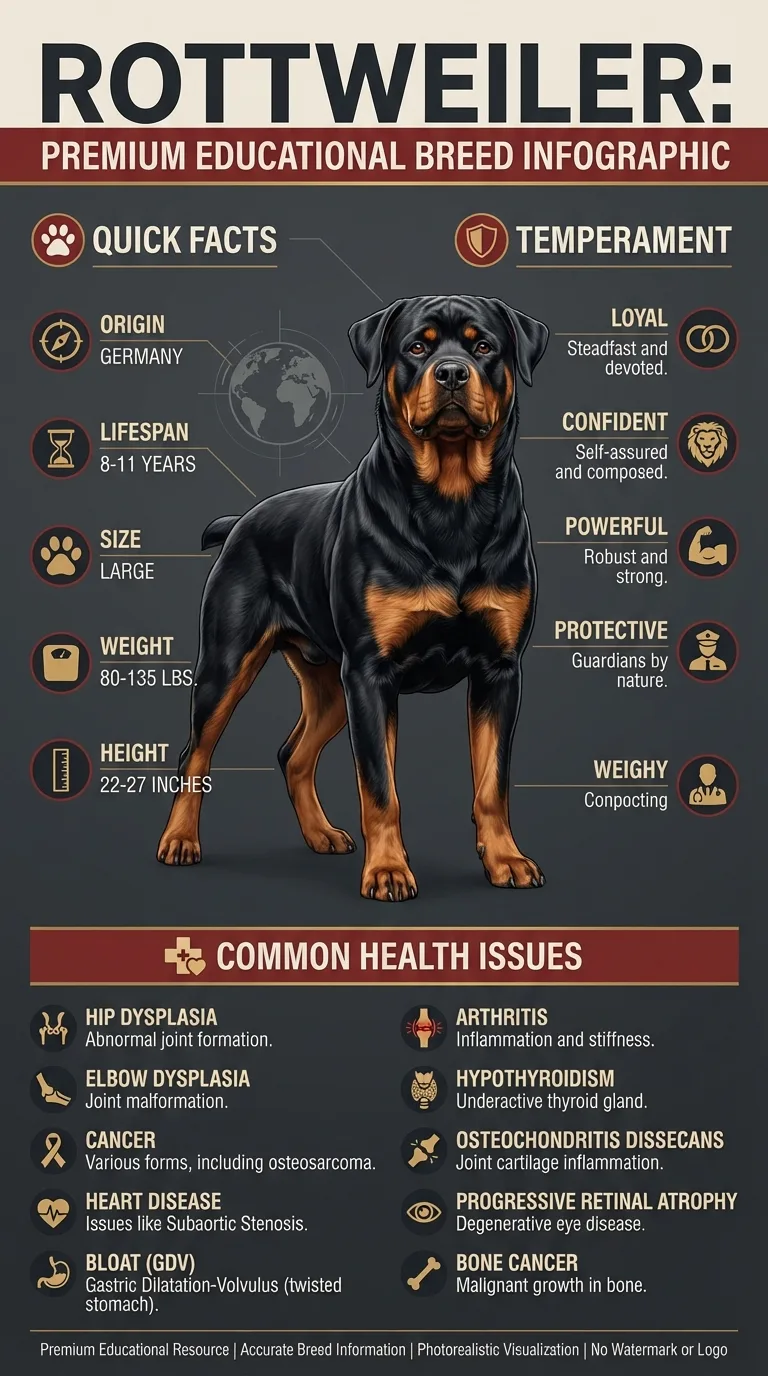
rottweiler infographic

This page is for someone who wants a large, serious dog and is deciding between genuine deterrence with the responsibility that carries, and a striking northern breed that greets everyone who walks in.

Quick verdict

The Rottweiler is the more trainable dog, far easier to groom and a real deterrent, but it demands committed socialisation, carries a heavy cancer burden and may give you only eight years.

Choose alaskan malamute if...

Choose the Alaskan Malamute if you want a longer-lived, indiscriminately friendly northern breed, you have cold weather and secure fencing, and you can supply two hours a day of physical work rather than structured training.

Choose rottweiler if...

Choose the Rottweiler if you want a trainable working guardian with a short coat and a moderate exercise need, you will do the socialisation properly through the first two years, and you accept a short expected lifespan.

Head-to-head comparison

Featurealaskan malamuterottweilerWinner
Weight75–110 lbs80–135 lbsalaskan malamute
Height23–25 in22–27 inEqual
Lifespan10–14 years8–11 yearsalaskan malamute
CoatThick double coatShort double coatrottweiler
Grooming need4/52/5rottweiler
Shedding5/5 — very heavy year-round4/5 — heavy seasonalrottweiler
Energy level4/54/5Equal
Exercise need5/54/5rottweiler
Trainability3/54/5rottweiler
Barking3/53/5Equal
Good with kids5/54/5alaskan malamute
Good with other dogs3/53/5Equal
Friendly to strangers4/52/5alaskan malamute
Apartment suitability1/52/5rottweiler
Good for first-time owners2/52/5Equal
Tolerates being alone2/52/5Equal
Typical monthly cost$150–300$125–250rottweiler
Typical first-year cost$2,000–4,000$2,000–3,500rottweiler

Deep dive

Eight to eleven years: the number to weigh before anything else

The Rottweiler's 8 to 11 year expectancy is the shortest of any large breed on this site, and at the bottom of that range it is shorter than several giants. It deserves to be the first thing considered rather than a footnote at the end.

The reason is on its own health list, which names cancer twice — cancer and bone cancer as separate entries. Osteosarcoma in particular is strongly associated with the breed, and it is what most often ends a Rottweiler's life. It usually announces itself as a persistent lameness in a middle-aged dog, most commonly in a front leg near the shoulder or wrist or a hind leg near the stifle, and it is regularly mistaken for a soft-tissue strain for weeks before anyone images it. The practical rule in this breed is unambiguous: a limp that has not resolved within a week or two is an X-ray, not more rest.

Heart disease is the second contributor. Large, powerfully built dogs carry more cardiac load, and the breed's list reflects that.

The Malamute's 10 to 14 years is genuinely remarkable for a dog that can reach 110 pounds, and it is one of the strongest arguments for the breed. Malamutes are frequently still hiking at nine and mobile at eleven or twelve.

The difference between the two ranges is up to six years — potentially the difference between two dogs and one over a couple of decades. Nobody should choose a Rottweiler without knowing that number, and nobody should let it be the only consideration either. Plenty of owners decide that ten years with this particular dog is worth more than fourteen with a different one. That is a legitimate choice as long as it is made with the figure in view.

Strangers 2/5 against 4/5: real deterrence and real responsibility

This is where the two breeds diverge most sharply and where the consequences are largest.

The Rottweiler's 2/5 with strangers is functional reserve. A well-bred, well-socialised Rottweiler watches rather than approaches, positions itself between its family and an unknown, and reacts only when something warrants it. Its own breed notes describe an excellent guard dog and flag that early socialisation is critical. That is genuine deterrence: most situations end when a hundred-pound dog stands up and looks at someone.

The obligation attached to that is not optional. A 2/5 stranger rating in an under-socialised dog does not stay neutral — it slides into suspicion, then into fence-line and lead reactivity, and the physical consequences of that in a 135-pound animal are serious. The work is specific: structured, repeated, positive exposure to unfamiliar people, dogs, surfaces, vehicles and environments through the first two years, and continued management afterwards. Alongside it sits loose-lead training, which in this breed is a safety requirement rather than a convenience. A dog that outweighs its handler and has not learned to walk politely is a dog that eventually does not get walked.

There are administrative consequences too. Rottweilers appear on breed restriction lists in some housing policies and insurance schedules, and in a few jurisdictions in local legislation. Check your tenancy agreement and your homeowners policy before you commit rather than after.

The Malamute's 4/5 is the mirror image. It is indiscriminately friendly and will meet a burglar the way it meets a delivery driver. Anyone buying a Malamute for security is buying a very large greeter. Its noise is a howl rather than a bark, and it carries further than the Rottweiler's, which at 3/5 is fairly restrained.

Osteochondritis dissecans and the large-breed puppy problem

Osteochondritis dissecans sits on the Rottweiler's list and it is a condition of growth rather than of age, which makes it one of the few entries an owner can genuinely influence.

OCD is a failure in the cartilage-to-bone conversion at a joint surface, usually the shoulder, elbow, knee or hock. A flap of cartilage separates and can break loose into the joint, producing lameness in a young dog — typically between four and ten months — that is often intermittent, worse after exercise, and easy to write off as a knock. Diagnosis is by imaging and treatment is frequently arthroscopic.

The risk factors are informative. Rapid growth, excess body weight during growth, over-supplementation with calcium, and high-impact exercise on a growing joint all increase the odds. That translates into concrete advice for a Rottweiler puppy: use a large-breed puppy food formulated with controlled calcium rather than an adult or all-life-stages food, do not supplement calcium at all, keep the puppy lean rather than chunky, and restrain forced exercise — no long walks, no stairs where avoidable, no repetitive jumping, no running alongside a bicycle — until growth plates close at around eighteen months. Free play on soft ground is the goal.

Hip and elbow dysplasia sit alongside it and share several of the same risk factors, which is why the same regime protects against all three. Ask any breeder for hip and elbow scores on both parents; a Rottweiler breeder who cannot produce them is not a serious one.

The rest of the list runs bloat, arthritis, hypothyroidism and progressive retinal atrophy. Bloat management is the standard set: split meals, quiet time either side of eating, a slow-feeder bowl if needed, and knowing where the out-of-hours clinic is.

The Malamute shares hip dysplasia, elbow dysplasia, bloat, hypothyroidism and progressive retinal atrophy, and adds hereditary cataracts, epilepsy, zinc-responsive dermatosis and inherited polyneuropathy.

4/5 against 3/5: a dog that works with you, and one that works beside you

The Rottweiler is one of the breeds that made modern police dog work possible, and its 4/5 trainability is honestly earned. It is a serious, focused worker that takes direction, holds a task and enjoys having a job. Obedience, tracking, carting, protection sport and detection all suit it, and a Rottweiler with structured work is a noticeably calmer dog at home.

It is also a thinking breed rather than an automatic one. Rottweilers tend to pause before complying, particularly in adolescence, and that pause is often mistaken for defiance. It is not; it is a dog checking whether the request is consistent with what it has been asked before. Consistency matters more with this breed than intensity, and heavy-handed correction on a powerful, confident dog is both ineffective and unwise.

The Malamute's 3/5 comes from a different place. A freighting breed that had to keep moving without consulting a driver was selected against handler focus, so a Malamute understands an instruction and then decides. Off-lead recall is the clearest expression of the gap: a trained Rottweiler can be genuinely reliable, and most Malamute owners never fully trust theirs.

Exercise is 4/5 against 5/5, and the content differs as much as the amount. A Rottweiler wants an hour to ninety minutes with a task in it — structured work, pulling, tracking, training. A Malamute wants two hours with physical resistance and derives nothing from mental work. On a wet Tuesday a Rottweiler owner can do twenty minutes of scent work indoors and get away with it. A Malamute owner cannot.

Both rate 2/5 for time alone and 2/5 for beginners, and both fail in characteristic ways when under-employed: the Rottweiler becomes bored, pushy and destructive; the Malamute becomes a landscaper and an escape artist.

Coat, cost and the practical household

Grooming is where the Rottweiler is decisively easier: 2/5 against 4/5. A short dense double coat needs a rubber curry or a deshedding tool once or twice a week and nothing else — no matting, no professional appointment, no ritual. Shedding is 4/5 against 5/5 and described as heavy seasonal, so there is a spring and autumn peak, but the volume is far below the Malamute's and the short hairs, while they embed in fabric, do not gather into drifts.

The Malamute's coat needs an undercoat rake taken to the skin two or three times a week, more during the two annual blows when the wool leaves in sheets, plus a firm rule against clipping since a double coat insulates in both directions.

Cost is close: $125–250 a month against $150–300, both at cost level 4/5, with first years of $2,000–3,500 against $2,000–4,000. The Rottweiler's spending is less predictable because of the cancer and orthopaedic profile — cruciate repair, arthroscopy for OCD, and cancer treatment are all realistic and all expensive. Insurance premiums for the breed reflect that, and insuring before anything is diagnosed matters.

With children the Malamute leads 5/5 to 4/5. The Rottweiler's score is not a warning about temperament so much as about physics and reserve: a powerful dog with a guardian's caution needs supervision around small children and their visiting friends, and its socialisation obligation extends to children it does not live with.

With other dogs both rate 3/5, and both concentrate their friction in same-sex adult pairings.

Apartments are 2/5 against 1/5. Neither belongs in a flat, though the Rottweiler's shorter coat and lower exercise need make it the marginally less impossible of the two.

Alaskan Malamute vs Rottweiler at a glance

Six ratings match exactly between these two: energy 4/5, barking 3/5, other dogs 3/5, first-time owners 2/5, time alone 2/5, and cost 4/5. The two that matter most do not — friendliness to strangers, 2/5 against 4/5, and a lifespan gap of up to six years.

The Rottweiler is the more trainable dog, far easier to groom with its short coat, and a real deterrent by breed design. What it demands in return is committed socialisation through the first two years, and it carries a heavy cancer burden that may give you only eight years.

Choose the Malamute if you want a longer-lived, indiscriminately friendly northern breed, you have cold weather and secure fencing, and you can supply two hours a day of physical work rather than structured training. Choose the Rottweiler if you want a trainable working guardian with a moderate exercise need, will do the socialisation properly, and accept a short expected lifespan.

Frequently asked questions

Which is the better guard dog?

The Rottweiler, without qualification. It rates 2/5 with strangers — watchful and reserved — and its own breed notes call it an excellent guard dog. The Malamute rates 4/5 and greets everyone, so it deters nothing.

Why do Rottweilers have such a short lifespan?

Cancer, which appears twice on the breed's health list. Osteosarcoma in particular is strongly associated with the breed and is usually what ends a Rottweiler's life, alongside heart disease. The range is 8 to 11 years.

How much exercise should a Rottweiler puppy get?

Deliberately restrained until growth plates close at around eighteen months. Forced walking, stairs, jumping and running alongside a bicycle all raise the risk of osteochondritis dissecans and dysplasia. Free play on soft ground is the goal.

Which is easier to train?

The Rottweiler at 4/5 against 3/5. It is a serious working dog that takes direction and holds a task. The Malamute considers each instruction on its merits, which is why its off-lead recall rarely becomes reliable.

Which sheds less?

The Rottweiler comfortably — 4/5 shedding and 2/5 grooming against 5/5 and 4/5. A curry mitt once or twice a week is the entire routine, against an undercoat rake two or three times a week for the Malamute.

Are there insurance or housing restrictions on Rottweilers?

In some places, yes. The breed appears on restriction lists in certain housing policies and insurance schedules, and in a few jurisdictions in local legislation. Check your tenancy agreement and homeowners policy before committing.

Which is better with children?

The Malamute at 5/5 against 4/5. The Rottweiler's score reflects a powerful dog with a guardian's reserve that needs supervision around small children, particularly visiting ones, rather than any natural unsuitability.

Quick answers

View more answers
Living

Malamute or Rottweiler: which should I choose?

The Rottweiler if you want a trainable working guardian with an easy coat and a moderate exercise need, and you will do the socialisation. The Malamute if you want a friendlier, longer-lived northern breed and can supply two hours of daily physical work.

Costs

Which is cheaper to keep?

The Rottweiler at $125–250 a month against $150–300, with both at cost level 4/5. Its veterinary spending is less predictable because of the cancer and orthopaedic profile.

Health

What is the most important health rule for a Rottweiler?

A limp that does not resolve within a week or two deserves an X-ray rather than rest. Bone cancer is common in the breed and early detection materially changes the options.

Training

How long should Rottweiler socialisation continue?

Actively through the first two years, and with ongoing management afterwards. A 2/5 stranger rating drifts toward suspicion and reactivity without deliberate, repeated positive exposure.

Related DogBreedCompass guides

  • Alaskan Malamute breed guideThe Malamute profile covers exercise load, coat raking and the containment work the breed requires.
  • Rottweiler breed guideThe Rottweiler profile covers socialisation, growth-stage management and the breed's working history.
  • cancer in RottweilersCancer appears twice on the breed's list and is the main reason its lifespan is so short.
  • hip dysplasia in RottweilersHip dysplasia shares risk factors with the breed's growth-stage joint problems and is screenable.
  • adopting a RottweilerRottweilers reach rescue regularly, often as adolescents whose socialisation was left too late.
  • Alaskan Malamute vs Rottweiler MixBuyers looking at Rottweiler-type dogs in rescue are usually weighing mixes as well as purebreds.

Related guides

Important reminder

Health information here is general and is not veterinary advice. Growth-stage nutrition, screening and cancer concerns should be discussed with your own veterinarian.

Some links on this site are affiliate links. We may earn a commission if you buy through them, at no additional cost to you.

Find Your Perfect Breed

Match your lifestyle to the right dog.

Take quiz

Find your match

Not sure which breed is right for you? Take our 2-minute quiz to find out.

Take the quiz