German Shepherd or Rottweiler: Which One Can You Handle?
Quick answer
German Shepherd vs Rottweiler: which should I choose?
Choose the German Shepherd for versatility and trainability if you can meet a 5/5 exercise requirement and live with year-round shedding. Choose the Rottweiler for a calmer house and far less coat work, provided you can physically manage up to 135 pounds and your insurer is comfortable with the breed.
Both of these are serious dogs that rate 2/5 for first-time owners, and the honest question is not which is better but which failure mode you are equipped to prevent. A German Shepherd that goes wrong becomes anxious and reactive. A Rottweiler that goes wrong becomes 135 pounds you cannot physically stop.
This is for someone who wants a large, capable, protective dog and is realistic enough to be asking which one suits them rather than which one looks better. It covers what each weighs, what each was bred to do, how they differ on shedding and grooming, the two very different health risks that shorten their lives, and the practical matters most articles skip — insurance, physical control, and what happens during adolescence if the training does not happen.
Quick verdict
The German Shepherd asks more of your time and your vacuum; the Rottweiler asks more of your physical strength and your insurance policy.
Choose german shepherd if...
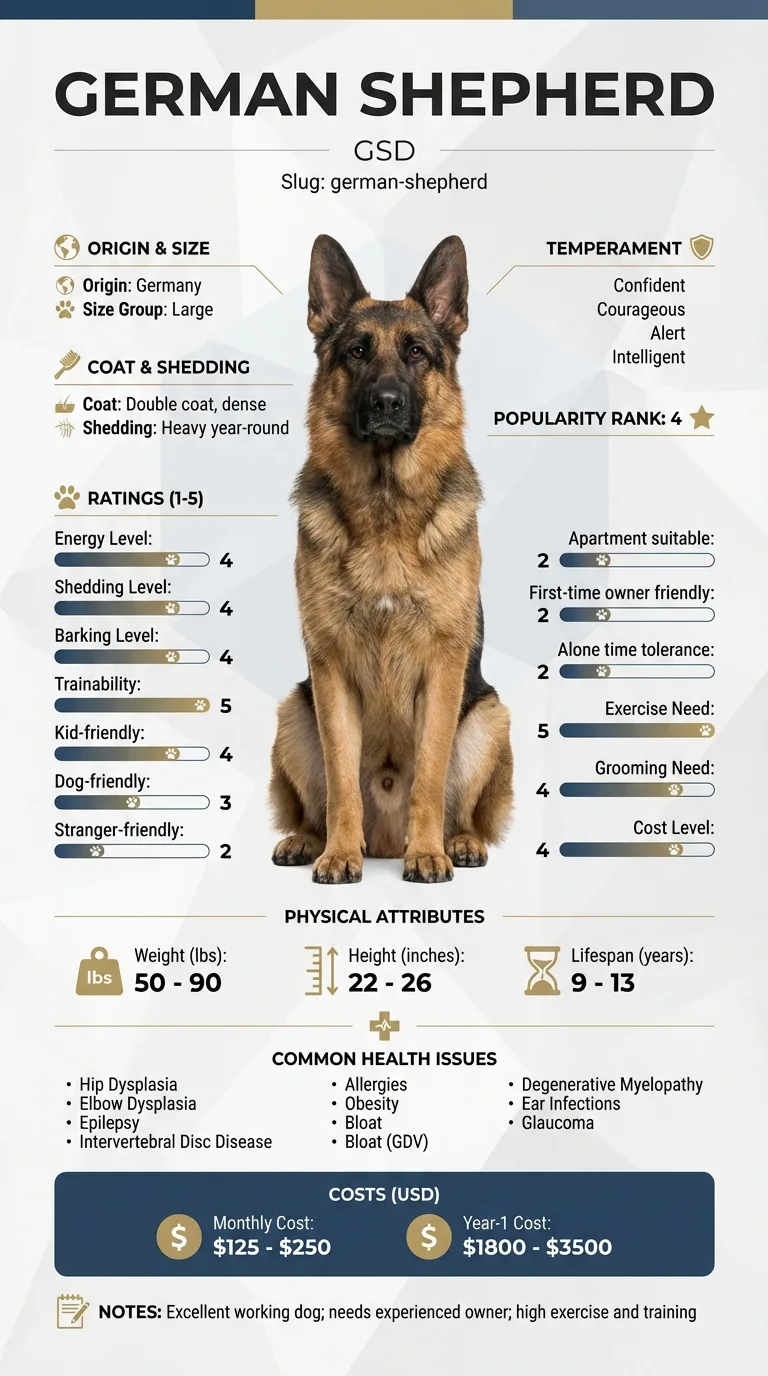
Choose the German Shepherd if you want the more trainable and more versatile of the two — 5/5 against 4/5 — and you want a dog that can do a job, whether that is scent work, obedience or protection sport. Accept in exchange that you are signing up for a very high exercise requirement (5/5) and a coat that sheds heavily year-round with grooming rated 4/5.
Choose rottweiler if...
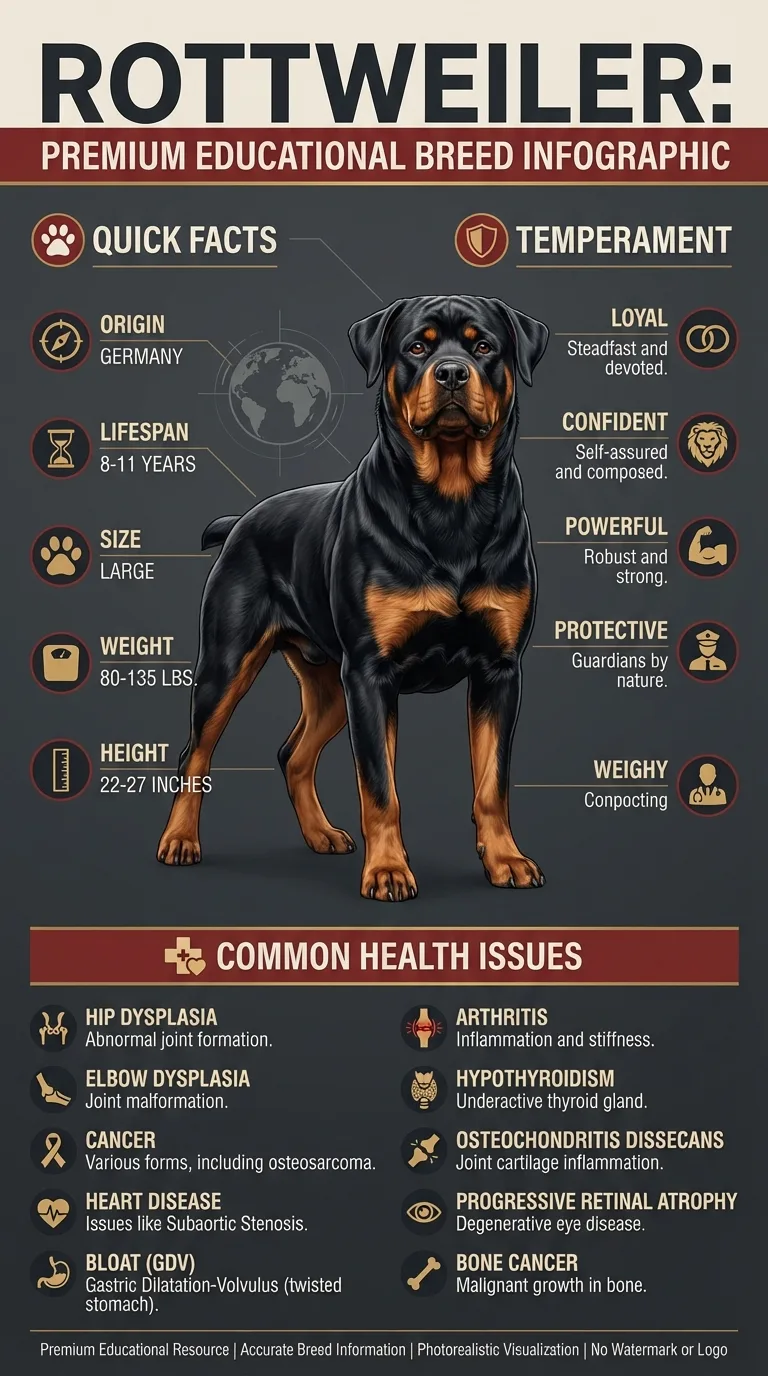
Choose the Rottweiler if you want a calmer, steadier dog around the house with far less coat maintenance (grooming 2/5 against 4/5) and a lower exercise requirement (4/5 against 5/5). You must be able to physically handle a dog that can reach 135 pounds, and you should check your home insurance before you commit rather than after.
Head-to-head comparison
Feature
german shepherd
rottweiler
Winner
Weight
50–90 lbs
80–135 lbs
Equal
Height
22–26 in
22–27 in
Equal
Lifespan
9–13 years
8–11 years
german shepherd
Coat
Double coat, dense
Double coat, short
Equal
Grooming need
High (4/5)
Low (2/5)
rottweiler
Shedding
High (4/5), year-round
High (4/5), seasonal
Equal
Energy level
High (4/5)
High (4/5)
Equal
Exercise need
Very high (5/5)
High (4/5)
rottweiler
Trainability
Very high (5/5)
High (4/5)
german shepherd
Barking
High (4/5)
Moderate (3/5)
rottweiler
Good with kids
High (4/5)
High (4/5)
Equal
Good with other dogs
Moderate (3/5)
Moderate (3/5)
Equal
Friendly to strangers
Low (2/5)
Low (2/5)
Equal
Apartment suitability
Low (2/5)
Low (2/5)
Equal
Good for first-time owners
Low (2/5)
Low (2/5)
Equal
Tolerates being alone
Low (2/5)
Low (2/5)
Equal
Typical monthly cost
$125–$250
$125–$250
Equal
Typical first-year cost
$1,800–$3,500
$2,000–$3,500
Equal
Deep dive
Forty-five pounds is not a detail
A German Shepherd tops out around 90 pounds. A Rottweiler tops out around 135. Both stand roughly the same height at the shoulder — 22 to 26 inches against 22 to 27 — which means the Rottweiler is not a taller dog, it is a denser one. That density is the point of the breed; it was bred to move cattle and to be an obstacle.
The practical test is simple and worth doing honestly before you choose: can everyone in the household hold this dog on a lead if it decides, once, to go somewhere? Not a trained dog on a good day — an adolescent that has spotted a cat. With a Shepherd the answer for most adults is yes. With a Rottweiler at the top of its range, for many people the answer is no, and the consequences of that are not theoretical.
The same weight shows up in ordinary logistics. Lifting a 135-pound dog into a car boot or onto a vet table is a two-person job. Boarding is priced by size. And a large-breed orthopaedic bed, ramp, and crate cost what they cost.
They shorten differently: myelopathy against bone cancer
Both share the large-breed structural risks — hip dysplasia, elbow dysplasia and bloat. Beyond that they diverge sharply, and this is where the lifespan gap comes from: 9 to 13 years for the Shepherd against 8 to 11 for the Rottweiler.
The German Shepherd's signature condition is degenerative myelopathy, a progressive spinal-cord disease that usually begins in the hind limbs in middle age and is not painful but is not reversible either. There is a DNA test for the associated SOD1 variant and any serious breeder will have used it. The breed is also the one most associated with exocrine pancreatic insufficiency, where the pancreas stops producing digestive enzymes — a dog that eats constantly and loses weight anyway needs that test, not a different food.
The Rottweiler's signature risk is osteosarcoma. Bone cancer sits at the top of the breed's condition list for a reason, it tends to arrive in middle age, and it is aggressive. The breed also carries elevated risk of subaortic stenosis, a heart defect that a good breeder screens for by cardiac examination, and cruciate ligament rupture that a heavy dog is more likely to suffer and slower to recover from.
Neither list should stop you. Both should change the questions you ask a breeder, and both are an argument for insuring early.
One of these is called the German Shedder
Both rate 4/5 for shedding, and the number hides the difference. The Rottweiler's short double coat sheds heavily but seasonally, in a couple of concentrated bursts a year, and grooming rates 2/5 — a rubber mitt and a bin bag twice a year covers most of it.
The German Shepherd sheds year-round, every day, everywhere, and then blows coat on top of that. Grooming rates 4/5 not because the coat mats but because keeping the undercoat under control takes an undercoat rake and real time. The nickname the breed has carried for decades is not affectionate exaggeration.
If a hair-free house matters to you at all, this is the axis that should decide it, and it decides for the Rottweiler.
Trainability is not the same as easiness
The Shepherd rates 5/5 for trainability against the Rottweiler's 4/5, and both numbers are honest. The Shepherd learns faster, works longer, and is the breed of choice for police, detection and protection work for good reason. It also means a Shepherd whose brain is unemployed will find work of its own, and the work it finds is usually barking — the breed rates 4/5 for vocalisation against the Rottweiler's 3/5, and a bored Shepherd is a loud one.
The Rottweiler is slower to offer a behaviour and more inclined to consider whether it agrees with you. Handled well, that reads as steadiness. Handled badly, it reads as stubbornness, and heavy-handed correction of a Rottweiler is a bad idea for reasons that should be obvious given the previous section on body weight.
Both rate 2/5 for first-time owners, and that rating is doing real work. Neither is a dog you learn on.
Both are reserved with strangers, and one has an insurance problem
Both rate 2/5 with strangers, which in practice means neither greets visitors with enthusiasm and both will position themselves between you and the door. That is the trait most people are buying, and it is also the trait that requires the most socialisation to keep proportionate — reserved is the goal, suspicious is not.
There is one asymmetry worth knowing before rather than after: Rottweilers appear on the restricted-breed lists of many home insurance policies and some rental agreements, and German Shepherds appear on fewer of them. This varies enormously by insurer and jurisdiction, so treat it as a phone call to make during the decision, not a fact to assume either way. It is the sort of thing that becomes a serious problem only if you discover it after the dog is home.
Exercise: both a lot, one more
The Shepherd rates 5/5 for exercise need and the Rottweiler 4/5. That single point understates the difference in what the exercise looks like. A Shepherd wants distance and a task — long walks, scent games, training sessions, something structured, most days of the year. A Rottweiler wants a solid walk and then to lie down heavily on your feet.
Both rate 4/5 for general energy indoors, and both rate 2/5 for tolerating an empty house, so neither suits a household where the dog is alone across a full working day without arrangements.
One caution specific to the heavier breed: do not over-exercise a growing Rottweiler. Forced running and repetitive jumping on a large, fast-growing skeleton is associated with joint problems later, and the breed already carries elbow and cruciate risk.
German Shepherd vs Rottweiler: the short version
On the ratings these two look almost identical. Both are reserved with strangers at 2/5, both rate 2/5 for first-time owners, both 2/5 for apartments, both 2/5 for time alone, both moderate with other dogs. Read the table quickly and you would conclude there is nothing to choose between them.
That reading is wrong, and the reason is that the two most important differences do not appear as ratings at all. One is forty-five pounds of body weight at the top of the range. The other is that they die of different things, on different timelines. Everything below is built around those two facts.
German Shepherd or Rottweiler: Which One Can You Handle? - German Shepherd vs Rottweiler: the short version
Frequently asked questions
Which is bigger, a German Shepherd or a Rottweiler?
The Rottweiler, and by a wide margin at the top of the range — 80 to 135 pounds against the German Shepherd's 50 to 90. They stand about the same height, 22 to 27 inches against 22 to 26, so the Rottweiler is not taller but considerably denser. That difference matters most for physical control on a lead and for lifting the dog into a car or onto a vet table.
Which sheds more?
Both rate 4/5 but in different patterns. The Rottweiler's short coat sheds heavily in seasonal bursts and needs little maintenance in between, with grooming rated 2/5. The German Shepherd sheds year-round on top of two heavy moults and rates 4/5 for grooming, because managing the undercoat takes a rake and real time. For a low-hair household the Rottweiler is clearly the easier of the two.
Which lives longer?
The German Shepherd, at 9 to 13 years against the Rottweiler's 8 to 11. The gap reflects breed-specific disease as much as size: the Rottweiler carries elevated osteosarcoma risk, while the Shepherd's signature condition, degenerative myelopathy, tends to affect quality of life in the later years rather than shorten them as sharply.
Is either good for a first-time dog owner?
Neither. Both rate 2/5 and the rating is meant literally. The German Shepherd's failure mode under inexperienced handling is anxiety and reactivity; the Rottweiler's is a very large dog that has learned it can win a physical argument. If this is a first dog, get help from a trainer before the puppy arrives rather than after adolescence starts.
Which is better with children?
Both rate 4/5, so neither has an advantage on temperament. Size is the practical consideration rather than character — an adolescent Rottweiler knocks over a small child without any intent to, and the same is true of a Shepherd at speed. Supervision is about physics here, not aggression.
Do Rottweilers cause problems with home insurance?
Often, yes. Rottweilers appear on the restricted-breed lists of many home insurance policies and some rental agreements more frequently than German Shepherds do. This varies a great deal by insurer and by jurisdiction, so call your insurer and, if renting, check the lease before committing rather than assuming either way.
Which barks more?
The German Shepherd, rated 4/5 against the Rottweiler's 3/5. Much of it is under-stimulation rather than temperament — a Shepherd with 5/5 exercise needs that is not getting them will find its own job, and barking is usually the one it picks.
German Shepherd vs Rottweiler: which should I choose?
Choose the German Shepherd for versatility and trainability if you can meet a 5/5 exercise requirement and live with year-round shedding. Choose the Rottweiler for a calmer house and far less coat work, provided you can physically manage up to 135 pounds and your insurer is comfortable with the breed.
Living
Which needs more exercise?
The German Shepherd, at 5/5 against the Rottweiler's 4/5, and it wants structured work rather than just distance. The Rottweiler is content with a solid daily walk.
Health
What are the main health risks?
Both carry hip and elbow dysplasia and bloat. Beyond that the German Shepherd's signature risks are degenerative myelopathy and exocrine pancreatic insufficiency; the Rottweiler's are osteosarcoma and subaortic stenosis.
Training
Which is easier to train?
The German Shepherd at 5/5 against 4/5 — it learns faster and works longer. The Rottweiler is slower to offer behaviour and more inclined to weigh whether it agrees, which reads as steadiness when handled well.
Related DogBreedCompass guides
German Shepherd breed guide – The full German Shepherd profile covers the working-line versus show-line split, which changes what you are getting.
Rottweiler breed guide – The Rottweiler profile covers temperament and the management the breed needs in more detail.
Belgian Malinois vs German Shepherd – The Malinois is the breed people move to when they want more drive than a Shepherd, and it is usually a mistake for a pet home.
Labrador Retriever vs Rottweiler – Anyone weighing a Rottweiler against a friendlier large breed usually lands on the Labrador next.
German Shepherd hip dysplasia – Hip dysplasia is the condition both breeds share and the one a breeder should have scored.
Rottweiler genetic disorders – The genetic-disorder page lists what a Rottweiler breeder should be screening for.
Health information here is general and is not veterinary advice. If your dog shows pain, sudden behaviour change, or worsening symptoms, consult a licensed veterinarian.
Some links on this site are affiliate links. We may earn a commission at no extra cost to you, and we only suggest products we believe are helpful for dog owners.
We research and check what we publish, but we do not warrant that any figure, date, price, or statement is accurate, complete, or current, and we accept no liability for any loss, cost, injury, or other harm arising from the use of this site. Use it as one reference among several. You remain responsible for your own decisions and for your dog's care - confirm anything that matters with a licensed veterinarian or another qualified professional before you act on it. Full disclaimer.