Living
Which is the better overall choice?
The Cocker fits far more households comfortably - small spaces, first-time owners, families with strangers coming and going - while the Rottweiler needs an experienced owner with real space.

Quick answer
Which is the better overall choice?
The Cocker fits far more households comfortably - small spaces, first-time owners, families with strangers coming and going - while the Rottweiler needs an experienced owner with real space.
English Cocker Spaniel or Rottweiler? On paper they differ most on grooming need, and on the scales Rottweiler is the heavier at 80–135 lbs. Here is how the two compare on everything that shapes an ordinary week.
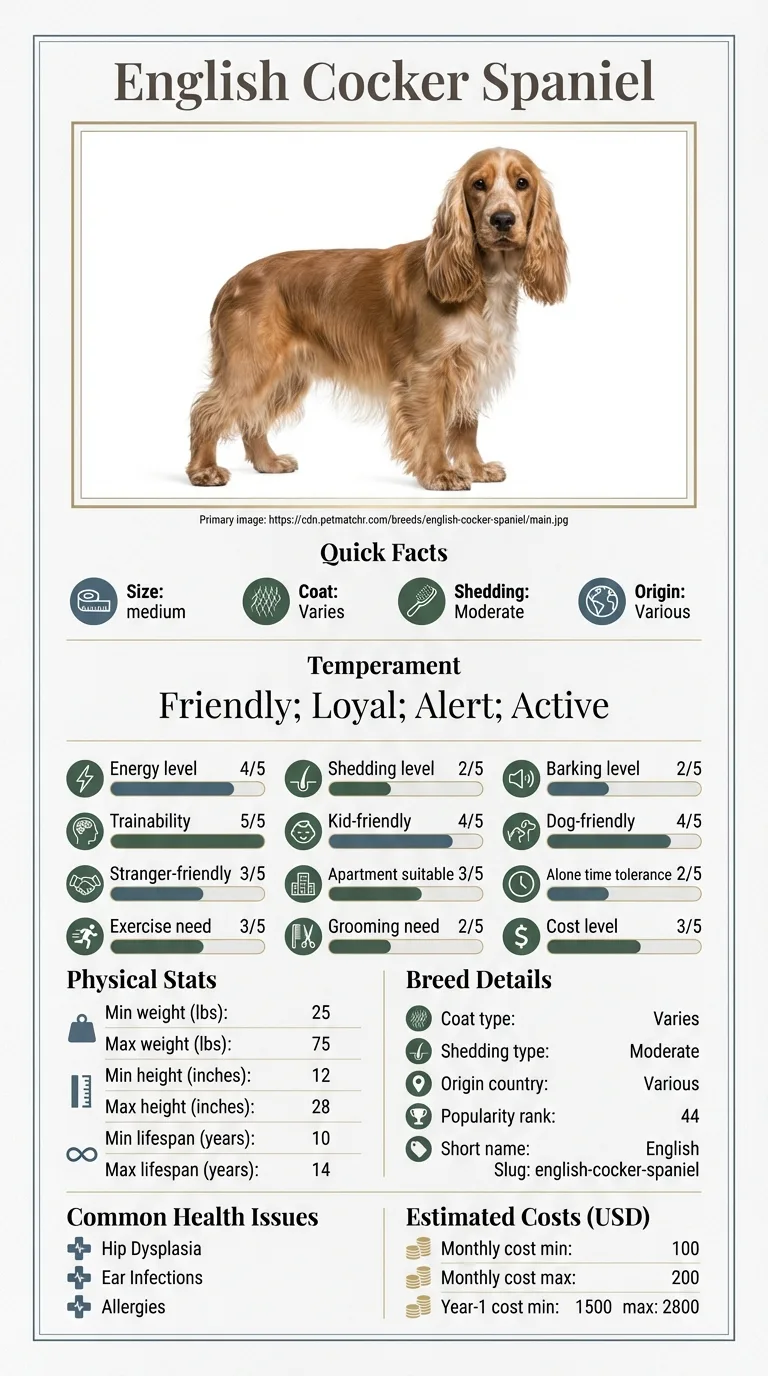
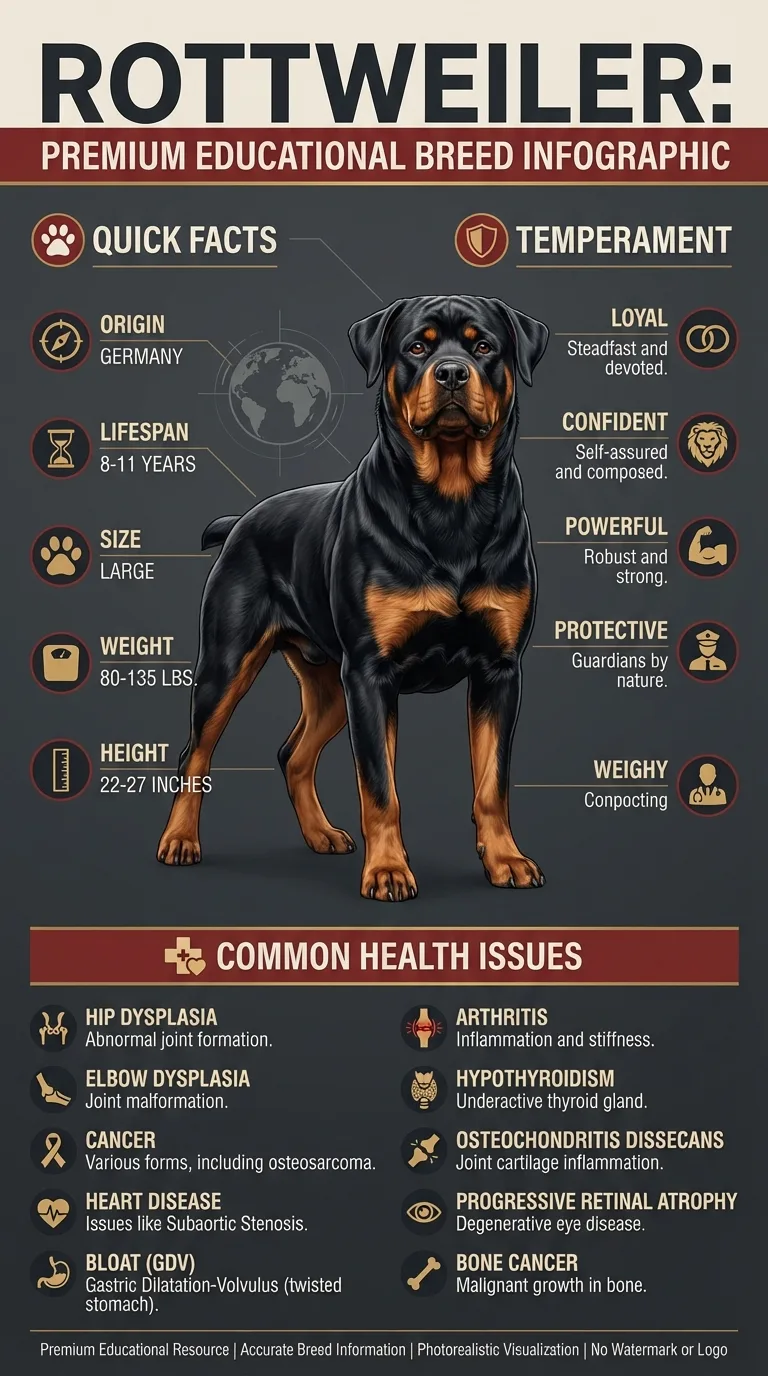
This is for someone already down to English Cocker Spaniel and Rottweiler and deciding between them. For this pair the decision usually turns on grooming need and apartment suitability, so those are covered first and in most detail. Anyone choosing from a flat has a clear answer here: English Cocker Spaniel rates 4/5 against 2/5. There is no origin story here — only what changes about your week.
Between English Cocker Spaniel and Rottweiler, grooming need is what separates them, and English Cocker Spaniel is the lower-effort dog of the two to keep.
Choose English Cocker Spaniel if you are in a flat or a smaller home, this is your first dog and shedding is a problem in your house.
Choose Rottweiler if you do not want a standing grooming appointment and you want a dog that is more watchful with visitors.
| Feature | english cocker spaniel | rottweiler | Winner |
|---|---|---|---|
| Size class | medium | large | Equal |
| Weight | 26–34 lbs | 80–135 lbs | Equal |
| Height | 15–17 in | 22–27 in | Equal |
| Lifespan | 12–14 years | 8–11 years | english cocker spaniel |
| Exercise need | High (4/5) | High (4/5) | Equal |
| Grooming need | High (4/5) | Low (2/5) | rottweiler |
| Shedding | Moderate (3/5) | High (4/5) | english cocker spaniel |
| Energy level | High (4/5) | High (4/5) | Equal |
| Barking | Moderate (3/5) | Moderate (3/5) | Equal |
| Apartment suitability | High (4/5) | Low (2/5) | english cocker spaniel |
| Good for first-time owners | High (4/5) | Low (2/5) | english cocker spaniel |
| Tolerates being alone | Low (2/5) | Low (2/5) | Equal |
| Trainability | High (4/5) | High (4/5) | Equal |
| Good with kids | Very high (5/5) | High (4/5) | english cocker spaniel |
| Good with other dogs | High (4/5) | Moderate (3/5) | english cocker spaniel |
| Friendly to strangers | High (4/5) | Low (2/5) | english cocker spaniel |
| Cost level | Moderate (3/5) | High (4/5) | english cocker spaniel |
| Coat | Medium, silky and feathered | Double coat, short | Equal |
| Origin | Various | Germany | Equal |
| Typical monthly cost | $100–$200 | $125–$250 | Equal |
| Typical first-year cost | $1,400–$2,900 | $2,000–$3,500 | Equal |
There's a three-to-four-fold weight difference here - the Rottweiler runs 80-135 lbs against the Cocker's 26-34 lbs, and stands a full 22-27 in at the shoulder against 15-17 in. This isn't a size comparison so much as a weight-class comparison; the Rottweiler is a genuinely large, powerful breed, and the Cocker is not built to keep up with it physically in any contest of strength.
Both breeds match on paper - High (4/5) energy, High (4/5) exercise need - but a Rottweiler's exercise translates into real force behind every pull on the leash given its size. Structured exercise and leash manners matter more here than with the Cocker simply because a poorly controlled 100+ lb dog is a different problem than a poorly controlled 30 lb one.
Grooming is easy with the Rottweiler - Low (2/5), against the Cocker's High (4/5) feathered-coat demands - but shedding runs the other way, High (4/5) for the Rottweiler against Moderate (3/5) for the Cocker. A short double coat still means real hair volume, just without the mats and trims a Cocker's coat requires.
Apartment suitability is where size finally becomes a real constraint: the Rottweiler rates Low (2/5), against the Cocker's High (4/5) - a large, powerful breed needs more room to move and, frankly, more caution around neighbors than a small apartment allows. Barking and alone-tolerance match at Moderate (3/5) and Low (2/5) for both, so noise isn't the deciding factor; space and liability are.
Trainability is identical on paper - High (4/5) for both - but first-time-owner suitability is not: the Cocker rates High (4/5), the Rottweiler just Low (2/5). A trainable dog and an easy dog for a beginner are not the same thing when that dog weighs over 100 lbs and carries the breed's protective instincts; a Rottweiler needs an owner who already knows what they're doing with a large, strong-willed breed.
The Cocker leads across every household-fit measure here. With kids it's Very High (5/5) against the Rottweiler's still-solid High (4/5). With other dogs the gap widens, High (4/5) against Moderate (3/5), and with strangers it widens further still, High (4/5) against Low (2/5) - the Rottweiler's guarding instincts, an asset in the right setting, make it naturally wary of people it doesn't know.
The lifespan gap is the single biggest number in this whole comparison: the Cocker's 12-14 years against the Rottweiler's 8-11, a difference of up to six years, typical of how much larger breeds tend to age faster. Both share a risk of hip dysplasia and progressive retinal atrophy. The Rottweiler's list runs considerably longer past that, including two forms of cancer, heart disease, and bloat - cancer in particular is a well-documented risk in the breed.
The Rottweiler costs more to keep at every level: High (4/5) general cost against the Cocker's Moderate (3/5), $125-250 a month against $100-200, and a first-year range up to $3,500 against the Cocker's $2,900 ceiling. Food volume alone for an 80-135 lb dog outpaces a 26-34 lb one considerably, before factoring in size-scaled medication and larger everything else.
English Cocker Spaniel weighs 26–34 lbs and lives 12–14 years; Rottweiler weighs 80–135 lbs and lives 8–11 years. The two diverge most on grooming need, apartment suitability and good for first-time owners and 1 other rated axes. They are level on tolerates being alone, barking and energy level, so those cannot decide it. Where the table declares a winner it means less work for the owner, nothing more; descriptive rows are left as ties on purpose. The value here is in the differences between the two columns; treat any single score as approximate.

Substantially - 80-135 lbs against 26-34 lbs, roughly three to four times the weight.
The Cocker, by a wide margin - 12-14 years against the Rottweiler's 8-11, a gap of up to six years.
Rated Low (2/5), well below the Cocker's High (4/5). Its size and protective instincts call for an experienced handler.
The Cocker, clearly - High (4/5) against the Rottweiler's Low (2/5).
Both carry a risk of hip dysplasia and progressive retinal atrophy. The Rottweiler's list is considerably longer, including cancer, heart disease, and bloat.
The Rottweiler, at every measure - up to $3,500 in a first year against the Cocker's $2,900 ceiling.
The Cocker, by a wide margin - High (4/5) against the Rottweiler's Low (2/5), reflecting the Rottweiler's guarding instincts.
The Cocker fits far more households comfortably - small spaces, first-time owners, families with strangers coming and going - while the Rottweiler needs an experienced owner with real space.
The Rottweiler costs more across the board - up to $3,500 in year one against the Cocker's $2,900 ceiling.
Exercise need matches at High (4/5) for both, but a Rottweiler's size makes leash control a bigger factor.
The Cocker lives considerably longer on average - 12-14 years against the Rottweiler's 8-11.
Secure checkout on Stripe. We never see your card.
7-day money-back guarantee. Instant access.

Health information here is general and is not veterinary advice. If your dog shows pain, sudden behaviour change, or worsening symptoms, consult a licensed veterinarian.
Some links on this site are affiliate links. We may earn a commission at no extra cost to you, and we only suggest products we believe are helpful for dog owners.
We research and check what we publish, but we do not warrant that any figure, date, price, or statement is accurate, complete, or current, and we accept no liability for any loss, cost, injury, or other harm arising from the use of this site. Use it as one reference among several. You remain responsible for your own decisions and for your dog's care - confirm anything that matters with a licensed veterinarian or another qualified professional before you act on it. Full disclaimer.
Match your lifestyle to the right dog.
Take quizNot sure which breed is right for you? Take our 2-minute quiz to find out.
Take the quiz