DogBreedCompass

Malamute or Corgi: A Working Coat on a Dog That Cannot Jump Down

Both breeds are double-coated working dogs that shed at 4/5 or above and both rate 4/5 for energy and 4/5 for cost. One weighs 27 pounds, stands 11 inches tall and must be stopped from jumping off the sofa.

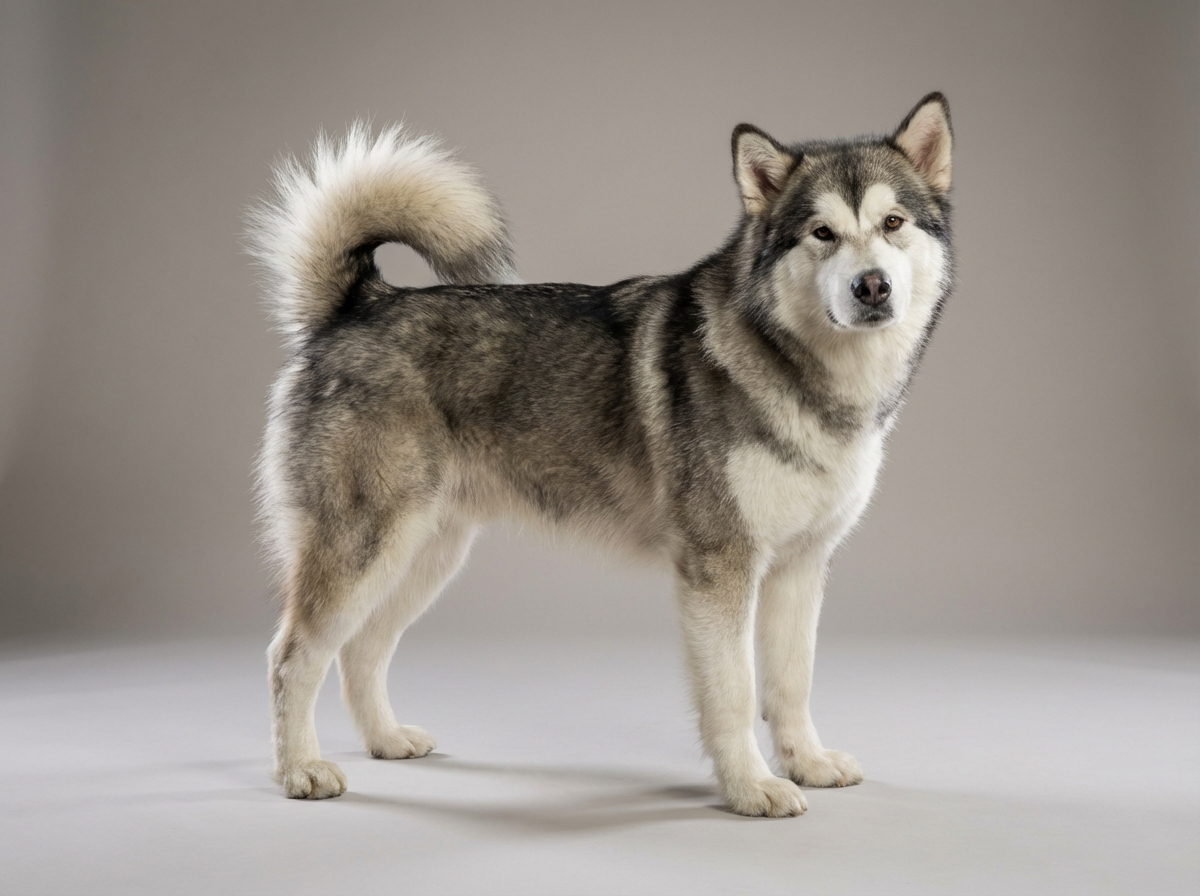
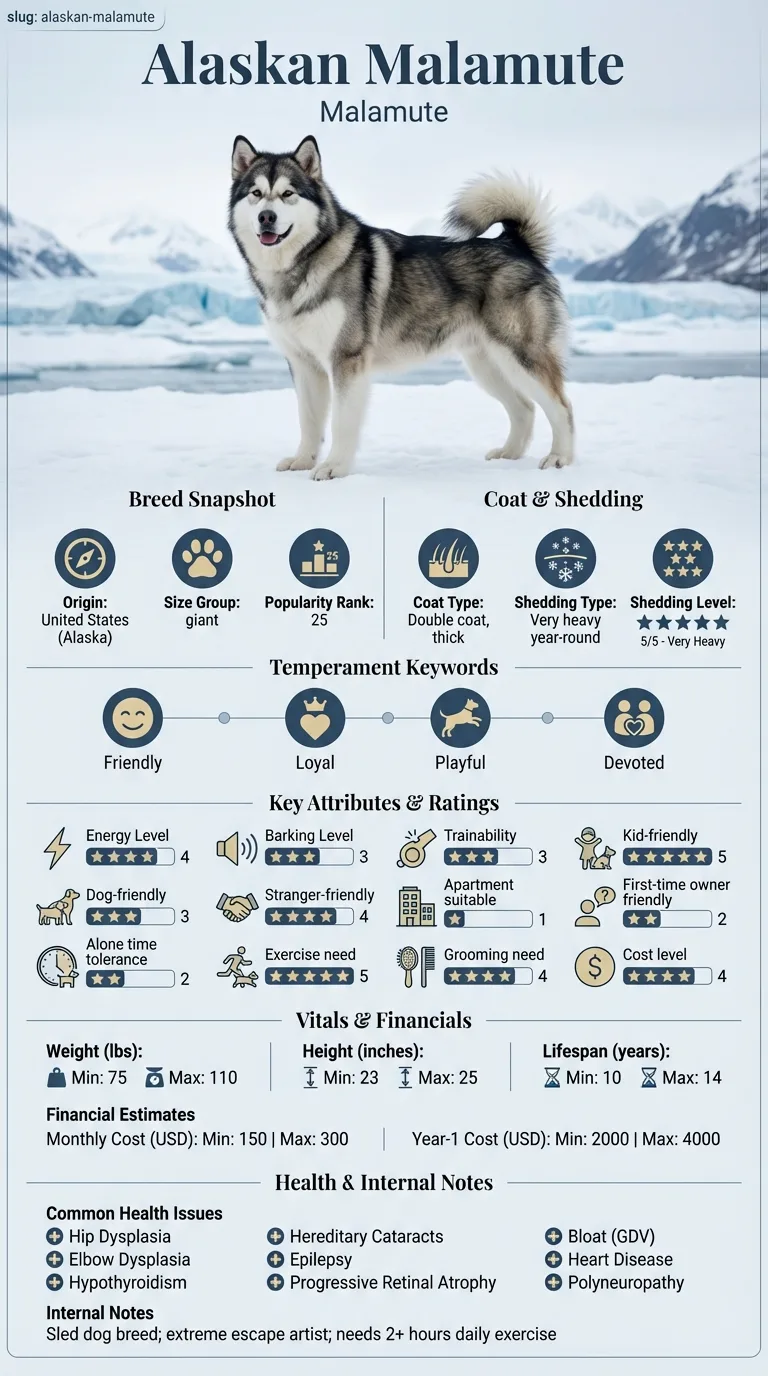
alaskan malamute infographic
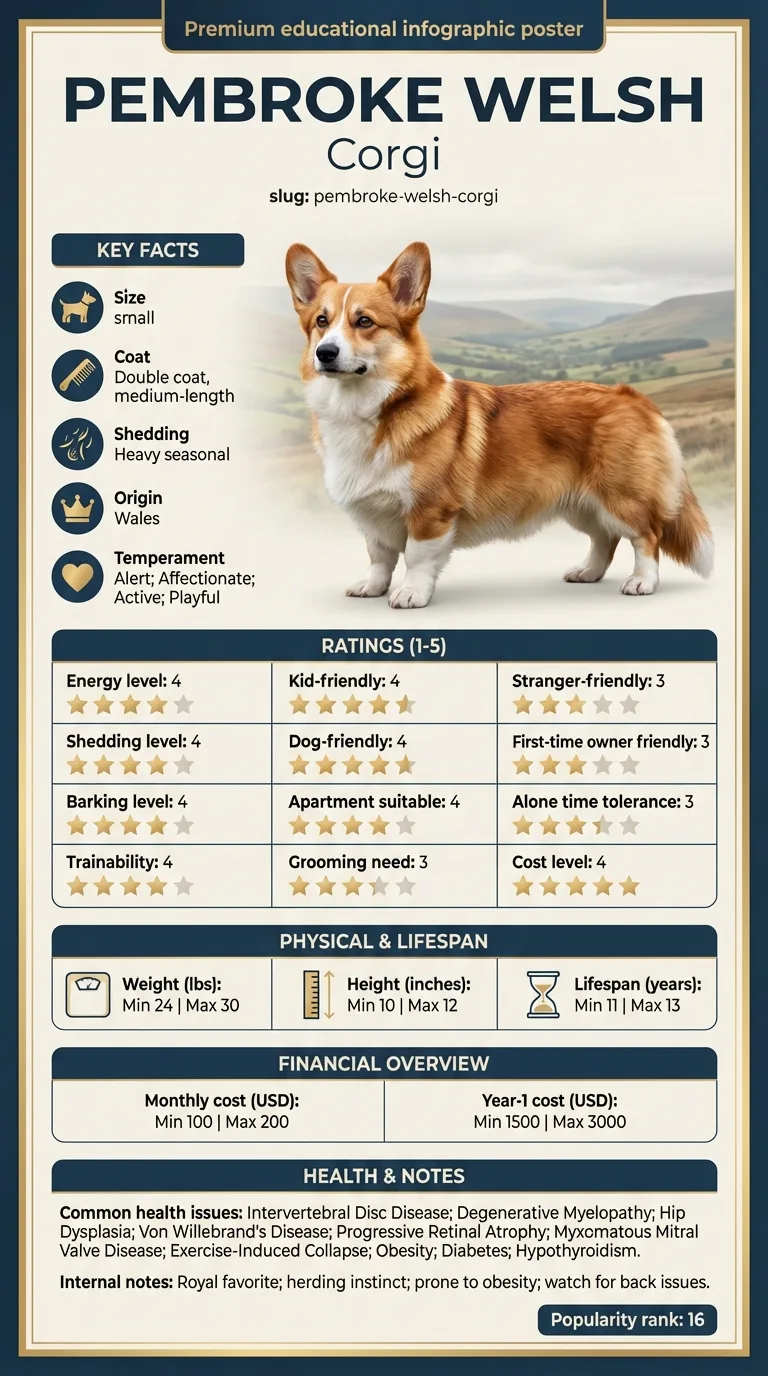
pembroke welsh corgi infographic

This page is for someone who wants a working temperament in a manageable size, and for anyone comparing a flat-friendly herder against a large northern breed without yet knowing what a long back actually requires.

Quick verdict

The Corgi delivers a working dog's brain and coat in a body that fits a flat at 4/5, but it comes with a back that has to be protected for life and a strong tendency to gain weight that makes protecting it harder.

Choose alaskan malamute if...

Choose the Alaskan Malamute if you want a large outdoor dog, you have cold weather, secure fencing and two hours a day for physical work, and you want a breed with no structural fragility to manage.

Choose pembroke welsh corgi if...

Choose the Pembroke Welsh Corgi if you want a smart, adaptable herding dog that suits a smaller home, tolerates a workday at 3/5 and trains at 4/5 — and you will manage its weight and keep it off the furniture.

Head-to-head comparison

Featurealaskan malamutepembroke welsh corgiWinner
Weight75–110 lbs24–30 lbsEqual
Height23–25 in10–12 inEqual
Lifespan10–14 years11–13 yearsEqual
CoatThick double coatMedium double coatpembroke welsh corgi
Grooming need4/53/5pembroke welsh corgi
Shedding5/5 — very heavy year-round4/5 — heavy seasonalpembroke welsh corgi
Energy level4/54/5Equal
Exercise need5/54/5pembroke welsh corgi
Trainability3/54/5pembroke welsh corgi
Barking3/54/5alaskan malamute
Good with kids5/54/5alaskan malamute
Good with other dogs3/54/5pembroke welsh corgi
Friendly to strangers4/53/5alaskan malamute
Apartment suitability1/54/5pembroke welsh corgi
Good for first-time owners2/53/5pembroke welsh corgi
Tolerates being alone2/53/5pembroke welsh corgi
Typical monthly cost$150–300$100–200pembroke welsh corgi
Typical first-year cost$2,000–4,000$1,500–3,000pembroke welsh corgi

Deep dive

The long back: what chondrodysplasia means in daily life

Intervertebral disc disease heads the Corgi's health list, and it is the single most important thing to understand before buying one.

The breed's short legs come from chondrodysplasia — a genetic form of dwarfism affecting cartilage growth. The same process that shortens the limbs also changes the composition of the spinal discs, which degenerate earlier and become more prone to bulging or rupturing into the spinal canal. When that happens the signs range from a reluctance to jump and a hunched, tense posture through to sudden hind-limb weakness or paralysis. Acute cases are surgical emergencies where the window for a good outcome is measured in hours.

The management is entirely practical and it starts on day one. No jumping down from sofas, beds or the boot of a car — ramps or steps instead, taught as a puppy so the dog never learns the habit. No stair-charging where it can be avoided. A harness rather than a collar. And, above everything, keeping the dog lean, because every extra pound loads the same discs.

That brings in the second entry: obesity, which the breed's own notes flag directly. Corgis are highly food-motivated, compact enough that a small excess shows up as a large percentage, and charming enough that people feed them. A heavy Corgi is a Corgi with a shorter comfortable life, and the connection between the two health entries is direct rather than incidental.

The Malamute has no comparable structural risk. It is a large, normally proportioned dog whose orthopaedic concerns are hips and elbows rather than spine, and while excess weight is unhelpful, the breed's 5/5 exercise requirement tends to keep it lean by force.

A small dog with a full working coat

People choose Corgis expecting a small-dog coat and get a working double coat in a small package. At 4/5 shedding with heavy seasonal blows, the volume of hair a Corgi produces is genuinely disproportionate to its size, and it is one of the most common surprises in the breed.

The structure is the same as the Malamute's: a weather-resistant outer coat over a dense insulating undercoat. It sheds moderately year-round and then releases the undercoat wholesale twice a year, at which point a 27 pound dog can fill a bin liner. The tool is the same too — an undercoat rake worked to the skin, plus a slicker, two or three times a week and daily during a blow. Grooming rates 3/5 rather than the Malamute's 4/5 only because there is less coat to get through, not because the job is different.

And the same prohibition applies: do not shave a Corgi. The double coat insulates in both directions and protects against sun, and shaved regrowth is often patchy and permanently altered in texture. A summer shave-down feels intuitive and is the wrong instinct.

The Malamute's coat is bigger in every dimension — 5/5 shedding, very heavy year-round, two dramatic annual blows, matting risk behind the ears and in the trousers if the routine slips. In absolute terms it is far more hair. In proportion to the dog, the Corgi is not far behind, and Corgi hair is short, straight and needle-like, which means it embeds in fabric and carpet more stubbornly than Malamute wool drifts.

Neither breed suits anyone who wants a low-hair house. If that is the priority, both should come off the list.

A heeler's brain: trainability, barking and the nipping question

The Corgi rates 4/5 for trainability against the Malamute's 3/5, and the difference is one of orientation rather than raw intelligence. A herding dog was selected to work in constant dialogue with a handler, taking direction at distance and adjusting. A freighting dog was selected to keep pulling without consulting anyone. Both are smart; only one is looking at you for instructions.

That makes the Corgi genuinely rewarding to train, and it also makes it a dog that must be given something to do. Under-employed Corgis develop the classic herding-breed repertoire: barking at movement, chasing bicycles and cars, and heel-nipping. The nipping is the one that catches families out. It is instinct — a cattle drover's tool for moving stock — and it typically shows up around running children. It responds well to early redirection onto legitimate outlets like ball work, treibball or trick training, but it needs to be recognised as hardware rather than misbehaviour.

Barking is 4/5 against the Malamute's 3/5, and it is the trait most likely to cause friction in a flat. Corgis are alert, vocal and opinionated. The 4/5 trainability helps — a quiet cue is achievable — but the tendency is real.

On sociability the Corgi leads with other dogs at 4/5 against 3/5, while the Malamute is warmer with strangers at 4/5 against 3/5 and better with children at 5/5 against 4/5.

Solitude and beginners both favour the Corgi at 3/5 against 2/5. It is not an all-day dog, but a normal working day with proper exercise either side is within range, and a committed first-time owner can manage one — provided they take the back seriously.

Degenerative myelopathy, Von Willebrand's and the tests to ask about

Beyond the disc disease, the Corgi's list carries two entries with established DNA tests, which makes the breeder conversation unusually concrete.

Degenerative myelopathy is a progressive disease of the spinal cord in older dogs, and the Pembroke is one of the breeds most associated with it. It is painless, which is part of what makes it so difficult: it begins as a subtle scuffing of one hind paw and dragging of the nails, progresses to hind-limb weakness and incoordination, and eventually to an inability to walk. There is a DNA test for the SOD1 variant linked to it, and although carrying two copies does not guarantee disease, the status of both parents is a fair and answerable question. The early signs are also easy to confuse with disc disease, which is why an older Corgi that starts scuffing a back foot deserves a proper neurological assessment rather than assumptions.

Von Willebrand's disease is the second — an inherited clotting disorder that matters most when the dog needs surgery, since an affected dog can bleed excessively from a routine procedure. It is DNA-testable and worth confirming before any elective operation.

The rest of the list is a mix: hip dysplasia, progressive retinal atrophy, myxomatous mitral valve disease, exercise-induced collapse, hypothyroidism, obesity and diabetes. Mitral valve disease is the common heart condition of middle-aged and older small dogs and usually announces itself as a murmur at a routine check.

The Malamute shares hip dysplasia, hypothyroidism and progressive retinal atrophy, and adds elbow dysplasia, bloat, epilepsy, hereditary cataracts, zinc-responsive dermatosis and inherited polyneuropathy. Its screening questions are hip and elbow scores plus eye certification.

Exercise, space and cost across a decade

The Corgi's 4/5 exercise rating is higher than most people expect from a short-legged dog and it is accurate. An adult needs about an hour a day, split, with mental work in the mix, and it will happily hike, though long-distance running on hard surfaces is not kind to the structure.

The Malamute's 5/5 is a different order: two hours minimum, physical resistance required, no indoor substitute, no bad-weather exemption, and a warm-climate routine pushed to first and last light for months. Its 1/5 apartment rating follows directly from that, against the Corgi's 4/5.

Where they agree is that neither is a low-effort dog. A Corgi given a garden and no work becomes vocal, bossy and heavy. A Malamute given the same becomes destructive and starts on the fence.

Cost is closer than the size gap suggests: both rate 4/5, with the Corgi at $100–200 a month against $150–300, and a first year of $1,500–3,000 against $2,000–4,000. The Corgi's spend is not food — it is the veterinary profile. Disc episodes are expensive when they happen, imaging is not cheap, and insurance premiums for the breed reflect both the spinal and cardiac entries on its list. Ramps, steps and a good harness are minor but real. The Malamute's spend is food volume and weight-scaled veterinary pricing, plus fencing.

Lifespan is effectively a draw at 11 to 13 years against 10 to 14, and in both breeds the difference between the bottom and the top of the range is largely down to weight management and joint care.

Alaskan Malamute vs Pembroke Welsh Corgi at a glance

Both breeds are double-coated working dogs that shed at 4/5 or above, and both rate 4/5 for energy and 4/5 for cost. One weighs 27 pounds, stands 11 inches tall, and needs to be actively stopped from jumping off the sofa.

The Corgi delivers a working dog's brain and coat in a body that fits a flat far better than the Malamute ever could. What comes with that low, long build is a back that has to be protected for life — no unsupervised jumping — and a strong tendency to gain weight that makes protecting that back harder still.

Choose the Malamute if you want a large outdoor dog, cold weather, secure fencing, and two hours a day for physical work, and you want a breed with no structural fragility to manage. Choose the Corgi if you want a smart, adaptable herding dog for a smaller home, and you will manage its weight and keep it off the furniture.

Frequently asked questions

Why should a Corgi not jump off furniture?

Its short legs come from a form of dwarfism that also changes the spinal discs, making them degenerate early and rupture more easily. Intervertebral disc disease heads the breed's health list, and repeated jumping down is a preventable contributor.

Do Corgis really shed as much as people say?

Yes. At 4/5 with heavy seasonal blows, a 27 pound Corgi carries a full working double coat and produces a volume of hair out of all proportion to its size. Short, straight Corgi hair also embeds in fabric more stubbornly than Malamute wool.

Can I shave a Corgi in summer?

No. The double coat insulates in both directions and protects the skin from sun, and shaved regrowth is frequently patchy and permanently altered. The same rule applies to the Malamute. Rake the undercoat out instead.

Which is easier to train?

The Corgi at 4/5 against 3/5. As a herding breed it was selected to work in dialogue with a handler, while the Malamute was selected to keep working without consulting one. Both are intelligent; only one is watching you for instructions.

Why do Corgis nip at heels?

It is a cattle drover's tool, and the instinct surfaces most often around running children. It is hardware rather than misbehaviour, and it redirects well onto ball work and structured games if addressed early.

What DNA tests should a Corgi breeder have done?

The SOD1 variant associated with degenerative myelopathy and Von Willebrand's disease, both of which have established tests in the breed. Then hip scores and eye certification.

Which is better for a flat?

The Corgi at 4/5 against 1/5, with an hour of daily exercise against the Malamute's two hours of physical work. The qualification is a 4/5 barking rating, which matters more with shared walls.

Quick answers

View more answers
Living

Malamute or Pembroke Welsh Corgi: which should I choose?

The Corgi if you want a working brain in a home-sized dog that trains at 4/5 and tolerates a workday — provided you manage weight and protect the back. The Malamute if you want a large outdoor dog with no structural fragility.

Costs

Which costs more?

The Malamute at $150–300 a month against $100–200, though both rate 4/5 for cost. The Corgi's expense is veterinary rather than dietary, driven by spinal and cardiac risk.

Health

What is the most important daily habit for a Corgi?

Keeping it lean. The breed is highly food-motivated and prone to obesity, and every extra pound loads a spine that is already structurally vulnerable. Measure food and count treats in the daily total.

Behavior

Which barks more?

The Corgi at 4/5 against 3/5. It is an alert, vocal herding breed that announces movement. At 4/5 trainability a quiet cue is achievable, but the tendency does not disappear.

Related DogBreedCompass guides

  • Alaskan Malamute breed guideThe Malamute profile covers exercise load, coat raking and the containment work the breed needs.
  • Pembroke Welsh Corgi breed guideThe Corgi profile covers back care, herding instinct and the breed's exercise expectations.
  • intervertebral disc disease in CorgisDisc disease is the breed's defining risk and the reason ramps and steps matter from day one.
  • obesity in Pembroke Welsh CorgisWeight is the one variable an owner fully controls, and it feeds directly into the spinal risk.
  • degenerative myelopathy in Alaskan MalamutesDegenerative myelopathy affects both breeds' older dogs and has a DNA test worth asking about.
  • adopting a Pembroke Welsh CorgiCorgis reach rescue in numbers, and an adult arrives with its build and back history already visible.

Related guides

Important reminder

Health information here is general and is not veterinary advice. Spinal risk, DNA testing and weight management should be discussed with your own veterinarian.

Some links on this site are affiliate links. We may earn a commission if you buy through them, at no additional cost to you.

Find Your Perfect Breed

Match your lifestyle to the right dog.

Take quiz

Find your match

Not sure which breed is right for you? Take our 2-minute quiz to find out.

Take the quiz