Health
Is the Weimaraner a brachycephalic breed?
No, it has a normal, moderately long muzzle and doesn't carry the flat-faced airway obstruction risk of brachycephalic breeds.

Quick answer
Is the Weimaraner a brachycephalic breed?
No, it has a normal, moderately long muzzle and doesn't carry the flat-faced airway obstruction risk of brachycephalic breeds.
Whatever you've read about brachycephalic breathing problems, it doesn't apply to this breed — and what does apply is worth understanding on its own terms.
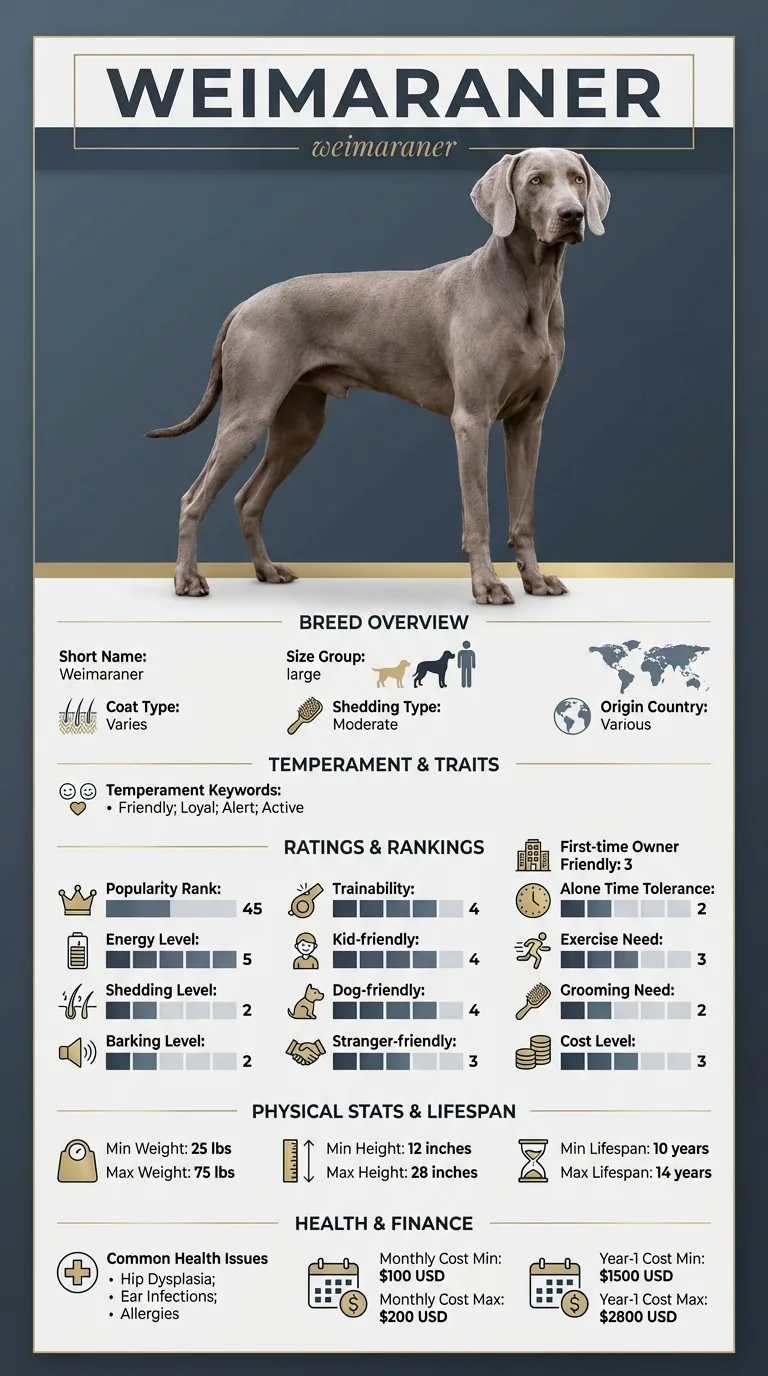
This is relevant to any Weimaraner owner trying to make sense of breathing-related symptoms, since ruling out the wrong cause (a flat-faced airway problem) helps focus attention on what's actually likely going on.
This guide is not medical advice. If your dog shows pain, sudden behavior change, or worsening symptoms, consult a licensed veterinarian.
Some links may be affiliate links. We may earn a commission at no extra cost to you. We only suggest products we believe are helpful for dog owners.
We research and check what we publish, but we do not warrant that any figure, date, price, or statement is accurate, complete, or current, and we accept no liability for any loss, cost, injury, or other harm arising from the use of this site. Use it as one reference among several. You remain responsible for your own decisions and for your dog's care - confirm anything that matters with a licensed veterinarian or another qualified professional before you act on it. Full disclaimer.
Weimaraners have a normal, moderately long muzzle and don't carry the structural airway obstruction risk seen in brachycephalic, flat-faced breeds, despite some online sources framing respiratory risk statistics around that comparison. The respiratory issues actually relevant to this breed connect instead to infectious illness, age-related cardiac disease, and normal heavy panting during exercise and heat.
True structural respiratory disease isn't a documented concern for this breed given its normal muzzle anatomy. The respiratory symptoms that do commonly occur — mild infectious illness, exercise- and heat-related panting, and age-related cardiac-linked breathing changes — are common in the sense that most active, social dogs encounter some version of them over a lifetime.
The Weimaraner's normal, moderately long muzzle means it doesn't carry the brachycephalic structural airway risk seen in flat-faced breeds. What is breed-relevant is the combination of very high exercise drive, which produces prominent panting during exertion, and documented cardiac disease risk in the breed's senior years, which can independently affect breathing.
Social exposure to other dogs, heat and humidity during exercise, and general activity level are the main environmental factors shaping this breed's actual respiratory experiences, none of which relate to the structural airway anatomy seen in brachycephalic breeds.
See a vet for a cough that persists more than a week, or panting that seems disproportionate to activity and heat. Labored breathing at rest, blue or pale gums, or breathing distress that doesn't resolve with rest are emergencies requiring immediate care.
See all Weimaraner health problems, which breeds are prone to respiratory disease, or the full Weimaraner breed guide for temperament, exercise needs and ownership costs.
Mild infectious illness like kennel cough typically resolves within one to two weeks. Cardiac-related breathing changes, if identified, are managed as an ongoing condition rather than something with a fixed resolution timeline.
Success looks like correctly identifying which category a breathing symptom actually falls into — infectious, cardiac, or normal exertional panting — rather than assuming a structural airway cause that doesn't apply to this breed's anatomy.
Brachycephalic obstructive airway syndrome, the breathing difficulty seen in Bulldogs, Pugs, and similar flat-faced breeds, is caused by a specific skull shape: a shortened muzzle that crowds the soft tissue of the airway into too little space, causing narrowed nostrils, an elongated soft palate, and other structural obstructions. Weimaraners have a normal, moderately long muzzle with none of this crowding, which means they simply don't carry this specific structural risk, regardless of what a mismatched statistic or breed list might suggest.
This distinction matters practically: if a Weimaraner is having genuine breathing difficulty, the underlying cause is almost certainly something else entirely — not a flat-faced airway problem — and chasing the wrong explanation delays finding the real one. Understanding what this breed's actual respiratory risks look like is more useful than worrying about a condition that doesn't apply to its anatomy.
For a Weimaraner, the more relevant respiratory considerations tend to connect to the breed's actual documented traits rather than skull shape. An active, social dog that spends time around other dogs at parks or in training classes has ordinary exposure risk to infectious respiratory illness like kennel cough, which typically causes a mild, self-limiting cough but occasionally needs veterinary attention if it persists or worsens. Cardiac disease, which does become more relevant as the breed ages, can also cause breathing changes — faster resting respiratory rate or a cough — as a secondary effect of the heart's reduced efficiency, not from an airway obstruction.
Heat and exertion are the other genuinely relevant factor: a breed with very high exercise drive combined with heavy panting during hard exercise in heat can look alarming, but this is a normal cooling mechanism working overtime, not respiratory disease, unless it's paired with other signs of overheating. Knowing which of these categories a symptom fits — infectious, cardiac, or simple heat-driven panting — is far more useful than assuming it stems from a structural airway problem this breed doesn't actually have.

If you think your Weimaraner has respiratory disease, the plan is three steps: write down what you have seen and when it started, book a veterinary appointment rather than waiting for the next flare, and take video of the behaviour or symptom before you go — the thing you are worried about rarely happens in the consulting room. Screening in the parents covers bloat (gdv), hip dysplasia, hypertrophic osteodystrophy.
What the vet visit should produce is a diagnosis and a written plan, not just reassurance: what is being ruled out, what the monitoring interval is, and which signs mean you come back sooner. Ask what the treatment costs across a year rather than per visit, because that is the number that decides whether you are managing this condition or reacting to it.
Between appointments, keep a short log — dates, what you saw, what changed. It is the single most useful thing an owner brings to a follow-up, and for respiratory disease it is often what separates a clear pattern from a guess.
After reading an alarming online statistic about respiratory disease risk in dogs, Wren became convinced her Weimaraner Otto's occasional post-exercise panting meant a serious airway problem, the kind she'd read was common in flat-faced breeds. She brought it up anxiously at his next checkup. Her vet clarified that Otto's muzzle structure was completely normal and that the statistic she'd read applied specifically to brachycephalic breeds, not Weimaraners. A quick exam confirmed Otto's airway was fine; his panting was simply proportional to how hard he'd been running that day. Wren left with a much clearer sense of what to actually watch for in her own dog, rather than worrying about a risk that had never applied to him in the first place.
Key takeaway: Not every respiratory statistic you find online applies to every breed — knowing your dog's actual anatomy helps you focus on the symptoms that are genuinely relevant instead of chasing the wrong explanation.
No. Weimaraners have a normal, moderately long muzzle without the flat-faced skull structure that causes brachycephalic airway obstruction in breeds like Bulldogs or Pugs. Any statistic framed around brachycephalic risk doesn't apply to this breed.
The more relevant causes include infectious respiratory illness like kennel cough, cardiac disease affecting breathing as dogs age, and normal heavy panting during hard exercise or heat, rather than any structural airway obstruction.
Occasional mild snoring can occur in any breed, but persistent, loud snoring or snorting isn't typical for this breed's normal muzzle structure and is worth mentioning to your vet rather than assuming it's expected.
Usually not by itself — panting is this breed's normal cooling mechanism and can look intense during hard exercise or heat. It becomes concerning if paired with other overheating signs like stumbling, excessive drooling, or collapse.
Yes, cardiac disease becoming relevant as the breed ages can cause a cough or faster resting breathing as a secondary effect of reduced heart efficiency, which is a different mechanism entirely from an airway obstruction.
It's a common, usually mild and self-limiting infectious respiratory illness spread between dogs in social settings like parks or training classes. It typically resolves on its own but warrants a vet visit if it persists, worsens, or is paired with lethargy or fever.
Labored breathing at rest, blue or pale gums, or breathing distress that doesn't resolve with rest are emergencies requiring immediate veterinary care, regardless of the underlying cause.
No, it has a normal, moderately long muzzle and doesn't carry the flat-faced airway obstruction risk of brachycephalic breeds.
Infectious illness like kennel cough, age-related cardiac disease, or normal heavy panting from exercise and heat.
Usually not alone, since it's a normal cooling mechanism, unless paired with other overheating signs like stumbling or collapse.
Yes, cardiac disease in aging dogs can cause a cough or faster resting breathing as a secondary effect of reduced heart efficiency.
Labored breathing at rest or blue or pale gums are emergencies requiring immediate veterinary care.
A one-page prep sheet for this condition: the signs, the questions to ask, what to get priced. Unlocks here.
You get: Vet visit prep sheet
No spam. One-click unsubscribe. See our privacy policy.
Preview page 1 before you decide.