Health
What causes arthritis in Weimaraners?
Cumulative joint wear from an active lifestyle, often worsened by an existing issue like hip dysplasia or an old injury.

Quick answer
What causes arthritis in Weimaraners?
Cumulative joint wear from an active lifestyle, often worsened by an existing issue like hip dysplasia or an old injury.
The dog who used to be first out the door on a walk starts hanging back at the porch steps. That slow, easy-to-miss change is usually arthritis, not a Weimaraner suddenly losing interest in exercise.
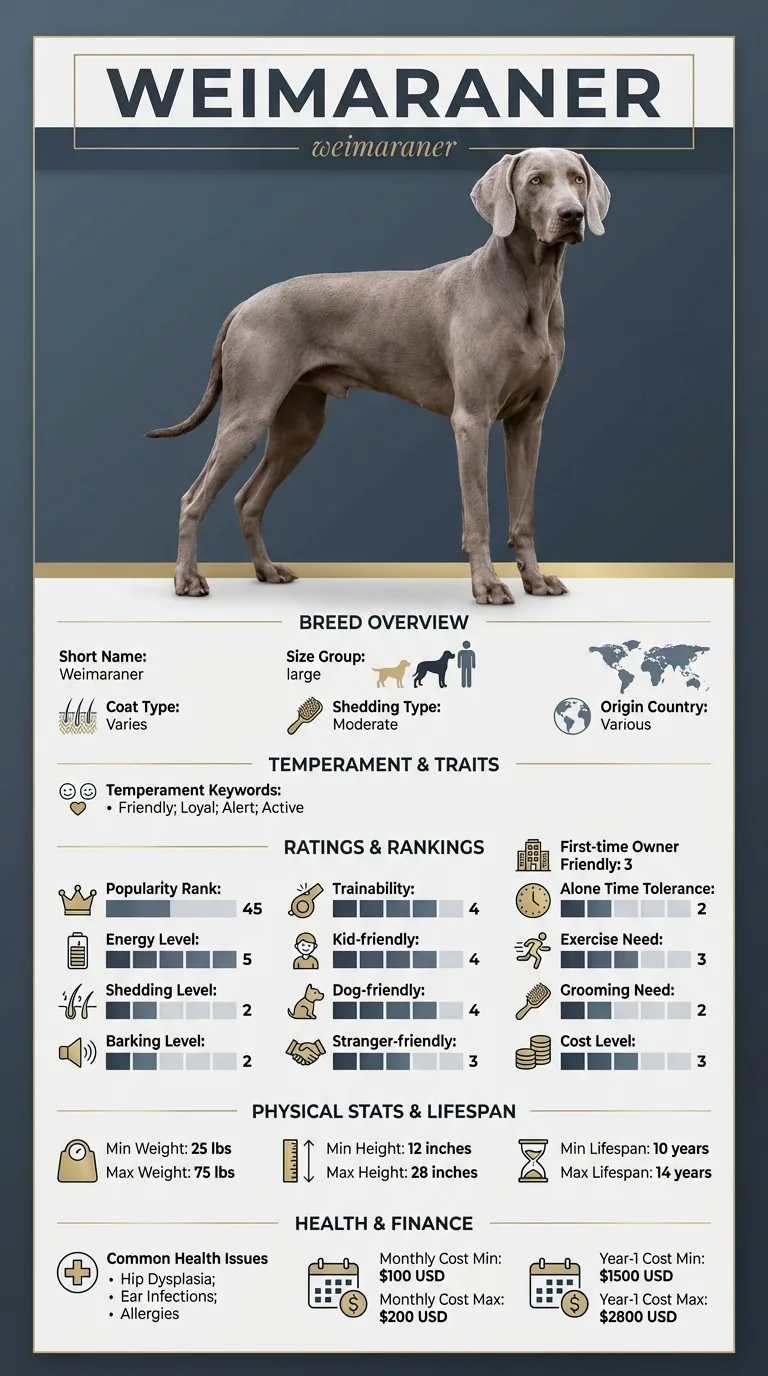
This affects owners of Weimaraners in their senior years, and sometimes middle-aged dogs with a history of hip dysplasia or an old injury that never fully resolved.
This guide is not medical advice. If your dog shows pain, sudden behavior change, or worsening symptoms, consult a licensed veterinarian.
Some links may be affiliate links. We may earn a commission at no extra cost to you. We only suggest products we believe are helpful for dog owners.
We research and check what we publish, but we do not warrant that any figure, date, price, or statement is accurate, complete, or current, and we accept no liability for any loss, cost, injury, or other harm arising from the use of this site. Use it as one reference among several. You remain responsible for your own decisions and for your dog's care - confirm anything that matters with a licensed veterinarian or another qualified professional before you act on it. Full disclaimer.
Arthritis is the progressive breakdown of cartilage cushioning a joint, leading to pain, stiffness, and reduced mobility over time. In an athletic breed like the Weimaraner, it typically develops on top of an existing joint issue, such as hip dysplasia, or follows years of high-impact activity.
Arthritis becomes increasingly common as any large, active breed ages, and Weimaraners are no exception, particularly those with a history of hip dysplasia. It is one of the more predictable senior-year issues for a breed built around sustained physical activity.
Weimaraners are a large, high-drive sporting breed with an exercise need at the top of the scale; the same joints that make them capable of running all day also accumulate wear faster than a lower-energy breed's. Hip dysplasia, a documented issue in the breed, compounds this by giving arthritis an already-imperfect joint to work on.
Years of hard surfaces, repetitive high-impact activity, and inconsistent exercise routines (alternating intense activity with long rest periods) accelerate joint wear. Excess body weight adds further mechanical stress regardless of activity level.
Talk to your vet if you notice stiffness after rest, reluctance to jump or use stairs, a change in gait, or general slowing down that isn't explained by anything else. These are worth a joint exam even before limping becomes obvious, since earlier management tends to preserve mobility longer.
See all Weimaraner health problems, which breeds are prone to arthritis, or the full Weimaraner breed guide for temperament, exercise needs and ownership costs.
Arthritis is a lifelong, progressive condition once it starts. Most dogs show meaningful comfort improvement within a few weeks of starting a management plan, but ongoing adjustments are normal as the condition slowly progresses over years.
Success is a dog that stays mobile, comfortable, and willing to move for as long as possible, with flare-ups managed quickly rather than a joint that's pain-free indefinitely.
Weimaraners are built for endurance and speed, not for careful, low-impact movement. A dog that spends years running full-out, jumping, and making hard turns puts real cumulative stress on hips, elbows, and knees. Add hip dysplasia, a documented issue in the breed, and joints that were already imperfectly formed wear down faster than joints that started out normal.
Arthritis is usually secondary in Weimaraners: it develops on top of an existing joint issue or an old injury rather than appearing out of nowhere in an otherwise healthy joint. That's different from breeds where arthritis is more purely age-related wear with no other contributing factor.
The early signs are subtle because this breed's default temperament is to push through discomfort rather than show it. A slight hesitation before jumping into the car, a slower start after resting, or reluctance on stairs are often the first real clues, well before obvious limping sets in.
None of these reverse joint damage, but consistent habits are what keep a dog comfortable and mobile for years after diagnosis.

Diane's Weimaraner, Sable, was diagnosed with mild hip dysplasia as a young dog but never showed obvious problems until age eight, when she started hesitating before jumping into the car and seemed stiff getting up in the mornings. A vet exam confirmed arthritis had developed in both hips. Diane switched their daily runs to shorter, steadier walks and added swimming twice a week at a local dog pool. She also added a ramp to the car and orthopedic bedding at home. Within about six weeks, Sable was moving more freely and seemed noticeably more comfortable in the mornings.
Key takeaway: The connection between Sable's earlier hip dysplasia diagnosis and her later arthritis wasn't a coincidence. Knowing a dog's joint history helps owners catch arthritis early instead of writing off the first signs as simple aging.
It varies, but dogs with hip dysplasia or a joint injury can show signs as early as middle age, while otherwise healthy Weimaraners more typically develop it in their senior years, roughly from age 7 or 8 onward.
Often, yes. Hip dysplasia is a documented issue in Weimaraners, and a joint that develops abnormally is more prone to the cartilage wear that becomes arthritis later in life.
No, arthritis is a degenerative condition that's managed, not cured. The goal of treatment is slowing progression and keeping the dog comfortable and mobile, not reversing existing joint damage.
Slower starts after resting, hesitation before jumping, and reduced enthusiasm for activities the dog used to love are usually earlier and subtler signs than an obvious limp.
No, but the type of exercise should change. Controlled, moderate activity like leash walks and swimming keeps joints moving and muscles supporting them strong, while high-impact activity like hard sprinting and jumping should be reduced.
Costs vary widely depending on severity, from modest ongoing costs for weight management and supportive care to significantly more if joint-support medication or supplements prescribed by a vet become part of the routine.
Significantly. Extra weight adds direct mechanical load to already-compromised joints, and keeping a lean body condition is one of the most effective things an owner can control.
Cumulative joint wear from an active lifestyle, often worsened by an existing issue like hip dysplasia or an old injury.
A slower start after resting or hesitation before jumping, often well before an obvious limp appears.
Yes, shift toward lower-impact activity like swimming and steady walks instead of hard sprinting and jumping.
Keeping the dog lean, managing exercise type, and following your vet's supportive care plan are the main levers owners actually control.
Ongoing costs vary with severity, but plan for regular vet checks and the possibility of supportive treatment as the condition progresses.
A one-page prep sheet for this condition: the signs, the questions to ask, what to get priced. Unlocks here.
You get: Vet visit prep sheet
No spam. One-click unsubscribe. See our privacy policy.
Preview page 1 before you decide.