Health
Why is whelping riskier in Shih Tzus?
Puppies inherit broad, round skulls that fit poorly through a small maternal pelvis, and uterine inertia is common in small breeds — so labour stalls more often.

Quick answer
Why is whelping riskier in Shih Tzus?
Puppies inherit broad, round skulls that fit poorly through a small maternal pelvis, and uterine inertia is common in small breeds — so labour stalls more often.
Two features of this breed's anatomy collide during whelping, and neither is optional. Shih Tzu puppies inherit a broad, rounded skull; Shih Tzu mothers have a birth canal sized for a nine-to-sixteen-pound dog. When the head that has to come out is proportionally large for the passage it must fit through, labour can stall — and a stalled labour is a surgical emergency, not something to sleep on.
First-time breeders who have read general whelping guidance written for average-shaped dogs, and pet owners facing an unplanned pregnancy with no veterinary plan in place. Also anyone who assumes a small dog means an easy birth, which is close to the opposite of the truth here.
This guide is not medical advice. If your dog shows pain, sudden behavior change, or worsening symptoms, consult a licensed veterinarian.
Some links may be affiliate links. We may earn a commission at no extra cost to you. We only suggest products we believe are helpful for dog owners.
We research and check what we publish, but we do not warrant that any figure, date, price, or statement is accurate, complete, or current, and we accept no liability for any loss, cost, injury, or other harm arising from the use of this site. Use it as one reference among several. You remain responsible for your own decisions and for your dog's care - confirm anything that matters with a licensed veterinarian or another qualified professional before you act on it. Full disclaimer.
Pregnancy and whelping in Shih Tzus carry elevated risk of dystocia, chiefly because puppies' broad skulls sit awkwardly against a small maternal pelvis, and because uterine inertia is common in small breeds. Caesarean delivery is frequently required, and the breed's documented airway syndrome adds anaesthetic risk on top. Planned veterinary supervision is the difference between a managed process and an emergency.
Assisted delivery is substantially more likely in brachycephalic small breeds than in the average dog, and planned caesareans are common practice in this breed group. Treating an unassisted, unsupervised whelp as the expected outcome is the single most dangerous assumption an owner can make here.
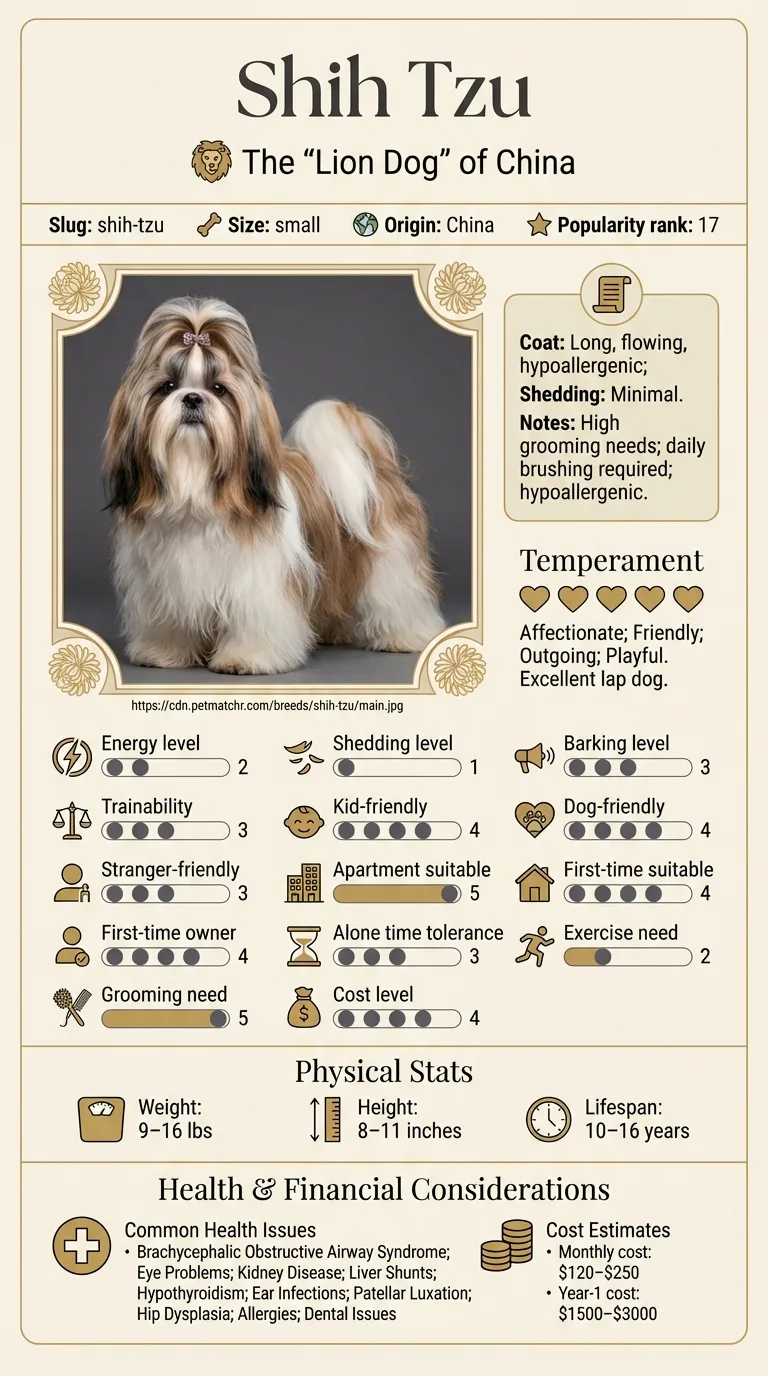
This breed's documented Brachycephalic Obstructive Airway Syndrome is the root of both halves of the problem: the same skull conformation that narrows the airway also produces the broad, round puppy head that struggles through a small pelvis. The breed's size — 9 to 16 pounds — sets the size of that pelvis. Its documented low exercise need and generally sedentary profile make maternal obesity a realistic contributor, and excess condition is associated with worse labour outcomes.
Preparation is the environmental factor that matters most. Whether a pregnancy is supervised, whether litter size and fetal size were assessed by imaging beforehand, whether a due date was actually calculated, and whether a 24-hour clinic was identified in advance all change outcomes far more than anything about the whelping box itself. Heat is a genuine secondary factor: a heavily pregnant brachycephalic dog handles warm weather badly, and a hot whelping room adds real stress.
Speak to your vet as soon as a pregnancy is suspected, and plan the whelping with them rather than alone — that is the single highest-value action available. Go immediately, at any hour, for: strong straining for more than about 20 to 30 minutes with no puppy delivered; more than roughly two hours between puppies when more are known to be inside; a green or dark discharge with no puppy following; the bitch going quiet and unproductive after active labour; foul-smelling discharge; collapse, marked weakness, tremors or seizures; or pregnancy extending past the calculated due date. Tremors and seizures around whelping or nursing can indicate eclampsia, which is a life-threatening emergency. Do not attempt to deliver a stuck puppy yourself.
Start here: Shih Tzu Most Common Genetic Disorders: What to Screen For
See all Shih TZU health problems, which breeds are prone to pregnancy complications, or the full Shih TZU breed guide for temperament, exercise needs and ownership costs.
Canine gestation runs roughly 63 days from ovulation, though breeding dates make that an estimate rather than a certainty — which is why veterinary dating matters. Expect the possibility of a caesarean rather than treating it as a failure; in this breed group it is a common and often planned outcome. Recovery from a caesarean typically means a few days of close monitoring and several weeks of restricted activity, alongside supporting a mother who is simultaneously healing and nursing.
A live, healthy litter and a mother who comes through it well — reached by planned veterinary supervision rather than by luck. It is worth stating the harder truth alongside that: for many Shih Tzu owners, the genuinely successful outcome is deciding not to breed at all. Spaying removes this entire category of risk, and for a pet dog with a documented airway condition that is a legitimate and often kinder decision.
Dystocia — difficult birth — happens when a puppy cannot pass through the maternal pelvis. In brachycephalic breeds the usual reason is fetal-maternal disproportion: the puppy's head and shoulders are simply wide relative to the canal.
What an owner sees is a dog who is clearly in labour and not producing puppies. Strong, visible abdominal straining for a sustained period with nothing delivered. Or the opposite and more insidious version: a bitch who was contracting and then goes quiet, resting between what should be productive pushes, hours passing with nothing happening. Uterine inertia — the uterus stopping effective contraction, sometimes from exhaustion, sometimes primarily — is common in small breeds and is easy to mistake for a normal pause.
Both pictures are veterinary emergencies. Puppies still inside a stalled labour are running out of oxygen, and the window in which they and the mother can be saved is measured in hours.
Caesarean rates are high in brachycephalic breeds, and for this breed the operation carries an extra layer of consideration beyond the surgery itself. A dog with documented BOAS has a compromised upper airway at rest. Sedation and anaesthesia relax airway tissue further, and recovery — the period after the tube comes out, when the dog must maintain her own airway while still groggy — is the highest-risk phase.
This is not an argument against a caesarean; when labour has stalled it is the thing that saves lives. It is an argument for choosing your practice deliberately, in advance, rather than at two in the morning. A team that regularly handles brachycephalic anaesthesia will plan for pre-oxygenation, careful airway management, and close monitored recovery rather than treating it as a routine spay-equivalent.
The practical version of this advice: have the conversation during pregnancy. Know which clinic you are going to, whether they are staffed overnight, how far the drive is, and what they will want you to do on the phone.

If you think your Shih Tzu has pregnancy complications, the plan is three steps: write down what you have seen and when it started, book a veterinary appointment rather than waiting for the next flare, and take video of the behaviour or symptom before you go — the thing you are worried about rarely happens in the consulting room. Screening in the parents covers brachycephalic obstructive airway syndrome, eye problems, kidney disease.
What the vet visit should produce is a diagnosis and a written plan, not just reassurance: what is being ruled out, what the monitoring interval is, and which signs mean you come back sooner. Ask what the treatment costs across a year rather than per visit, because that is the number that decides whether you are managing this condition or reacting to it.
Between appointments, keep a short log — dates, what you saw, what changed. It is the single most useful thing an owner brings to a follow-up, and for pregnancy complications it is often what separates a clear pattern from a guess.
A Shih Tzu delivered her first puppy without difficulty at around four in the morning and then settled. Her owners, reading that rests between puppies are normal, let her sleep. Two hours later she was still resting, still visibly pregnant, and only mildly straining now and then. The scan done before the due date had shown three puppies — which is the detail that saved the litter, because it turned 'she seems to be taking a while' into 'two puppies are unaccounted for.' The emergency clinic, chosen weeks earlier because they were staffed overnight and experienced with flat-faced breeds, diagnosed uterine inertia and delivered the remaining two by caesarean. All three puppies lived. The vet was blunt afterwards: another two hours and the conversation would have been different.
Key takeaway: Knowing how many puppies are in there, before labour starts, is what turns a worrying quiet spell into an actionable emergency.
Assisted delivery is considerably more likely than in an average-shaped breed, and planned caesareans are common in brachycephalic small breeds. It should be anticipated and prepared for rather than treated as an unlikely worst case.
Roughly two hours with more puppies known to be inside warrants an urgent call, and strong unproductive straining for 20 to 30 minutes warrants going in immediately. Timing is the information your vet needs most.
It reduces the mother's reserve during the sustained effort of labour, and it raises anaesthetic risk for a caesarean — particularly during recovery, when she must maintain her own airway while still sedated.
Not necessarily, and often the reverse. A single puppy or very small litter can grow larger than each puppy would in a bigger litter, which worsens the disproportion problem.
Contractions that never become effective, or that weaken and stop before delivery is complete. It is common in small breeds and is easy to mistake for a normal rest between puppies, which is why it is dangerous.
No. Attempting this risks serious injury to both puppy and mother. A stalled delivery is a reason to be in a car on the way to a vet, not to intervene.
A dangerous drop in blood calcium, usually while nursing, presenting as restlessness, tremors, stiffness or seizures. It is a life-threatening emergency requiring immediate veterinary treatment.
It deserves honest thought. Given the documented airway condition, the elevated dystocia risk and the anaesthetic considerations, many vets would advise against breeding a pet-quality dog of this breed, and spaying removes the risk entirely.
Puppies inherit broad, round skulls that fit poorly through a small maternal pelvis, and uterine inertia is common in small breeds — so labour stalls more often.
Strong straining for 20 to 30 minutes with no puppy, roughly two hours between puppies with more inside, green discharge with no puppy, or the bitch going quiet after active labour. Go immediately.
Yes — documented BOAS raises anaesthetic risk, especially during recovery, so choosing a practice experienced with brachycephalic anaesthesia in advance genuinely matters.
Veterinary assessment of litter and fetal size, a calculated due date, twice-daily temperature monitoring in the final week, and a confirmed 24-hour clinic with known drive time.
For a pet dog, genuinely yes. It removes this entire risk category, and given the breed's documented airway condition many vets would advise against breeding pet-quality dogs.
A one-page prep sheet for this condition: the signs, the questions to ask, what to get priced. Unlocks here.
You get: Vet visit prep sheet
No spam. One-click unsubscribe. See our privacy policy.
Preview page 1 before you decide.