Living
Which breed suits most households better?
The Aussie, if you can meet its exercise demand — it's cheaper to keep and lives longer. The Saint Bernard suits a household prioritizing a gentle temperament over cost and longevity.

Quick answer
Which breed suits most households better?
The Aussie, if you can meet its exercise demand — it's cheaper to keep and lives longer. The Saint Bernard suits a household prioritizing a gentle temperament over cost and longevity.
Australian Shepherd or Saint Bernard? On paper they differ most on exercise need, and on the scales Saint Bernard is the heavier at 120–180 lbs. Here is how the two compare on everything that shapes an ordinary week.
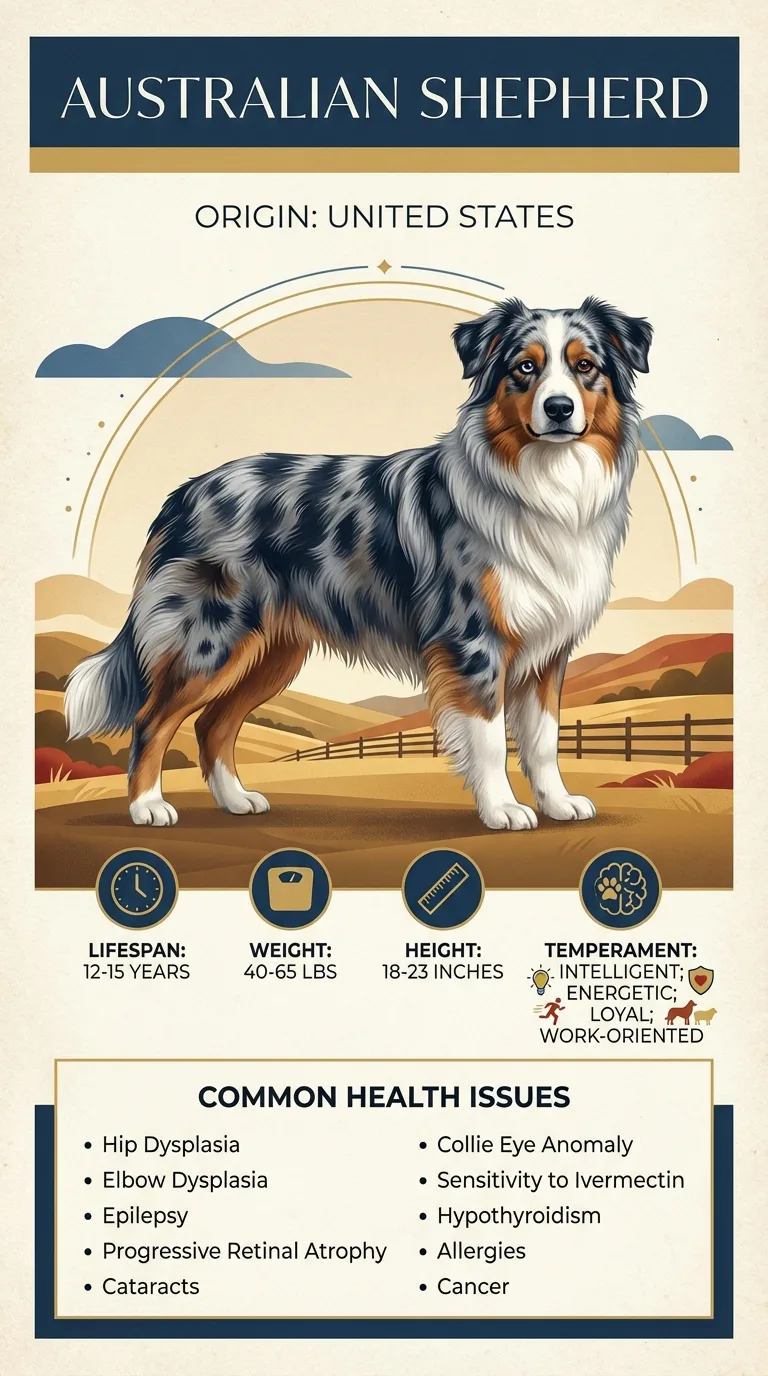
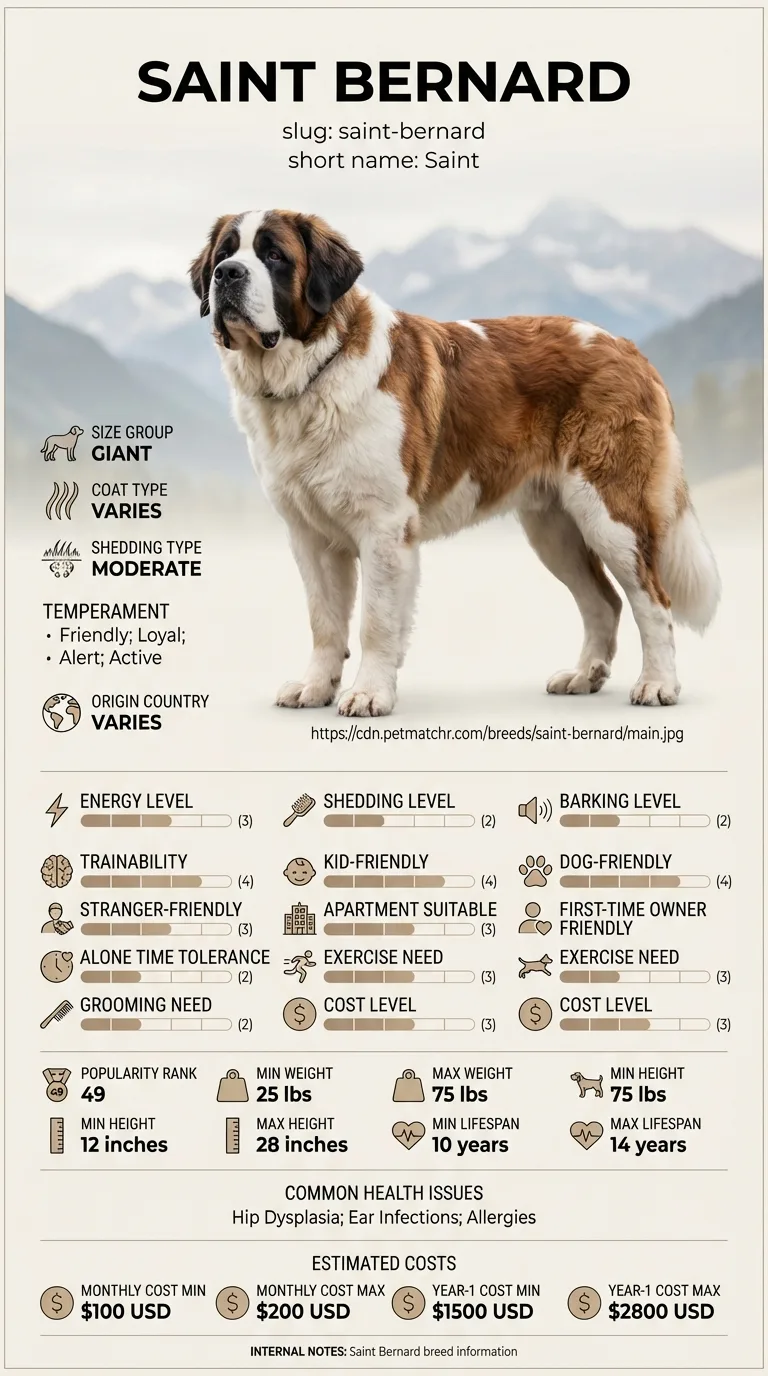
This is for someone already down to Australian Shepherd and Saint Bernard and deciding between them. For this pair the decision usually turns on exercise need and energy level, so those are covered first and in most detail. Both rate 1/5 for flats, so housing does not settle this one. The focus throughout is on daily consequences rather than breed background.
Between Australian Shepherd and Saint Bernard, exercise need is what separates them, and Saint Bernard is the lower-effort dog of the two to keep.
Choose Australian Shepherd if you want a dog that picks up training quickly, a smaller dog suits your car, your home or your back and you want a dog that can keep up with an active routine.
Choose Saint Bernard if this is your first dog, your walking routine is modest and the dog will be alone during the working day.
| Feature | australian shepherd | saint bernard | Winner |
|---|---|---|---|
| Size class | medium | giant | Equal |
| Weight | 40–65 lbs | 120–180 lbs | Equal |
| Height | 18–23 in | 26–30 in | Equal |
| Lifespan | 12–15 years | 8–10 years | australian shepherd |
| Exercise need | Very high (5/5) | Low (2/5) | saint bernard |
| Grooming need | Moderate (3/5) | Moderate (3/5) | Equal |
| Shedding | High (4/5) | High (4/5) | Equal |
| Energy level | Very high (5/5) | Low (2/5) | Equal |
| Barking | Moderate (3/5) | Low (2/5) | saint bernard |
| Apartment suitability | Very low (1/5) | Very low (1/5) | Equal |
| Good for first-time owners | Low (2/5) | Moderate (3/5) | saint bernard |
| Tolerates being alone | Low (2/5) | Moderate (3/5) | saint bernard |
| Trainability | Very high (5/5) | Moderate (3/5) | australian shepherd |
| Good with kids | High (4/5) | Very high (5/5) | saint bernard |
| Good with other dogs | High (4/5) | High (4/5) | Equal |
| Friendly to strangers | Low (2/5) | High (4/5) | saint bernard |
| Cost level | Moderate (3/5) | Very high (5/5) | australian shepherd |
| Coat | Medium-length double coat | Short or long double coat | Equal |
| Origin | United States | Various | Equal |
| Typical monthly cost | $100–$200 | $150–$310 | Equal |
| Typical first-year cost | $1,500–$2,800 | $2,200–$4,200 | Equal |
The Saint Bernard is in a different class entirely — 120-180 lbs and 26-30 inches, a genuine giant breed, against the Aussie's mid-size 40-65 lbs and 18-23 inches. A Saint Bernard can outweigh an Aussie by well over 100 lbs. Everything from doorway clearance to the size of the food bowl scales up accordingly with this breed. If you've never lived with a giant breed before, the sheer physical presence takes some adjustment beyond what the numbers alone convey.
This is close to the widest exercise gap on the site: very high (5/5) for the Aussie against low (2/5) for the Saint Bernard. Giant breeds like this one are built for calm strength rather than endurance, and their joints do better with moderate activity than with the sustained running an Aussie craves. If your ideal dog is a jogging partner, the Saint Bernard isn't it.
This category ties completely: moderate (3/5) grooming and high (4/5) shedding for both breeds. The Saint Bernard's coat, whether the short or long variety, sheds as much as the Aussie's double coat does. Don't let the giant frame fool you into expecting a bigger grooming commitment here — it's the same routine, just on a much larger dog. The main practical difference is the sheer volume of hair a Saint Bernard sheds in a single brushing session.
Both breeds tie at very low (1/5) for apartment suitability — neither belongs in a small unit, giant breed or not. The Saint Bernard does bark less, low (2/5) against the Aussie's moderate (3/5), and tolerates being alone somewhat better, moderate (3/5) versus low (2/5). Space is the binding constraint for either dog here, not temperament. A house with a real yard serves either breed far better than a walk-up apartment ever could.
The Aussie rates very high (5/5) for trainability, the Saint Bernard moderate (3/5) — a gentler, more food-motivated learner rather than a sharp, quick study. Despite that gap, the Saint Bernard actually rates better for first-time owners, moderate (3/5) against the Aussie's low (2/5); its easygoing temperament forgives training mistakes more readily than the Aussie's working drive does. Its sheer size still means early leash and manners training matter more than they might with a smaller breed.
The Saint Bernard rates ahead with kids, very high (5/5) against the Aussie's high (4/5), and well ahead with strangers, high (4/5) versus low (2/5) — this is a breed built for warmth toward people generally. Other dogs tie at high (4/5) for both. If a friendly, social dog around a full house of guests matters to you, the Saint Bernard is the stronger pick here.
The Aussie's lifespan advantage is significant: 12-15 years against just 8-10 for the Saint Bernard, a gap typical of giant breeds. Both share hip and elbow dysplasia as joint concerns, but the Saint Bernard's list also includes dilated cardiomyopathy and bloat (GDV), both serious conditions more common in large, deep-chested dogs — worth discussing with a vet before committing to this breed.
This is the widest cost gap in the batch: very high (5/5) overall for the Saint Bernard against moderate (3/5) for the Aussie. The dollar figures confirm it — $150-310 monthly versus $100-200, and $2,200-4,200 in year one against $1,500-2,800. A giant breed simply eats, medicates and often insures at a higher rate than a mid-size dog does. Factor that gap into your budget for the full 8-to-10-year lifespan, not just the puppy year.
Australian Shepherd weighs 40–65 lbs and lives 12–15 years; Saint Bernard weighs 120–180 lbs and lives 8–10 years. The two diverge most on exercise need, energy level and trainability and 2 other rated axes. They are level on apartment suitability, good with other dogs and grooming need, so those cannot decide it. The table below marks a winner only where one breed is genuinely easier for a typical owner; size and origin are facts rather than merits and stay level. Ratings come from one source applied to both breeds, so they are meaningful against each other rather than as absolute scores.

Dramatically — 120-180 lbs and 26-30 inches for the Saint Bernard against 40-65 lbs and 18-23 inches for the Aussie. It's a genuine giant breed, not just a large one.
No — it rates low (2/5), against very high (5/5) for the Aussie, one of the widest exercise gaps this site tracks. Giant breeds generally do better with moderate activity than sustained running.
It rates moderate (3/5) for first-time owners, better than the Aussie's low (2/5), thanks to a gentler, more forgiving temperament. Its sheer size still calls for confident handling, especially as a puppy.
More than the Aussie by a wide margin: $150-310 a month and $2,200-4,200 in year one, against $100-200 and $1,500-2,800 for the Aussie. It carries the highest overall cost rating in this comparison batch.
Hip and elbow dysplasia, shared with the Aussie, plus dilated cardiomyopathy and bloat (GDV), both linked to its large, deep-chested frame. Ask a breeder about heart screening specifically.
The Aussie, by a large margin — 12-15 years against just 8-10 for the Saint Bernard, a typical gap for a giant breed.
Yes, noticeably — it rates high (4/5) against the Aussie's low (2/5). This breed's reputation for warmth toward people, including strangers, holds up in the data here.
The Aussie, if you can meet its exercise demand — it's cheaper to keep and lives longer. The Saint Bernard suits a household prioritizing a gentle temperament over cost and longevity.
Roughly $50-110 more for the Saint Bernard ($150-310 versus $100-200 for the Aussie) — the widest cost gap in this comparison batch.
The Aussie rates very high (5/5); the Saint Bernard low (2/5) — one of the largest exercise gaps tracked on this site.
The Aussie, by several years — 12-15 versus 8-10 for the Saint Bernard, a typical pattern for giant breeds.
Secure checkout on Stripe. We never see your card.
7-day money-back guarantee. Instant access.
Health information here is general and is not veterinary advice. If your dog shows pain, sudden behaviour change, or worsening symptoms, consult a licensed veterinarian.
Some links on this site are affiliate links. We may earn a commission at no extra cost to you, and we only suggest products we believe are helpful for dog owners.
We research and check what we publish, but we do not warrant that any figure, date, price, or statement is accurate, complete, or current, and we accept no liability for any loss, cost, injury, or other harm arising from the use of this site. Use it as one reference among several. You remain responsible for your own decisions and for your dog's care - confirm anything that matters with a licensed veterinarian or another qualified professional before you act on it. Full disclaimer.
Match your lifestyle to the right dog.
Take quizNot sure which breed is right for you? Take our 2-minute quiz to find out.
Take the quiz