Living
Which breed should most people choose?
It's genuinely close — cost and trainability tie outright. Lean Schnauzer for apartment life and lower shedding, Aussie if you want a slightly higher-drive working dog.

Quick answer
Which breed should most people choose?
It's genuinely close — cost and trainability tie outright. Lean Schnauzer for apartment life and lower shedding, Aussie if you want a slightly higher-drive working dog.
Australian Shepherd or Schnauzer (Standard)? On paper they differ most on apartment suitability, and on the scales Australian Shepherd is the heavier at 40–65 lbs. Here is how the two compare on everything that shapes an ordinary week.
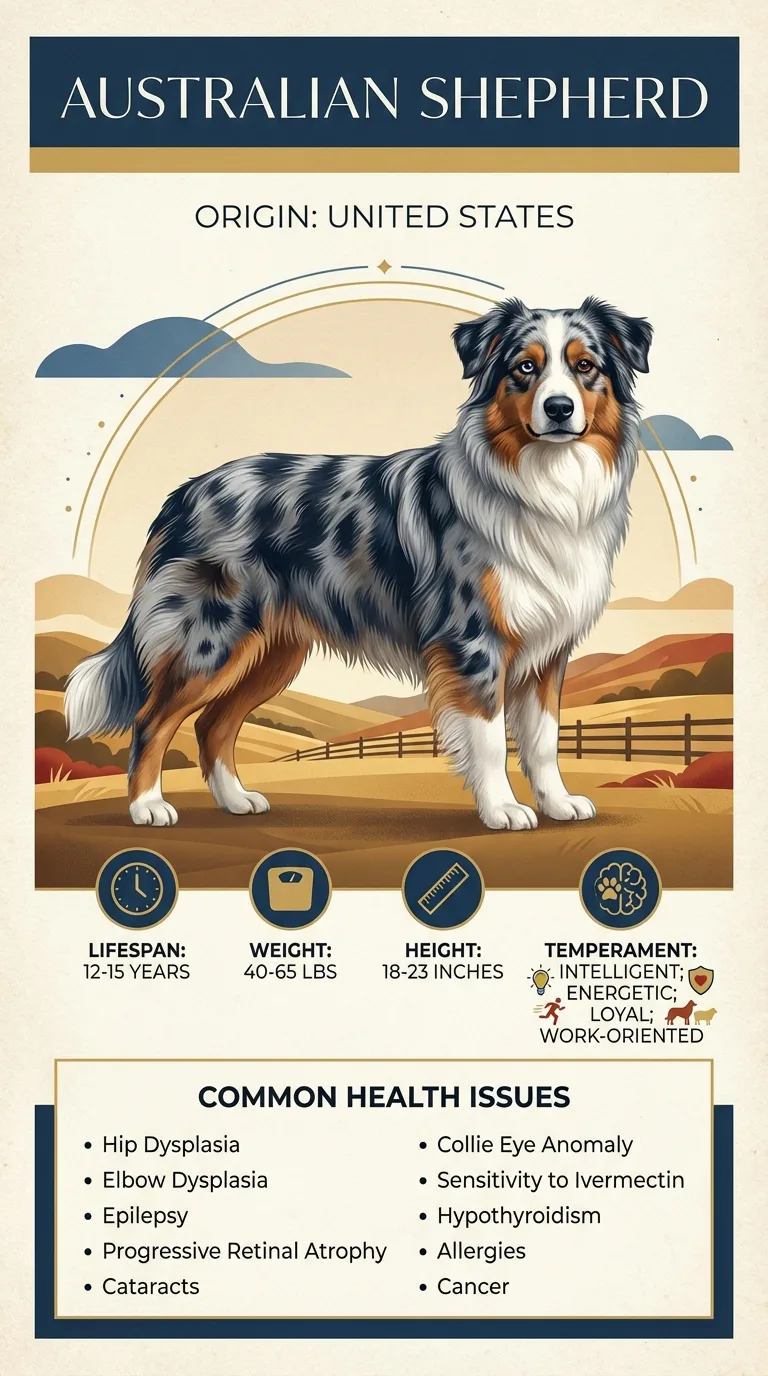
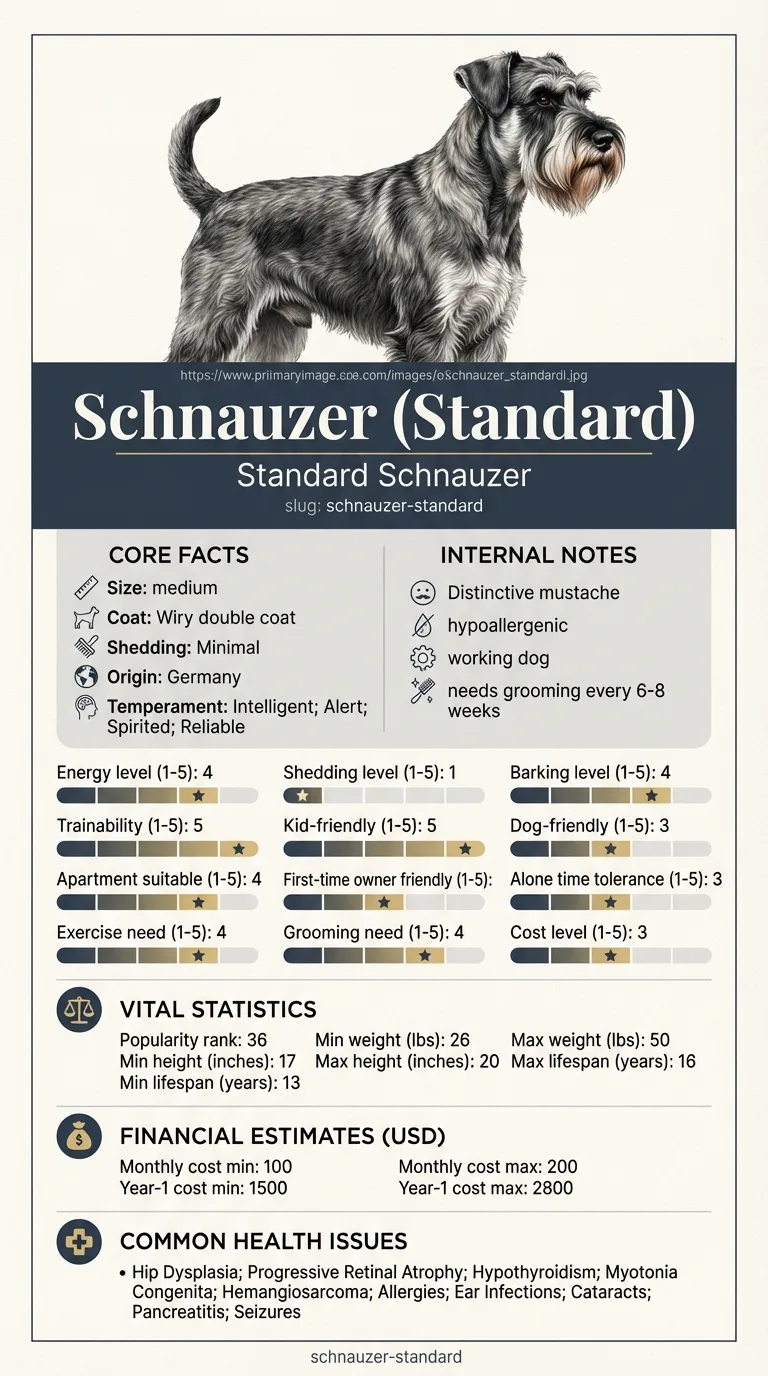
This is for someone already down to Australian Shepherd and Schnauzer (Standard) and deciding between them. For this pair the decision usually turns on apartment suitability and shedding, so those are covered first and in most detail. Anyone choosing from a flat has a clear answer here: Schnauzer (Standard) rates 4/5 against 1/5. It is written for the decision rather than the breed history.
Between Australian Shepherd and Schnauzer (Standard), apartment suitability is what separates them, and Schnauzer (Standard) is the lower-effort dog of the two to keep.
Choose Australian Shepherd if you do not want a standing grooming appointment, you already have another dog and you want a dog that can keep up with an active routine.
Choose Schnauzer (Standard) if you are in a flat or a smaller home, this is your first dog and shedding is a problem in your house.
| Feature | australian shepherd | schnauzer standard | Winner |
|---|---|---|---|
| Size class | medium | medium | Equal |
| Weight | 40–65 lbs | 26–50 lbs | Equal |
| Height | 18–23 in | 17–20 in | Equal |
| Lifespan | 12–15 years | 13–16 years | schnauzer standard |
| Exercise need | Very high (5/5) | High (4/5) | schnauzer standard |
| Grooming need | Moderate (3/5) | High (4/5) | australian shepherd |
| Shedding | High (4/5) | Very low (1/5) | schnauzer standard |
| Energy level | Very high (5/5) | High (4/5) | Equal |
| Barking | Moderate (3/5) | High (4/5) | australian shepherd |
| Apartment suitability | Very low (1/5) | High (4/5) | schnauzer standard |
| Good for first-time owners | Low (2/5) | Moderate (3/5) | schnauzer standard |
| Tolerates being alone | Low (2/5) | Moderate (3/5) | schnauzer standard |
| Trainability | Very high (5/5) | Very high (5/5) | Equal |
| Good with kids | High (4/5) | Very high (5/5) | schnauzer standard |
| Good with other dogs | High (4/5) | Moderate (3/5) | australian shepherd |
| Friendly to strangers | Low (2/5) | Moderate (3/5) | schnauzer standard |
| Cost level | Moderate (3/5) | Moderate (3/5) | Equal |
| Coat | Medium-length double coat | Wiry double coat | Equal |
| Origin | United States | Germany | Equal |
| Typical monthly cost | $100–$200 | $100–$200 | Equal |
| Typical first-year cost | $1,500–$2,800 | $1,500–$2,800 | Equal |
These two land closer in size than most Aussie comparisons on this site: the Standard Schnauzer weighs 26-50 lbs and stands 17-20 inches, against the Aussie's 40-65 lbs and 18-23 inches. There's real overlap at the upper end of the Schnauzer's range and the lower end of the Aussie's, though the Aussie still runs heavier and taller on average. If crate or car sizing matters to your decision, check the specific weight you're planning around rather than the size class alone.
The Aussie rates very high (5/5) for exercise need, the Standard Schnauzer high (4/5) — a narrower gap than you'll find in most of this site's Aussie comparisons. Both are working-lineage breeds that expect genuine daily activity, not a token walk. If you're deciding purely on energy level, this comparison won't make it easy for you. Both dogs will happily join you for a long run or a hike, so lean on other categories to break the tie.
The Standard Schnauzer rates higher on grooming, high (4/5) against moderate (3/5) for the Aussie, thanks to its wiry coat that benefits from regular hand-stripping or clipping. Shedding runs the other direction, though: very low (1/5) for the Schnauzer versus high (4/5) for the Aussie. It's a hands-on coat that keeps most of its hair on the dog rather than your floor.
The Schnauzer rates high (4/5) for apartment suitability against the Aussie's very low (1/5), a meaningful gap. It does bark more, high (4/5) versus moderate (3/5) for the Aussie, so a smaller space might still mean managing a vocal dog. It also tolerates being alone somewhat better than the Aussie, moderate (3/5) versus low (2/5). Weigh that barking tendency against your walls and neighbors before assuming the higher apartment score settles things.
Trainability ties at very high (5/5) for both — another close match in this pairing. For first-time owners, the Schnauzer rates a bit better, moderate (3/5) against the Aussie's low (2/5), though neither breed is the easiest starting point on this site; both were bred to work and expect a handler who gives them direction. A first dog that happens to be this smart still needs a job, or it'll invent one you won't like.
The Schnauzer rates ahead with kids, very high (5/5) against the Aussie's high (4/5), while the Aussie edges ahead with other dogs, high (4/5) versus moderate (3/5). With strangers, the Schnauzer is the more outgoing of the two, moderate (3/5) against the Aussie's low (2/5). Neither dog is a poor fit for a busy household; the differences here are matters of degree, not dealbreakers.
The Schnauzer tends to outlive the Aussie slightly, 13-16 years against 12-15. Their health lists overlap in several places — hip dysplasia, progressive retinal atrophy, hypothyroidism, allergies and cataracts all appear on both — so eye and hip screening is worth asking about for either breed. The Aussie lists epilepsy specifically, while the Schnauzer's list includes seizures as a related but separately noted concern.
This is a rare exact match: both breeds carry a moderate (3/5) overall cost rating, the same $100-200 monthly range, and even the identical $1,500-2,800 first-year cost range. If budget is your deciding factor, this comparison genuinely won't tip the scale either way — look to grooming routine or exercise need instead. For once, the budget question resolves itself, freeing you to choose on temperament and lifestyle fit alone.
Australian Shepherd weighs 40–65 lbs and lives 12–15 years; Schnauzer (Standard) weighs 26–50 lbs and lives 13–16 years. The two diverge most on apartment suitability and shedding. They are level on cost level and trainability, so those cannot decide it. In the table, a "winner" means easier for an ordinary household — not better. Size, coat and origin are recorded without a verdict. Because both breeds are scored the same way, the gaps are reliable even where the absolute numbers are rough.

Closer than most pairings here — 26-50 lbs and 17-20 inches for the Schnauzer against 40-65 lbs and 18-23 inches for the Aussie. There's genuine overlap between a large Schnauzer and a smaller Aussie.
The Aussie, by a wide margin — high (4/5) against very low (1/5) for the Schnauzer's wiry coat. The Schnauzer trades that low shedding for a higher grooming need, though, rated high (4/5).
The Schnauzer, rated high (4/5) against the Aussie's moderate (3/5) — worth knowing if noise is a concern, even though the Schnauzer otherwise rates better for apartment living.
The Schnauzer rates slightly better, moderate (3/5) against the Aussie's low (2/5), but neither is an easy beginner breed — both were bred to work and expect real direction from their owner.
Essentially identical — same overall cost rating, same $100-200 monthly range, and the same $1,500-2,800 first-year range. This is one of the few comparisons on this site where cost doesn't differentiate the two breeds at all.
Yes, several — hip dysplasia, progressive retinal atrophy, hypothyroidism, allergies and cataracts appear on both lists. The Aussie's epilepsy and the Schnauzer's noted seizure risk are related concerns worth discussing with a vet for either breed.
The Schnauzer, by a small margin — 13-16 years against the Aussie's 12-15.
It's genuinely close — cost and trainability tie outright. Lean Schnauzer for apartment life and lower shedding, Aussie if you want a slightly higher-drive working dog.
None — both fall in the identical $100-200 range with the same overall cost rating.
Both are demanding, very high (5/5) for the Aussie and high (4/5) for the Schnauzer — one of the narrower exercise gaps on this site.
The Standard Schnauzer, slightly — 13-16 years against 12-15 for the Aussie.
Secure checkout on Stripe. We never see your card.
7-day money-back guarantee. Instant access.
Health information here is general and is not veterinary advice. If your dog shows pain, sudden behaviour change, or worsening symptoms, consult a licensed veterinarian.
Some links on this site are affiliate links. We may earn a commission at no extra cost to you, and we only suggest products we believe are helpful for dog owners.
We research and check what we publish, but we do not warrant that any figure, date, price, or statement is accurate, complete, or current, and we accept no liability for any loss, cost, injury, or other harm arising from the use of this site. Use it as one reference among several. You remain responsible for your own decisions and for your dog's care - confirm anything that matters with a licensed veterinarian or another qualified professional before you act on it. Full disclaimer.
Match your lifestyle to the right dog.
Take quizNot sure which breed is right for you? Take our 2-minute quiz to find out.
Take the quiz