Health
Is cardiac disease a documented Australian Shepherd risk?
No, it's best characterized in toy and small breeds like Cavalier King Charles Spaniels, not in Australian Shepherds.

Quick answer
Is cardiac disease a documented Australian Shepherd risk?
No, it's best characterized in toy and small breeds like Cavalier King Charles Spaniels, not in Australian Shepherds.
Heart disease sounds like the kind of thing every aging dog should worry about, but the breed-specific version of this risk belongs to toy and small dogs, not the Aussie.
Owners of senior Australian Shepherds who've read general breed health rankings, noticed cardiac disease listed as a top small-breed risk, and wondered if it applies to their own dog are the audience for this page.
This guide is not medical advice. If your dog shows pain, sudden behavior change, or worsening symptoms, consult a licensed veterinarian.
Some links may be affiliate links. We may earn a commission at no extra cost to you. We only suggest products we believe are helpful for dog owners.
We research and check what we publish, but we do not warrant that any figure, date, price, or statement is accurate, complete, or current, and we accept no liability for any loss, cost, injury, or other harm arising from the use of this site. Use it as one reference among several. You remain responsible for your own decisions and for your dog's care - confirm anything that matters with a licensed veterinarian or another qualified professional before you act on it. Full disclaimer.
Cardiac disease, specifically myxomatous mitral valve disease, is well characterized as a top senior-year risk in toy and small breeds, but it isn't established as a documented Australian Shepherd risk. The senior-year concerns that actually matter for this breed are orthopedic, ophthalmic, and endocrine conditions already on record for it.
Mitral valve disease is extremely common in the toy and small breeds where it's documented, affecting a majority of Cavalier King Charles Spaniels by their senior years, but it has no comparable prevalence data in Australian Shepherds because it isn't characterized as occurring at elevated rates in this breed at all.
The valve degeneration behind most breed-specific cardiac rankings has a documented genetic concentration in small and toy breeds, most clearly demonstrated in Cavalier King Charles Spaniels; no comparable genetic link has been established in Australian Shepherd lines. This breed's actual inherited risk profile runs through different systems entirely, joints, eyes, and drug metabolism, reflecting its working-dog ancestry rather than any cardiac predisposition.
Because this isn't a documented breed-specific condition for Aussies, there's no meaningful environmental trigger profile to describe for it here. General factors that affect any senior dog's heart, such as obesity and untreated chronic dental disease, apply the same way they would to any breed, without an Aussie-specific angle.
See a vet promptly for any senior Aussie showing persistent coughing, fainting, labored breathing at rest, or a sudden drop in exercise tolerance, since these deserve evaluation in any breed. Expect that workup to weigh joint and neurological causes alongside cardiac ones, given what's actually documented for this breed.
Cardiac disease shows up on general dog-health rankings so often that it's easy to assume every aging dog faces the same risk profile. For Australian Shepherds, that assumption can distract from the breed's actual documented concerns.
See all Australian Shepherd health problems, which breeds are prone to cardiac disease, or the full Australian Shepherd breed guide for temperament, exercise needs and ownership costs.
There's no meaningful cardiac-disease timeline to track for this breed specifically, since it isn't a documented Aussie risk. The relevant timeline instead runs through the breed's real senior concerns, with orthopedic changes typically becoming noticeable from around 7 to 8 years onward.
Success here looks like redirecting attention from an unsupported cardiac worry toward the senior wellness screening this breed's actual health record supports: joints, eyes, and thyroid function. An owner who leaves a senior wellness visit with a hip and eye recheck plan, rather than an unnecessary echocardiogram, has the right picture for this breed.
Myxomatous mitral valve disease is the specific condition behind most breed cardiac-risk rankings, and it's overwhelmingly a small-breed disease. Cavalier King Charles Spaniels carry the strongest documented link, with a large share of the breed showing valve degeneration by middle age; other toy breeds, including Chihuahuas, Dachshunds, and Pomeranians, also show elevated rates.
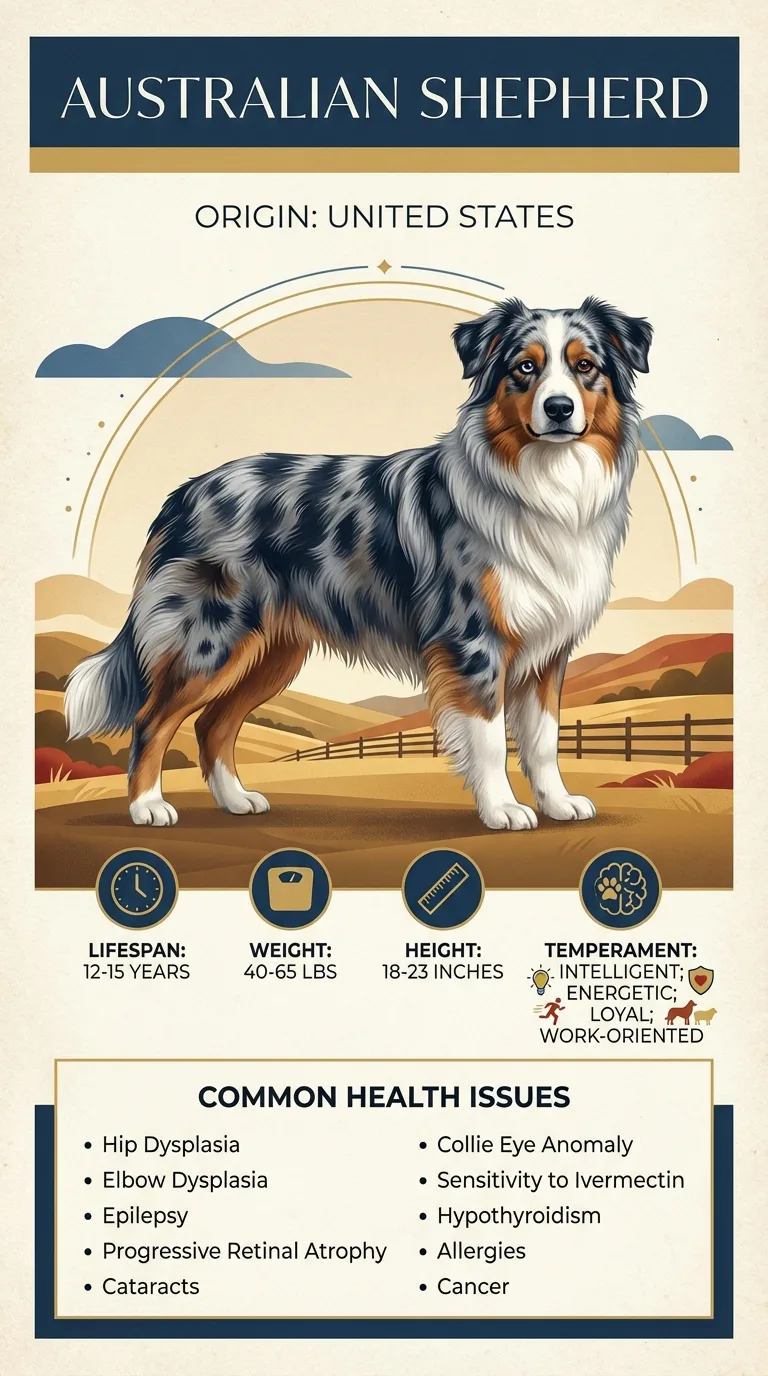
Australian Shepherds simply don't appear in this research the same way. Their documented health profile centers on orthopedic issues like hip and elbow dysplasia, inherited eye conditions like progressive retinal atrophy and collie eye anomaly, epilepsy, and a well-known drug sensitivity to ivermectin tied to the MDR1 gene mutation common in herding breeds.
That doesn't mean an Aussie's heart is immune to every possible issue — any senior dog can develop acquired heart disease, including dilated cardiomyopathy, regardless of breed. It does mean a heart murmur or breathing change in an aging Aussie should prompt a full vet workup rather than an assumption that it's the same valve disease documented in small breeds.

A senior Australian Shepherd wellness visit is better spent screening for the conditions this breed is actually known for. Hip and elbow joints, eyes, and thyroid function are the areas with real documented payoff for early detection in this breed.
Vets will still listen to the heart at every exam, as they do for every dog, and will pursue cardiac workup if they hear something abnormal. But building a senior-care plan around cardiac disease specifically, the way a Cavalier King Charles Spaniel owner reasonably might, isn't supported by what's documented in Aussie health research.
The more useful long-term habit is tracking mobility, vision changes, coat and skin issues, and any new lumps, the categories where this breed's real risks actually live.

When Marisol's Australian Shepherd, Scout, turned nine in Tulsa, she read a general breed health ranking that listed cardiac disease as the top senior risk across small breeds and got worried it applied to Scout too. Her vet listened to Scout's heart, found nothing abnormal, and redirected the conversation toward what actually matters for an aging Aussie: hip and elbow range of motion, a vision check for early PRA signs, and routine thyroid bloodwork. Scout's slightly slower morning walks turned out to trace back to mild elbow stiffness rather than any cardiac issue, and a joint-support plan resolved most of it within a few weeks.
Key takeaway: A cardiac-disease ranking built around toy and small breeds doesn't transfer to an Australian Shepherd; the senior wellness attention that actually pays off for this breed goes toward joints, eyes, and thyroid health instead.
No, it isn't documented as one of the breed's characterized health risks. It's most established in toy and small breeds such as Cavalier King Charles Spaniels, where mitral valve disease affects a large share of dogs by old age.
Myxomatous mitral valve degeneration is an inherited connective-tissue disease of the heart valve, well characterized in Cavalier King Charles Spaniels and other small breeds. It shows up as a heart murmur and progressive heart enlargement with age.
Any dog can develop acquired heart conditions such as dilated cardiomyopathy in old age, but this isn't a documented characteristic risk for Aussies the way it is for toy and small breeds. A vet who finds a murmur in an Aussie will typically investigate broader causes rather than assume small-breed valve disease.
Hip and elbow dysplasia, epilepsy, progressive retinal atrophy, collie eye anomaly, cataracts, ivermectin sensitivity, hypothyroidism, allergies, and cancer are the breed's documented risks worth tracking as dogs age. These are where senior wellness attention has real documented payoff.
Routine cardiac screening isn't standard veterinary protocol for this breed the way hip and eye screening is. A vet will listen to the heart at annual exams and pursue further testing only if something abnormal turns up.
Persistent coughing unrelated to exercise, sudden exercise intolerance, fainting episodes, and labored breathing at rest warrant prompt veterinary evaluation regardless of breed. These signs shouldn't be dismissed just because cardiac disease isn't an Aussie hallmark.
Far more often it traces back to hip or elbow dysplasia-related joint pain, given how well-documented orthopedic issues are in this breed's aging population. A vet exam is still the right way to rule out cardiac causes rather than guessing.
No, it's best characterized in toy and small breeds like Cavalier King Charles Spaniels, not in Australian Shepherds.
It warrants standard veterinary follow-up but isn't evidence of a breed-typical condition the way it would be in a small breed.
Reduced stamina more often points to hip or elbow dysplasia in this breed than to a cardiac issue.
Routine cardiac screening isn't a standard recommended expense for this breed the way hip and eye exams are.
Training isn't a relevant factor in evaluating cardiac risk for this breed.
A one-page prep sheet for this condition: the signs, the questions to ask, what to get priced. Unlocks here.
You get: Vet visit prep sheet
No spam. One-click unsubscribe. See our privacy policy.
See a sample page before you decide.
Early access list
The free prep sheet covers the same-day warning signs, a symptom log and the questions to ask. We are considering a fuller kit that adds a cost worksheet for the usual tests and treatments (US price ranges with their sources) and a plain-English guide to ways of covering the bill. It is not built yet; this list tells us whether it is worth building.
One email, no spam, unsubscribe anytime. Information only, not veterinary advice.