Health
What are the main signs of allergies in an Australian Shepherd?
Recurring ear infections, paw chewing, and skin redness or hot spots are the most common signs, often worsening seasonally.

Quick answer
What are the main signs of allergies in an Australian Shepherd?
Recurring ear infections, paw chewing, and skin redness or hot spots are the most common signs, often worsening seasonally.
Your Aussie shakes their head after every meal, or their paws smell faintly yeasty by evening. That's not a one-off — it's the slow signature of a chronic allergy.
Owners who free-feed or rotate treats often struggle to pin down food triggers, and owners in humid or high-pollen regions see their Aussie's symptoms swing hard with the seasons. Both groups tend to treat the ear infection or the hot spot as the problem, when it's really a downstream symptom.
This guide is not medical advice. If your dog shows pain, sudden behavior change, or worsening symptoms, consult a licensed veterinarian.
Some links may be affiliate links. We may earn a commission at no extra cost to you. We only suggest products we believe are helpful for dog owners.
We research and check what we publish, but we do not warrant that any figure, date, price, or statement is accurate, complete, or current, and we accept no liability for any loss, cost, injury, or other harm arising from the use of this site. Use it as one reference among several. You remain responsible for your own decisions and for your dog's care - confirm anything that matters with a licensed veterinarian or another qualified professional before you act on it. Full disclaimer.
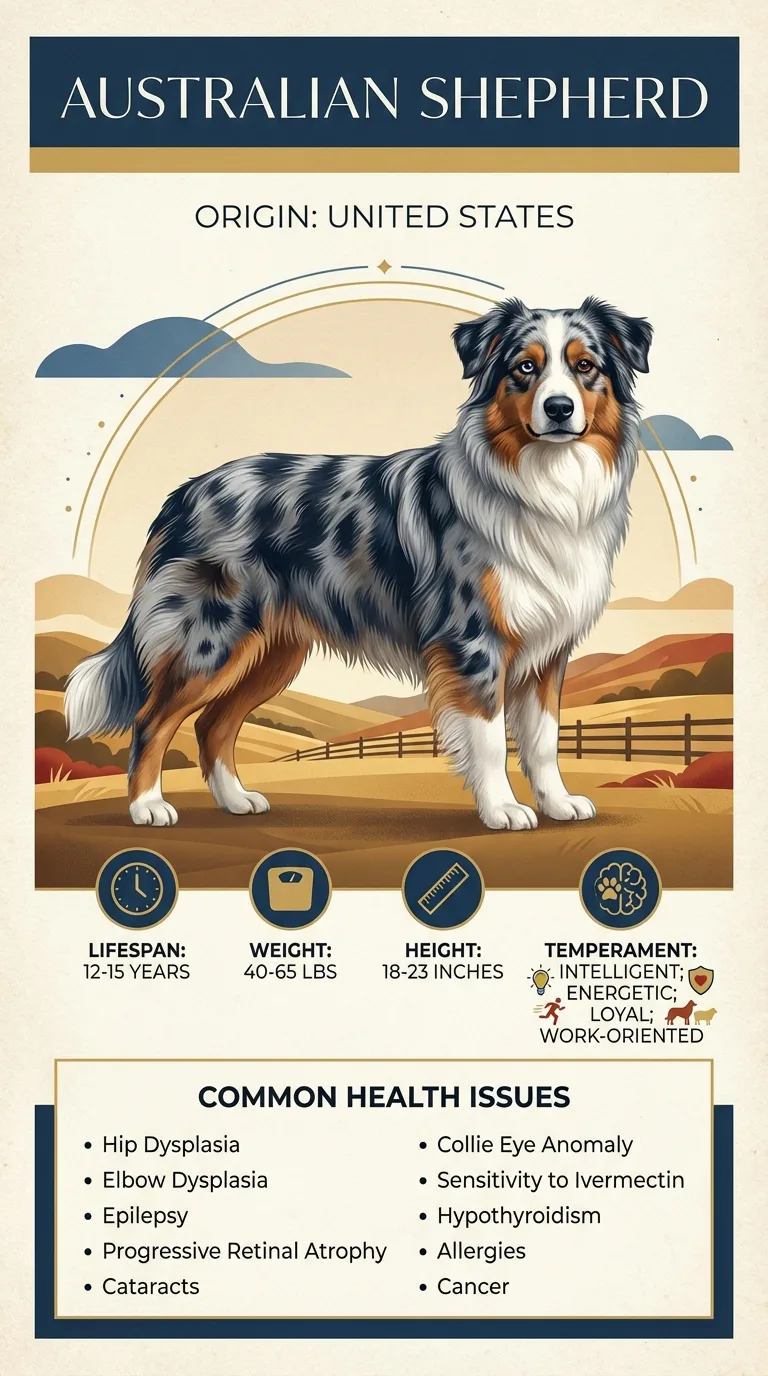
Chronic allergies are a documented health issue in Australian Shepherds, typically surfacing as recurring ear infections, itchy or red skin, and paw chewing rather than as a single dramatic event. The pattern usually builds slowly, and by the time an owner notices, the underlying trigger has often been active for weeks or months.
Allergies are frequent enough in this breed to be listed among its documented health concerns, and many Aussie owners deal with at least one flare-up cycle over the dog's lifetime, often starting between one and three years of age.
This breed's documented predisposition to allergies means the immune system is more prone to overreacting to substances that wouldn't bother most dogs. That sensitivity does not go away with age; it tends to resurface whenever exposure to a trigger increases.
A medium double coat can trap pollen and dust close to the skin, and a high-energy dog that spends hours outdoors picks up more environmental allergens than a low-activity breed. Indoor air quality, seasonal pollen counts, and flea exposure all compound the underlying sensitivity.
Talk to your vet if itching, redness, or ear odor persists more than a week or keeps recurring despite home care. Persistent scratching that breaks the skin, or an ear infection that doesn't clear with treatment, both need a professional look rather than more waiting.
Chronic allergies rarely get worse from one big mistake — it's usually a handful of small habits that quietly keep the flare-up cycle spinning.
See all Australian Shepherd health problems, which breeds are prone to allergies, or the full Australian Shepherd breed guide for temperament, exercise needs and ownership costs.
Most owners see meaningful improvement within 6 to 12 weeks of starting a consistent management plan, though full trigger identification through an elimination diet can take just as long on its own.
Success means fewer and milder flare-ups, not a permanent cure. A well-managed Aussie may still react during peak pollen season but recovers faster and stays comfortable most of the year.
Food-driven allergies tend to show up year-round regardless of season, often centered on the ears, paws, and rear end, and they usually respond to a strict elimination diet over 8 to 12 weeks. Environmental allergies swing with pollen counts, mold, and dust, hitting hardest in spring and fall, and they respond more to reducing exposure than to changing food.
Many Aussies deal with both at once, which is why symptoms rarely disappear completely with a single fix. A vet-guided elimination diet paired with seasonal tracking is usually the only way to separate the two threads.

Diego had his third ear infection of the year by the time his owner, Marcus, finally asked the vet whether something bigger was going on. A workup pointed to an environmental allergy, worse every spring, compounded by a chicken sensitivity Marcus hadn't suspected. Switching Diego to a limited-ingredient diet and adding weekly ear checks during pollen season cut his infections from four a year to one. Marcus still watches April and May closely, but Diego's ears now stay clear most of the year for the first time since puppyhood.
Key takeaway: Recurring infections are rarely the actual problem — they're a signal pointing at an allergy underneath. Finding that root cause takes patience, but it changes the whole trajectory of managing the dog's comfort.
Recurring ear infections are usually a downstream symptom of an underlying allergy, not a standalone ear problem. Until the trigger is identified, treating each infection only resets the cycle.
Food allergies tend to stay steady year-round, while environmental ones flare with the seasons. A vet-guided elimination diet is the most reliable way to tell them apart.
No, chronic allergies are managed rather than cured. The goal is identifying triggers and reducing flare-up frequency and severity, not eliminating the sensitivity itself.
Common proteins like chicken and beef, along with certain grains, are frequent culprits, though the specific trigger varies by dog. An elimination diet supervised by your vet is how you find the actual one.
Most vets recommend 8 to 12 weeks of a strict, single-protein diet with no other treats or table scraps before drawing conclusions.
Yes, if your Aussie's itching or ear issues get noticeably worse in spring or fall, that's a strong sign an environmental allergen like pollen or mold is involved.
A gentle, vet-recommended shampoo used less frequently can help, since over-bathing strips the skin's natural barrier and can make irritation worse.
They often intensify between one and three years old as the immune system matures, then tend to stabilize into a predictable seasonal pattern rather than continuing to worsen indefinitely, provided the trigger is being managed.
Yes, running an air purifier, washing bedding weekly in hot water, and vacuuming frequently during high-pollen months all reduce the allergen load your Aussie is exposed to indoors.
Recurring ear infections, paw chewing, and skin redness or hot spots are the most common signs, often worsening seasonally.
Weekly checks catch early buildup before it turns into a full infection, especially during high-pollen months.
Yes, chronic scratching and licking can break the skin barrier and lead to secondary bacterial or yeast infections.
Avoid rotating proteins and treats until an elimination diet has identified the actual trigger, since frequent changes make the culprit harder to find.
Spring and fall tend to be the hardest seasons for environmental allergies, while food-triggered symptoms stay fairly constant year-round.
A one-page prep sheet for this condition: the signs, the questions to ask, what to get priced. Unlocks here.
You get: Vet visit prep sheet
No spam. One-click unsubscribe. See our privacy policy.
Preview page 1 before you decide.