About $177–$366 monthly and $2,596–$4,956 for year one, well above average — with the local nuance that New Jersey's puppy protection statute closes long before a giant breed's inherited joint disease becomes visible.
A Saint Bernard in Newark costs roughly $177 to $366 a month, with year one landing near $2,596 to $4,956 — well above the national average, because proximity to the New York metro pulls veterinary and boarding prices up along with everything else. New Jersey also gives dog buyers something most states do not, and it is worth understanding precisely, including where it stops.
Why costs vary
The friction is biological rather than legal. Hip Dysplasia and Elbow Dysplasia are documented in this breed and both are hereditary, but in a giant that spends the better part of two years growing, neither typically declares itself inside any consumer-protection window. Dilated Cardiomyopathy, Entropion and Bloat follow the same pattern: they arrive on the dog's schedule, not the statute's.
Cost summary
Newark prices well above the national line under New York's influence, with boarding as the sharpest premium and a bounded eight-month prevention season as the one relief.
Estimate · source: estimation · confidence: medium · updated 2026-09-06 · not a quote
First year
$2596 - $4956
Ongoing monthly
$177 - $366
First-year expenses
Item
Cost range
One-time setup (giant crate, bed, first exam, spay/neuter)
Worth spending part of this budget window on screening documentation and an early insurance quote rather than on gear alone.
$615 - $1060
Monthly expenses
Item
Cost range
Food
A giant's volume against above-average regional retail, which makes this the largest recurring line by a wide margin.
$85 - $151
Prevention (eight-month season)
A bounded northeastern window, though every dose still lands in the top weight bracket the product offers.
$33 - $60
How these numbers are estimated
Each range starts from a national baseline for this breed's size class and is then adjusted for local cost of living and veterinary pricing. The baselines, and the source each one came from, are listed on our sources page (dataset 2026.09). Two inputs, the purchase price and the emergency reserve, have no published national figure we could verify, so we leave them to you rather than invent them.
These are planning estimates, not quotes. Your own numbers will move with the individual dog, your vet and your insurer. Build a budget with your own figures.
Is pet insurance worth it?
Because the statute reaches only the early problems, insurance is what covers the later ones, and its value depends almost entirely on when it is bought.
When insurance makes sense
Buy in the first months, before anything is noted on the record. Hereditary conditions are typically covered only by policies that predate any sign of them.
When you might skip it
An owner with a large liquid reserve can self-fund, but should size it for an orthopedic procedure at this metro's pricing rather than a national average.
Ways to save without cutting essentials
In this market the meaningful decisions all happen early, and none of them involve haggling over a consultation fee.
Confirm the current scope and time limits of New Jersey's pet purchase protection law rather than assuming its reach.
Ask for both parents' hip and elbow evaluations before purchase, which covers the risk the statute does not.
Get insurance quoted in the first months while the dog's record is clean.
Buy prevention against the region's eight-month season instead of a default twelve.
Book boarding early, since a giant only fits the largest run and those go first in a dense market.
Newark Cost Factors: The Window Closes Before the Hips Speak
This is not a criticism of the law, which does real work. It catches the situations it was written for: a puppy that arrives sick, or one carrying a defect a veterinarian can identify almost immediately. Those are the cases where a buyer has genuinely been sold something they were not told about, and the statute gives them a path.
What it cannot do is reach forward three years to a giant breed's radiographs. Inherited joint disease in a dog of this size usually becomes apparent well after any statutory period has run, often after the second birthday, sometimes considerably later. A New Jersey buyer who assumes the law has them covered against the expensive scenario has misunderstood which scenario it covers.
The practical consequence is that the protection you want for the later, larger risk has to come from somewhere else — from health screening on the parents before purchase, and from an insurance policy bought while the dog is young and unremarkable on paper. Both of those are decisions made in the first months, which is exactly when a new owner is least inclined to think about year four.
What Being Next to New York Adds
Newark's pricing reflects its neighbour. Veterinary consultations, boarding and grooming all run above the national line, and this breed already sits in the highest keeping tier there is, so the two effects stack. Boarding is the sharpest of them, because a giant occupies the largest run and the largest run is the scarcest category in a dense market.
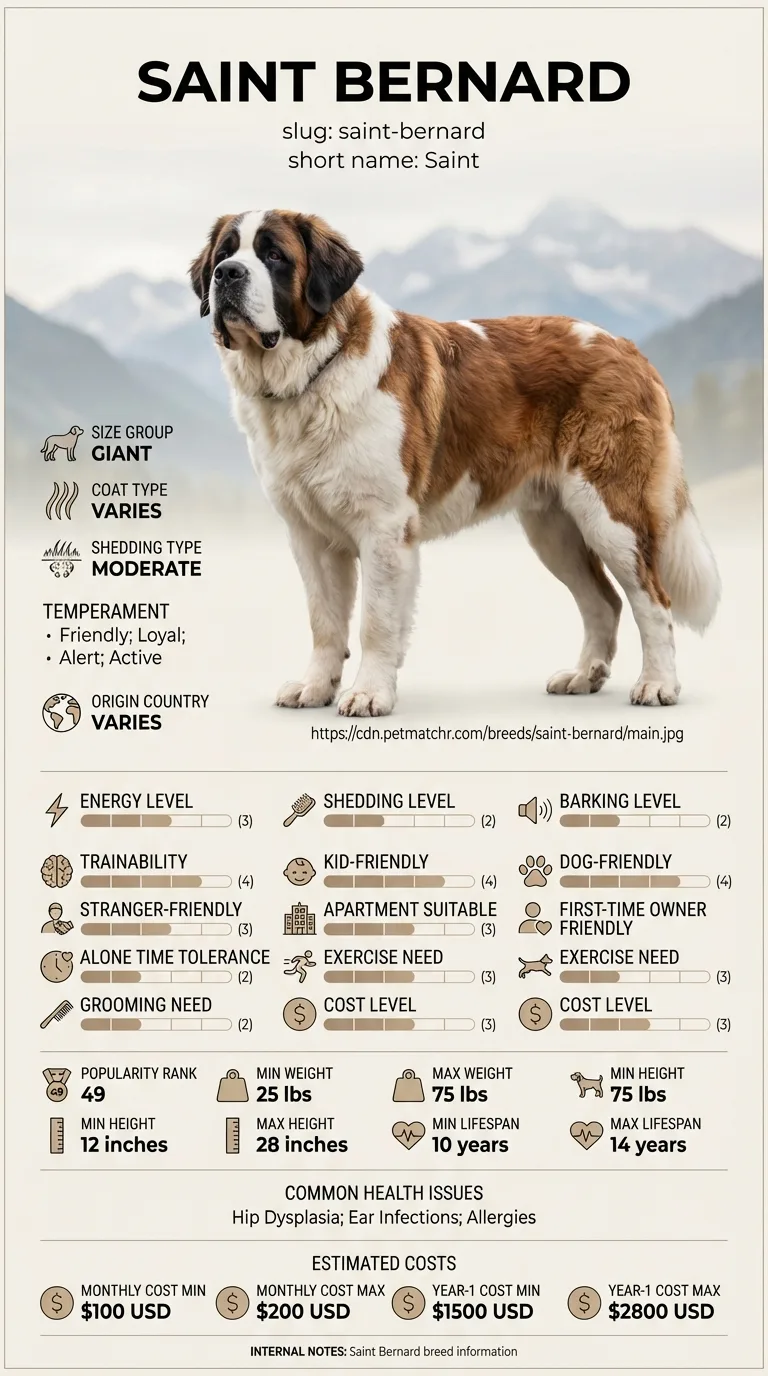
Housing is the other pressure. Much of the metro is dense, and this breed carries the lowest apartment-suitability rating on the scale — a rating about floor area rather than temperament. The dog itself is easy company in a dense place: documented at 2 out of 5 for energy, 2 out of 5 for barking, gentle and patient, and rated 4 out of 5 with strangers.
On the credit side, New Jersey's parasite-prevention window runs a bounded eight months rather than the year-round schedule of a southern city, which trims a line made expensive by this breed's top-bracket dosing weight.
Saint Bernard Cost in Newark - What Being Next to New York Adds
The Protection That Ran Out at Six Months
A Newark household bought a Saint Bernard puppy and read up carefully on New Jersey's buyer protections, which reassured them. The dog was healthy through its first year and its second. Hind-limb stiffness appeared somewhere in year three, and radiographs confirmed dysplastic hips. The statute had nothing to say by then, and neither did an insurance policy they had never taken out. The surgery went ahead and was funded from savings, and the family is blunt about which of the two decisions they would change.
Key takeaway: In New Jersey the consumer law covers the first weeks and a giant breed's hips speak in the third year. The insurance decision is the one that bridges the gap, and it has to be made early.
Frequently asked questions
How much does a Saint Bernard cost monthly in Newark?
About $177 to $366, well above the national average, reflecting how close this market sits to New York pricing.
And the first twelve months?
Roughly $2,596 to $4,956, once the initial exam, sterilisation and giant-sized equipment are added to the ongoing costs.
Does New Jersey's puppy law protect me against hip dysplasia?
Realistically, no. The law addresses dogs found unfit shortly after purchase, and inherited joint disease in a giant breed normally becomes apparent long after that window has closed.
Does the law apply to breeders as well as pet shops?
The statute is framed around pet shop sales. Confirm the current scope and time limits directly, since the law has been amended over the years.
So what actually protects me against the expensive outcome?
Health screening on both parents before you buy, and an insurance policy taken out while the dog is young and has nothing on its record.
How much emergency reserve should I keep?
Around $1,450, sized against this metro's above-average pricing and the drug and material volumes a giant patient requires.
About $177–$366 monthly and $2,596–$4,956 for year one, well above average — with the local nuance that New Jersey's puppy protection statute closes long before a giant breed's inherited joint disease becomes visible.
This guide is not medical advice. If your dog shows pain, sudden behavior change, or worsening symptoms, consult a licensed veterinarian.
Some links may be affiliate links. We may earn a commission at no extra cost to you. We only suggest products we believe are helpful for dog owners.
We research and check what we publish, but we do not warrant that any figure, date, price, or statement is accurate, complete, or current, and we accept no liability for any loss, cost, injury, or other harm arising from the use of this site. Use it as one reference among several. You remain responsible for your own decisions and for your dog's care - confirm anything that matters with a licensed veterinarian or another qualified professional before you act on it. Full disclaimer.