Costs
Saint Bernard cost in Anchorage
About $180–$372/month and $2,640–$5,040 for year one — above the mainland average, because freight is billed by weight and this breed's food bag is the heaviest recurring purchase in the house.

See Saint Bernard price across all cities →
Quick answer
Saint Bernard cost in Anchorage
About $180–$372/month and $2,640–$5,040 for year one — above the mainland average, because freight is billed by weight and this breed's food bag is the heaviest recurring purchase in the house.
A Saint Bernard in Anchorage runs about $180 to $372 a month, with year one landing near $2,640 to $5,040 — clearly above the Lower 48 baseline. The reason is not that Alaskans overpay for dogs. It is that almost everything a dog consumes arrives here by barge or by air, freight is billed by weight and bulk, and a 120-to-180-pound dog's staple purchase is the heaviest, bulkiest thing most households buy on a repeating schedule.
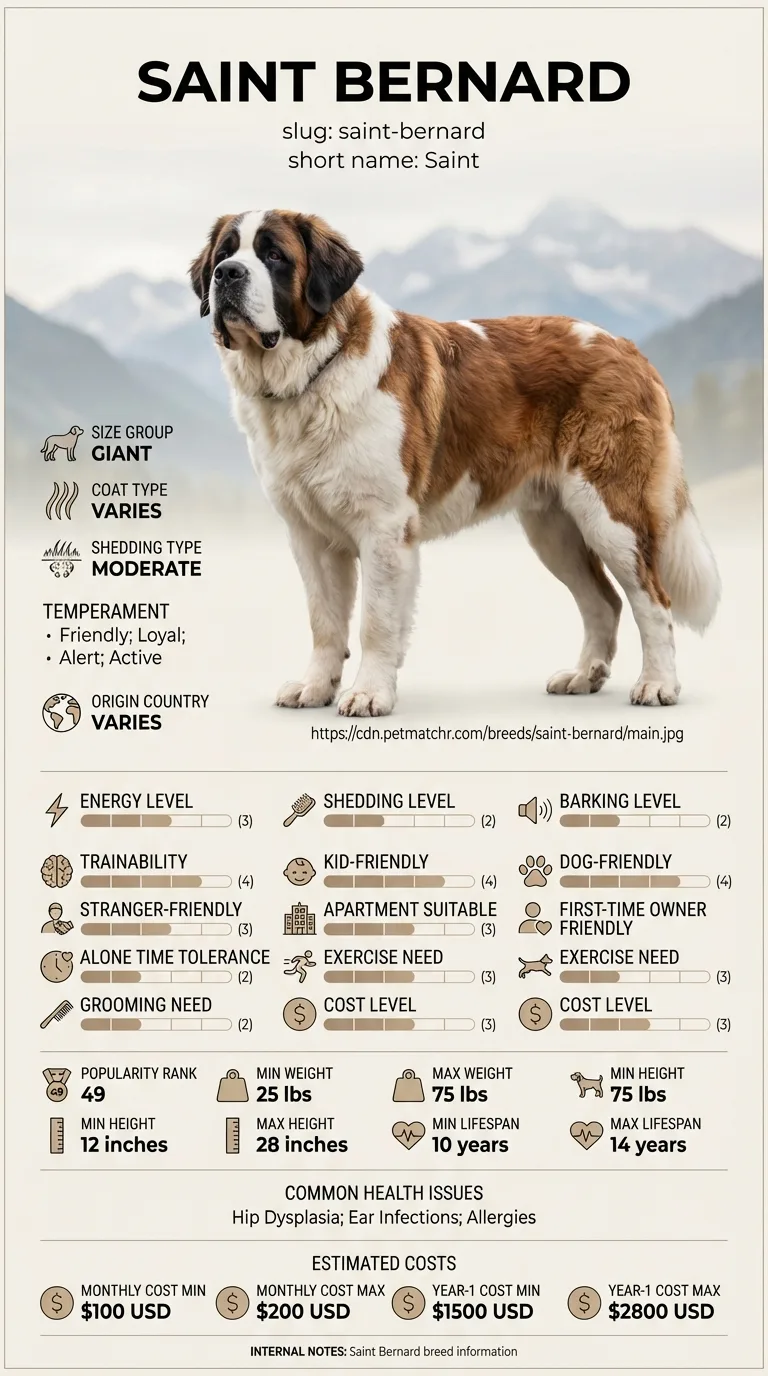
Bloat (GDV) is the emergency that turns a normal week into a surgical bill without notice, and this breed carries documented risk for it alongside Hip Dysplasia, Elbow Dysplasia, Dilated Cardiomyopathy and Entropion. Anchorage compounds that, because specialist referral options are limited and anything shipped in for a giant patient carries the same freight premium as the food.
These numbers carry Anchorage's freight premium on every physical good, partly offset by the shortest parasite-prevention season of any city covered here.
Estimate · source: estimation · confidence: medium · updated 2026-09-06 · not a quote
| Item | Cost range |
|---|---|
One-time setup (giant crate, bed, first exam, spay/neuter) Bulky gear is the worst category to ship north, so buying locally once tends to beat replacing a cheaper mainland item after it fails. | $624 - $1080 |
| Item | Cost range |
|---|---|
Food (bulk kibble, freight-inflated) The largest and least avoidable Anchorage premium, because this breed's consumption is measured in forty-pound sacks and Alaska shipping prices mass directly. | $86 - $154 |
Parasite prevention (top weight tier, four-month season) Expensive per dose at this body weight, but Alaska's short season means far fewer doses across the year than any Lower 48 city on this list. | $38 - $70 |
Each range starts from a national baseline for this breed's size class and is then adjusted for local cost of living and veterinary pricing. The baselines, and the source each one came from, are listed on our sources page (dataset 2026.09). Two inputs, the purchase price and the emergency reserve, have no published national figure we could verify, so we leave them to you rather than invent them.
These are planning estimates, not quotes. Your own numbers will move with the individual dog, your vet and your insurer. Build a budget with your own figures.
Insurance is worth taking seriously in Anchorage less because of the premium and more because of what a complicated case looks like when specialist capacity is thin and every input arrives from somewhere else.
Enrolling before any joint, cardiac or gastric finding is on record is the strong play here, particularly given that a giant-breed surgical case in this market starts from a high base.
An owner with a genuinely deep cash reserve and a realistic plan for travel-linked care can self-fund instead, provided the reserve is sized for a giant patient rather than an average one.
In Anchorage the savings are found in how you take delivery, not in what you feed. Volume buying still wins, but only when the freight is already in the shelf price.
Anchorage's cost profile is unusual because it is not driven by wages or rent the way a coastal metro's is. It is driven by logistics. Goods move north through the port or on a plane, and the invoice reflects mass and cube. That structure is neutral across most of a household budget and brutally non-neutral for a giant-breed owner.
The practical effect is that the ordinary strategies invert. In most cities the advice is to buy the biggest bag available, because per-pound pricing rewards volume. In Anchorage the biggest bag is also the most expensive thing to move, so the saving is smaller than the label suggests — and mainland delivery may not be available at any price for oversize freight.
There is a genuine offset, and it is the largest one on this list. Alaska's climate gives Anchorage roughly a four-month parasite-prevention window, the shortest of any city covered here. For a breed that sits in the top weight bracket for heartworm and flea-tick dosing, eight months off the schedule is a real annual saving that partly funds the freight premium on everything else.
The owners who handle this well treat food as a logistics problem rather than a shopping problem. That means buying locally in Anchorage where the freight is already baked into the shelf price rather than discovering it at checkout, watching for pallet-level buying groups, and having enough dry storage to take delivery when supply is good rather than when the bin runs empty.
The rest of the budget behaves like a high-cost market. Routine veterinary care, boarding and grooming all price above the national line, and every one of those services charges more for a dog in this weight class regardless of city. The gear bill is front-loaded: a crate and bed sized for a giant breed are large, awkward objects, and buying them once, well, and locally usually beats shipping a cheaper version north twice.

An Anchorage family did the sensible thing and priced their new Saint Bernard's food online, where the per-pound number looked far better than the local shelf. The order went through at a price that did not include the oversize freight, and the corrected total arrived afterwards. They switched to buying locally in quantity, built out a sealed storage bin in the garage, and stopped treating the online price as the real one.
Key takeaway: In Anchorage, the sticker price of dog food is not the price of dog food. For a breed that eats at this volume, the freight line is the budget.
Roughly $180–$372, above the Lower 48 average, driven mainly by the freight component in food, supplies and veterinary pricing.
About $2,640–$5,040 once the initial exam, spay/neuter and giant-size gear are added to the recurring figure.
Because this breed's staple purchase is a forty- or fifty-pound sack, and Alaska freight is priced on weight and bulk. The heavier the item, the harder the remoteness premium lands.
Yes — the roughly four-month parasite season is the shortest on this list, and this breed sits in the top weight tier for those products, so the months you skip are worth real money.
It is worth quoting early. Bloat, joint disease and cardiac disease are all documented in this breed, and limited local specialist capacity means a serious case can involve travel on top of treatment.
Around $1,500. Giant-breed emergency surgery is expensive anywhere, and Anchorage's elevated service pricing sets a higher floor than most markets.
About $180–$372/month and $2,640–$5,040 for year one — above the mainland average, because freight is billed by weight and this breed's food bag is the heaviest recurring purchase in the house.
This guide is not medical advice. If your dog shows pain, sudden behavior change, or worsening symptoms, consult a licensed veterinarian.
Some links may be affiliate links. We may earn a commission at no extra cost to you. We only suggest products we believe are helpful for dog owners.
We research and check what we publish, but we do not warrant that any figure, date, price, or statement is accurate, complete, or current, and we accept no liability for any loss, cost, injury, or other harm arising from the use of this site. Use it as one reference among several. You remain responsible for your own decisions and for your dog's care - confirm anything that matters with a licensed veterinarian or another qualified professional before you act on it. Full disclaimer.
One sheet with every line item, the emergency fund and when insurance pays off - unlocks on this page.
You get: 12-month budget sheet
No spam. One-click unsubscribe. See our privacy policy.
Preview page 1 before you decide.