Costs
Saint Bernard cost in Boston
About $203–$419/month and $2,970–$5,670 for year one — near the top of this list, because a top-tier-cost breed and a top-tier-cost metro multiply rather than add.

See Saint Bernard price across all cities →
Quick answer
Saint Bernard cost in Boston
About $203–$419/month and $2,970–$5,670 for year one — near the top of this list, because a top-tier-cost breed and a top-tier-cost metro multiply rather than add.
A Saint Bernard in Boston runs about $203 to $419 a month, with the first year near $2,970 to $5,670 — among the highest figures on this list. That is not one expensive thing happening. It is two. Boston is one of the priciest metros in the country for veterinary care and boarding, and this is a breed rated cost level 5, the top tier. Those two factors multiply against each other rather than sitting side by side.
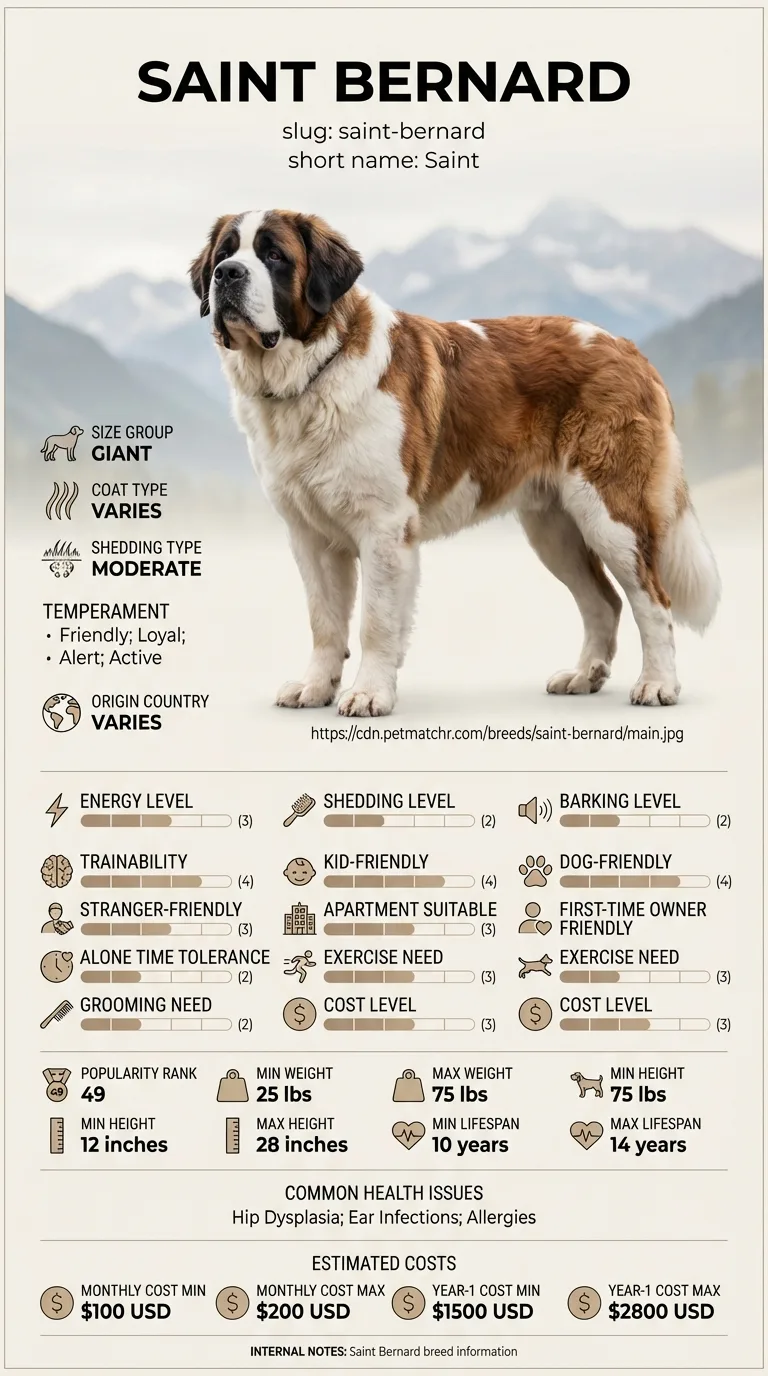
The documented conditions here are Hip Dysplasia, Elbow Dysplasia, Dilated Cardiomyopathy, Entropion and Bloat (GDV). Three of those routinely lead to surgery, and surgery is precisely where the weight multiplier and the Boston multiplier stack most steeply.
Every line here carries both a Boston premium and a size premium, which is why the totals sit near the top of this list rather than merely above the middle.
Estimate · source: estimation · confidence: medium · updated 2026-09-06 · not a quote
| Item | Cost range |
|---|---|
One-time setup (giant crate, orthopedic bed, first exam, spay/neuter) Surgical pricing carries most of this line locally; worth asking what an elective gastropexy would add during the same anesthetic event. | $702 - $1215 |
| Item | Cost range |
|---|---|
Food (top-tier market, top-tier volume) Quantity is set by the dog and price per pound is set by one of the most expensive retail markets in the Northeast. | $97 - $173 |
Parasite prevention (eight-month Northeast season) Real winters shorten the schedule, which is the one place the Boston budget catches a genuine break at this dosing weight. | $43 - $78 |
Each range starts from a national baseline for this breed's size class and is then adjusted for local cost of living and veterinary pricing. The baselines, and the source each one came from, are listed on our sources page (dataset 2026.09). Two inputs, the purchase price and the emergency reserve, have no published national figure we could verify, so we leave them to you rather than invent them.
These are planning estimates, not quotes. Your own numbers will move with the individual dog, your vet and your insurer. Build a budget with your own figures.
Boston is one of the markets where the insurance calculation genuinely tips, because the exposure being insured is larger here than the same exposure would be in most of the country.
If a five-figure surgical scenario would be difficult to fund from savings, insure early, before any orthopedic or cardiac finding exists to be excluded.
Only an owner with a genuinely deep, liquid reserve should consider carrying this risk personally in a market priced like this one.
You cannot negotiate physics or Boston rents. What you can do is reduce the number of occasions on which both get billed.
It is worth being concrete about why the Boston number looks the way it does. Take any procedure a large dog might need. The drug component scales roughly with weight, and this breed can weigh four times a beagle. The labour component scales with time under anesthesia, which also runs longer in a heavier patient. The facility component scales with the size of the space the animal occupies during recovery. Then apply the pricing of a metro where clinical wages, rent and insurance all run well above the national line.
That is the whole explanation for the range at the top of this page. There is nothing exotic in it and nothing avoidable through shopping around, because the underlying inputs are physical rather than negotiable.
Boston does provide something in return. It is one of the best-served regions in the country for veterinary referral, with genuine depth in orthopedics, cardiology and emergency surgery. For a breed whose documented list includes both joint disease and cardiomyopathy, being close to that depth has real clinical value, even though it is exactly what you are paying for.
Two conclusions follow. The first is that the emergency reserve for this breed in this city has to be genuinely large — not scaled down because the dog is calm and healthy today, but sized to the worst plausible night. Around seventeen hundred dollars is a realistic starting figure and it is a starting figure, not a ceiling.
The second is that insurance arithmetic is different here than it is in a cheap market. In a low-cost metro an owner can plausibly self-fund a giant-breed surgery from savings. In Boston, where the same case runs materially higher, the premium buys down a risk that is genuinely harder to absorb.
The rest of the budget is ordinary in kind and large in degree. Dense housing means many households pay for walking, the eight-month parasite window is moderate for the Northeast, and every service on the list — grooming, boarding, daycare — bands its pricing by dog size and puts this breed in the top band.

A Boston owner who had previously kept a spaniel was startled by the estimate for a straightforward procedure on her Saint Bernard and asked the practice to break it down. The consultation fee was nearly identical to what she remembered. Everything else was not: anesthetic drugs by weight, fluids by weight, a longer theatre slot, a larger recovery kennel. Nothing on the invoice was unreasonable. It was simply four times the dog in a city that charges a premium per unit.
Key takeaway: In Boston the breed's cost tier and the city's cost tier are not two separate problems. They are the same number, multiplied.
Because two multipliers stack. Boston prices veterinary and boarding services well above the national average, and this breed sits in the highest cost tier because its weight drives drug dosing, surgical time and facility use.
About $203–$419 a month and roughly $2,970–$5,670 across the first twelve months including setup and initial veterinary work.
Not really. Anesthetic volume, medication dosing and implant sizing are physical quantities. What you can control is keeping the dog lean, which reduces how often those quantities get used.
Genuinely, yes. The region has unusual depth in veterinary orthopedics, cardiology and emergency surgery, which matters for a breed with documented joint and cardiac risk.
More than it does in a cheap market. The premium buys down a surgical exposure that is materially larger in this metro than the same case would be elsewhere.
About $1,700 as a working floor, reflecting Boston's service pricing against a 120-to-180-pound patient.
About $203–$419/month and $2,970–$5,670 for year one — near the top of this list, because a top-tier-cost breed and a top-tier-cost metro multiply rather than add.
This guide is not medical advice. If your dog shows pain, sudden behavior change, or worsening symptoms, consult a licensed veterinarian.
Some links may be affiliate links. We may earn a commission at no extra cost to you. We only suggest products we believe are helpful for dog owners.
We research and check what we publish, but we do not warrant that any figure, date, price, or statement is accurate, complete, or current, and we accept no liability for any loss, cost, injury, or other harm arising from the use of this site. Use it as one reference among several. You remain responsible for your own decisions and for your dog's care - confirm anything that matters with a licensed veterinarian or another qualified professional before you act on it. Full disclaimer.
One sheet with every line item, the emergency fund and when insurance pays off - unlocks on this page.
You get: 12-month budget sheet
No spam. One-click unsubscribe. See our privacy policy.
Preview page 1 before you decide.