Costs
Saint Bernard cost in Atlanta
About $153–$316/month and $2,244–$4,284 in year one — near the national average, with the local twist being that congestion turns emergency drive time into a real variable for a bloat-prone giant.

See Saint Bernard price across all cities →
Quick answer
Saint Bernard cost in Atlanta
About $153–$316/month and $2,244–$4,284 in year one — near the national average, with the local twist being that congestion turns emergency drive time into a real variable for a bloat-prone giant.
A Saint Bernard in Atlanta costs roughly $153 to $316 a month, with the first year around $2,244 to $4,284 — close to the national average, since metro Atlanta's general cost of living sits near the US line. The Atlanta-specific factor for this breed has nothing to do with price. It is drive time. Bloat is a documented risk in Saint Bernards, it is measured in hours, and Atlanta is one of the most congested metros in the country.
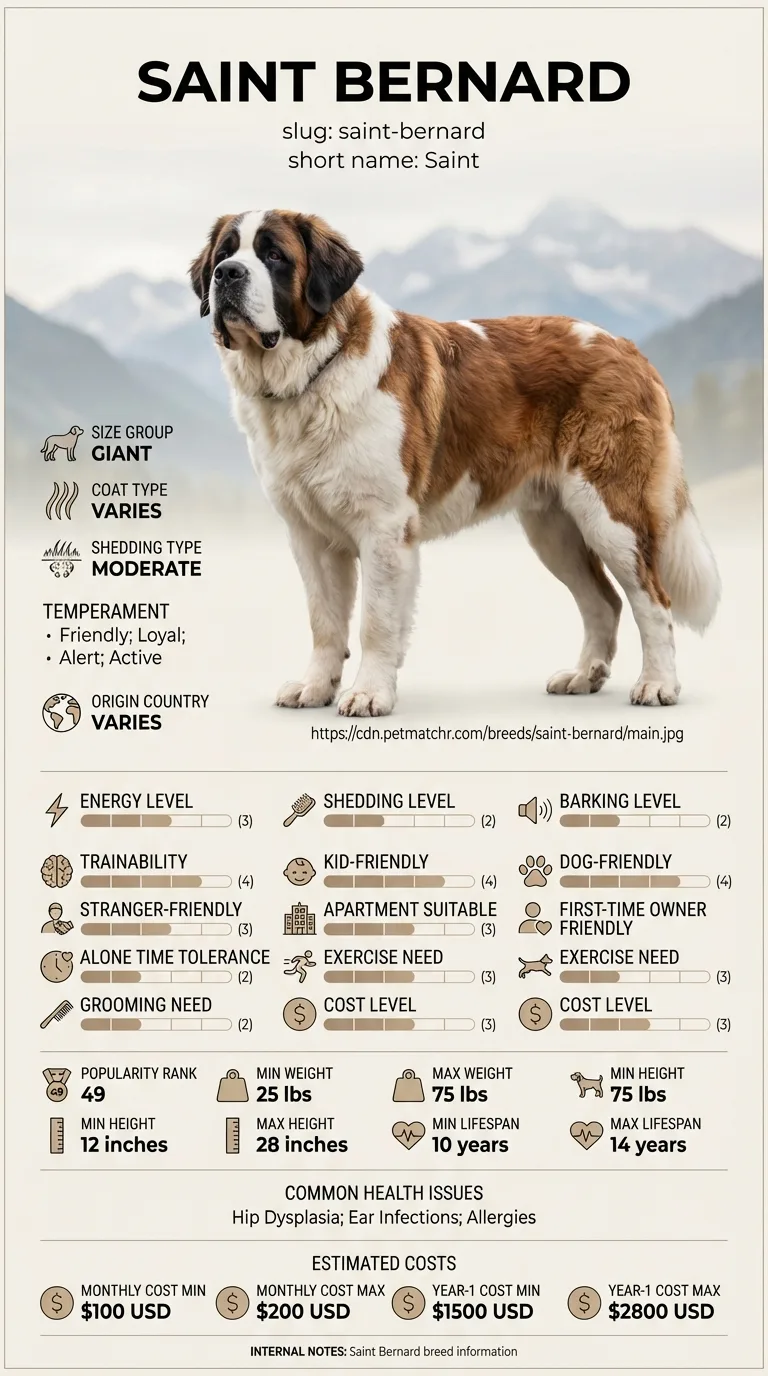
Bloat is the fast one. The slower expensive items in this breed are documented Hip Dysplasia, Elbow Dysplasia, Dilated Cardiomyopathy and Entropion, all of which cost more here than they would in a smaller breed simply because surgical time, anesthetic agents and medications are all quantities dosed against 120 to 180 pounds of dog.
Atlanta prices close to the national average across the board, with the long warm season adding months of parasite prevention at this breed's top-tier dosing weight.
Estimate · source: estimation · confidence: medium · updated 2026-09-06 · not a quote
| Item | Cost range |
|---|---|
One-time setup (giant crate, bed, first exam, spay/neuter) Worth asking your surgeon what an elective preventive gastropexy would add if it is performed during the same anesthetic event as the spay or neuter. | $530 - $918 |
| Item | Cost range |
|---|---|
Food (split into smaller meals) Priced near the national average, though the quantity is set by the dog rather than the market. Splitting the daily ration across meals is standard practice in deep-chested breeds. | $73 - $131 |
Parasite prevention (eleven-month Georgia season) The humid warm season runs long here, and at this body weight each dose sits in the highest price bracket the product line offers. | $33 - $59 |
Each range starts from a national baseline for this breed's size class and is then adjusted for local cost of living and veterinary pricing. The baselines, and the source each one came from, are listed on our sources page (dataset 2026.09). Two inputs, the purchase price and the emergency reserve, have no published national figure we could verify, so we leave them to you rather than invent them.
These are planning estimates, not quotes. Your own numbers will move with the individual dog, your vet and your insurer. Build a budget with your own figures.
In Atlanta the case for insurance rests almost entirely on the unscheduled events, because the scheduled care here is affordably priced and predictable.
If the household is one emergency surgery away from real financial strain, insure. Bloat arrives without a warning period, and the bill is set by a giant patient rather than an average one.
An owner holding a reserve deep enough to cover overnight abdominal surgery outright, without borrowing, can reasonably carry that risk themselves.
Atlanta's savings come from preparation rather than price shopping. The market is fair; the geography is what needs managing.
Metro Atlanta's pricing is unremarkable in a useful way. Routine veterinary visits, boarding and grooming sit within reach of the national average, and Georgia's general cost of living does not distort a dog budget the way a tier-five coastal market does. The long humid warm season pushes parasite prevention to roughly eleven months, which for a dog in the top weight bracket is a genuine annual line rather than a rounding error.
What Atlanta does have is distance measured in minutes rather than miles. The Downtown Connector and the Perimeter are famously unreliable at predicting how long a trip will take, and the metro's suburban sprawl means a lot of households sit twenty highway miles from the nearest twenty-four-hour emergency hospital.
For most breeds that is an inconvenience. For a deep-chested giant with documented bloat risk it is worth planning around in advance, because the decision you do not want to be making at nine on a weeknight is which of three hospitals to aim for and whether the route you know is currently a parking lot.
Before the dog comes home, find the two nearest emergency hospitals that are genuinely open overnight, confirm they take walk-in surgical cases, and drive to both once at a bad hour so you know the real route rather than the mapped one. That exercise costs an evening and it is the single highest-value preparation for this breed in this metro.
The money side is more ordinary. Food for a dog of this size is the largest recurring line and it does not shrink. Atlanta's near-average service pricing means neither a windfall nor a penalty on grooming and boarding, though every one of those services charges a size premium. Where Atlanta genuinely costs more than a northern city is the eleven-month prevention schedule, which at this body weight sits in the most expensive dosing tier available.

An Atlanta owner whose Saint Bernard started pacing and retching unproductively on a weekday evening headed for the emergency hospital nine miles away, which on a Sunday morning is a fifteen-minute run. That night it took closer to fifty. The dog came through surgery, and the first thing the family did afterwards was find a second hospital on the other side of their neighborhood so that the route was never a single point of failure again.
Key takeaway: In Atlanta, plan the emergency drive before the emergency. For a bloat-prone giant breed, the map you have memorised is part of the medical plan.
About $153–$316, tracking close to the national average because metro Atlanta's general costs sit near the US line.
Around $2,244–$4,284, which adds the first exam, spay/neuter and giant-size gear to the ongoing monthly total.
Because bloat is documented in Saint Bernards and it is an hours-count emergency. In a metro where a twenty-mile trip can take an unpredictable amount of time, the route is part of the outcome.
Identify two genuinely overnight emergency hospitals, confirm they handle walk-in surgery, and drive both routes once at a congested hour so you are not learning them under pressure.
Worth pricing early. Emergency abdominal surgery in a giant breed is a large bill in any market, and Atlanta's near-average pricing does not make it a small one.
About $1,250, which reflects Atlanta's mid-range service pricing against the reality that a 120-to-180-pound patient consumes far more of everything during a crisis.
About $153–$316/month and $2,244–$4,284 in year one — near the national average, with the local twist being that congestion turns emergency drive time into a real variable for a bloat-prone giant.
This guide is not medical advice. If your dog shows pain, sudden behavior change, or worsening symptoms, consult a licensed veterinarian.
Some links may be affiliate links. We may earn a commission at no extra cost to you. We only suggest products we believe are helpful for dog owners.
We research and check what we publish, but we do not warrant that any figure, date, price, or statement is accurate, complete, or current, and we accept no liability for any loss, cost, injury, or other harm arising from the use of this site. Use it as one reference among several. You remain responsible for your own decisions and for your dog's care - confirm anything that matters with a licensed veterinarian or another qualified professional before you act on it. Full disclaimer.
One sheet with every line item, the emergency fund and when insurance pays off - unlocks on this page.
You get: 12-month budget sheet
No spam. One-click unsubscribe. See our privacy policy.
Preview page 1 before you decide.