Costs
Saint Bernard cost in Manchester
About $155–$319 monthly and $2,266–$4,326 for year one, a little above average — with the local point that on wooded New Hampshire lots, a buried containment wire is the wrong economy for a dog this heavy.

See Saint Bernard price across all cities →
Quick answer
Saint Bernard cost in Manchester
About $155–$319 monthly and $2,266–$4,326 for year one, a little above average — with the local point that on wooded New Hampshire lots, a buried containment wire is the wrong economy for a dog this heavy.
A Saint Bernard in Manchester costs roughly $155 to $319 a month, with year one near $2,266 to $4,326 — a shade above the national average, though New Hampshire's lack of a sales tax quietly takes the edge off anything you buy over a counter. The decision that costs the most here is a fencing decision, and on New Hampshire lots it is usually made for the wrong reasons.
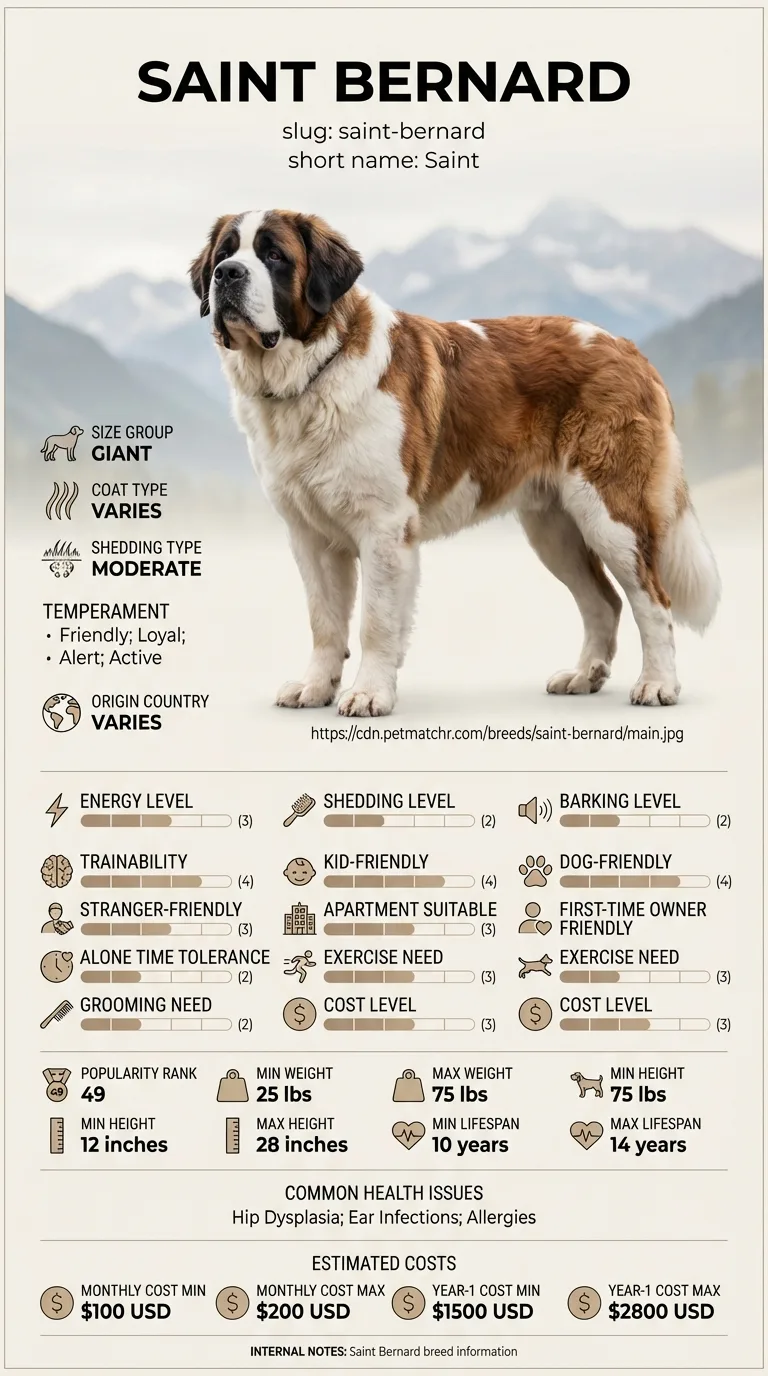
Alongside the documented list of Hip Dysplasia, Elbow Dysplasia, Dilated Cardiomyopathy, Entropion and Bloat, containment failure in a giant breed carries its own costs: road risk, wildlife encounters, and the liability that follows any incident involving a dog this size. None of that is a breed fault. It is physics and momentum.
Manchester prices slightly above the national line, softened by no sales tax on goods and by a short seven-month prevention season, with a proper dog yard as the local capital item.
Estimate · source: estimation · confidence: medium · updated 2026-10-06 · not a quote
| Item | Cost range |
|---|---|
One-time setup and a fenced dog yard The widest range on this page by far, because it depends entirely on how much ground you enclose. Enclose a defined yard rather than a parcel. | $900 - $2400 |
| Item | Cost range |
|---|---|
Food (untaxed, but large) The largest recurring line, and the one where New Hampshire's lack of sales tax quietly adds up over a decade. | $74 - $133 |
Parasite prevention (seven-month season) One of the shorter windows on this list, which genuinely reduces a line that is expensive at this dog's weight. | $26 - $47 |
Each range starts from a national baseline for this breed's size class and is then adjusted for local cost of living and veterinary pricing. The baselines, and the source each one came from, are listed on our sources page (dataset 2026.09). Two inputs, the purchase price and the emergency reserve, have no published national figure we could verify, so we leave them to you rather than invent them.
These are planning estimates, not quotes. Your own numbers will move with the individual dog, your vet and your insurer. Build a budget with your own figures.
The medical case for coverage here is the standard giant-breed one, and it is worth noting that liability exposure is a separate question your home insurer answers, not your pet insurer.
Buy early if a surgical event would be difficult to fund, and separately confirm how your homeowner's policy treats a dog of this size.
A household with a deep reserve can self-fund the medical side, but should still check the liability side rather than assume it.
Spend properly on containment once, then let New Hampshire's short season and untaxed goods do the rest.
Two problems, both practical. The first is that an underground system contains by deterrence, and deterrence is a contest between the correction and the motivation. A 120-to-180-pound dog that decides to cross a boundary crosses it, and having crossed, faces the same correction coming back — which is how a contained dog becomes a loose dog stuck on the wrong side of its own yard.
The second is that a buried wire keeps nothing out. On wooded New Hampshire lots that means coyotes, loose dogs, delivery drivers and children can all walk straight into a space the dog reasonably considers its own. This breed is documented as watchful, gentle and rated 4 out of 5 with both dogs and strangers, which is a lovely profile and not the same thing as a plan.
The alternative is not fencing the whole parcel, which nobody does. It is fencing a defined dog yard — a well-built, properly gated section near the house, sized generously but not heroically. A breed with a 2-out-of-5 exercise requirement does not need an acre to be content; it needs a secure, reachable outdoor space and a household that walks it.
Manchester's service pricing sits just above the national line, which is the pull of the wider New England market rather than anything local. The absence of a state sales tax is a genuine if undramatic benefit on the goods side of a giant breed's budget, where the quantities are large: food, bedding, crates and ramps all cross a counter untaxed.
The parasite-prevention season is a clearly bounded seven months, one of the shorter windows covered here, which meaningfully reduces a line that is expensive at this dog's dosing weight. Winter itself is close to free for this breed. An alpine dog in a double coat is comfortable in a New Hampshire January in a way that most breeds are not, and no coat purchase or shortened walk regime is required.
The rest is ordinary. Food is the largest recurring line, grooming is a real cost for a heavy seasonal shedder, and boarding is charged by run size with a giant only fitting the biggest and dearest option.

A household outside Manchester ran an underground system successfully for two years, until a deer crossed the front of the property one November evening. The dog went through the boundary at speed, then stood at the edge of the road unwilling to come back across it. Nothing happened, which the owners are clear was luck. They fenced a half-acre dog yard the following spring and describe the buried wire as the cheapest thing they ever bought twice.
Key takeaway: Containment that works by deterrence works until motivation outweighs it. At 150 pounds, plan the fence for the evening the deer walks past.
About $155 to $319, marginally above the national average, reflecting the wider New England market.
Roughly $2,266 to $4,326, once the first exam, sterilisation and giant-sized equipment are added to the recurring monthly figure.
They are a poor fit. Containment by correction is a contest against motivation, and a dog of this weight that crosses the boundary is then reluctant to cross back, leaving it loose.
A properly fenced and gated dog yard near the house rather than the whole parcel. A breed needing 2-out-of-5 exercise does not require acreage to be content.
A modest but real one, and it lands hardest on this breed because the goods side of a giant's budget — food volume, large bedding, crates and ramps — is unusually big.
Around $1,300, sized against New Hampshire's slightly above-average pricing and the quantity of everything a giant patient consumes.
About $155–$319 monthly and $2,266–$4,326 for year one, a little above average — with the local point that on wooded New Hampshire lots, a buried containment wire is the wrong economy for a dog this heavy.
This guide is not medical advice. If your dog shows pain, sudden behavior change, or worsening symptoms, consult a licensed veterinarian.
Some links may be affiliate links. We may earn a commission at no extra cost to you. We only suggest products we believe are helpful for dog owners.
We research and check what we publish, but we do not warrant that any figure, date, price, or statement is accurate, complete, or current, and we accept no liability for any loss, cost, injury, or other harm arising from the use of this site. Use it as one reference among several. You remain responsible for your own decisions and for your dog's care - confirm anything that matters with a licensed veterinarian or another qualified professional before you act on it. Full disclaimer.
One sheet with every line item, the emergency fund and when insurance pays off - unlocks on this page.
You get: 12-month budget sheet
No spam. One-click unsubscribe. See our privacy policy.
See a sample page before you decide.