Behavior
Lower-maintenance coat?
The Vizsla, with very low (1/5) grooming need versus the Saint Bernard's moderate (3/5).

Quick answer
Lower-maintenance coat?
The Vizsla, with very low (1/5) grooming need versus the Saint Bernard's moderate (3/5).
Saint Bernard or Vizsla? On paper they differ most on exercise need, and on the scales Saint Bernard is the heavier at 120–180 lbs. Here is how the two compare on everything that shapes an ordinary week.
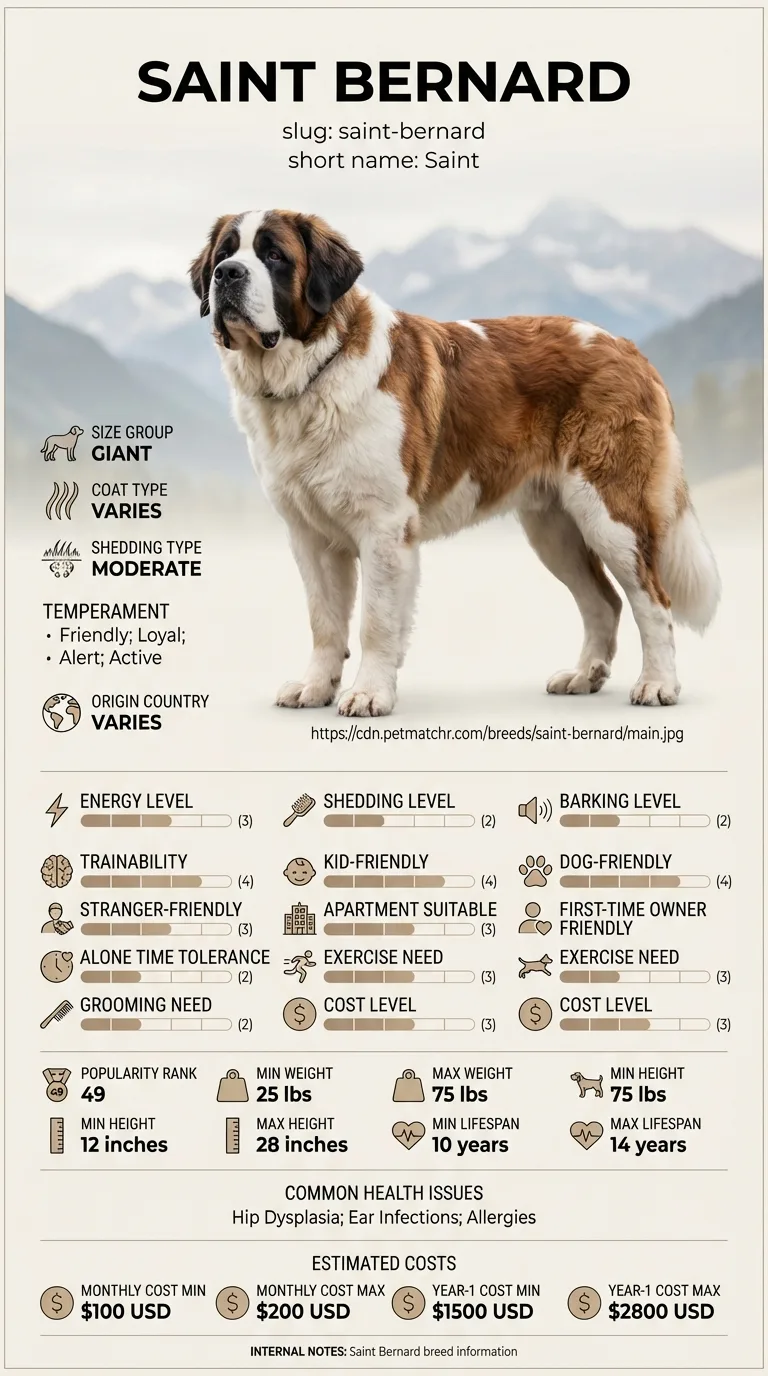
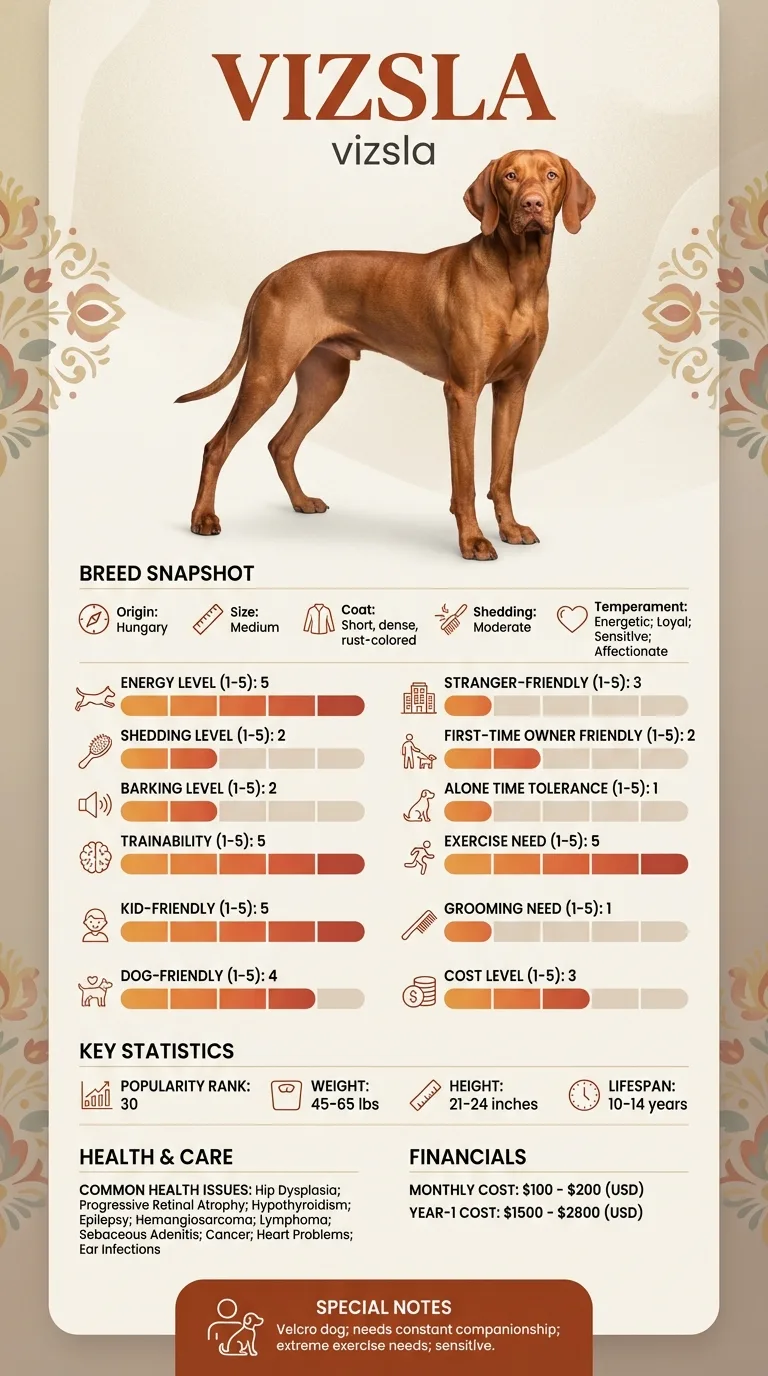
This is for someone already down to Saint Bernard and Vizsla and deciding between them. For this pair the decision usually turns on exercise need and energy level, so those are covered first and in most detail. Both rate 1/5 for flats, so housing does not settle this one. It is written for the decision rather than the breed history.
Between Saint Bernard and Vizsla, exercise need is what separates them, and Saint Bernard is the lower-effort dog of the two to keep.
Choose Saint Bernard if this is your first dog, your walking routine is modest and the dog will be alone during the working day.
Choose Vizsla if you do not want a standing grooming appointment, shedding is a problem in your house and you want a dog that picks up training quickly.
| Feature | saint bernard | vizsla | Winner |
|---|---|---|---|
| Size class | giant | medium | Equal |
| Weight | 120–180 lbs | 45–65 lbs | Equal |
| Height | 26–30 in | 21–24 in | Equal |
| Lifespan | 8–10 years | 10–14 years | vizsla |
| Exercise need | Low (2/5) | Very high (5/5) | saint bernard |
| Grooming need | Moderate (3/5) | Very low (1/5) | vizsla |
| Shedding | High (4/5) | Low (2/5) | vizsla |
| Energy level | Low (2/5) | Very high (5/5) | Equal |
| Barking | Low (2/5) | Low (2/5) | Equal |
| Apartment suitability | Very low (1/5) | Very low (1/5) | Equal |
| Good for first-time owners | Moderate (3/5) | Low (2/5) | saint bernard |
| Tolerates being alone | Moderate (3/5) | Very low (1/5) | saint bernard |
| Trainability | Moderate (3/5) | Very high (5/5) | vizsla |
| Good with kids | Very high (5/5) | Very high (5/5) | Equal |
| Good with other dogs | High (4/5) | High (4/5) | Equal |
| Friendly to strangers | High (4/5) | Moderate (3/5) | saint bernard |
| Cost level | Very high (5/5) | Moderate (3/5) | vizsla |
| Coat | Short or long double coat | Short, dense, rust-colored | Equal |
| Origin | Various | Hungary | Equal |
| Typical monthly cost | $150–$310 | $100–$200 | Equal |
| Typical first-year cost | $2,200–$4,200 | $1,500–$2,800 | Equal |
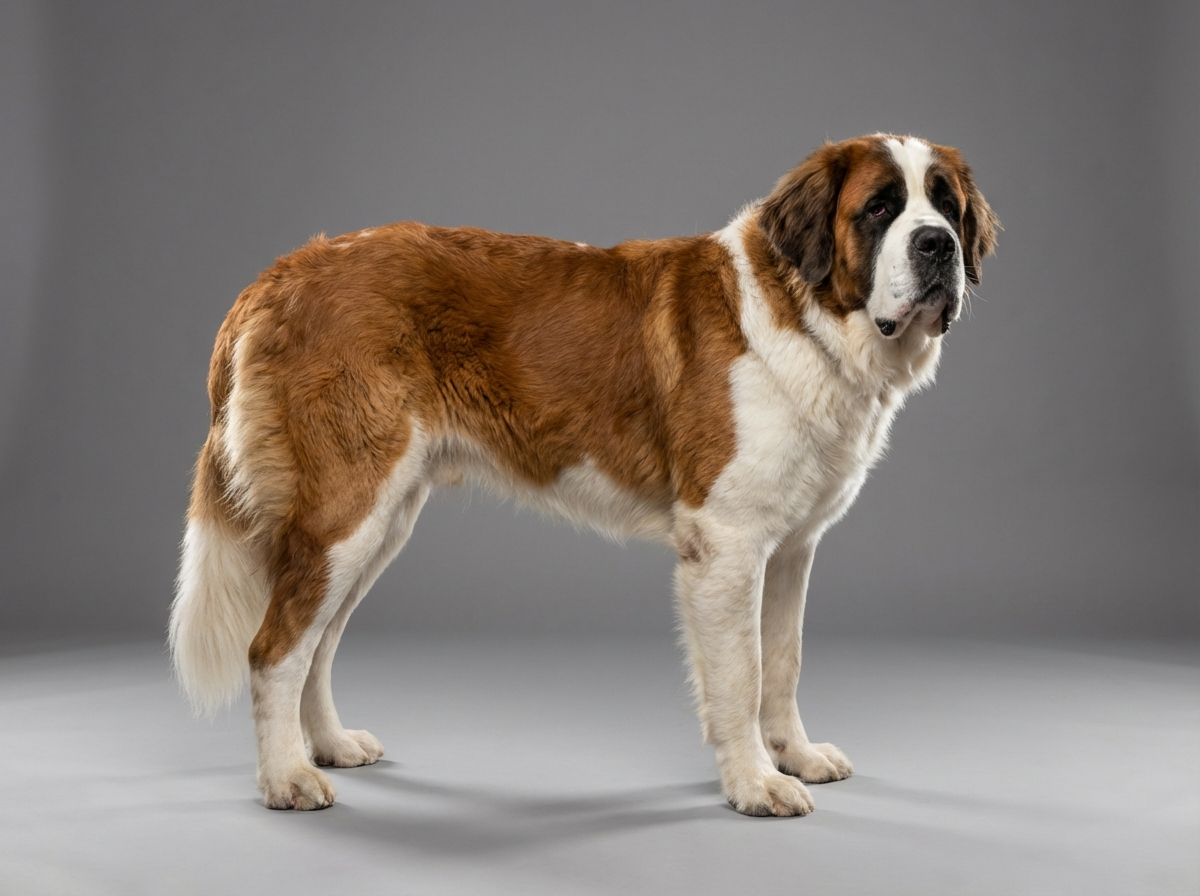
At 45–65 lbs and 21–24 inches, the Vizsla is a lean, athletic medium-to-large dog dwarfed by the Saint Bernard's 120–180 lb, 26–30 inch frame — roughly a two-to-three-times weight difference. The Vizsla's build is famously lithe and low-fat, built for endurance in the field, while the Saint Bernard's mass is dense muscle and bone suited to cold-weather work. Both need substantial space, but the Vizsla's need is driven by activity room rather than sheer bulk — it wants to run, not just have somewhere to lie down, which changes what 'enough space' actually means for each dog.
The exercise gap here is one of the widest on this site: the Saint Bernard rates low (2/5) while the Vizsla rates very high (5/5), reflecting its history as a tireless hunting companion. Vizslas are famously described as 'Velcro dogs' — the "Energetic" and "Affectionate" temperament tags reflect a breed that wants to run and then be physically close to its person, not just released into a yard alone. A bored, under-exercised Vizsla can become anxious or destructive. The Saint Bernard's modest needs mean this pairing suits very different households: one built around long runs and field time, the other around a quieter routine.
Grooming flips in the Vizsla's favor — very low (1/5) against the Saint Bernard's moderate (3/5) — and its short, dense, rust-colored coat sheds only low (2/5) compared to the Saint Bernard's high (4/5). A Vizsla is close to wash-and-go, needing little more than an occasional wipe-down, while the Saint Bernard's double coat and drool require a more involved routine. For anyone weighing coat care as a deciding factor, the Vizsla is the clearly lower-maintenance dog, though its short coat offers little insulation and means it feels the cold more than the Saint Bernard's built-for-snow coat.
Both breeds rate very low (1/5) for apartment suitability, and while the Vizsla is far smaller, its very-high exercise need and very-low (1/5) alone-tolerance make it just as poor a match for a small, unattended space as the Saint Bernard. Barking rates low (2/5) for both, so neither is a notably vocal breed. The bigger issue for the Vizsla in an apartment setting isn't noise but activity — this breed genuinely needs room to run daily, something a small unit with limited outdoor access struggles to provide regardless of square footage.
Trainability rates very high (5/5) for the Vizsla against moderate (3/5) for the Saint Bernard, and Vizslas are widely regarded as quick, eager learners thanks to their hunting-dog heritage. Yet the Vizsla rates low (2/5) for first-time owners versus the Saint Bernard's moderate (3/5) — high trainability doesn't offset the intensity of its exercise and attention needs, which can overwhelm a first-time owner even if the dog itself learns commands easily. A Vizsla rewards an owner with hunting, running, or dog-sport experience more than one simply looking for an obedient pet.
Both breeds rate very high (5/5) with kids and high (4/5) with other dogs, another closely matched pairing on sociability. Strangers see a modest edge for the Saint Bernard — high (4/5) versus the Vizsla's moderate (3/5) — consistent with the Vizsla's "Sensitive" temperament tag, which can translate to a dog that's more reserved or anxious around unfamiliar people than its Loyal, Affectionate reputation with its own family suggests. Households with frequent visitors may find the Saint Bernard the more consistently welcoming greeter of the two.
The Vizsla's 10–14 year lifespan runs ahead of the Saint Bernard's 8–10 years, but its health list carries significant cancer risk: Hemangiosarcoma, Lymphoma, and Cancer all appear alongside Hip Dysplasia, Progressive Retinal Atrophy, Hypothyroidism, Epilepsy, Sebaceous Adenitis, Heart Problems, and Ear Infections. The Saint Bernard's shorter list (Hip Dysplasia, Elbow Dysplasia, Dilated Cardiomyopathy, Entropion, Bloat) trades fewer named conditions for the acute risk of bloat. Both share Hip Dysplasia risk. Vizsla owners in particular should discuss cancer screening and monitoring with their vet given how many cancer-related conditions appear on the breed's list.
Cost level rates very high (5/5) for the Saint Bernard against moderate (3/5) for the Vizsla, with monthly costs of $150–310 versus $100–200 and first-year costs of $2,200–4,200 versus $1,500–2,800. The Vizsla's very-low (1/5) grooming need keeps its coat-care costs minimal, but its very-high exercise needs may add costs elsewhere — dog walkers, running gear, or field-training classes for an owner unable to provide enough activity solo. The Saint Bernard's higher baseline cost is driven mainly by food volume and giant-breed veterinary pricing.
Saint Bernard weighs 120–180 lbs and lives 8–10 years; Vizsla weighs 45–65 lbs and lives 10–14 years. The two diverge most on exercise need, energy level and grooming need and 4 other rated axes. They are level on apartment suitability, barking and good with other dogs, so those cannot decide it. In the table, a "winner" means easier for an ordinary household — not better. Size, coat and origin are recorded without a verdict. Because both breeds are scored the same way, the gaps are reliable even where the absolute numbers are rough.

The Vizsla by far — very low (1/5) grooming need and low (2/5) shedding, versus the Saint Bernard's moderate (3/5) grooming and high (4/5) shedding.
Not ideally — despite very high (5/5) trainability, it rates only low (2/5) for first-time owners because of its intense exercise needs and very low (1/5) tolerance for being alone.
The Vizsla, rated very high (5/5) for both exercise need and energy level, versus the Saint Bernard's low (2/5) on both.
The Saint Bernard, rated high (4/5) versus the Vizsla's moderate (3/5); the Vizsla's sensitive temperament can make it more reserved around unfamiliar people.
Not comfortably — the Vizsla rates very low (1/5) for alone tolerance, and the Saint Bernard only moderate (3/5).
The Vizsla's health list includes Hemangiosarcoma, Lymphoma, and general Cancer risk, more cancer-related entries than appear on the Saint Bernard's list.
The Vizsla, at $100–200 monthly and $1,500–2,800 first-year, well under the Saint Bernard's $150–310 monthly and $2,200–4,200 first-year.
The Vizsla, with very low (1/5) grooming need versus the Saint Bernard's moderate (3/5).
The Vizsla, rated very high (5/5) versus the Saint Bernard's moderate (3/5).
The Saint Bernard, given its low (2/5) exercise need versus the Vizsla's very high (5/5).
Both rate very high (5/5) — an even match.
Secure checkout on Stripe. We never see your card.
7-day money-back guarantee. Instant access.
Health information here is general and is not veterinary advice. If your dog shows pain, sudden behaviour change, or worsening symptoms, consult a licensed veterinarian.
Some links on this site are affiliate links. We may earn a commission at no extra cost to you, and we only suggest products we believe are helpful for dog owners.
We research and check what we publish, but we do not warrant that any figure, date, price, or statement is accurate, complete, or current, and we accept no liability for any loss, cost, injury, or other harm arising from the use of this site. Use it as one reference among several. You remain responsible for your own decisions and for your dog's care - confirm anything that matters with a licensed veterinarian or another qualified professional before you act on it. Full disclaimer.
Match your lifestyle to the right dog.
Take quizNot sure which breed is right for you? Take our 2-minute quiz to find out.
Take the quiz