Living
Which should you pick overall?
The Frenchie fits apartments and first-time owners; the Saint Bernard needs a house with real space and is worth it if you want an exceptionally gentle dog with kids.

Quick answer
Which should you pick overall?
The Frenchie fits apartments and first-time owners; the Saint Bernard needs a house with real space and is worth it if you want an exceptionally gentle dog with kids.
French Bulldog or Saint Bernard? On paper they differ most on apartment suitability, and on the scales Saint Bernard is the heavier at 120–180 lbs. Here is how the two compare on everything that shapes an ordinary week.
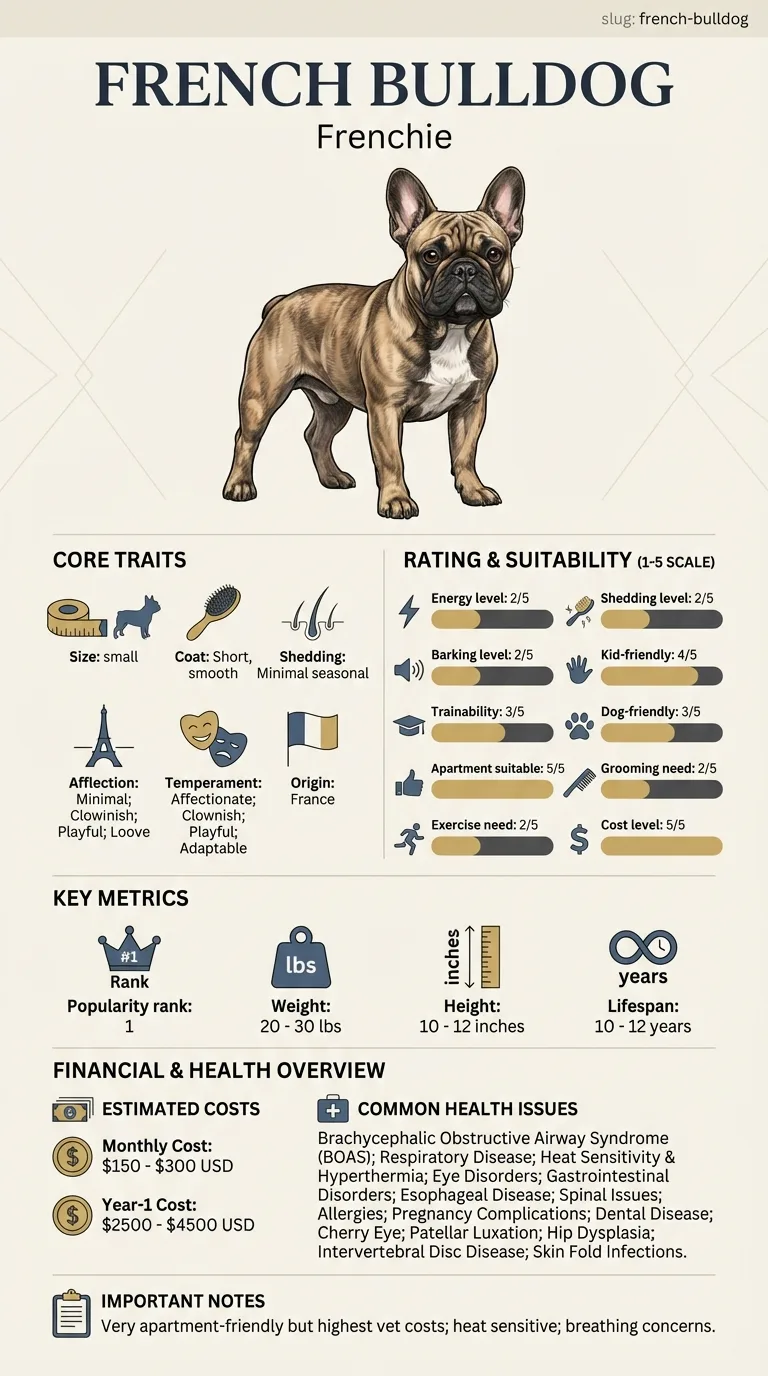
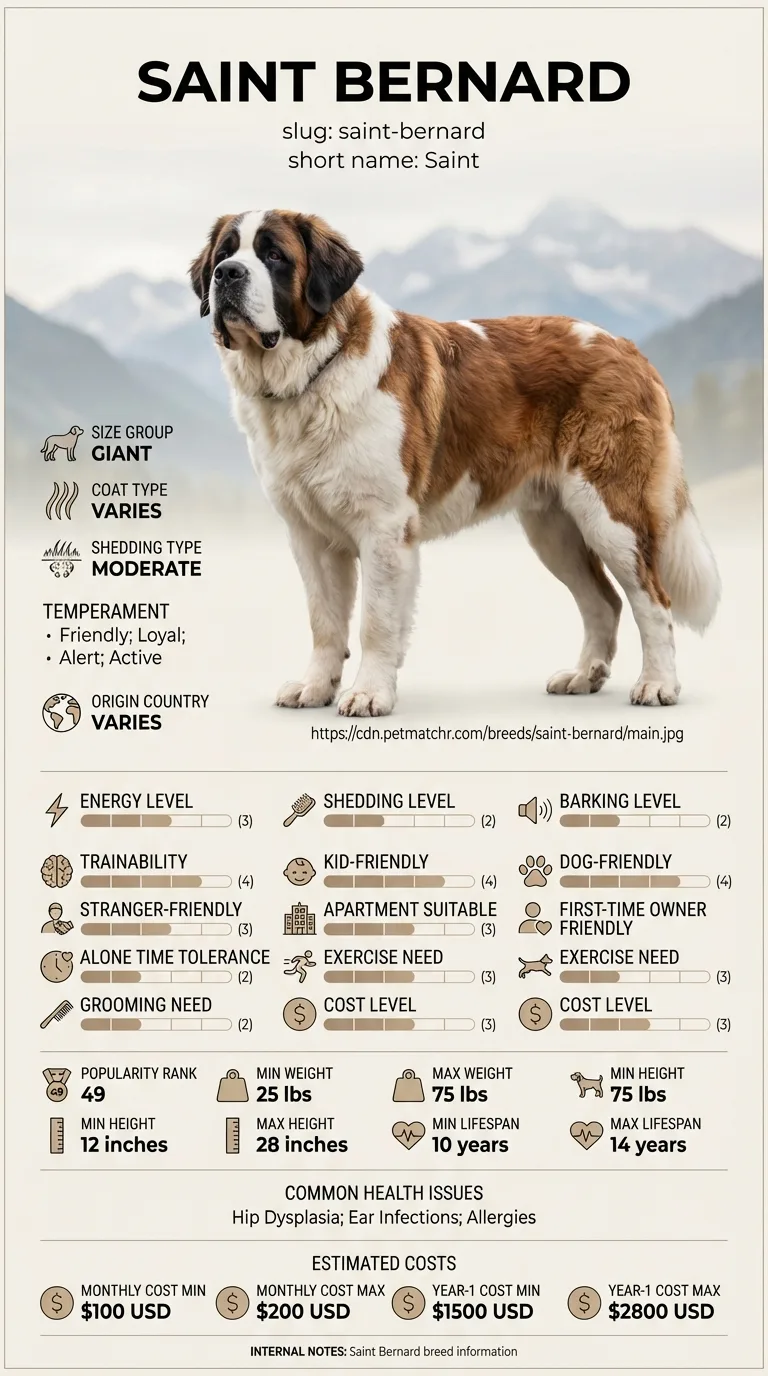
This is for someone already down to French Bulldog and Saint Bernard and deciding between them. For this pair the decision usually turns on apartment suitability and shedding, so those are covered first and in most detail. Anyone choosing from a flat has a clear answer here: French Bulldog rates 5/5 against 1/5. There is no origin story here — only what changes about your week.
Between French Bulldog and Saint Bernard, apartment suitability is what separates them, and French Bulldog is the lower-effort dog of the two to keep.
Choose French Bulldog if you are in a flat or a smaller home, this is your first dog and you do not want a standing grooming appointment.
Choose Saint Bernard if there are young children at home and you already have another dog.
| Feature | french bulldog | saint bernard | Winner |
|---|---|---|---|
| Size class | small | giant | Equal |
| Weight | 20–30 lbs | 120–180 lbs | Equal |
| Height | 10–12 in | 26–30 in | Equal |
| Lifespan | 10–12 years | 8–10 years | french bulldog |
| Exercise need | Low (2/5) | Low (2/5) | Equal |
| Grooming need | Low (2/5) | Moderate (3/5) | french bulldog |
| Shedding | Low (2/5) | High (4/5) | french bulldog |
| Energy level | Low (2/5) | Low (2/5) | Equal |
| Barking | Low (2/5) | Low (2/5) | Equal |
| Apartment suitability | Very high (5/5) | Very low (1/5) | french bulldog |
| Good for first-time owners | Very high (5/5) | Moderate (3/5) | french bulldog |
| Tolerates being alone | Very high (5/5) | Moderate (3/5) | french bulldog |
| Trainability | Moderate (3/5) | Moderate (3/5) | Equal |
| Good with kids | High (4/5) | Very high (5/5) | saint bernard |
| Good with other dogs | Moderate (3/5) | High (4/5) | saint bernard |
| Friendly to strangers | Moderate (3/5) | High (4/5) | saint bernard |
| Cost level | Very high (5/5) | Very high (5/5) | Equal |
| Coat | Short, smooth | Short or long double coat | Equal |
| Origin | France | Various | Equal |
| Typical monthly cost | $150–$300 | $150–$310 | Equal |
| Typical first-year cost | $2,500–$4,500 | $2,200–$4,200 | Equal |
Put a Saint Bernard next to a French Bulldog and the size gap does most of the talking on its own. The Bernard runs 120-180 lbs and stands 26-30 in at the shoulder; the Frenchie is 20-30 lbs and 10-12 in. That's up to a nine-fold weight difference — the widest gap anywhere in this comparison set, and it shapes nearly every other number on this page.
Both breeds tie at a low 2/5 for exercise need, which surprises people expecting a giant breed to demand more. Saint Bernards are calm, deliberate dogs rather than high-drive ones — a couple of walks a day suits them fine. The practical difference isn't energy, it's the sheer physical mass you're walking, feeding, and managing at the end of the leash.
The Frenchie stays low-effort here, 2/5 for grooming and 2/5 for shedding. The Saint Bernard steps up to moderate grooming (3/5) and high shedding (4/5) — its double coat, whether short or long, comes off the dog in real volume, especially seasonally. Budget for a much bigger vacuum cleaner if you go with the Bernard. Twice-yearly coat blowouts are typical, and a long-coated Saint Bernard will need more frequent brushing than a short-coated one to keep mats from forming.
Barking ties low (2/5) for both. Everything else swings hard toward the Frenchie: apartment suitability is 5/5 against the Bernard's very low 1/5 — the widest apartment-fit gap in this whole batch — and alone tolerance runs 5/5 versus a moderate 3/5. A dog approaching 180 lbs needs space a small apartment simply can't offer. Even a generously sized apartment rarely has the floor space for a dog that can weigh as much as a full-grown adult to move around comfortably.
The Frenchie rates 5/5 for first-time owners against the Bernard's moderate 3/5. Trainability, unusually, ties at moderate 3/5 for both — the Saint Bernard isn't hard to teach, it's just large enough that handling mistakes carry higher stakes. An inexperienced owner can manage the training; managing a 150-lb dog physically is the part that takes practice. Leash manners matter more with the Bernard than with almost any other breed in this comparison, simply because a lapse in control has far bigger physical consequences.
This is the one category where the giant breed wins outright: good with kids rates very high (5/5) for the Saint Bernard against the Frenchie's already-strong 4/5, and it also edges ahead with other dogs (4/5 vs. 3/5) and strangers (4/5 vs. 3/5). The gentle-giant reputation shows up directly in these numbers. Even so, supervise young kids around a dog this size purely on physical grounds — a friendly nudge from a 150-lb dog can still knock a toddler over.
The Saint Bernard's 8-10 year lifespan is the shortest in this whole comparison batch, even shorter than the Frenchie's 10-12. Its five-item health list includes bloat (GDV) and dilated cardiomyopathy, both serious risks tied to its size and deep chest, alongside hip and elbow dysplasia and entropion. The Frenchie's fifteen-item list is respiratory- and spine-driven instead — the two share no conditions in common.
Cost level ties at very high (5/5) for both, and the dollar figures back that up almost exactly: $150-300 monthly for the Frenchie versus $150-310 for the Bernard, and $2,500-4,500 versus $2,200-4,200 in year one. It's genuinely striking that a 25-lb dog and a 150-lb dog land in nearly the same monthly range — the Frenchie's medical costs and the Bernard's food and space needs balance each other out almost dollar for dollar.
French Bulldog weighs 20–30 lbs and lives 10–12 years; Saint Bernard weighs 120–180 lbs and lives 8–10 years. The two diverge most on apartment suitability, shedding and good for first-time owners and 1 other rated axes. They are level on barking, cost level and energy level, so those cannot decide it. Where the table declares a winner it means less work for the owner, nothing more; descriptive rows are left as ties on purpose. The value here is in the differences between the two columns; treat any single score as approximate.

Enormously — 120-180 lbs against 20-30 lbs, a gap of up to nine times the weight, making this one of the most size-mismatched comparisons on the site.
Yes, rated high (4/5) against the Frenchie's low (2/5). Their double coat, short or long, sheds noticeably, especially seasonally.
Very — a 5/5 rating, actually edging out the Frenchie's already strong 4/5. It's the one household-fit category where the giant breed comes out ahead.
Not comfortably — it rates very low (1/5) for apartment suitability against the Frenchie's perfect 5/5, the widest gap in this whole comparison set.
About the same as a Frenchie, surprisingly — both rate very high (5/5) on cost level, with near-identical monthly ranges ($150-310 vs. $150-300) despite the massive size difference.
No direct overlap. The Bernard's issues center on bloat, heart disease (DCM), and joint dysplasia tied to its size; the Frenchie's center on its flat face and spine.
The Frenchie, and not by a small margin — 10-12 years versus just 8-10 for the Saint Bernard, the shortest lifespan of any breed in this batch.
The Frenchie fits apartments and first-time owners; the Saint Bernard needs a house with real space and is worth it if you want an exceptionally gentle dog with kids.
Nearly identical — $150-300 for the Frenchie and $150-310 for the Bernard, despite the huge size gap between them.
Neither, really — both tie at a low 2/5 exercise need, since Saint Bernards are calm rather than high-drive despite their size.
The Frenchie, at 10-12 years against the Saint Bernard's 8-10 — the shortest lifespan in this entire batch.
Secure checkout on Stripe. We never see your card.
7-day money-back guarantee. Instant access.

Health information here is general and is not veterinary advice. If your dog shows pain, sudden behaviour change, or worsening symptoms, consult a licensed veterinarian.
Some links on this site are affiliate links. We may earn a commission at no extra cost to you, and we only suggest products we believe are helpful for dog owners.
We research and check what we publish, but we do not warrant that any figure, date, price, or statement is accurate, complete, or current, and we accept no liability for any loss, cost, injury, or other harm arising from the use of this site. Use it as one reference among several. You remain responsible for your own decisions and for your dog's care - confirm anything that matters with a licensed veterinarian or another qualified professional before you act on it. Full disclaimer.
Match your lifestyle to the right dog.
Take quizNot sure which breed is right for you? Take our 2-minute quiz to find out.
Take the quiz