Living
Which breed should you pick overall?
Space decides this one before temperament does — a 150-pound Saint Bernard needs a house, while the Griffon fits an apartment the Saint Bernard can't.

Quick answer
Which breed should you pick overall?
Space decides this one before temperament does — a 150-pound Saint Bernard needs a house, while the Griffon fits an apartment the Saint Bernard can't.
Brussels Griffon or Saint Bernard? On paper they differ most on apartment suitability, and on the scales Saint Bernard is the heavier at 120–180 lbs. Here is how the two compare on everything that shapes an ordinary week.
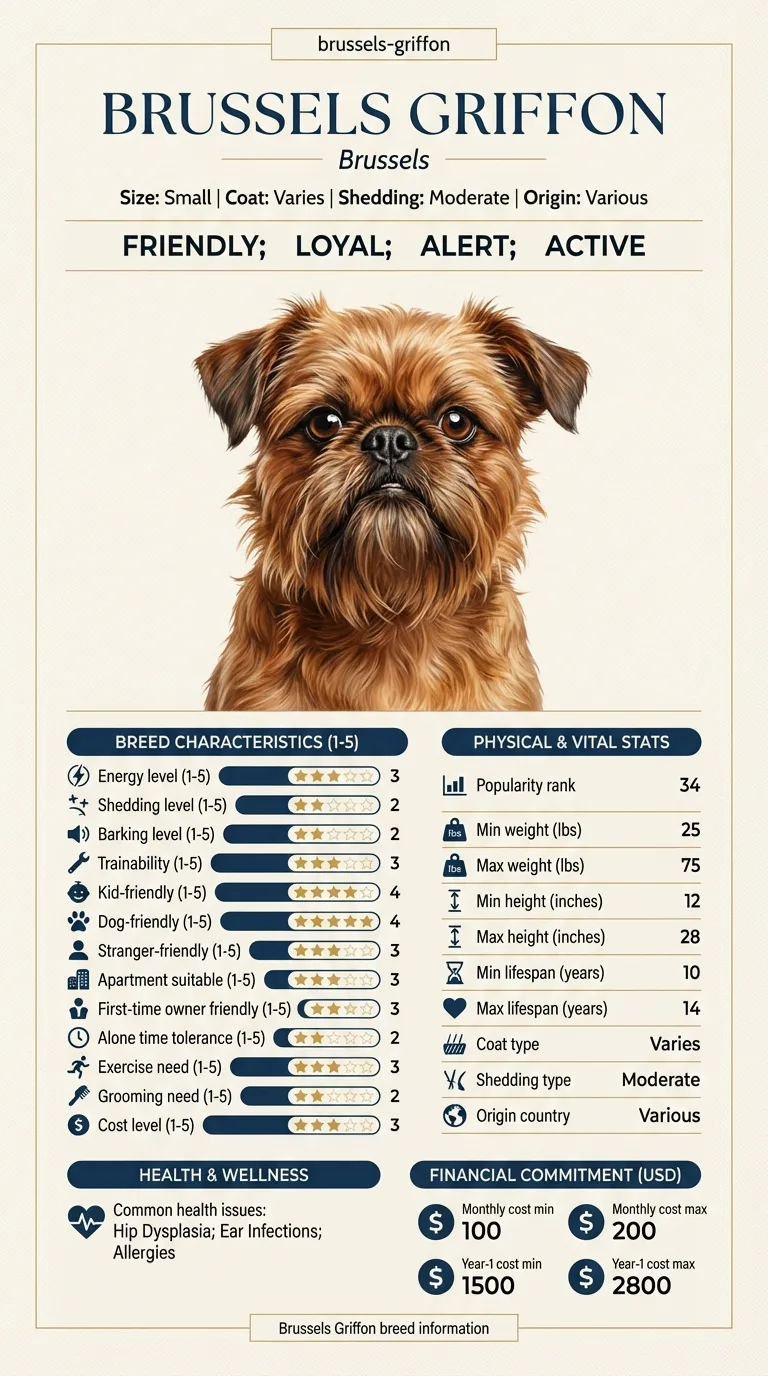
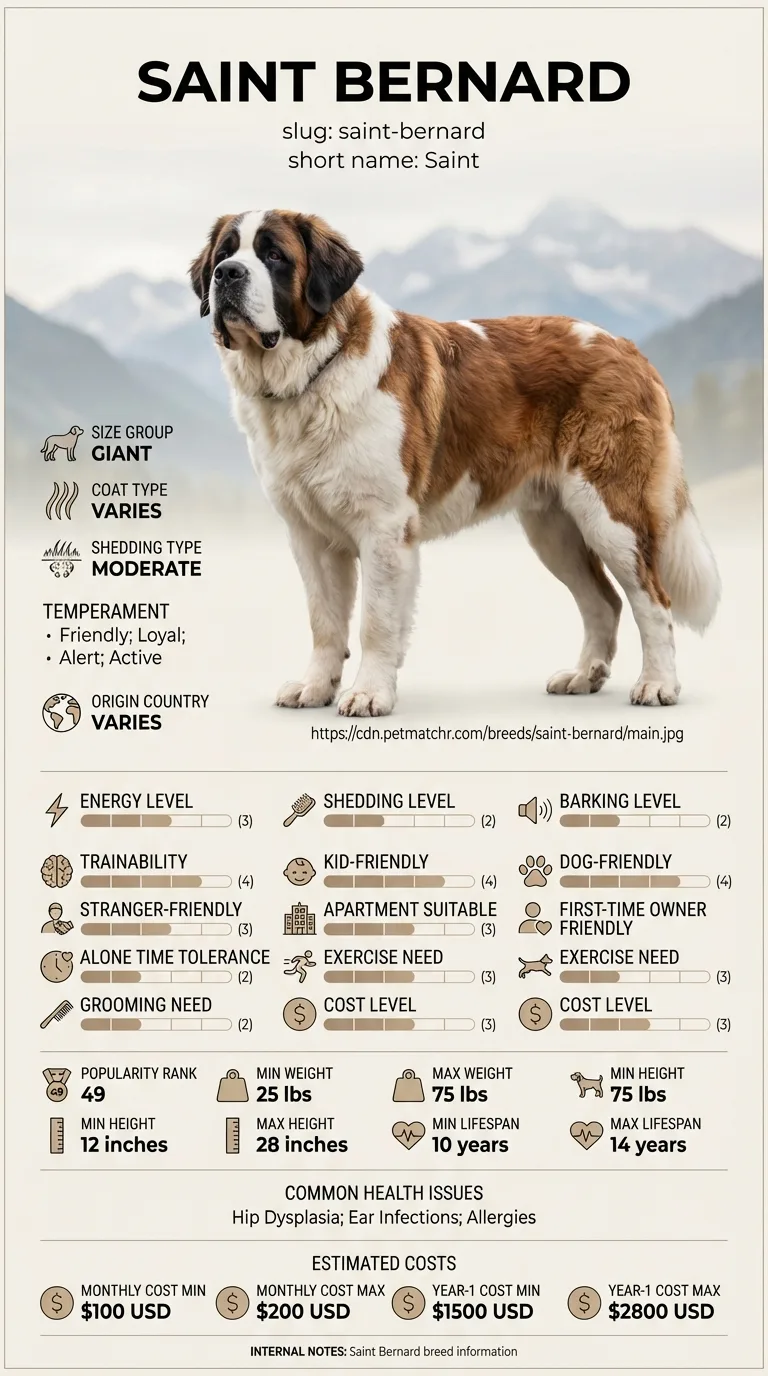
This is for someone already down to Brussels Griffon and Saint Bernard and deciding between them. For this pair the decision usually turns on apartment suitability and shedding, so those are covered first and in most detail. Anyone choosing from a flat has a clear answer here: Brussels Griffon rates 5/5 against 1/5. It is written for the decision rather than the breed history.
Between Brussels Griffon and Saint Bernard, apartment suitability is what separates them, and Brussels Griffon is the lower-effort dog of the two to keep.
Choose Brussels Griffon if you are in a flat or a smaller home, shedding is a problem in your house and a smaller dog suits your car, your home or your back.
Choose Saint Bernard if the dog will be alone during the working day, there are young children at home and you already have another dog.
| Feature | brussels griffon | saint bernard | Winner |
|---|---|---|---|
| Size class | small | giant | Equal |
| Weight | 8–12 lbs | 120–180 lbs | Equal |
| Height | 7–10 in | 26–30 in | Equal |
| Lifespan | 12–15 years | 8–10 years | brussels griffon |
| Exercise need | Low (2/5) | Low (2/5) | Equal |
| Grooming need | Moderate (3/5) | Moderate (3/5) | Equal |
| Shedding | Low (2/5) | High (4/5) | brussels griffon |
| Energy level | Moderate (3/5) | Low (2/5) | Equal |
| Barking | Moderate (3/5) | Low (2/5) | saint bernard |
| Apartment suitability | Very high (5/5) | Very low (1/5) | brussels griffon |
| Good for first-time owners | Moderate (3/5) | Moderate (3/5) | Equal |
| Tolerates being alone | Low (2/5) | Moderate (3/5) | saint bernard |
| Trainability | Moderate (3/5) | Moderate (3/5) | Equal |
| Good with kids | Moderate (3/5) | Very high (5/5) | saint bernard |
| Good with other dogs | Moderate (3/5) | High (4/5) | saint bernard |
| Friendly to strangers | Moderate (3/5) | High (4/5) | saint bernard |
| Cost level | Moderate (3/5) | Very high (5/5) | brussels griffon |
| Coat | Rough or smooth | Short or long double coat | Equal |
| Origin | Various | Various | Equal |
| Typical monthly cost | $80–$150 | $150–$310 | Equal |
| Typical first-year cost | $1,100–$2,300 | $2,200–$4,200 | Equal |
The Saint Bernard is listed at giant size class for a reason: 120 to 180 pounds and up to 30 inches tall, compared to the Brussels Griffon's small 8 to 12 pounds and under 10 inches. This is likely the largest size gap in any Griffon comparison on this site — a full-grown Saint Bernard can outweigh fifteen Griffons. Measure your doorways and car trunk before falling for those famous droopy-jowled photos.
Exercise need actually ties at a low 2/5 for both breeds, which surprises people expecting a giant breed to need more activity — Saint Bernards are a famously low-key, calm breed despite their size. Energy level even tips toward the Griffon as the livelier of the two, moderate (3/5) against the Saint Bernard's low (2/5). That said, a calm temperament doesn't mean zero exercise needs — both breeds still benefit from a regular daily routine.
Grooming need ties at a moderate 3/5 for both breeds, but shedding clearly favors the Griffon, low (2/5) against the Saint Bernard's high (4/5) — a predictable result of that short-or-long double coat covering a much larger dog. Expect noticeably more fur to manage with the Saint Bernard despite the grooming score being the same. Investing in a strong vacuum is worth doing before the Saint Bernard's coat becomes a daily surprise.
This is the widest apartment-suitability gap in the comparison: the Griffon rates a full 5/5, the Saint Bernard a very low 1/5. Size is the obvious reason, but so is the breed's general unsuitability for cramped space. Barking actually favors the Saint Bernard, rating low (2/5) against the Griffon's moderate (3/5), and it tolerates being alone somewhat better too, moderate (3/5) against the Griffon's low (2/5).
Trainability and first-time owner suitability both tie at a moderate 3/5 for these two breeds, despite their size difference — the Saint Bernard's famously gentle, patient temperament apparently offsets the challenges of training a 150-pound dog. Don't read that tie as 'equally easy,' though; a Saint Bernard in training still requires more physical management than a Griffon does. Physical strength during the training period is the real variable to plan for, not raw trainability.
The Saint Bernard rates very high (5/5) with kids against the Griffon's moderate (3/5), and it's also better with other dogs (4/5 vs 3/5) and friendlier to strangers (4/5 vs 3/5). The temperament words fit the reputation — gentle, patient, friendly, and watchful — a breed built around being good with people despite its intimidating size. That combination makes the Saint Bernard a common choice for larger, more chaotic households with kids underfoot.
The Griffon's 12-to-15-year lifespan runs well ahead of the Saint Bernard's 8 to 10, a steep trade for a giant breed. Hip dysplasia is the shared risk between them; the Saint Bernard's list also includes elbow dysplasia, dilated cardiomyopathy, entropion, and bloat (GDV) — the last a genuine emergency risk for large, deep-chested dogs. Discuss cardiac and joint screening with a vet familiar with giant breeds before committing to a puppy.
Cost level rates very high (5/5) for the Saint Bernard against the Griffon's moderate (3/5), and the dollar figures show why: $150 to $310 monthly against $80 to $150, and a first-year cost that can run as high as $4,200 against the Griffon's $2,300 ceiling. Feeding, medicating, and insuring a 150-plus-pound dog costs accordingly more — factor that in well before you've already fallen for one.
Brussels Griffon weighs 8–12 lbs and lives 12–15 years; Saint Bernard weighs 120–180 lbs and lives 8–10 years. The two diverge most on apartment suitability, shedding and good with kids and 1 other rated axes. They are level on exercise need, good for first-time owners and grooming need, so those cannot decide it. In the table, a "winner" means easier for an ordinary household — not better. Size, coat and origin are recorded without a verdict. Because both breeds are scored the same way, the gaps are reliable even where the absolute numbers are rough.

Enormously — 120 to 180 pounds against 8 to 12, likely the biggest size gap on this site's Griffon comparisons.
No — it ties the Griffon at a low 2/5 exercise need, a common surprise given its size. Saint Bernards are known for being calm, not hyperactive.
The Griffon, by a wide margin — 5/5 apartment suitability against the Saint Bernard's very low 1/5.
The Saint Bernard, rated very high (5/5) against the Griffon's moderate (3/5), matching its gentle, patient reputation.
Roughly double — $150 to $310 monthly against the Griffon's $80 to $150, and up to $4,200 in the first year against $2,300.
Only hip dysplasia directly; the Saint Bernard's list also includes bloat, a serious risk for large, deep-chested breeds.
The Griffon, and substantially — 12 to 15 years against the Saint Bernard's 8 to 10.
Space decides this one before temperament does — a 150-pound Saint Bernard needs a house, while the Griffon fits an apartment the Saint Bernard can't.
The Saint Bernard runs $150 to $310 a month against the Griffon's $80 to $150.
Both tie at a low 2/5 — the Saint Bernard's size doesn't translate into a high exercise requirement.
The Griffon typically lives 12 to 15 years, several years longer than the Saint Bernard's 8 to 10.
Secure checkout on Stripe. We never see your card.
7-day money-back guarantee. Instant access.

Health information here is general and is not veterinary advice. If your dog shows pain, sudden behaviour change, or worsening symptoms, consult a licensed veterinarian.
Some links on this site are affiliate links. We may earn a commission at no extra cost to you, and we only suggest products we believe are helpful for dog owners.
We research and check what we publish, but we do not warrant that any figure, date, price, or statement is accurate, complete, or current, and we accept no liability for any loss, cost, injury, or other harm arising from the use of this site. Use it as one reference among several. You remain responsible for your own decisions and for your dog's care - confirm anything that matters with a licensed veterinarian or another qualified professional before you act on it. Full disclaimer.
Match your lifestyle to the right dog.
Take quizNot sure which breed is right for you? Take our 2-minute quiz to find out.
Take the quiz