Behavior
Which needs more exercise?
The Rottweiler, at High (4/5) versus the Saint Bernard's Low (2/5).

Quick answer
Which needs more exercise?
The Rottweiler, at High (4/5) versus the Saint Bernard's Low (2/5).
Rottweiler or Saint Bernard? On paper they differ most on exercise need, and on the scales Saint Bernard is the heavier at 120–180 lbs. Here is how the two compare on everything that shapes an ordinary week.
This is for someone already down to Rottweiler and Saint Bernard and deciding between them. For this pair the decision usually turns on exercise need and energy level, so those are covered first and in most detail. Anyone choosing from a flat has a clear answer here: Rottweiler rates 2/5 against 1/5. It is written for the decision rather than the breed history.
Between Rottweiler and Saint Bernard, exercise need is what separates them, and Saint Bernard is the lower-effort dog of the two to keep.
Choose Rottweiler if you do not want a standing grooming appointment, you want a dog that picks up training quickly and a smaller dog suits your car, your home or your back.
Choose Saint Bernard if this is your first dog, your walking routine is modest and the dog will be alone during the working day.
| Feature | rottweiler | saint bernard | Winner |
|---|---|---|---|
| Size class | large | giant | Equal |
| Weight | 80–135 lbs | 120–180 lbs | Equal |
| Height | 22–27 in | 26–30 in | Equal |
| Lifespan | 8–11 years | 8–10 years | rottweiler |
| Exercise need | High (4/5) | Low (2/5) | saint bernard |
| Grooming need | Low (2/5) | Moderate (3/5) | rottweiler |
| Shedding | High (4/5) | High (4/5) | Equal |
| Energy level | High (4/5) | Low (2/5) | Equal |
| Barking | Moderate (3/5) | Low (2/5) | saint bernard |
| Apartment suitability | Low (2/5) | Very low (1/5) | rottweiler |
| Good for first-time owners | Low (2/5) | Moderate (3/5) | saint bernard |
| Tolerates being alone | Low (2/5) | Moderate (3/5) | saint bernard |
| Trainability | High (4/5) | Moderate (3/5) | rottweiler |
| Good with kids | High (4/5) | Very high (5/5) | saint bernard |
| Good with other dogs | Moderate (3/5) | High (4/5) | saint bernard |
| Friendly to strangers | Low (2/5) | High (4/5) | saint bernard |
| Cost level | High (4/5) | Very high (5/5) | rottweiler |
| Coat | Double coat, short | Short or long double coat | Equal |
| Origin | Germany | Various | Equal |
| Typical monthly cost | $125–$250 | $150–$310 | Equal |
| Typical first-year cost | $2,000–$3,500 | $2,200–$4,200 | Equal |
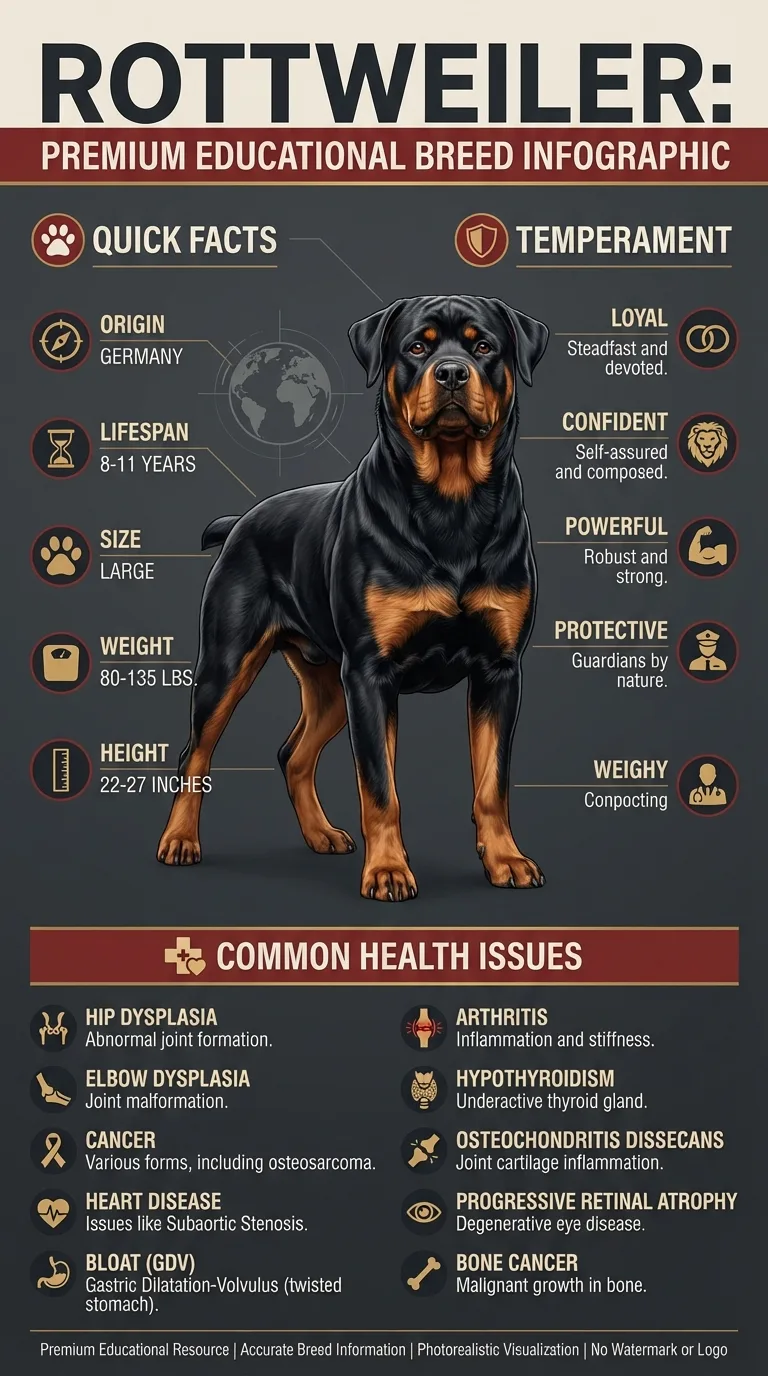
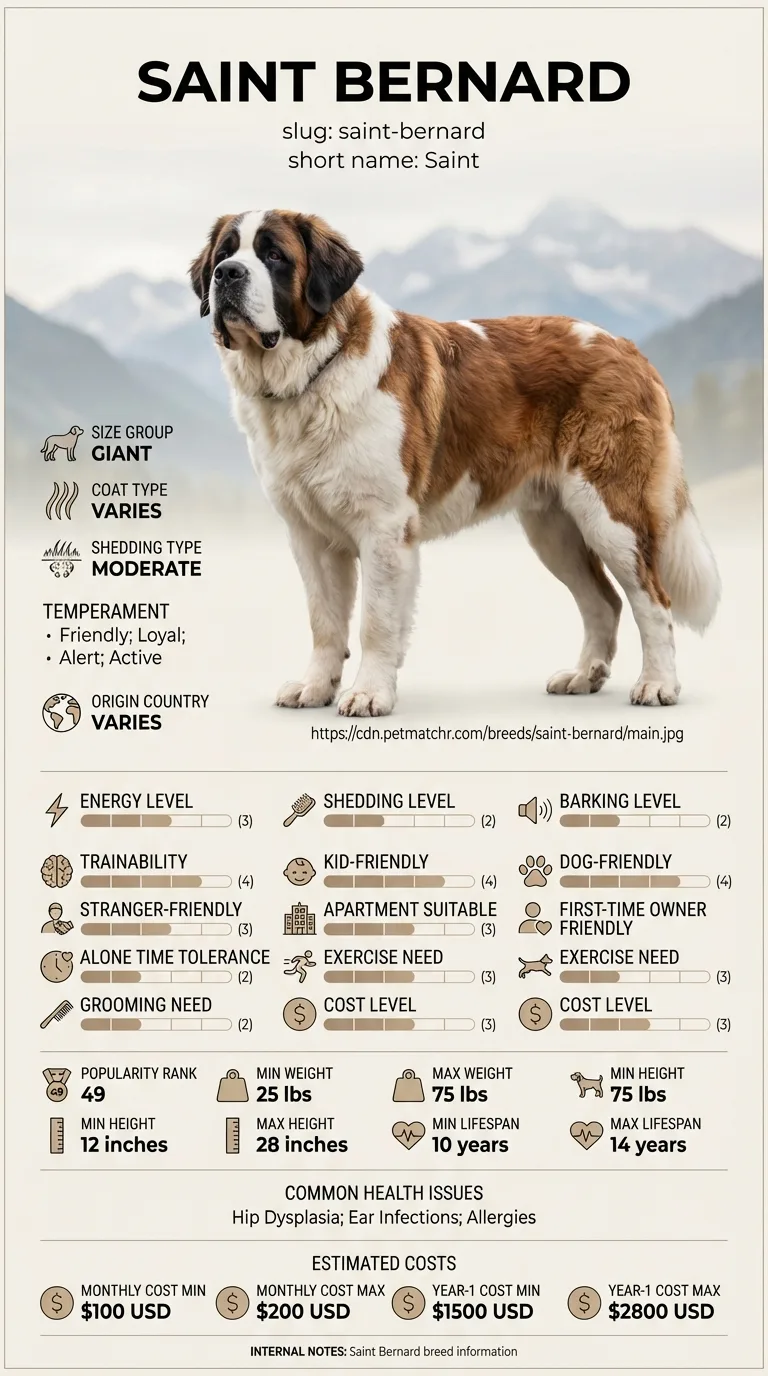
The Rottweiler is the more compact of the two on paper, 80–135 lbs and 22–27 in, while the Saint Bernard climbs into giant-breed territory at 120–180 lbs and 26–30 in. That size gap shows up everywhere else in the comparison — the Saint Bernard needs more floor space, a bigger crate, and a stronger door frame to get through. Despite the Rottweiler being the smaller of the two here, it is still a large, dense-muscled dog; the real story is that the Saint Bernard is bigger still, and buyers underestimating its bulk are a common source of Saint Bernard rehoming. The Rottweiler's coat is a short double coat, while the Saint Bernard's can run short or long-haired within the breed, adding another variable to grooming expectations beyond raw size.
This pair splits sharply. The Rottweiler carries a High (4/5) exercise need and High (4/5) energy level, while the Saint Bernard sits at Low (2/5) for both. That is a genuinely large practical difference — the Rottweiler wants structured daily work, while the Saint Bernard is content with modest walks and can overheat quickly if pushed hard, a real risk for a giant breed with a heavy coat. Anyone picturing a jogging companion should lean Rottweiler; anyone wanting a low-key giant should lean Saint Bernard. A short outdoor stroll suits the Saint Bernard fine, while skipping the Rottweiler's daily structured exercise session tends to show up as restlessness or destructive chewing within days.
Grooming need favors the Rottweiler, Low (2/5) against Moderate (3/5) for the Saint Bernard, whose short-or-long double coat needs more regular brushing to manage. Shedding, though, is tied at High (4/5) for both — the Saint Bernard's reputation for drool and fur is well earned, and the Rottweiler's short double coat blows out seasonally just as heavily. Expect a vacuum-heavy household with either breed. Both breeds trace back to working and rescue lineages that valued a functional coat over an ornamental one, which is part of why neither needs elaborate styling despite the shedding load.
The Rottweiler scores Low (2/5) for apartment suitability while the Saint Bernard drops to Very low (1/5), reflecting its sheer size more than temperament. Barking favors the Saint Bernard, Low (2/5) versus Moderate (3/5) for the Rottweiler, and the Saint Bernard also tolerates being alone better, Moderate (3/5) against Low (2/5). Neither is an apartment-first pick, but a Saint Bernard in a house with room to sprawl can actually be the calmer indoor presence of the two. Owners renting in a building with weight limits or breed restrictions should check policies carefully, since either dog's size alone can trigger extra deposits or outright denials.
Trainability favors the Rottweiler, High (4/5) versus Moderate (3/5), and the Rottweiler also edges ahead on first-time-owner suitability slightly, Low (2/5) against the Saint Bernard's Moderate (3/5) — still not a beginner-easy pair on either side. Temperament words tell the real story: the Rottweiler is Loyal, Confident, Powerful, and Protective, while the Saint Bernard is Gentle, Patient, Friendly, and Watchful — a notably softer, more biddable-sounding profile despite its lower raw trainability score. First-time owners drawn to the Saint Bernard's gentler reputation should still budget real time for basic obedience, since an untrained giant breed is harder to manage than an untrained medium one.
The Saint Bernard pulls ahead across the board here — Very high (5/5) with kids against the Rottweiler's already-strong High (4/5), High (4/5) with other dogs against Moderate (3/5), and High (4/5) friendliness to strangers against a notably lower Low (2/5) for the Rottweiler. Families expecting a dog that greets visitors warmly and tolerates chaotic multi-dog gatherings will likely find the Saint Bernard's Gentle, Friendly temperament the easier fit. The Rottweiler's Protective streak means introductions to new people and animals should be more deliberate and supervised than the Saint Bernard typically requires.
Lifespan favors the Rottweiler narrowly, 8–11 years versus 8–10 for the Saint Bernard. The Rottweiler's list is longer, ten conditions including Cancer, Heart Disease, Bloat (GDV), and Osteochondritis Dissecans, while the Saint Bernard's five-item list — Hip Dysplasia, Elbow Dysplasia, Dilated Cardiomyopathy, Entropion, and Bloat (GDV) — is shorter but still carries the same bloat risk common to deep-chested large breeds. Both need joint screening; giant breeds like the Saint Bernard are especially prone to early orthopedic wear given their mass. Deep-chested body types in both breeds raise Bloat (GDV) risk specifically, which is why many owners of either breed use slow-feed bowls and avoid vigorous exercise right after meals.
The Rottweiler is the cheaper of the two, Cost level High (4/5) against Very high (5/5) for the Saint Bernard. Monthly costs run $125–$250 for the Rottweiler versus $150–$310 for the Saint Bernard, and first-year costs follow the same gap, $2,000–$3,500 against $2,200–$4,200. A giant breed's food bill, larger-dose medications, and bigger everything — beds, crates, car harnesses — add up fast. Pet insurance premiums for a giant breed like the Saint Bernard also tend to run higher than for the Rottweiler, another line item worth pricing out before committing.
Rottweiler weighs 80–135 lbs and lives 8–11 years; Saint Bernard weighs 120–180 lbs and lives 8–10 years. The two diverge most on exercise need, energy level and friendly to strangers. Almost every rated axis separates them at least slightly. In the table, a "winner" means easier for an ordinary household — not better. Size, coat and origin are recorded without a verdict. Because both breeds are scored the same way, the gaps are reliable even where the absolute numbers are rough.

The Saint Bernard, considerably — 120–180 lbs and up to 30 inches tall, a full giant-breed size class above the Rottweiler's 80–135 lbs and 27-inch max height.
Yes on paper — Low (2/5) exercise need and energy level for the Saint Bernard versus High (4/5) for the Rottweiler, plus a notably gentler temperament profile (Gentle, Patient, Friendly versus Powerful, Protective).
The Saint Bernard scores Very high (5/5) with kids against the Rottweiler's High (4/5), and its Gentle, Patient temperament backs that up.
The Rottweiler — High (4/5) cost level and a $2,000–$3,500 first-year estimate, versus Very high (5/5) and $2,200–$4,200 for the Saint Bernard.
No — shedding is tied at High (4/5) for both breeds regardless of the Saint Bernard's lower energy level.
The Saint Bernard by a wide margin, High (4/5) versus Low (2/5) for the Rottweiler, which is naturally more watchful of unfamiliar people.
Not comfortably — the Rottweiler scores Low (2/5) and the Saint Bernard drops to Very low (1/5) for apartment suitability, both needing real space.
The Rottweiler, at High (4/5) versus the Saint Bernard's Low (2/5).
The Rottweiler, 8–11 years versus 8–10 for the Saint Bernard.
The Saint Bernard scores slightly higher, Moderate (3/5) versus Low (2/5) for the Rottweiler.
They tie on shedding, but the Saint Bernard's coat and jowls make it the messier of the two day to day.
Secure checkout on Stripe. We never see your card.
7-day money-back guarantee. Instant access.
Health information here is general and is not veterinary advice. If your dog shows pain, sudden behaviour change, or worsening symptoms, consult a licensed veterinarian.
Some links on this site are affiliate links. We may earn a commission at no extra cost to you, and we only suggest products we believe are helpful for dog owners.
We research and check what we publish, but we do not warrant that any figure, date, price, or statement is accurate, complete, or current, and we accept no liability for any loss, cost, injury, or other harm arising from the use of this site. Use it as one reference among several. You remain responsible for your own decisions and for your dog's care - confirm anything that matters with a licensed veterinarian or another qualified professional before you act on it. Full disclaimer.
Match your lifestyle to the right dog.
Take quizNot sure which breed is right for you? Take our 2-minute quiz to find out.
Take the quiz