Health
Which breed lives longer?
The English Springer Spaniel, averaging 12-14 years compared to the Saint Bernard's 8-10.

Quick answer
Which breed lives longer?
The English Springer Spaniel, averaging 12-14 years compared to the Saint Bernard's 8-10.
English Springer Spaniel or Saint Bernard? On paper they differ most on exercise need, and on the scales Saint Bernard is the heavier at 120–180 lbs. Here is how the two compare on everything that shapes an ordinary week.
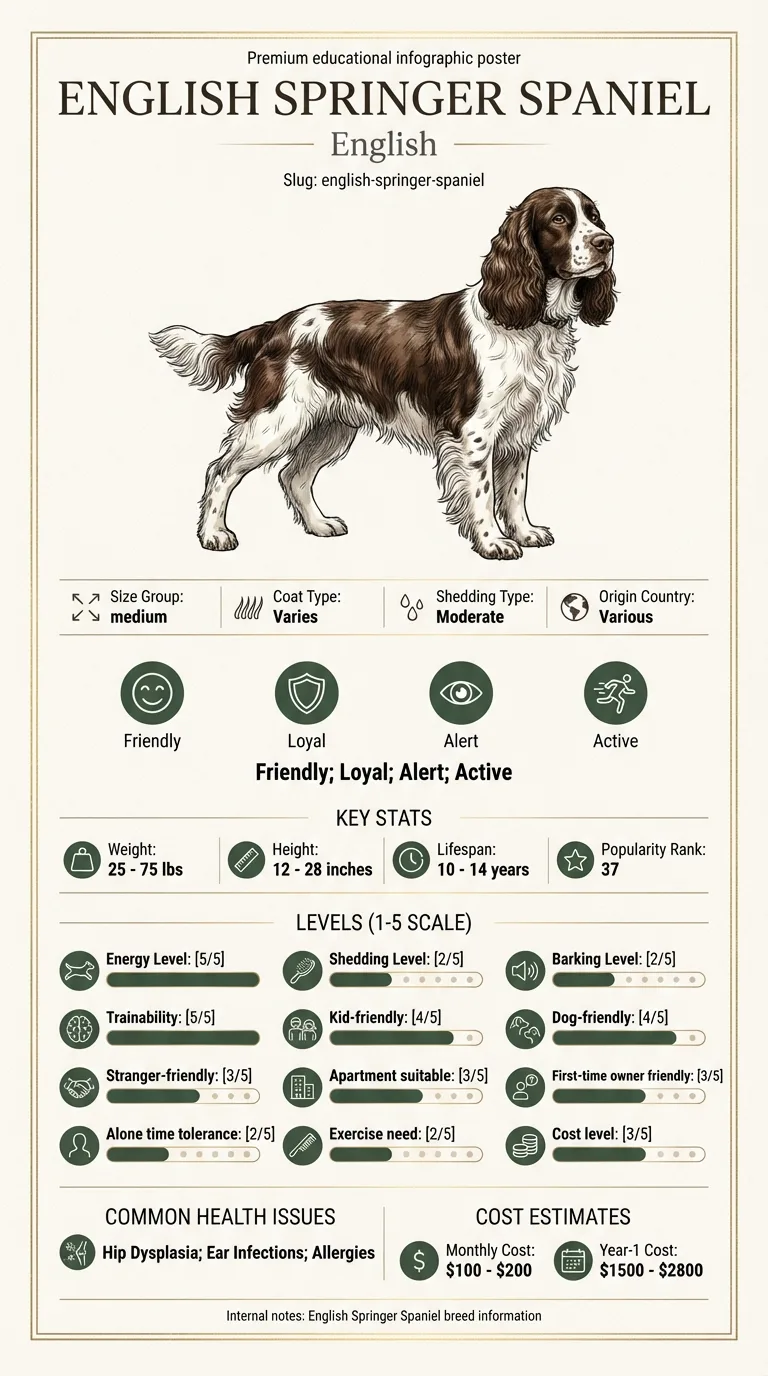
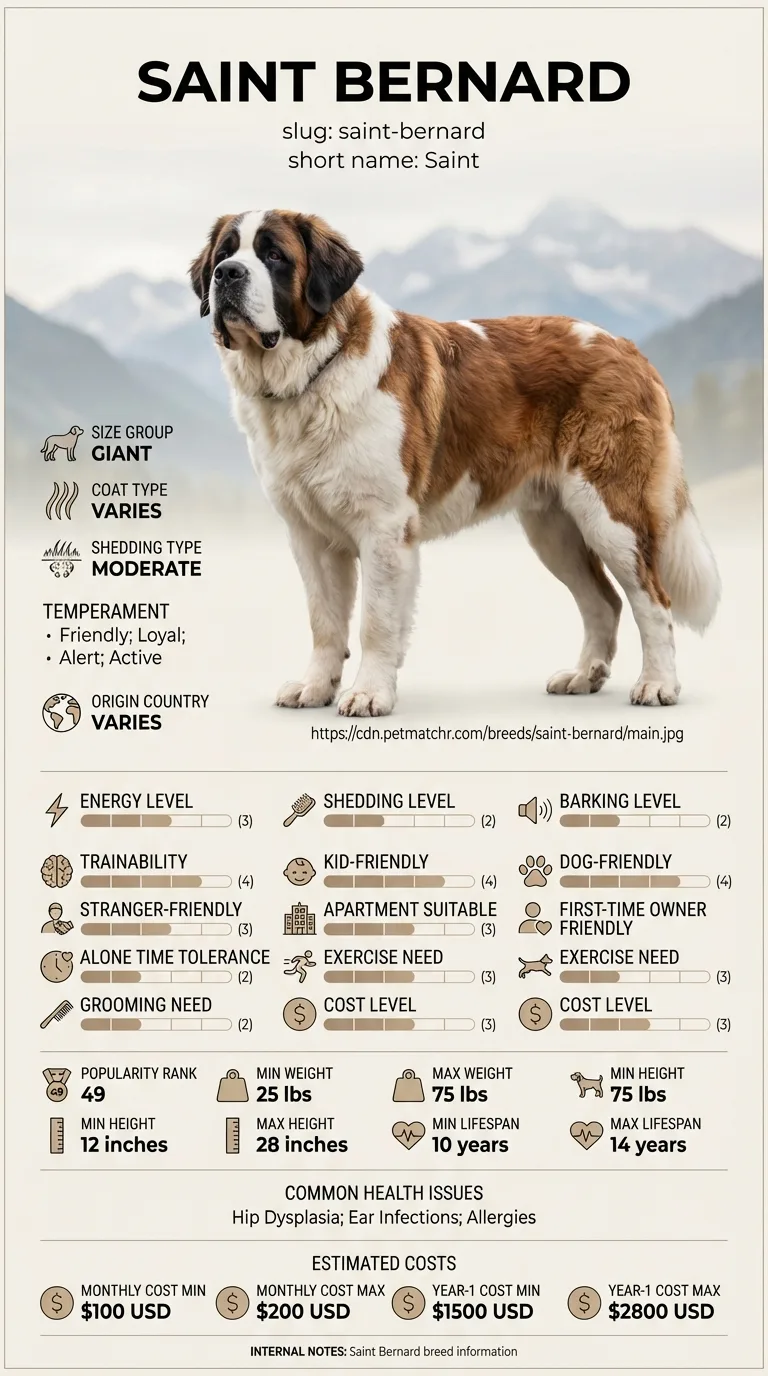
This is for someone already down to English Springer Spaniel and Saint Bernard and deciding between them. For this pair the decision usually turns on exercise need and energy level, so those are covered first and in most detail. Anyone choosing from a flat has a clear answer here: English Springer Spaniel rates 2/5 against 1/5. The focus throughout is on daily consequences rather than breed background.
Between English Springer Spaniel and Saint Bernard, exercise need is what separates them, and Saint Bernard is the lower-effort dog of the two to keep.
Choose English Springer Spaniel if shedding is a problem in your house, you want a dog that picks up training quickly and a smaller dog suits your car, your home or your back.
Choose Saint Bernard if you do not want a standing grooming appointment, your walking routine is modest and the dog will be alone during the working day.
| Feature | english springer spaniel | saint bernard | Winner |
|---|---|---|---|
| Size class | medium | giant | Equal |
| Weight | 40–50 lbs | 120–180 lbs | Equal |
| Height | 19–20 in | 26–30 in | Equal |
| Lifespan | 12–14 years | 8–10 years | english springer spaniel |
| Exercise need | Very high (5/5) | Low (2/5) | saint bernard |
| Grooming need | High (4/5) | Moderate (3/5) | saint bernard |
| Shedding | Moderate (3/5) | High (4/5) | english springer spaniel |
| Energy level | Very high (5/5) | Low (2/5) | Equal |
| Barking | Moderate (3/5) | Low (2/5) | saint bernard |
| Apartment suitability | Low (2/5) | Very low (1/5) | english springer spaniel |
| Good for first-time owners | Moderate (3/5) | Moderate (3/5) | Equal |
| Tolerates being alone | Low (2/5) | Moderate (3/5) | saint bernard |
| Trainability | Very high (5/5) | Moderate (3/5) | english springer spaniel |
| Good with kids | Very high (5/5) | Very high (5/5) | Equal |
| Good with other dogs | High (4/5) | High (4/5) | Equal |
| Friendly to strangers | High (4/5) | High (4/5) | Equal |
| Cost level | Moderate (3/5) | Very high (5/5) | english springer spaniel |
| Coat | Medium, feathered double coat | Short or long double coat | Equal |
| Origin | Various | Various | Equal |
| Typical monthly cost | $100–$200 | $150–$310 | Equal |
| Typical first-year cost | $1,400–$2,900 | $2,200–$4,200 | Equal |
Phosphofructokinase Deficiency is a name unique to the English Springer Spaniel's health list, a metabolic enzyme disorder that has nothing to do with its build but everything to do with how differently these two breeds are put together. At 40 to 50 pounds and 19 to 20 inches, the Springer is a mid-size sporting dog with a compact, athletic frame. The Saint Bernard triples that weight and more, running 120 to 180 pounds at 26 to 30 inches, a mountain-rescue breed built with heavy bone, a broad head, and enough mass to plow through snow. Housing, furniture, and even car-transport decisions look completely different depending on which of these two ends up in the family.
Very high (5/5) versus low (2/5) — the exercise gap between the Springer Spaniel and the Saint Bernard is one of the widest in this entire comparison. Springers were bred to flush and retrieve game for hours in the field, and that drive doesn't switch off in a backyard; daily runs, fetch, and off-leash time in a secure area are close to mandatory. The Saint Bernard, despite its size, is a famously low-key breed content with a couple of short walks a day, and overexertion in heat is a real risk given its heavy coat and bulk. An energetic household mismatched with a Saint Bernard will find it placid to the point of stubborn; a sedentary household with a Springer will find pent-up energy turning destructive fast.
High (4/5) grooming and moderate (3/5) shedding describe the Springer's feathered double coat, which mats around the ears and legs without regular brushing. The Saint Bernard actually rates slightly easier on grooming, moderate (3/5), despite the coat coming in two varieties — short or long, both dense double coats — but it makes up for that with a high (4/5) shedding rating and a drooling habit that adds its own daily wipe-down routine. Neither breed suits an owner hoping to skip the brush entirely. The practical difference: Springer grooming means detangling feathering, while Saint Bernard grooming means managing volume — fur and slobber both — across a much larger surface area.
Both breeds struggle in small spaces, but the Saint Bernard struggles more — apartment suitability rates very low (1/5) against the Springer's still-modest low (2/5), a gap driven almost entirely by sheer physical footprint rather than temperament. Barking favors the Saint Bernard, low (2/5) compared to the Springer's moderate (3/5), matching its generally quieter, more watchful-than-vocal nature. Tolerating time alone also tips toward the Saint Bernard, moderate (3/5) versus the Springer's low (2/5); a breed historically stationed at monastery way stations to wait for travelers seems to carry some patience for solitude that a field-bred gun dog doesn't share. Neither is an ideal studio-apartment dog, but for different structural reasons.
Trainability rates very high (5/5) for the Springer Spaniel and only moderate (3/5) for the Saint Bernard, and the temperament lists back that up directly — 'biddable' shows up for the Springer, while 'gentle' and 'patient' describe the Saint Bernard's more laid-back, less eager-to-please working style. Both breeds land at the same moderate (3/5) score for suiting first-time owners, though the reasons diverge: a Springer's high energy can overwhelm an inexperienced handler even as it trains easily, while a Saint Bernard's sheer size makes leash manners and recall non-negotiable regardless of how gentle its temperament actually is. A 180-pound dog that hasn't learned to walk politely is a genuine safety issue.
Good with kids ties at very high (5/5) for both breeds, and good with other dogs ties too, at high (4/5) — on paper, either dog fits a busy family home. Friendliness to strangers also ties, high (4/5), reflecting the friendly temperament word both breeds share alongside their differences elsewhere. Where households should actually pay attention is size-appropriate supervision: a Saint Bernard's watchful, gentle nature around children is well documented, but an untrained 150-pound dog can knock over a toddler by accident during ordinary play, something a 45-pound Springer simply can't do by comparison. Visitors, similarly, will find both breeds welcoming, though the Saint Bernard's size alone can intimidate before its temperament has a chance to reassure anyone.
A Springer Spaniel's expected 12 to 14 years stands well above the Saint Bernard's 8 to 10, a gap typical of small-to-mid breeds against giants. Hip dysplasia and elbow dysplasia appear on both lists, but the Saint Bernard adds dilated cardiomyopathy, entropion (an eyelid condition common in loose-skinned large breeds), and bloat (GDV), the fast-onset digestive emergency that deep-chested giant breeds face at elevated rates. The Springer's remaining risks run smaller in scale but still notable: ear infections from its long, hanging ears, progressive retinal atrophy, and phosphofructokinase deficiency, a rare inherited enzyme disorder that affects red blood cell function during exercise. Screening for that last condition is specific to the breed and worth asking breeders about directly.
Cost level rates moderate (3/5) for the Springer and very high (5/5) for the Saint Bernard, and the dollar ranges confirm it: $1,400-$2,900 first-year for the Springer against $2,200-$4,200 for the Saint Bernard, with monthly costs of $100-$200 versus $150-$310. Food volume alone explains a large share of that gap between a 45-pound dog and a 150-pound one, but giant-breed veterinary care compounds it — larger anesthesia doses, bigger-ticket imaging for hip and elbow dysplasia, and bloat (GDV) surgery if it ever becomes necessary can run into thousands of dollars on short notice. A Saint Bernard owner budgeting for the breed should treat the emergency-fund line item as seriously as the monthly food bill.
English Springer Spaniel weighs 40–50 lbs and lives 12–14 years; Saint Bernard weighs 120–180 lbs and lives 8–10 years. The two diverge most on exercise need, energy level and trainability and 1 other rated axes. They are level on good with other dogs, good for first-time owners and good with kids, so those cannot decide it. The table below marks a winner only where one breed is genuinely easier for a typical owner; size and origin are facts rather than merits and stay level. Ratings come from one source applied to both breeds, so they are meaningful against each other rather than as absolute scores.

Considerably — a Saint Bernard can weigh up to 180 pounds against a Springer's 50-pound ceiling, roughly three to four times the mass.
The Springer Spaniel by far, rated very high (5/5) against the Saint Bernard's low (2/5) exercise need.
Yes, Bloat (GDV) is listed on its health profile, a known risk for large, deep-chested breeds that requires prompt emergency care if it occurs.
The Springer Spaniel, rated very high (5/5) for trainability against the Saint Bernard's moderate (3/5).
Yes — both rate very high (5/5) for compatibility with children, though a Saint Bernard's size still calls for supervision during play.
The Springer Spaniel, with a moderate (3/5) cost rating and first-year costs around $1,400-$2,900 versus the Saint Bernard's very high (5/5) rating and $2,200-$4,200.
The English Springer Spaniel, averaging 12-14 years compared to the Saint Bernard's 8-10.
The Saint Bernard, rated low (2/5) versus the Springer's moderate (3/5).
Neither is ideal, but the Springer rates slightly higher at low (2/5) versus the Saint Bernard's very low (1/5).
The Saint Bernard, rated high (4/5) against the Springer's moderate (3/5).
Secure checkout on Stripe. We never see your card.
7-day money-back guarantee. Instant access.
Health information here is general and is not veterinary advice. If your dog shows pain, sudden behaviour change, or worsening symptoms, consult a licensed veterinarian.
Some links on this site are affiliate links. We may earn a commission at no extra cost to you, and we only suggest products we believe are helpful for dog owners.
We research and check what we publish, but we do not warrant that any figure, date, price, or statement is accurate, complete, or current, and we accept no liability for any loss, cost, injury, or other harm arising from the use of this site. Use it as one reference among several. You remain responsible for your own decisions and for your dog's care - confirm anything that matters with a licensed veterinarian or another qualified professional before you act on it. Full disclaimer.
Match your lifestyle to the right dog.
Take quizNot sure which breed is right for you? Take our 2-minute quiz to find out.
Take the quiz