Living
Which is bigger?
The Shetland Sheepdog, at 15–25 lbs versus the Yorkshire Terrier's 4–7 lbs.

Quick answer
Which is bigger?
The Shetland Sheepdog, at 15–25 lbs versus the Yorkshire Terrier's 4–7 lbs.
Shetland Sheepdog or Yorkshire Terrier? On paper they differ most on shedding, and on the scales Shetland Sheepdog is the heavier at 15–25 lbs. Here is how the two compare on everything that shapes an ordinary week.
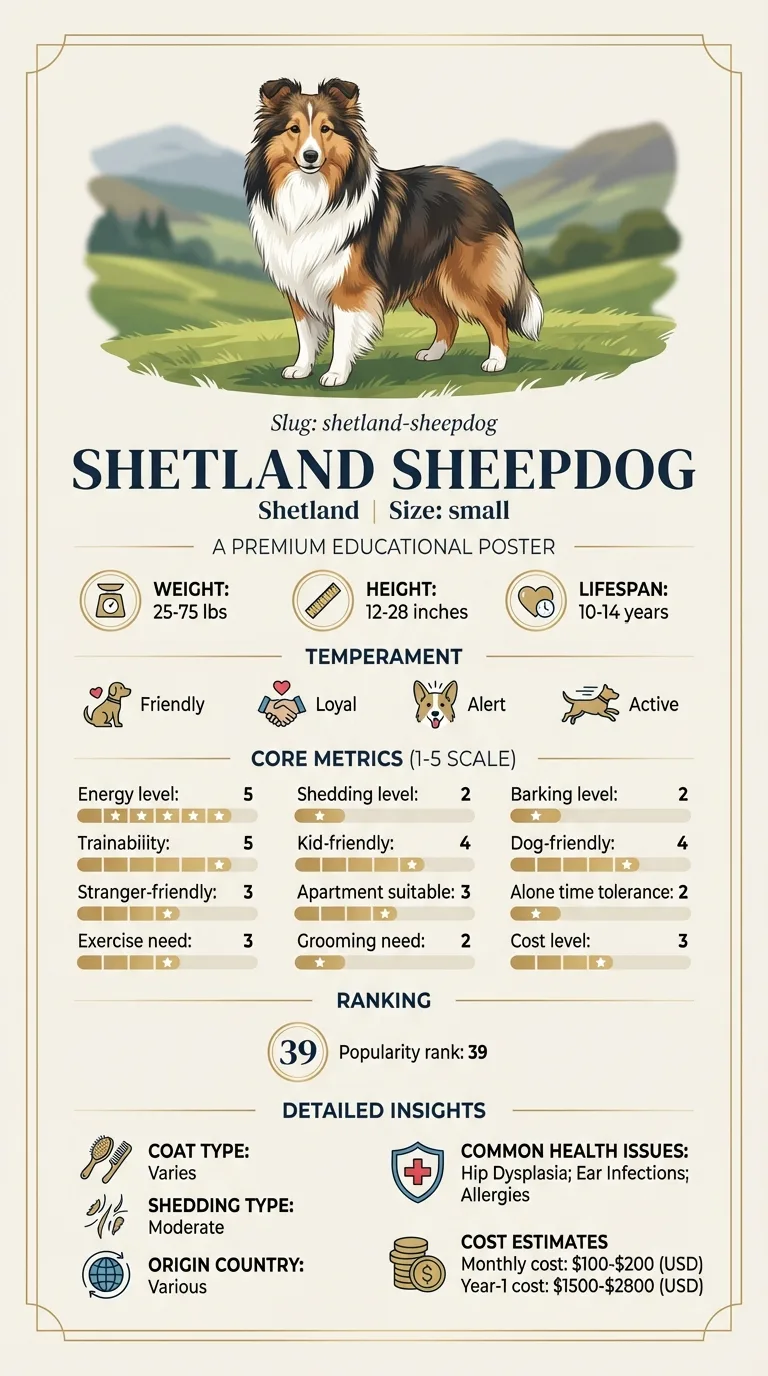
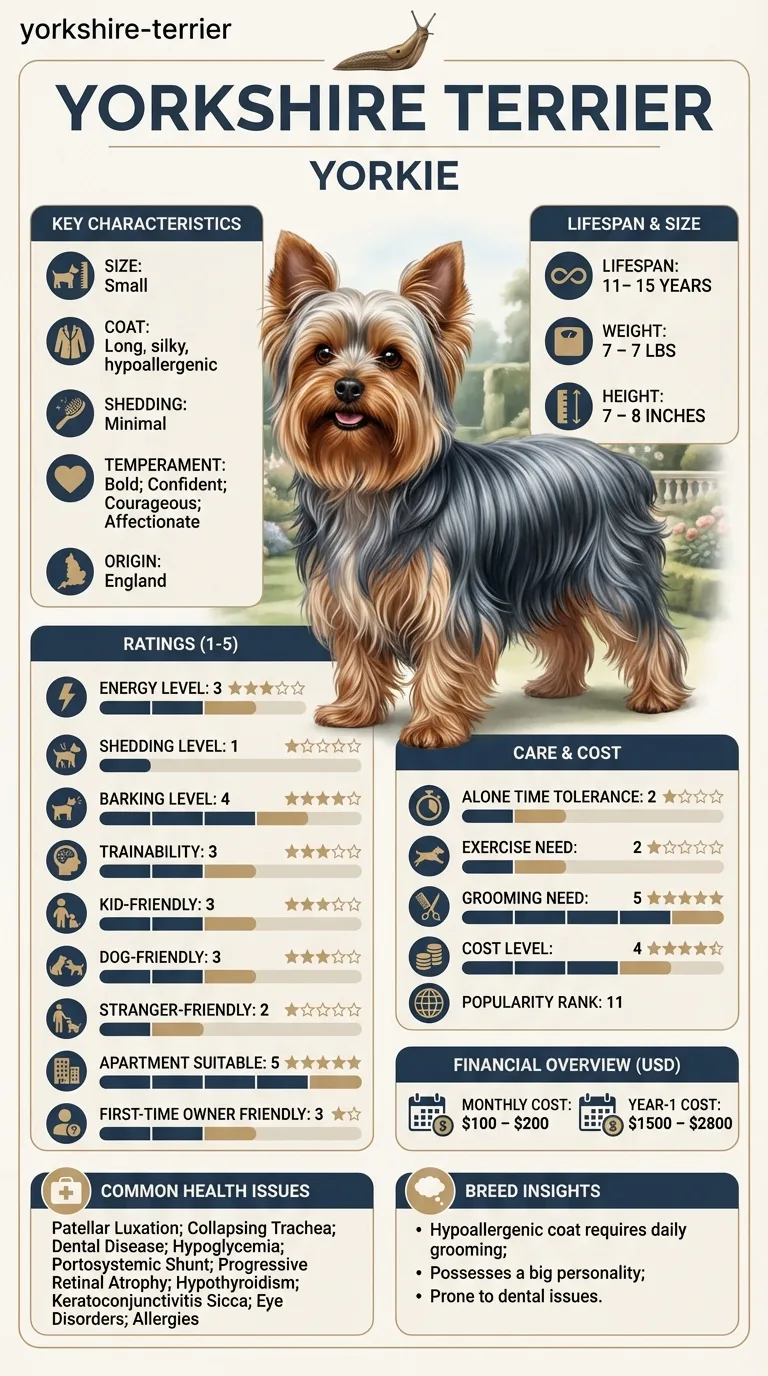
This is for someone already down to Shetland Sheepdog and Yorkshire Terrier and deciding between them. For this pair the decision usually turns on shedding and exercise need, so those are covered first and in most detail. Anyone choosing from a flat has a clear answer here: Yorkshire Terrier rates 5/5 against 3/5. Breed history is left out; what follows is what you will actually live with.
Between Shetland Sheepdog and Yorkshire Terrier, shedding is what separates them, and Yorkshire Terrier is the lower-effort dog of the two to keep.
Choose Shetland Sheepdog if this is your first dog, you do not want a standing grooming appointment and there are young children at home.
Choose Yorkshire Terrier if you are in a flat or a smaller home, shedding is a problem in your house and your walking routine is modest.
| Feature | shetland sheepdog | yorkshire terrier | Winner |
|---|---|---|---|
| Size class | small | small | Equal |
| Weight | 15–25 lbs | 4–7 lbs | Equal |
| Height | 13–16 in | 7–8 in | Equal |
| Lifespan | 12–14 years | 11–15 years | Equal |
| Exercise need | High (4/5) | Low (2/5) | yorkshire terrier |
| Grooming need | High (4/5) | Very high (5/5) | shetland sheepdog |
| Shedding | High (4/5) | Very low (1/5) | yorkshire terrier |
| Energy level | High (4/5) | Moderate (3/5) | Equal |
| Barking | Very high (5/5) | High (4/5) | yorkshire terrier |
| Apartment suitability | Moderate (3/5) | Very high (5/5) | yorkshire terrier |
| Good for first-time owners | High (4/5) | Moderate (3/5) | shetland sheepdog |
| Tolerates being alone | Low (2/5) | Low (2/5) | Equal |
| Trainability | Very high (5/5) | Moderate (3/5) | shetland sheepdog |
| Good with kids | High (4/5) | Moderate (3/5) | shetland sheepdog |
| Good with other dogs | High (4/5) | Moderate (3/5) | shetland sheepdog |
| Friendly to strangers | Low (2/5) | Low (2/5) | Equal |
| Cost level | Moderate (3/5) | High (4/5) | shetland sheepdog |
| Coat | Long, dense double coat | Long, silky, hypoallergenic | Equal |
| Origin | Various | England | Equal |
| Typical monthly cost | $80–$150 | $100–$190 | Equal |
| Typical first-year cost | $1,100–$2,300 | $1,400–$2,900 | Equal |
Few pairings on this site show a bigger size mismatch than this one: a Shetland Sheepdog at 15–25 lbs already reads as small, but a Yorkshire Terrier at just 4–7 lbs and 7–8 inches tall is in an entirely different weight class — closer to a third of the Sheltie's size. Both wear long coats that can make them look fuller than their frames, the Sheltie's dense double coat and the Yorkie's silky, hypoallergenic single coat, but pick either up and the difference is immediate. For owners choosing based on how much dog they can physically handle day to day, the Yorkie is dramatically the lighter lift.
The Sheltie is the clearly more active breed here, rated High (4/5) for exercise need against the Yorkshire Terrier's Low (2/5) — a gap that shows up in energy level too, High (4/5) versus Moderate (3/5). A Sheltie without a real daily walk and mental task will bark and pace; a Yorkie is genuinely content with a short walk and some indoor play, reflecting its history as a companion and small-vermin hunter rather than a working herder covering acres of pasture. That doesn't mean the Yorkie is lazy — it's still an alert, busy little dog — just that its physical needs top out far lower than the Sheltie's.
Coat maintenance flips the usual size assumption. The Yorkshire Terrier actually requires more grooming than the Sheltie — Very High (5/5) versus High (4/5) — because its long, silky, hypoallergenic coat needs near-daily brushing to avoid matting and often regular trims. Where the Yorkie pulls ahead is shedding: rated Very Low (1/5) thanks to that hypoallergenic coat, compared to the Sheltie's High (4/5) shedding from its dense double coat. In practice, a Yorkie owner spends more time at the brush but sees far less hair on the furniture, while a Sheltie owner deals with more shedding but a less finicky grooming routine overall.
The Yorkshire Terrier is the stronger apartment dog by a wide margin, rated Very High (5/5) for apartment suitability against the Sheltie's Moderate (3/5), a direct result of its much lower exercise needs and small footprint. Barking works against both breeds, though — the Sheltie rates Very High (5/5) and the Yorkie still rates High (4/5), so neither is a silent roommate; small-space owners of either breed should plan on some noise management. Both dogs tolerate being left alone equally poorly, rated Low (2/5) each, meaning long solo workdays are a stretch for either one regardless of size.
The Sheltie is the more trainable of the two, Very High (5/5) versus the Yorkshire Terrier's Moderate (3/5), and it's also rated higher for first-time owners, High (4/5) against Moderate (3/5). The Yorkie's temperament — Bold, Confident, Courageous, Affectionate — captures a dog with genuine terrier stubbornness packed into a tiny body; that boldness can make leash training and recall more of a project than its size suggests. The Sheltie's herding-bred responsiveness to direction makes it one of the more forgiving breeds for a new owner to train, while a Yorkie rewards patience and consistency more than raw obedience-class polish.
The Sheltie outperforms the Yorkshire Terrier with both kids (High 4/5 versus Moderate 3/5) and other dogs (High 4/5 versus Moderate 3/5), reflecting its heritage as a breed bred to work calmly alongside livestock, other dogs, and a shepherd's family. The Yorkie's Bold and Courageous temperament can translate to a small dog that doesn't back down from bigger playmates or boisterous kids, which is part of why supervision matters more with a breed this size. Both score identically Low (2/5) on friendliness to strangers, so neither is the dog for owners hoping for an instant greeter at the door.
Lifespans land in the same 11–15 year neighborhood for both breeds. The Sheltie's health list — Collie Eye Anomaly, MDR1 Drug Sensitivity, Dermatomyositis, Hypothyroidism, and Patellar Luxation — is comparatively short next to the Yorkshire Terrier's, which runs to ten listed conditions including Collapsing Trachea, Hypoglycemia, Portosystemic Shunt, Progressive Retinal Atrophy, and Dental Disease alongside shared concerns like Patellar Luxation and Hypothyroidism. That longer list reflects the health trade-offs common in very small toy breeds, where tiny body size correlates with more fragile joints, airways, and blood sugar regulation. Prospective Yorkie owners should budget for more frequent vet monitoring than the Sheltie's profile suggests.
The Sheltie is the cheaper breed to keep on paper, rated Moderate (3/5) against the Yorkshire Terrier's High (4/5), and the dollar ranges bear that out: $80–$150 monthly for the Sheltie versus $100–$190 for the Yorkie, with first-year costs of $1,100–$2,300 against $1,400–$2,900. It's a counterintuitive result given the Yorkie's tiny size — food costs are lower, but that's offset by pricier grooming (professional trims aren't cheap) and the longer list of potential health conditions that can mean more diagnostic visits over a lifetime. Small doesn't automatically mean cheap once grooming and vet care are factored in.
Shetland Sheepdog weighs 15–25 lbs and lives 12–14 years; Yorkshire Terrier weighs 4–7 lbs and lives 11–15 years. The two diverge most on shedding, exercise need and apartment suitability and 1 other rated axes. They are level on tolerates being alone and friendly to strangers, so those cannot decide it. The comparison marks an easier option only where one exists. Facts like weight and country of origin are not scored. Both dogs are rated from the same dataset, which is what makes the numbers comparable with each other even though any individual dog sits somewhere inside its breed's range.

The Yorkshire Terrier by far — it weighs just 4–7 lbs compared to the Sheltie's 15–25 lbs, making it roughly a third the size or less.
The Yorkshire Terrier, rated Low (2/5) for exercise need versus the Sheltie's High (4/5) — a short walk and some play satisfies it.
Yes — it rates Very High (5/5) for grooming, higher than the Sheltie's High (4/5), because its long silky coat needs frequent brushing and trims.
Neither is especially quiet, but the Yorkshire Terrier edges out the Sheltie slightly, High (4/5) barking versus the Sheltie's Very High (5/5).
The Yorkshire Terrier, rated Very High (5/5) for apartment suitability against the Sheltie's Moderate (3/5), largely due to its much lower exercise needs.
The Yorkshire Terrier's list is longer, including Collapsing Trachea, Hypoglycemia, and Portosystemic Shunt alongside shared concerns like Patellar Luxation and Hypothyroidism that also appear in the Sheltie.
The Sheltie, rated Very High (5/5) trainability against the Yorkshire Terrier's Moderate (3/5), thanks to its herding-bred responsiveness to direction.
The Shetland Sheepdog, at 15–25 lbs versus the Yorkshire Terrier's 4–7 lbs.
The Sheltie, rated High (4/5) versus the Yorkie's Very Low (1/5).
The Yorkshire Terrier, at $100–$190 versus the Sheltie's $80–$150.
The Sheltie, rated Very High (5/5) versus the Yorkshire Terrier's Moderate (3/5).
Secure checkout on Stripe. We never see your card.
7-day money-back guarantee. Instant access.
Health information here is general and is not veterinary advice. If your dog shows pain, sudden behaviour change, or worsening symptoms, consult a licensed veterinarian.
Some links on this site are affiliate links. We may earn a commission at no extra cost to you, and we only suggest products we believe are helpful for dog owners.
We research and check what we publish, but we do not warrant that any figure, date, price, or statement is accurate, complete, or current, and we accept no liability for any loss, cost, injury, or other harm arising from the use of this site. Use it as one reference among several. You remain responsible for your own decisions and for your dog's care - confirm anything that matters with a licensed veterinarian or another qualified professional before you act on it. Full disclaimer.
Match your lifestyle to the right dog.
Take quizNot sure which breed is right for you? Take our 2-minute quiz to find out.
Take the quiz