DogBreedCompass
← Back to breed profileEvery breed’s cost in Omaha

Saint Bernard Cost in Omaha

See Saint Bernard price across all cities →

Quick answer

Saint Bernard cost in Omaha

Roughly $137–$282 monthly and $2,002–$3,822 for year one, under the national average — with the local angle being that in an insurance town, the parameters worth reading are the hereditary clause, the waiting period and the annual limit.

A Saint Bernard in Omaha costs roughly $137 to $282 a month, with the opening year near $2,002 to $3,822 — under the national average, in line with Nebraska's moderate cost of living. Omaha is also, improbably for a city of its size, one of the great insurance towns in America, and that makes it the right place to talk about the document most giant-breed owners buy without reading.

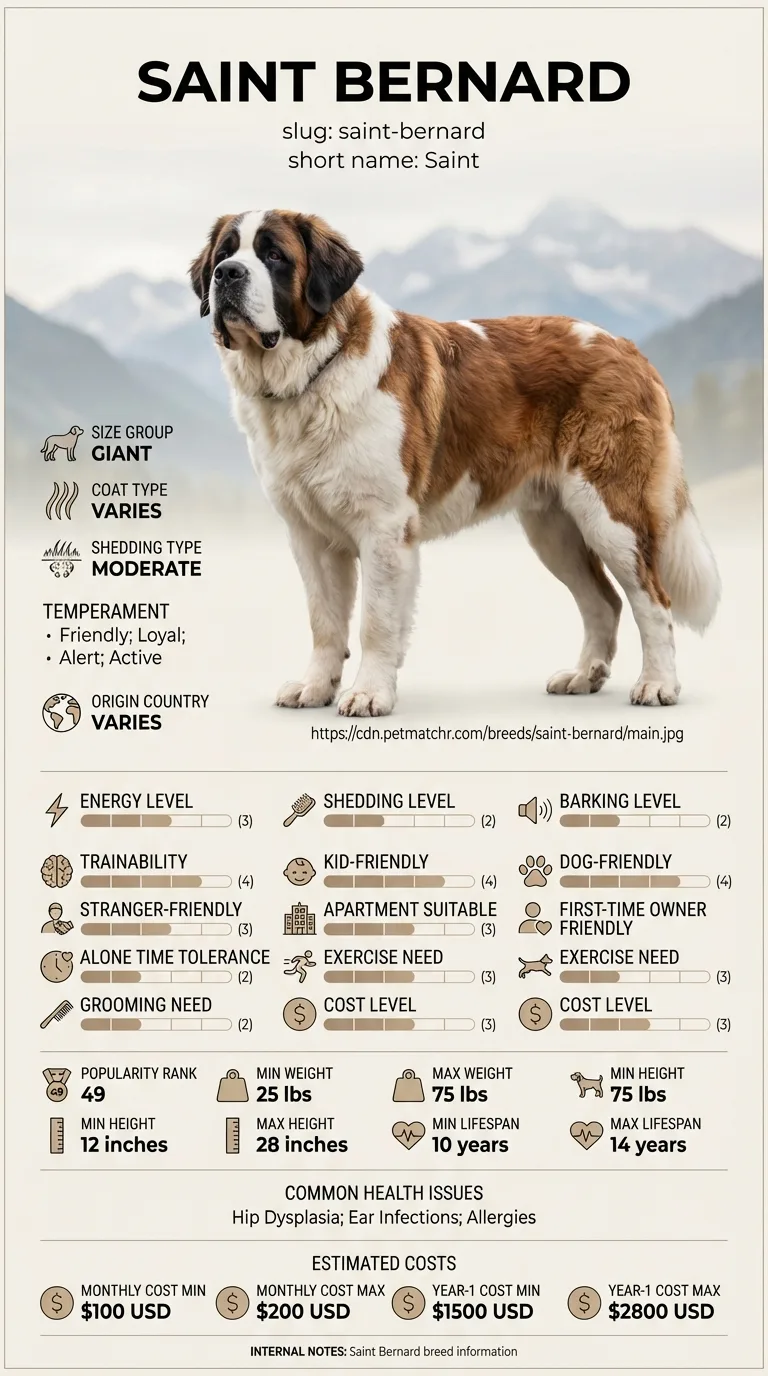
Saint Bernard Cost in Omaha infographic

Why costs vary

This breed's documented risks are Hip Dysplasia, Elbow Dysplasia, Dilated Cardiomyopathy, Entropion and Bloat. Two of those are hereditary orthopedic conditions and one is a chronic cardiac disease requiring lifelong medication, which means the parameters that matter most here are the hereditary clause, the waiting period, and whether the annual limit is large enough to cover a giant-breed operation in one go.

Cost summary

Omaha prices below the national average with a short seven-month prevention season, and the local lesson is procedural: the policy schedule deserves the same attention as the price list.

Estimate · source: estimation · confidence: medium · updated 2026-09-06 · not a quote

First year
$2002 - $3822
Ongoing monthly
$137 - $282

First-year expenses

ItemCost range
One-time setup (giant crate, bed, first exam, spay/neuter)
Get quotes during this same window, since a policy bought before any finding is recorded is worth considerably more than one bought after.
$470 - $815

Monthly expenses

ItemCost range
Food
The largest recurring line and one that no insurance product covers at any premium level.
$66 - $118
Parasite prevention (seven-month season)
A bounded Nebraska window, which trims a line otherwise inflated by this breed's top-bracket dosing weight.
$25 - $45

Is pet insurance worth it?

The product is only as good as the parameters, and for a giant breed the parameters that matter are not the ones the advertising leads with.

When insurance makes sense

When the annual limit is genuinely large enough for a giant-breed operation, hereditary conditions are covered, and the policy starts before anything is on record.

When you might skip it

When the household reserve could absorb the same operation outright, or when the only available policy excludes hereditary conditions, in which case it is not covering this breed's main risk.

Ways to save without cutting essentials

The savings in Omaha come from choosing the right policy parameters early and buying the right prevention season.

  • Compare annual limits against a giant-breed surgical estimate rather than an average one.
  • Check how hereditary and congenital conditions are treated before comparing premiums.
  • Get quoted in the first months, since anything already on the record becomes a permanent exclusion.
  • Buy prevention against Nebraska's seven-month window instead of a default twelve.
  • Skip winter clothing, which an alpine double-coated breed does not need in this climate.

Omaha Cost Factors: Read the Schedule, Not the Brochure

Four parameters do most of the work. The annual limit sets the ceiling, and a limit that comfortably covers an average dog's worst year may not cover a giant's, because the same procedure consumes more drug, more theatre time and larger hardware. The reimbursement percentage decides what share of that bill you still pay. The deductible determines whether small claims are worth making at all. And the waiting period governs when cover actually begins, which is not the day you pay.

The fifth parameter is the one that matters most in this breed: how the policy treats hereditary and congenital conditions. Some insurers cover them, some exclude them, and virtually all of them apply the rule that a condition already showing signs before cover begins is pre-existing and outside the policy forever. In a breed whose two most expensive documented problems are inherited, that clause is the whole product.

Premiums here reflect Omaha's moderate market, but the breed rating does not. Insurers band by breed and size, and giants sit near the top of the band, so expect a quote that looks unrelated to what a friend pays for a terrier.

The Rest of a Nebraska Budget

Away from the policy schedule, Omaha is straightforward and reasonably priced. Routine veterinary care, boarding and grooming all sit under the national line. The parasite-prevention season runs about seven months, a bounded window that genuinely reduces a cost inflated by this breed's dosing weight.

Winter suits the dog. An alpine breed in a double coat handles Nebraska cold without additional equipment, and with energy and exercise requirement both documented at 2 out of 5, the short days do not create a behavioural problem to spend money solving.

The ordinary lines are the ordinary lines. Food is the largest and least negotiable of them. Grooming is a real recurring cost for a heavy seasonal shedder. Boarding is priced by run size, and a giant only ever fits the largest and most expensive category on the tariff.

Saint Bernard Cost in Omaha - The Rest of a Nebraska Budget

Covered, Up to a Point

An Omaha owner held a policy on their Saint Bernard for four years and considered the dog well covered. When a cruciate repair and a complicated recovery arrived in the same policy year as an unrelated illness, the annual limit was reached before the year was. The insurer paid exactly what the schedule said it would. The owner's conclusion was not that insurance failed, but that they had compared premiums across three products and never once compared the limits.

Key takeaway: In an insurance city, borrow the local habit: read the schedule. For a giant breed the annual limit and the hereditary clause matter more than the monthly premium.

Frequently asked questions

How much is a Saint Bernard per month in Omaha?

Roughly $137 to $282, below the national average, tracking Nebraska's moderate general costs.

What does year one cost?

Around $2,002 to $3,822, once the first exam, sterilisation and giant-sized equipment are added to the recurring figure.

Which policy parameter matters most for this breed?

The hereditary and congenital clause, because two of this breed's costliest documented conditions are inherited joint problems.

Is the annual limit really a concern?

It can be. A limit that covers an average dog's worst year may fall short for a giant, where the same operation uses more drug, more theatre time and larger hardware.

Why is my quote higher than a friend's for a smaller dog?

Insurers band premiums by breed and size, and giant breeds sit near the top of that banding. The quote is rated to the dog rather than to the city.

How much emergency reserve should I hold alongside a policy?

About $1,150, which covers deductibles and the portion a policy does not reimburse at Omaha's below-average service pricing.

Quick answers

View more answers
Costs

Saint Bernard cost in Omaha

Roughly $137–$282 monthly and $2,002–$3,822 for year one, under the national average — with the local angle being that in an insurance town, the parameters worth reading are the hereditary clause, the waiting period and the annual limit.

Related DogBreedCompass guides

Important reminder

This guide is not medical advice. If your dog shows pain, sudden behavior change, or worsening symptoms, consult a licensed veterinarian.

Some links may be affiliate links. We may earn a commission at no extra cost to you. We only suggest products we believe are helpful for dog owners.

Get the 12-month budget for this breed in your city

One sheet with every line item, the emergency fund and when insurance pays off - unlocks on this page.

You get: 12-month budget sheet

No spam. One-click unsubscribe. See our privacy policy.

Preview page 1 before you decide.

Related guides