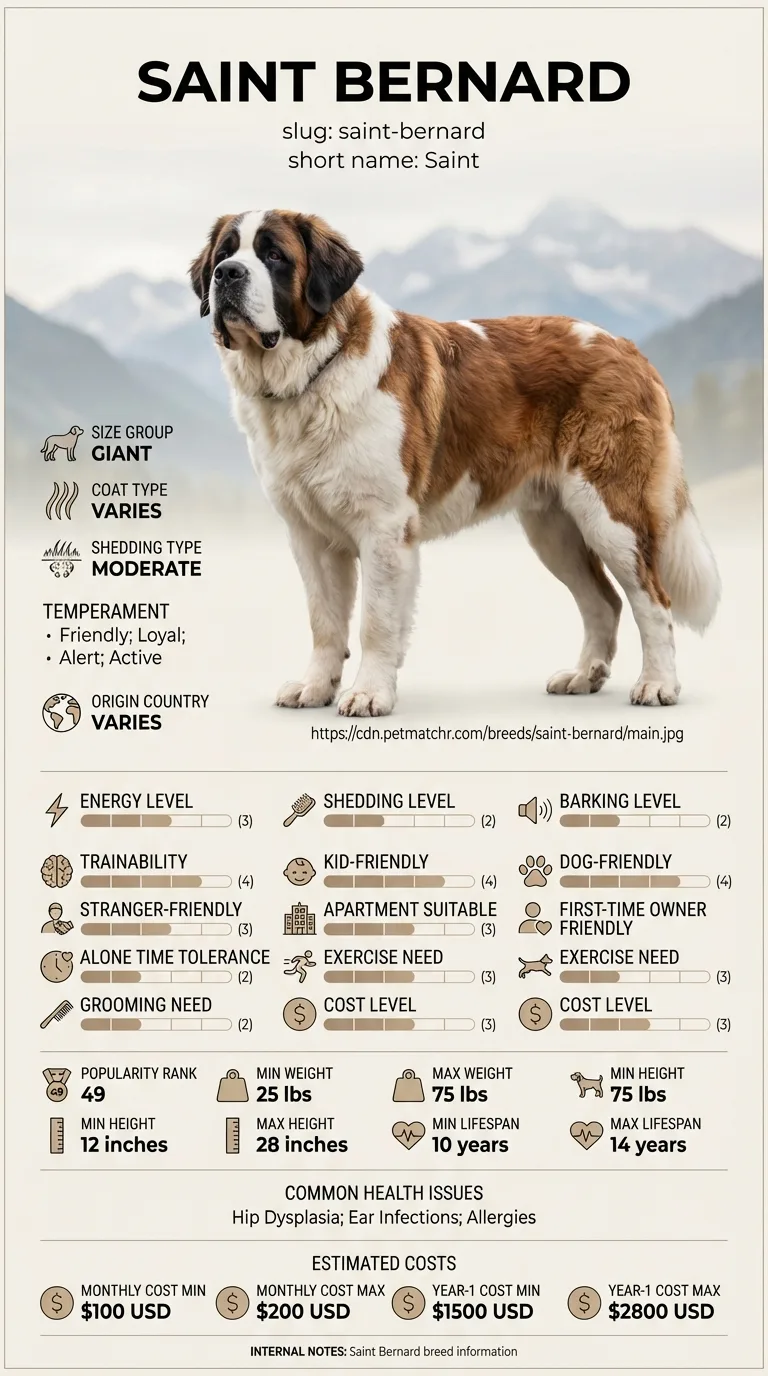
Saint Bernard cost in Kansas City
About $141–$291 monthly and $2,068–$3,948 for year one, under the national average — with the local advantage being unusual veterinary research density, which occasionally opens a funded route into cardiac care.
See Saint Bernard price across all cities →
Quick answer
Saint Bernard cost in Kansas City
About $141–$291 monthly and $2,068–$3,948 for year one, under the national average — with the local advantage being unusual veterinary research density, which occasionally opens a funded route into cardiac care.
A Saint Bernard in Kansas City costs roughly $141 to $291 a month, with the first twelve months arriving near $2,068 to $3,948 — under the national average, in line with a metro whose general costs sit below the US line. What Kansas City has that almost nowhere else does is institutional: the corridor running through this region holds the world's largest concentration of animal-health companies, and that changes what is available rather than what things cost.

Dilated Cardiomyopathy is documented in this breed, and it is the diagnosis that turns a dog into a long-term patient: repeat imaging, daily medication, and drug quantities dosed against 120 to 180 pounds. Hip Dysplasia, Elbow Dysplasia, Entropion and Bloat sit alongside it, each of them more expensive in a giant than in an average dog for the same reason.
Kansas City prices below the national average with a bounded eight-month prevention season, and offers regional research depth that occasionally offsets the cost of a chronic diagnosis.
Estimate · source: estimation · confidence: medium · updated 2026-09-06 · not a quote
| Item | Cost range |
|---|---|
One-time setup (giant crate, bed, first exam, spay/neuter) Equipment prices are national, so this line barely moves with the local cost of living. | $490 - $848 |
| Item | Cost range |
|---|---|
Food The largest ordinary line, with the quantity set by a 120-to-180-pound body rather than by local retail pricing. | $68 - $121 |
Parasite prevention (eight-month season) A clearly seasonal window here, though every dose lands in the top weight bracket the manufacturer offers. | $28 - $51 |
Kansas City's routine care is affordable, so coverage here is really about the chronic diagnosis and the unscheduled surgery rather than the everyday.
Buy before anything is on record. A cardiac diagnosis arriving first turns into a permanent exclusion, and it is the diagnosis with the longest financial tail in this breed.
An owner with a genuine reserve who is comfortable funding both an emergency and a long medication regimen can reasonably carry it themselves.
In this market the savings come from access and timing rather than from bargaining, because the underlying prices are already reasonable.
Veterinary clinical studies recruit patients the way human ones do, and they are not exotic. Cardiology is one of the areas where they appear most often, because cardiac disease in dogs is common, measurable and commercially interesting. Participating studies frequently cover some or all of the diagnostics and medication they require, and they always come with eligibility criteria, a protocol and an obligation to attend appointments on a schedule.
The honest framing is this: a study is not a discount scheme and it is not a substitute for a treatment plan. It is an occasional, conditional route to care you might otherwise be paying for outright, and in a region with this much veterinary research activity the odds of one existing for a given condition are simply better than average. Ask your veterinarian whether anything is recruiting before you assume there is not.
Everything else about the Kansas City budget is pleasantly ordinary. Service pricing runs below the national average on both sides of the metro, the parasite-prevention window is a clearly bounded eight months rather than a year-round obligation, and the housing stock is roomy enough that the space a giant breed needs is not a luxury purchase.

It is worth being specific, because dilated cardiomyopathy is the documented condition on this breed's list that most often becomes a permanent line in the household budget. The pattern is an initial workup including imaging, a medication regimen taken daily, and rechecks. Two of those three scale directly with body weight: the drugs are dosed by the kilogram, and a 150-pound patient goes through them at a rate a beagle never approaches.
The early-warning signs are also easier to miss in this breed than in most. A dog with a documented energy level of 2 out of 5 and an exercise requirement to match does not display exercise intolerance the way a working breed would, because it was never doing very much to begin with. That argues for taking the annual examination seriously rather than treating it as a formality, and for mentioning any change in breathing at rest.
Against all that, the recurring budget is modest. Food is the biggest ordinary line, grooming is real but manageable, and boarding is priced by run size, where a giant only ever fits the top category.

A Kansas City household with a seven-year-old Saint Bernard on cardiac medication mentioned the cost to their veterinarian at a recheck. The practice knew of a regional study recruiting dogs with that diagnosis and made an introduction. The dog did not end up meeting the criteria, but the conversation surfaced a longer dispensing option that trimmed the monthly drug bill noticeably. The owners describe the useful part as simply having asked.
Key takeaway: In a region this dense with veterinary research, the question costs nothing and is occasionally answered yes. Even when it is not, asking usually surfaces a cheaper way to buy the same medication.
About $141 to $291, below the national average, reflecting a metro whose general costs sit under the US line.
Roughly $2,068 to $3,948, adding the initial exam, sterilisation and giant-sized equipment to the running monthly total.
It is the region around Kansas City holding the world's densest concentration of animal-health companies. It does not lower your vet bill, but it does mean more veterinary research activity nearby, and more studies recruiting patients.
Sometimes. Studies often cover the diagnostics and medication their protocol requires, but they have strict eligibility rules and scheduling obligations, and one may simply not exist for your dog's condition.
Because dilated cardiomyopathy is documented in Saint Bernards, and it is the diagnosis most likely to become a permanent monthly cost, with medication dosed against a very large body.
About $1,150, sized against Kansas City's below-average service pricing and the volume of drug and materials a giant patient consumes.
About $141–$291 monthly and $2,068–$3,948 for year one, under the national average — with the local advantage being unusual veterinary research density, which occasionally opens a funded route into cardiac care.
This guide is not medical advice. If your dog shows pain, sudden behavior change, or worsening symptoms, consult a licensed veterinarian.
Some links may be affiliate links. We may earn a commission at no extra cost to you. We only suggest products we believe are helpful for dog owners.
One sheet with every line item, the emergency fund and when insurance pays off - unlocks on this page.
You get: 12-month budget sheet
No spam. One-click unsubscribe. See our privacy policy.
Preview page 1 before you decide.