Newfoundland vs Poodle (Standard): Which Suits Your Home?
Quick answer
Newfoundland or Standard Poodle, which should you get?
If you want a calm giant that tolerates alone time and don't mind heavy shedding, the Newfoundland fits. If you want an athletic, low-shedding dog that trains quickly but needs daily structured exercise, go Poodle.
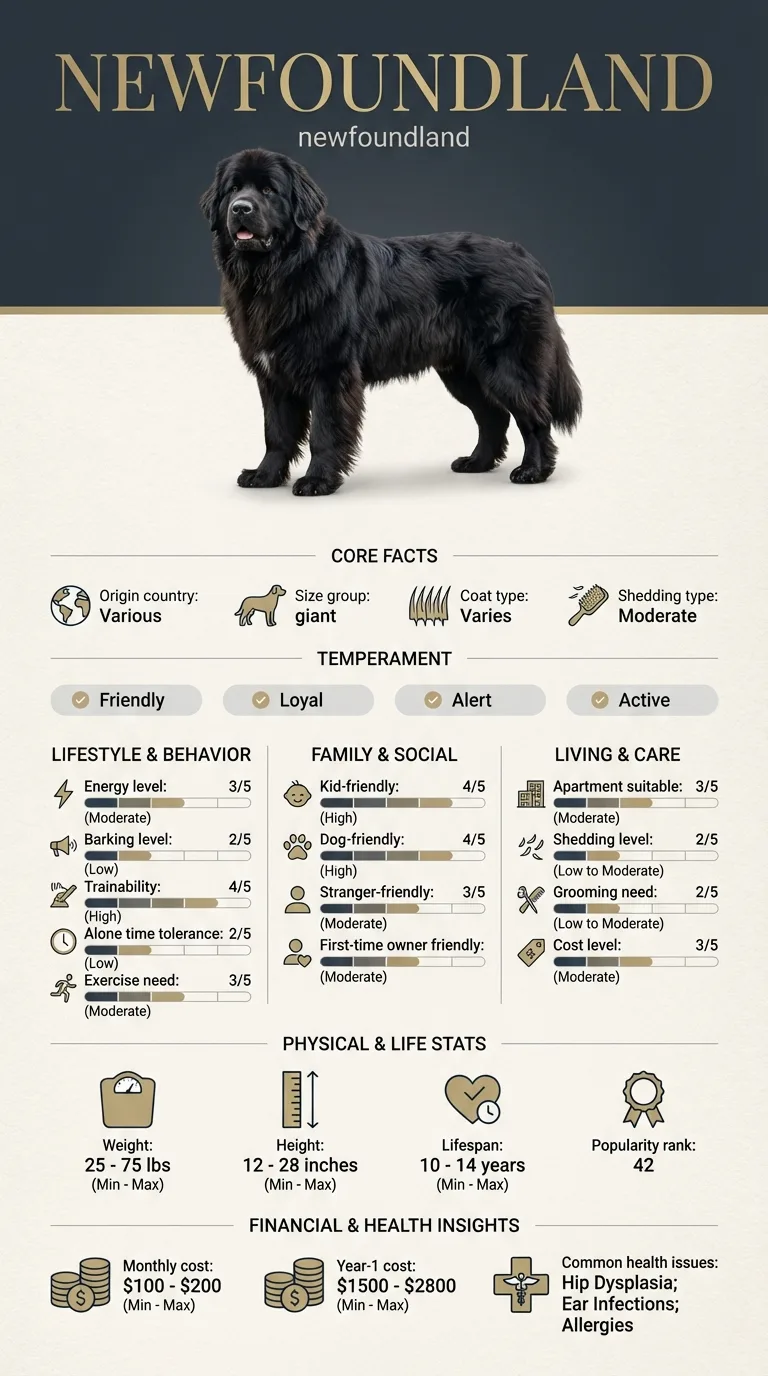
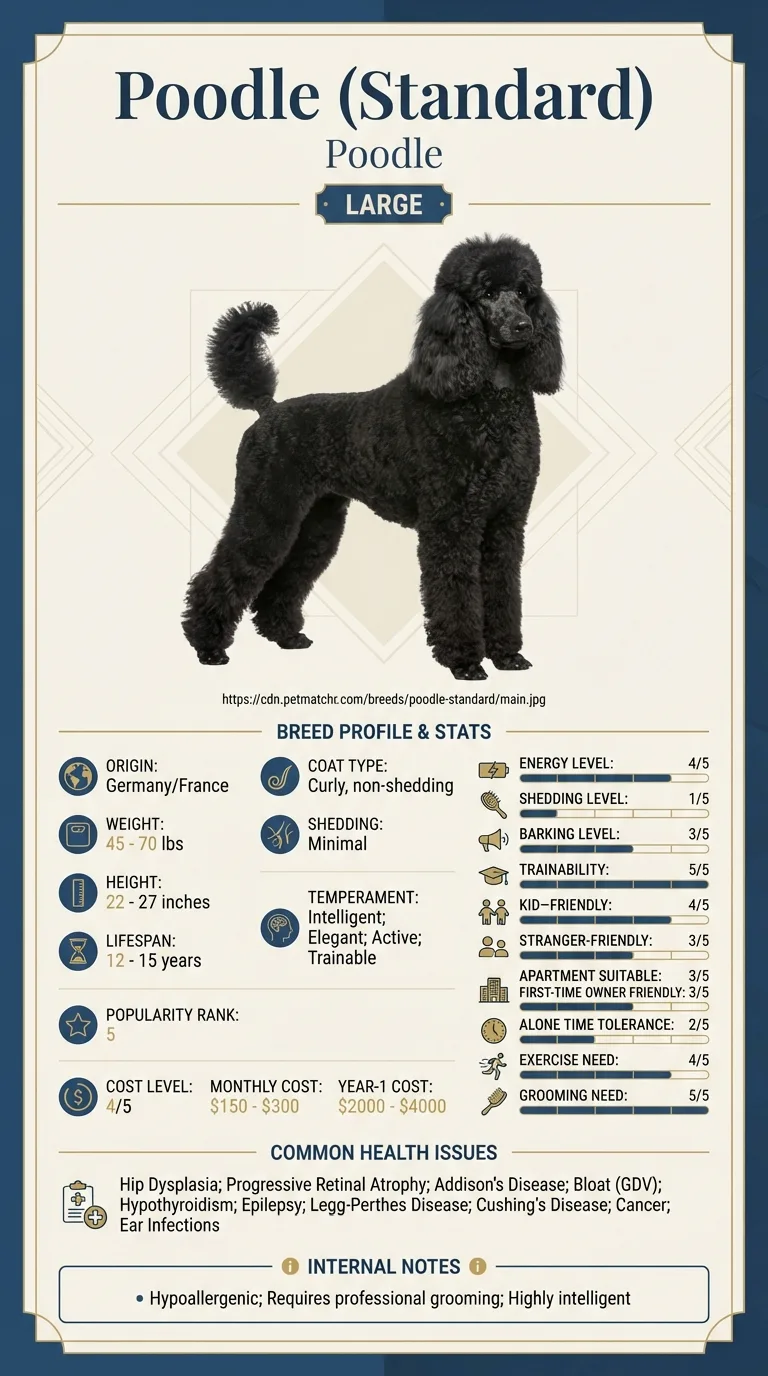
Newfoundland or Poodle (Standard)? On paper they differ most on shedding, and on the scales Newfoundland is the heavier at 100–150 lbs. Here is how the two compare on everything that shapes an ordinary week.
This is for someone already down to Newfoundland and Poodle (Standard) and deciding between them. For this pair the decision usually turns on shedding and energy level, so those are covered first and in most detail. Anyone choosing from a flat has a clear answer here: Poodle (Standard) rates 3/5 against 1/5. The focus throughout is on daily consequences rather than breed background.
Quick verdict
Between Newfoundland and Poodle (Standard), shedding is what separates them, and Newfoundland is the lower-effort dog of the two to keep.
Choose newfoundland if...
Choose Newfoundland if you do not want a standing grooming appointment, your walking routine is modest and the dog will be alone during the working day.
Choose poodle standard if...
Choose Poodle (Standard) if you are in a flat or a smaller home, shedding is a problem in your house and you want a dog that picks up training quickly.
Head-to-head comparison
Feature
newfoundland
poodle standard
Winner
Size class
giant
large
Equal
Weight
100–150 lbs
45–70 lbs
Equal
Height
26–28 in
22–27 in
Equal
Lifespan
9–10 years
12–15 years
poodle standard
Exercise need
Moderate (3/5)
High (4/5)
newfoundland
Grooming need
High (4/5)
Very high (5/5)
newfoundland
Shedding
Very high (5/5)
Very low (1/5)
poodle standard
Energy level
Low (2/5)
High (4/5)
Equal
Barking
Low (2/5)
Moderate (3/5)
newfoundland
Apartment suitability
Very low (1/5)
Moderate (3/5)
poodle standard
Good for first-time owners
Moderate (3/5)
Moderate (3/5)
Equal
Tolerates being alone
Moderate (3/5)
Low (2/5)
newfoundland
Trainability
High (4/5)
Very high (5/5)
poodle standard
Good with kids
Very high (5/5)
High (4/5)
newfoundland
Good with other dogs
High (4/5)
High (4/5)
Equal
Friendly to strangers
High (4/5)
Moderate (3/5)
newfoundland
Cost level
Very high (5/5)
High (4/5)
poodle standard
Coat
Heavy water-resistant double coat
Curly, non-shedding
Equal
Origin
Various
Germany/France
Equal
Typical monthly cost
$150–$310
$150–$300
Equal
Typical first-year cost
$2,200–$4,200
$2,000–$4,000
Equal
Deep dive
Size and build
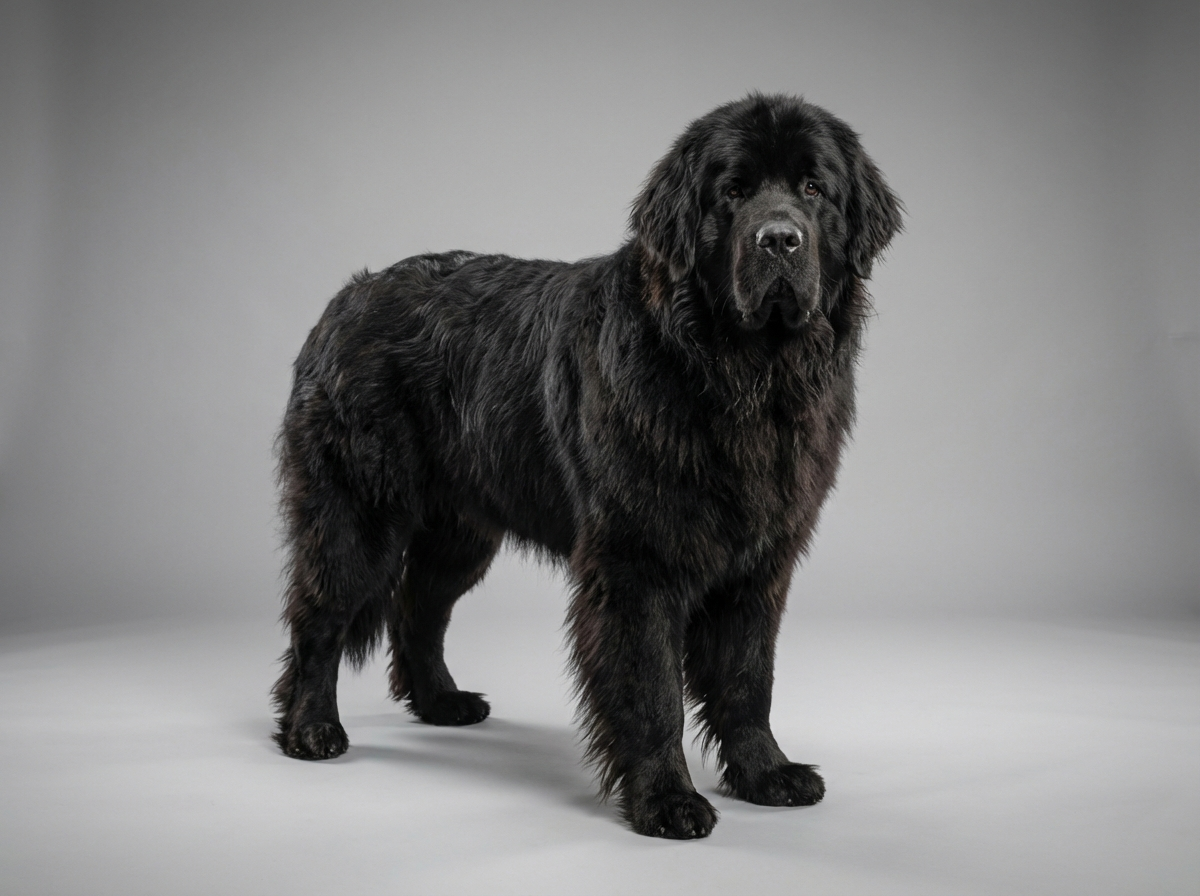
A full-grown Newfoundland can hit 150 lbs, more than double the Standard Poodle's top weight of 70 lbs. Both are tall dogs, with only a couple inches separating their height ranges (26-28 in vs 22-27 in), so the difference is almost entirely mass. The Newfoundland carries a broad, heavy-boned frame built for water work; the Poodle is athletic and narrow by comparison. If floor space and furniture load-bearing matter to you, the 50-80 lb gap is the number to plan around.
Energy and exercise
The Poodle rates a 4 out of 5 for exercise need against the Newfoundland's 3, and it shows in daily energy level too: the Poodle scores High (4/5) where the Newfoundland sits at Low (2/5). That is a genuine surprise for people who assume the bigger dog needs more running. In practice the Poodle wants structured activity, like fetch, swimming, or agility, while the Newfoundland is content with a couple of moderate walks.
Grooming and shedding
Grooming need is close (4/5 for the Newfoundland, 5/5 for the Poodle), but shedding is where the two part ways completely. The Newfoundland sheds at a 5/5, dropping its dense double coat seasonally in heavy volume. The Poodle sheds at 1/5 thanks to its curly, non-shedding coat, which is why it turns up on hypoallergenic-adjacent lists, though that coat still needs clipping every 4-6 weeks to avoid matting.
Apartment living, noise and time alone
Apartment suitability tells the real story: the Newfoundland scores Very Low (1/5) and the Poodle Moderate (3/5). Barking runs Low (2/5) for the Newfoundland versus Moderate (3/5) for the Poodle, so neither is a nuisance barker, but only one of them fits in a condo without a yard. Both dogs tolerate alone time reasonably, Moderate (3/5) for the Newfoundland and Low (2/5) for the Poodle, so plan for a dog walker either way if your days run long.
Training and owner experience
Both are rated Moderate (3/5) for first-time owners, so neither is a beginner trap, but they get there differently. The Poodle is Very High (5/5) on trainability, one of the most trainable breeds around, while the Newfoundland is High (4/5), eager to please but slower and heavier to redirect mid-motion. If you have not trained a dog before, the Poodle's quicker uptake on commands may offset its higher energy demands.
Kids, other dogs and visitors
Both score well with kids and other dogs, with the Newfoundland edging ahead on kids (Very High 5/5 versus High 4/5) and on friendliness to strangers (High 4/5 versus Moderate 3/5). The Poodle is still good with children and dogs, just a notch more reserved with new people at the door. Neither breed leans toward anything worse than moderate on any household-fit measure here, which is unusual for a giant-versus-large matchup.
Health and lifespan
The Poodle is expected to live 12-15 years against the Newfoundland's 9-10, a gap of roughly 3-5 years that should weigh heavily in the decision. Health-wise, the Newfoundland carries five known concerns including subaortic stenosis and dilated cardiomyopathy, while the Poodle's list runs to ten, including Addison's disease, epilepsy, and cancer. Both share hip dysplasia and bloat risk, so a raised feeding station and slow-feed bowl are worth using regardless of which one you pick.
Cost to keep
Monthly costs land almost identically, $150-310 for the Newfoundland versus $150-300 for the Poodle, and first-year costs are close too ($2,200-4,200 vs $2,000-4,000). The Poodle's cost level rates High (4/5) against the Newfoundland's Very High (5/5), with the gap coming mostly from food volume rather than grooming, since the Poodle's coat maintenance is not cheap either. Budget for regular professional grooming on the Poodle and a bigger food bill on the Newfoundland.
Newfoundland vs Poodle (Standard) at a glance
Newfoundland weighs 100–150 lbs and lives 9–10 years; Poodle (Standard) weighs 45–70 lbs and lives 12–15 years. The two diverge most on shedding, energy level and apartment suitability. They are level on good with other dogs and good for first-time owners, so those cannot decide it. The table below marks a winner only where one breed is genuinely easier for a typical owner; size and origin are facts rather than merits and stay level. Ratings come from one source applied to both breeds, so they are meaningful against each other rather than as absolute scores.
Newfoundland vs Poodle (Standard): Which Suits Your Home? - Newfoundland vs Poodle (Standard) at a glance
Frequently asked questions
How much bigger is a Newfoundland than a Standard Poodle?
A Newfoundland can weigh up to 150 lbs versus the Poodle's 70 lb ceiling, more than double. Height is closer, at 26-28 in versus 22-27 in, so the Newfoundland's extra size is mostly bulk and bone, not height.
Which one sheds less?
The Poodle, by a wide margin. It rates 1/5 for shedding thanks to its curly, non-shedding coat, versus 5/5 for the Newfoundland's heavy double coat. The tradeoff is that the Poodle needs professional clipping every 4-6 weeks, which the Newfoundland does not.
Is either one good for a first-time owner?
Both rate Moderate (3/5), so neither is ideal but neither is a disaster either. The Poodle trains faster (5/5 trainability) which helps a novice owner, while the Newfoundland's calmer energy (2/5) makes daily management easier even though its size is intimidating.
Can either dog live in an apartment?
Not comfortably. The Newfoundland scores Very Low (1/5) for apartment suitability and really needs a house with outdoor space. The Poodle is more workable at Moderate (3/5), especially if you meet its High (4/5) exercise need with daily structured activity.
Which is cheaper to own?
They are close. Monthly costs run $150-310 for the Newfoundland and $150-300 for the Poodle, and first-year costs sit at $2,200-4,200 versus $2,000-4,000. The Poodle's grooming bills offset what it saves in food compared to the giant Newfoundland.
Do they share any health risks?
Yes, both are prone to hip dysplasia and bloat (GDV), so a slow-feed bowl and a vet-approved feeding schedule matter for either breed. Beyond that their risk lists diverge: the Newfoundland's issues lean cardiac, while the Poodle's ten-item list includes Addison's disease, epilepsy, and cancer.
Which one will likely be around longer?
The Poodle, typically by 3-5 years. Its lifespan runs 12-15 years against the Newfoundland's 9-10. That gap alone pushes some buyers toward the Poodle when longevity is the deciding factor.
Newfoundland or Standard Poodle, which should you get?
If you want a calm giant that tolerates alone time and don't mind heavy shedding, the Newfoundland fits. If you want an athletic, low-shedding dog that trains quickly but needs daily structured exercise, go Poodle.
Costs
What will you spend monthly?
$150-310 for a Newfoundland, $150-300 for a Standard Poodle, functionally the same budget, just allocated differently between food and grooming.
Living
Which needs more daily exercise?
The Poodle, rated High (4/5) versus the Newfoundland's Moderate (3/5). The Poodle also runs a High (4/5) energy level against the Newfoundland's Low (2/5).
Health
Which one lives longer?
The Poodle, at 12-15 years versus the Newfoundland's 9-10 years, a meaningful 3-5 year difference.
Related DogBreedCompass guides
Newfoundland breed guide – Readers comparing the two usually want the full profile of Newfoundland before deciding.
Poodle (Standard) breed guide – The same for Poodle (Standard), so the comparison can be checked against the detail.
Newfoundland vs Saint Bernard – Saint Bernard is the closest breed to Newfoundland on the measured axes, so it is the natural next comparison.
Health information here is general and is not veterinary advice. If your dog shows pain, sudden behaviour change, or worsening symptoms, consult a licensed veterinarian.
Some links on this site are affiliate links. We may earn a commission at no extra cost to you, and we only suggest products we believe are helpful for dog owners.
We research and check what we publish, but we do not warrant that any figure, date, price, or statement is accurate, complete, or current, and we accept no liability for any loss, cost, injury, or other harm arising from the use of this site. Use it as one reference among several. You remain responsible for your own decisions and for your dog's care - confirm anything that matters with a licensed veterinarian or another qualified professional before you act on it. Full disclaimer.