Behavior
Which breed sheds more?
The GWP, rated Moderate (3/5) versus the Shar-Pei's Low (2/5).

Quick answer
Which breed sheds more?
The GWP, rated Moderate (3/5) versus the Shar-Pei's Low (2/5).
Chinese Shar-Pei or German Wirehaired Pointer? On paper they differ most on exercise need, and on the scales German Wirehaired Pointer is the heavier at 60–70 lbs. Here is how the two compare on everything that shapes an ordinary week.
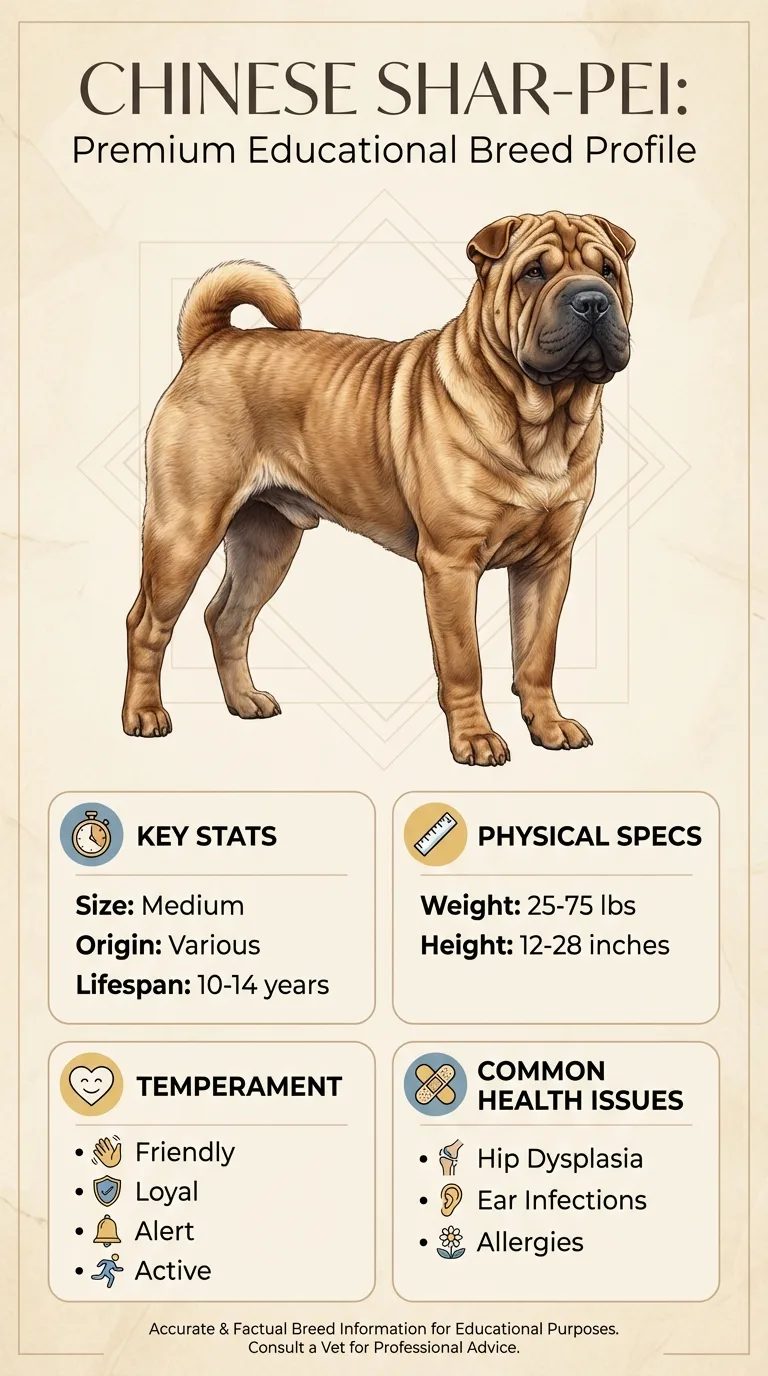
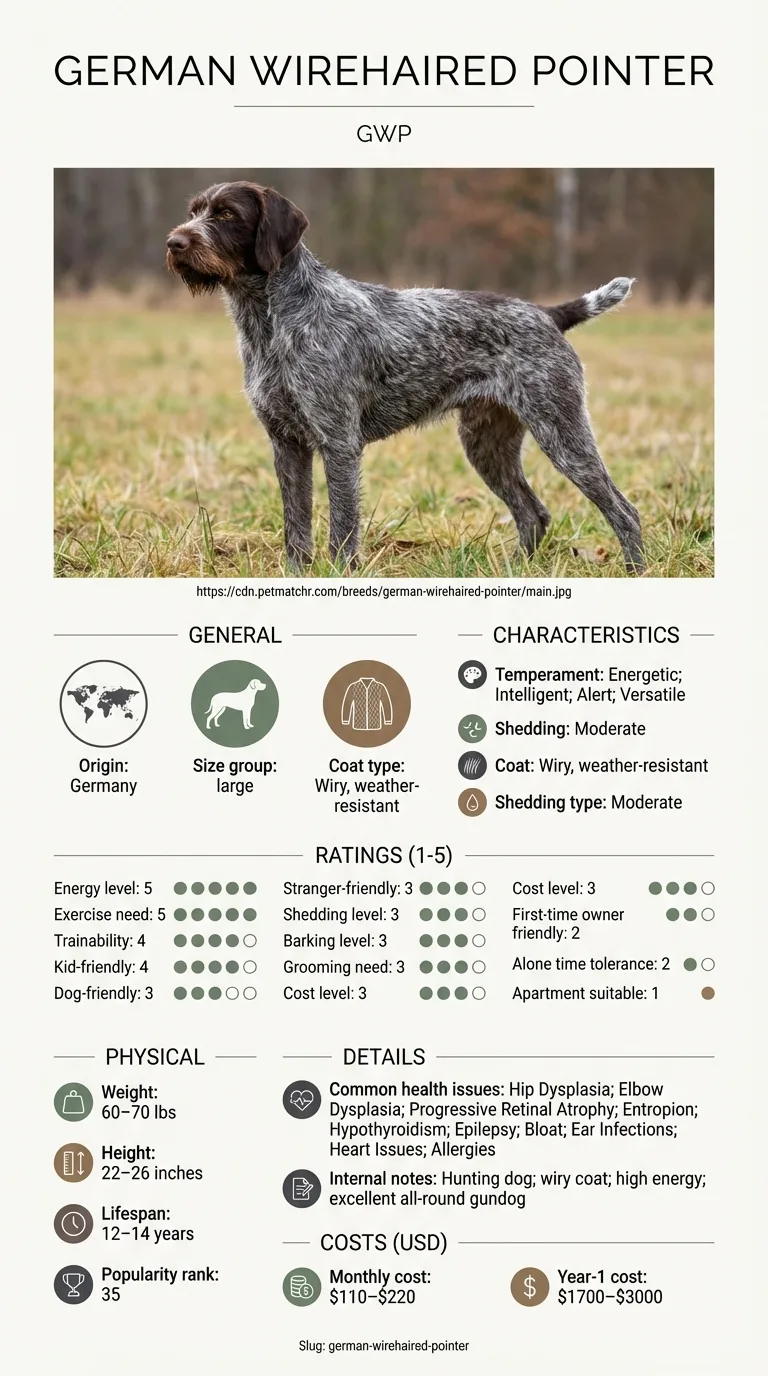
This is for someone already down to Chinese Shar-Pei and German Wirehaired Pointer and deciding between them. For this pair the decision usually turns on exercise need and energy level, so those are covered first and in most detail. Anyone choosing from a flat has a clear answer here: Chinese Shar-Pei rates 4/5 against 1/5. There is no origin story here — only what changes about your week.
Between Chinese Shar-Pei and German Wirehaired Pointer, exercise need is what separates them, and Chinese Shar-Pei is the lower-effort dog of the two to keep.
Choose Chinese Shar-Pei if you are in a flat or a smaller home, you do not want a standing grooming appointment and shedding is a problem in your house.
Choose German Wirehaired Pointer if there are young children at home, you already have another dog and you want a dog that picks up training quickly.
| Feature | chinese shar pei | german wirehaired pointer | Winner |
|---|---|---|---|
| Size class | medium | large | Equal |
| Weight | 45–60 lbs | 60–70 lbs | Equal |
| Height | 18–20 in | 22–26 in | Equal |
| Lifespan | 8–12 years | 12–14 years | german wirehaired pointer |
| Exercise need | Low (2/5) | Very high (5/5) | chinese shar pei |
| Grooming need | Low (2/5) | Moderate (3/5) | chinese shar pei |
| Shedding | Low (2/5) | Moderate (3/5) | chinese shar pei |
| Energy level | Low (2/5) | Very high (5/5) | Equal |
| Barking | Low (2/5) | Moderate (3/5) | chinese shar pei |
| Apartment suitability | High (4/5) | Very low (1/5) | chinese shar pei |
| Good for first-time owners | Low (2/5) | Low (2/5) | Equal |
| Tolerates being alone | Moderate (3/5) | Low (2/5) | chinese shar pei |
| Trainability | Low (2/5) | High (4/5) | german wirehaired pointer |
| Good with kids | Moderate (3/5) | High (4/5) | german wirehaired pointer |
| Good with other dogs | Low (2/5) | Moderate (3/5) | german wirehaired pointer |
| Friendly to strangers | Low (2/5) | Moderate (3/5) | german wirehaired pointer |
| Cost level | High (4/5) | Moderate (3/5) | german wirehaired pointer |
| Coat | Short and harsh | Wiry, weather-resistant | Equal |
| Origin | Various | Germany | Equal |
| Typical monthly cost | $100–$200 | $110–$220 | Equal |
| Typical first-year cost | $1,400–$2,900 | $1,700–$3,000 | Equal |
At 60-70 lbs and 22-26 inches, the German Wirehaired Pointer is the largest dog the Shar-Pei will face in this set of comparisons relative to its own 45-60 lb, 18-20 inch frame -- a full size class apart, medium versus large. The GWP's wiry, weather-resistant coat also gives it a rougher, bulkier outline than its weight alone suggests, built for pushing through brush on long hunts. The Shar-Pei's compact, dense-boned body is heavier per inch of height, but next to a GWP it will still look like the smaller, lower dog in nearly every practical sense -- doorway clearance, car space, and counter-surfing reach included.
The German Wirehaired Pointer's Very high (5/5) exercise rating puts it in the same demanding bracket as other versatile hunting breeds, requiring sustained daily activity that its Energetic, Versatile temperament actively seeks out. The Shar-Pei's Low (2/5) rating sits at the far opposite end of this comparison's scale, and its Independent, Calm nature means it won't self-motivate toward exercise the way a GWP will. A household that under-exercises a GWP risks a bored, Alert dog channeling energy into unwanted behaviors, while a Shar-Pei left equally under-active is simply a Shar-Pei having a normal day -- the gap between these two breeds' baseline needs is about as wide as this comparison gets.
Both breeds land in similar territory on shedding, Moderate (3/5) for the GWP against Low (2/5) for the Shar-Pei, but grooming diverges more: the GWP's wiry double coat rates Moderate (3/5) and typically needs hand-stripping a few times a year to stay weatherproof, a specialized task most Shar-Pei owners never encounter. The Shar-Pei's Low (2/5) grooming score reflects its short, harsh coat's low maintenance, though its folds still require the kind of hands-on attention a smooth-coated GWP never demands. Owners weighing the two should factor in that GWP coat care is occasional but specialized, while Shar-Pei coat care is frequent but simple.
This is one of the starkest apartment-suitability gaps in the comparison set: the Shar-Pei rates High (4/5) while the GWP rates Very low (1/5), the lowest score a breed can receive here. Combined with its Very high exercise need and Moderate (3/5) barking, a German Wirehaired Pointer confined to apartment life is set up to struggle regardless of how attentive its owner is. The Shar-Pei's Moderate (3/5) tolerance for being alone also outpaces the GWP's Low (2/5), reinforcing that this is fundamentally a house-and-yard breed being compared against a genuinely apartment-friendly one.
The GWP rates High (4/5) on trainability, a notch below the top score but still reflecting its Intelligent, Versatile working background, while the Shar-Pei's Low (2/5) trainability stems from its more Independent disposition. Both breeds score Low (2/5) for first-time owners, meaning neither is recommended as a starter dog: the GWP demands an owner who can match its exercise and mental-stimulation needs, while the Shar-Pei needs someone comfortable earning trust slowly rather than commanding quick obedience. Experienced hunting-dog owners will likely find GWP training rewarding and fast-moving; Shar-Pei training tends to be a longer, quieter process built on consistency rather than repetition.
The GWP edges ahead socially, rating High (4/5) with kids against the Shar-Pei's Moderate (3/5), and Moderate (3/5) with both other dogs and strangers versus the Shar-Pei's Low (2/5) in both categories. Its Alert, Versatile temperament makes it attentive around children without being standoffish toward newcomers, a balance the Shar-Pei's Reserved nature doesn't naturally strike. That said, a GWP's high energy means young kids need to be taught calm handling around an enthusiastic, athletic dog, while the Shar-Pei's lower energy makes for gentler day-to-day interactions even if its warmth takes longer to earn.
The German Wirehaired Pointer has a notable lifespan advantage, 12-14 years against the Shar-Pei's 8-12, one of the widest gaps in this batch. Its health list spans hip and elbow dysplasia, progressive retinal atrophy, entropion, hypothyroidism, epilepsy, bloat, ear infections, heart issues, and allergies -- and strikingly, three of those conditions (entropion, hypothyroidism, and ear infections) also appear on the Shar-Pei's shorter five-item list. That overlap is worth flagging to any vet: both breeds can develop the same eyelid and ear complications, even though the Shar-Pei's skin fold dermatitis and Familial Shar-Pei Fever remain unique to its wrinkled structure.
Cost level favors the GWP, rated Moderate (3/5) against the Shar-Pei's High (4/5), though the raw dollar figures are close: $110-$220 monthly and $1,700-$3,000 in year one for the GWP versus $100-$200 monthly and $1,400-$2,900 for the Shar-Pei. The GWP's larger size pushes up food and preventive-care costs, but its lower incidence of specialized grooming keeps overall spending from climbing much higher than the Shar-Pei's, whose skin-fold maintenance and ear-infection susceptibility add recurring vet expense despite the smaller body. Prospective owners of either breed should budget similarly for the first year regardless of the cost-level label.
Chinese Shar-Pei weighs 45–60 lbs and lives 8–12 years; German Wirehaired Pointer weighs 60–70 lbs and lives 12–14 years. The two diverge most on exercise need, energy level and apartment suitability and 1 other rated axes. Almost every rated axis separates them at least slightly. Where the table declares a winner it means less work for the owner, nothing more; descriptive rows are left as ties on purpose. The value here is in the differences between the two columns; treat any single score as approximate.

Considerably -- the GWP weighs 60-70 lbs and stands 22-26 inches, compared to the Shar-Pei's 45-60 lbs and 18-20 inches.
The Shar-Pei by a wide margin, rated High (4/5) on apartment suitability against the GWP's Very low (1/5).
Yes -- both are prone to entropion, hypothyroidism, and ear infections, despite otherwise different health profiles.
The Shar-Pei, rated Low (2/5) versus the GWP's Very high (5/5).
The GWP, typically 12-14 years compared to the Shar-Pei's 8-12 years.
The GWP, rated High (4/5) against the Shar-Pei's Low (2/5).
The GWP rates a lower general cost level (Moderate vs High), though first-year dollar costs are fairly close between the two.
The GWP, rated Moderate (3/5) versus the Shar-Pei's Low (2/5).
The GWP, rated Moderate (3/5) against the Shar-Pei's Low (2/5).
The GWP's wiry coat needs occasional hand-stripping; the Shar-Pei's does not.
The Shar-Pei, with Low (2/5) energy versus the GWP's Very high (5/5).
Secure checkout on Stripe. We never see your card.
7-day money-back guarantee. Instant access.
Health information here is general and is not veterinary advice. If your dog shows pain, sudden behaviour change, or worsening symptoms, consult a licensed veterinarian.
Some links on this site are affiliate links. We may earn a commission at no extra cost to you, and we only suggest products we believe are helpful for dog owners.
We research and check what we publish, but we do not warrant that any figure, date, price, or statement is accurate, complete, or current, and we accept no liability for any loss, cost, injury, or other harm arising from the use of this site. Use it as one reference among several. You remain responsible for your own decisions and for your dog's care - confirm anything that matters with a licensed veterinarian or another qualified professional before you act on it. Full disclaimer.
Match your lifestyle to the right dog.
Take quizNot sure which breed is right for you? Take our 2-minute quiz to find out.
Take the quiz