Training
Boston Terrier or Shiba Inu — which should a first-time owner pick?
The Boston Terrier, without much debate — it rates 5/5 for first-timers against the Shiba's 2/5. The Shiba's independence takes real experience to manage.

Quick answer
Boston Terrier or Shiba Inu — which should a first-time owner pick?
The Boston Terrier, without much debate — it rates 5/5 for first-timers against the Shiba's 2/5. The Shiba's independence takes real experience to manage.
Boston Terrier or Shiba Inu? On paper they differ most on good for first-time owners, and on the scales Shiba Inu is the heavier at 17–23 lbs. Here is how the two compare on everything that shapes an ordinary week.
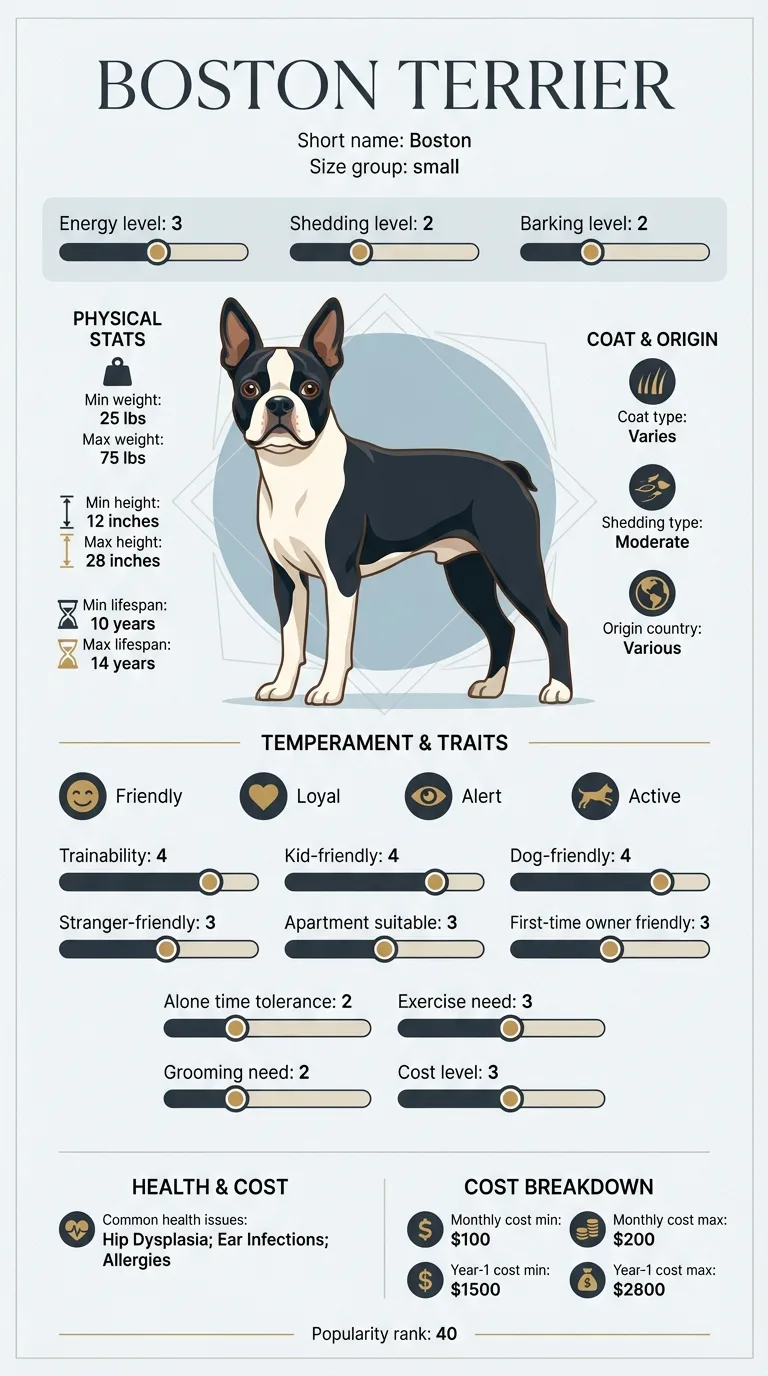
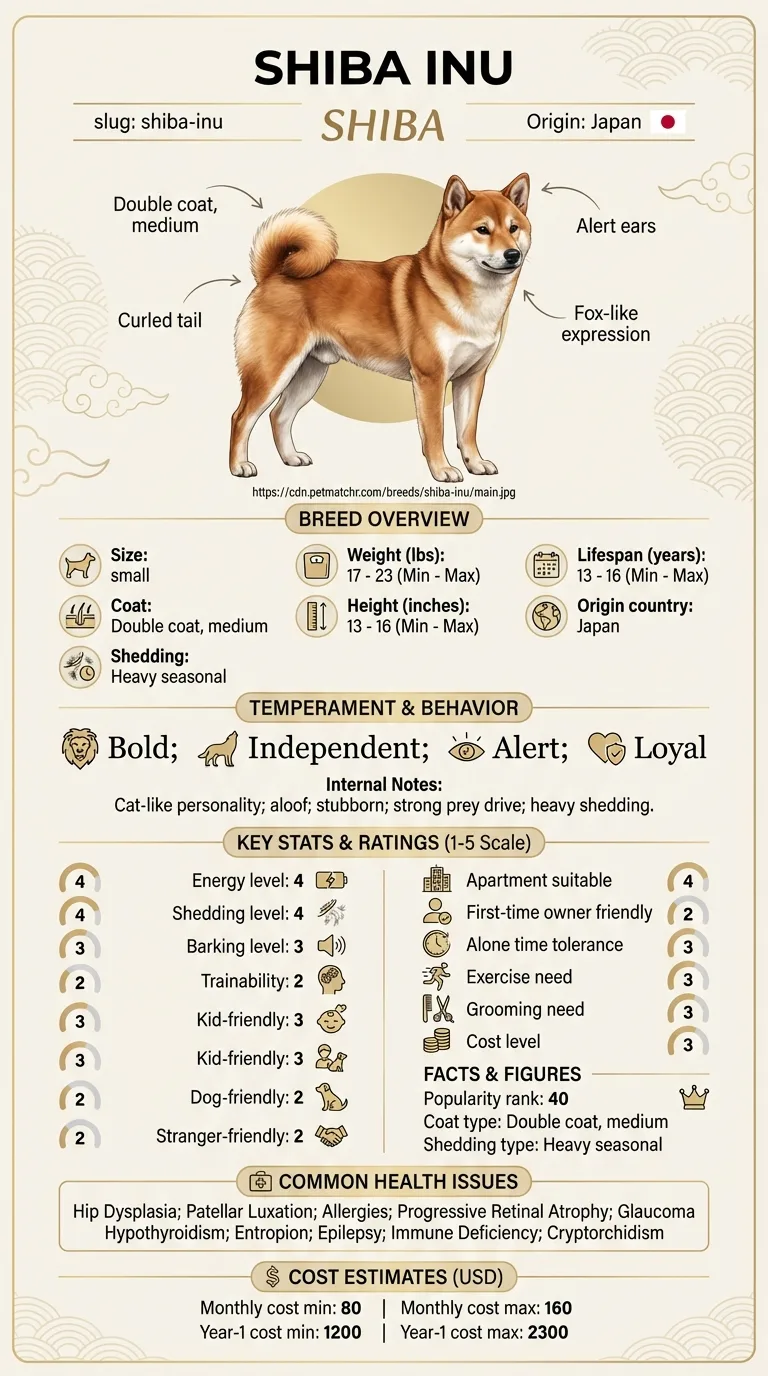
This is for someone already down to Boston Terrier and Shiba Inu and deciding between them. For this pair the decision usually turns on good for first-time owners and grooming need, so those are covered first and in most detail. Anyone choosing from a flat has a clear answer here: Boston Terrier rates 5/5 against 4/5. Breed history is left out; what follows is what you will actually live with.
Between Boston Terrier and Shiba Inu, good for first-time owners is what separates them, and Boston Terrier is the lower-effort dog of the two to keep.
Choose Boston Terrier if you are in a flat or a smaller home, this is your first dog and you do not want a standing grooming appointment.
Choose Shiba Inu if you want a dog that can keep up with an active routine and you want a dog that is more watchful with visitors.
| Feature | boston terrier | shiba inu | Winner |
|---|---|---|---|
| Size class | small | small | Equal |
| Weight | 12–25 lbs | 17–23 lbs | Equal |
| Height | 15–17 in | 13–16 in | Equal |
| Lifespan | 11–13 years | 13–16 years | shiba inu |
| Exercise need | Low (2/5) | Moderate (3/5) | boston terrier |
| Grooming need | Very low (1/5) | Moderate (3/5) | boston terrier |
| Shedding | Low (2/5) | High (4/5) | boston terrier |
| Energy level | Moderate (3/5) | High (4/5) | Equal |
| Barking | Low (2/5) | Moderate (3/5) | boston terrier |
| Apartment suitability | Very high (5/5) | High (4/5) | boston terrier |
| Good for first-time owners | Very high (5/5) | Low (2/5) | boston terrier |
| Tolerates being alone | Moderate (3/5) | Moderate (3/5) | Equal |
| Trainability | High (4/5) | Low (2/5) | boston terrier |
| Good with kids | Very high (5/5) | Moderate (3/5) | boston terrier |
| Good with other dogs | High (4/5) | Low (2/5) | boston terrier |
| Friendly to strangers | High (4/5) | Low (2/5) | boston terrier |
| Cost level | Moderate (3/5) | Moderate (3/5) | Equal |
| Coat | Short and smooth | Double coat, medium | Equal |
| Origin | Various | Japan | Equal |
| Typical monthly cost | $80–$150 | $80–$160 | Equal |
| Typical first-year cost | $1,100–$2,300 | $1,200–$2,300 | Equal |
Weight-wise these two nearly overlap — 12 to 25 pounds for the Boston, 17 to 23 for the Shiba — and both stay under 17 inches at the shoulder. The build tells a different story: the Shiba's fox-like frame, double coat, and upright ears are built for cold-weather stamina, while the Boston's short coat and flat face read as purely companion-bred. Neither dog will strain your apartment's square footage.
The Shiba rates a 3/5 for exercise need but a 4/5 for energy level — it's less about distance covered and more about intensity, sharp bursts of activity and a strong prey drive that needs an outlet. The Boston's 2/5 exercise need and moderate 3/5 energy make it the calmer of the two by a clear margin. A tired Shiba is a manageable Shiba; an under-exercised one gets creative.
Grooming favors the Boston hands-down — a 1/5 need against the Shiba's 3/5, since the Shiba's plush double coat requires regular brushing to manage. Shedding is where the Shiba really shows up, rated 4/5 (with a seasonal 'blowout' typical of double-coated breeds) versus the Boston's low 2/5. If shedding is a dealbreaker, the Boston is the far easier housemate.
On paper both score reasonably well for apartments — the Boston at 5/5, the Shiba at 4/5 — and barking is moderate for the Shiba (3/5) against low for the Boston (2/5). The bigger apartment-living factor isn't in the noise numbers, though: it's the Shiba's independent streak, which can make it more prone to getting into things when bored and unsupervised in a small space.
This is the widest gap in the whole comparison. The Boston rates 5/5 for first-time owners and 4/5 for trainability — an easy dog to raise. The Shiba Inu rates just 2/5 on both counts, a breed known for independence and a mind of its own that doesn't respond to training the way more eager-to-please breeds do. A first Shiba is a real commitment to patience.
The Boston is the more sociable dog across the board here: 5/5 with kids versus the Shiba's 3/5, 4/5 with other dogs versus the Shiba's 2/5, and 4/5 with strangers versus the Shiba's 2/5. None of that makes the Shiba a bad dog — it's simply a more aloof, one-household breed that doesn't naturally warm to new people or animals the way the Boston does.
The Shiba typically outlives the Boston by a couple of years — 13 to 16 versus 11 to 13 — and carries a longer documented health list, including hip dysplasia, epilepsy, and several eye conditions. Patellar luxation shows up in both breeds' data, worth screening for regardless of which you choose. The Boston's list stays shorter but leans on airway and eye problems tied to its short face.
Costs track closely: both breeds sit at a moderate 3/5, with monthly ranges of $80–$150 for the Boston and $80–$160 for the Shiba, and first-year totals within about a hundred dollars of each other. Neither is the budget factor here — training support (especially for a Shiba) and any grooming tools are the likelier real-world add-ons.
Boston Terrier weighs 12–25 lbs and lives 11–13 years; Shiba Inu weighs 17–23 lbs and lives 13–16 years. The two diverge most on good for first-time owners, grooming need and shedding and 4 other rated axes. They are level on tolerates being alone and cost level, so those cannot decide it. The comparison marks an easier option only where one exists. Facts like weight and country of origin are not scored. Both dogs are rated from the same dataset, which is what makes the numbers comparable with each other even though any individual dog sits somewhere inside its breed's range.

Very close — 12-25 lbs for the Boston versus 17-23 lbs for the Shiba, both under 17 inches tall. The visual difference comes from coat and build, not raw size.
Not really, based on the data — it rates just 2/5 for first-time owners and 2/5 for trainability, both driven by its famously independent streak. The Boston Terrier, at 5/5 on both, is the far more beginner-friendly choice.
The Shiba Inu, rated 4/5 for shedding against the Boston's 2/5. Its double coat blows out seasonally, which the Boston's short coat never does.
The Boston is, rated 4/5. The Shiba rates just 2/5 — its independent, sometimes prey-driven temperament makes it less naturally sociable with other dogs than the Boston.
$80-150 for the Boston, $80-160 for the Shiba Inu — close enough that cost shouldn't be the deciding factor between them.
Patellar luxation appears in both breeds' health data. Beyond that the lists diverge, with the Shiba's running longer and including hip dysplasia, epilepsy, and several eye disorders.
The Shiba Inu, typically 13-16 years against the Boston's 11-13 — about a two-to-three-year edge.
The Boston Terrier, without much debate — it rates 5/5 for first-timers against the Shiba's 2/5. The Shiba's independence takes real experience to manage.
$80-150 for the Boston, $80-160 for the Shiba — nearly identical.
The Shiba, rated 4/5 energy against the Boston's moderate 3/5, with sharper bursts of intensity.
The Shiba Inu, typically 13-16 years versus 11-13 for the Boston.
Secure checkout on Stripe. We never see your card.
7-day money-back guarantee. Instant access.

Health information here is general and is not veterinary advice. If your dog shows pain, sudden behaviour change, or worsening symptoms, consult a licensed veterinarian.
Some links on this site are affiliate links. We may earn a commission at no extra cost to you, and we only suggest products we believe are helpful for dog owners.
We research and check what we publish, but we do not warrant that any figure, date, price, or statement is accurate, complete, or current, and we accept no liability for any loss, cost, injury, or other harm arising from the use of this site. Use it as one reference among several. You remain responsible for your own decisions and for your dog's care - confirm anything that matters with a licensed veterinarian or another qualified professional before you act on it. Full disclaimer.
Match your lifestyle to the right dog.
Take quizNot sure which breed is right for you? Take our 2-minute quiz to find out.
Take the quiz