Living
Which is the harder dog to own day to day?
The Husky, mainly due to its 5/5 exercise need and 1/5 tolerance for being left alone - it demands far more daily commitment than the Bloodhound.

Quick answer
Which is the harder dog to own day to day?
The Husky, mainly due to its 5/5 exercise need and 1/5 tolerance for being left alone - it demands far more daily commitment than the Bloodhound.
Bloodhound or Siberian Husky? On paper they differ most on exercise need, and on the scales Bloodhound is the heavier at 90–110 lbs. Here is how the two compare on everything that shapes an ordinary week.
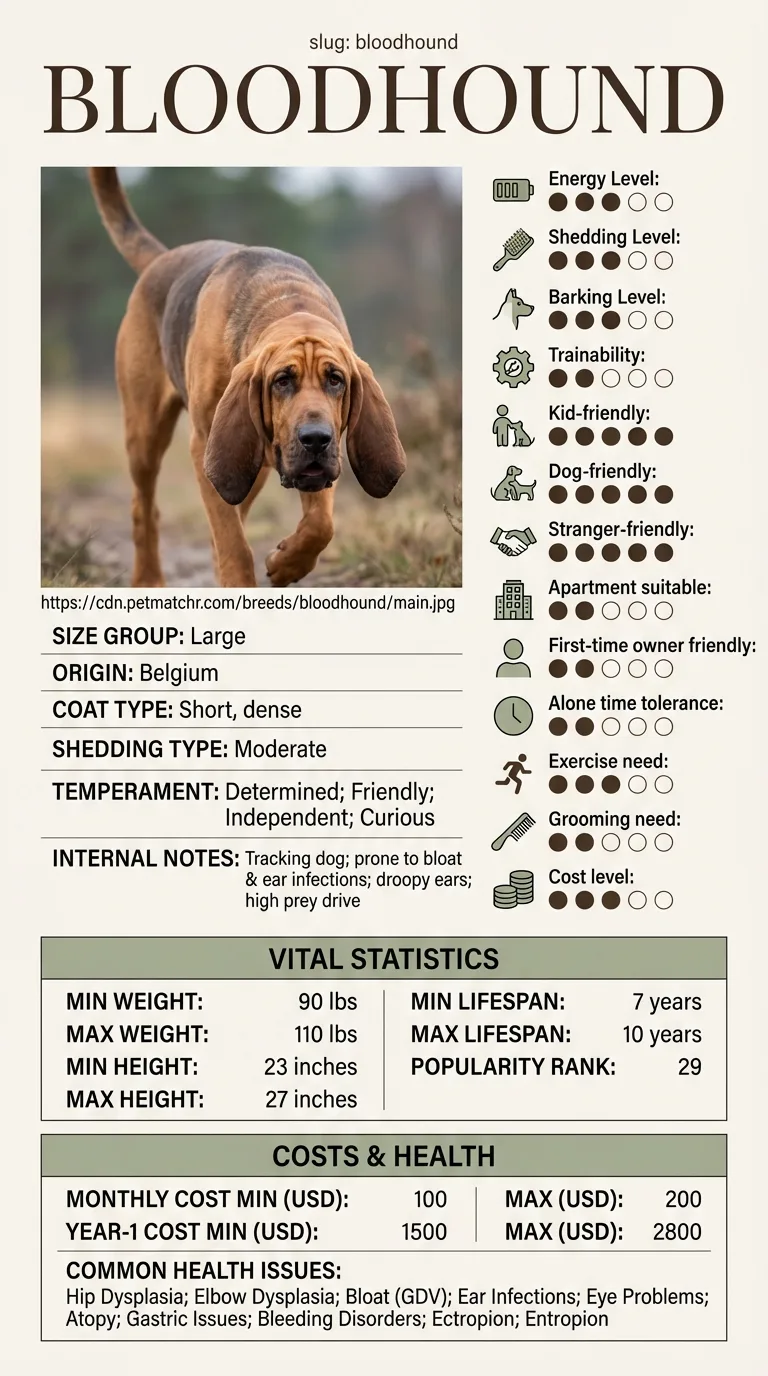
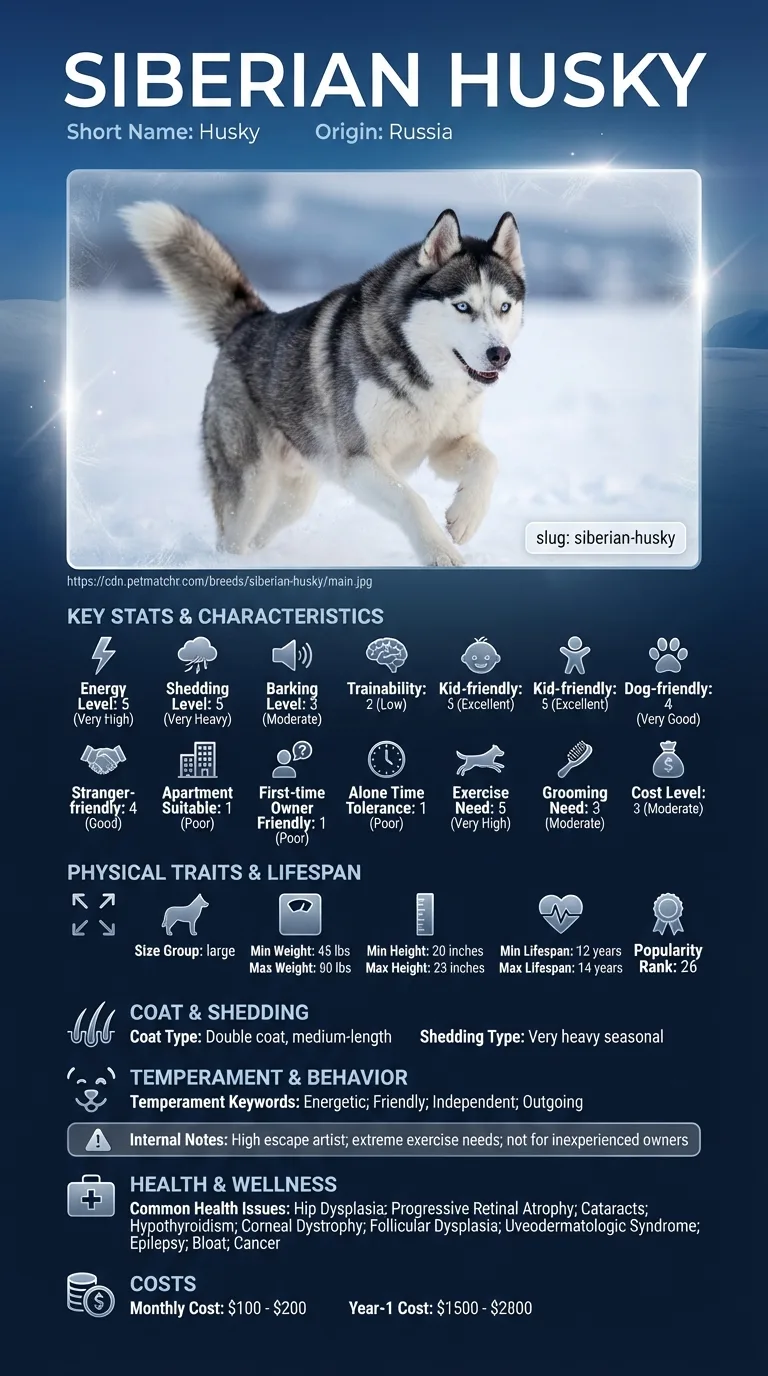
This is for someone already down to Bloodhound and Siberian Husky and deciding between them. For this pair the decision usually turns on exercise need and energy level, so those are covered first and in most detail. Anyone choosing from a flat has a clear answer here: Bloodhound rates 2/5 against 1/5. The focus throughout is on daily consequences rather than breed background.
Between Bloodhound and Siberian Husky, exercise need is what separates them, and Bloodhound is the lower-effort dog of the two to keep.
Choose Bloodhound if you do not want a standing grooming appointment, shedding is a problem in your house and your walking routine is modest.
Choose Siberian Husky if there are young children at home, a smaller dog suits your car, your home or your back and you want a dog that can keep up with an active routine.
| Feature | bloodhound | siberian husky | Winner |
|---|---|---|---|
| Size class | large | large | Equal |
| Weight | 90–110 lbs | 45–60 lbs | Equal |
| Height | 23–27 in | 20–23 in | Equal |
| Lifespan | 7–10 years | 12–14 years | siberian husky |
| Exercise need | Moderate (3/5) | Very high (5/5) | bloodhound |
| Grooming need | Low (2/5) | Moderate (3/5) | bloodhound |
| Shedding | Moderate (3/5) | Very high (5/5) | bloodhound |
| Energy level | Moderate (3/5) | Very high (5/5) | Equal |
| Barking | Moderate (3/5) | Moderate (3/5) | Equal |
| Apartment suitability | Low (2/5) | Very low (1/5) | bloodhound |
| Good for first-time owners | Low (2/5) | Very low (1/5) | bloodhound |
| Tolerates being alone | Low (2/5) | Very low (1/5) | bloodhound |
| Trainability | Low (2/5) | Low (2/5) | Equal |
| Good with kids | High (4/5) | Very high (5/5) | siberian husky |
| Good with other dogs | High (4/5) | High (4/5) | Equal |
| Friendly to strangers | High (4/5) | High (4/5) | Equal |
| Cost level | Moderate (3/5) | Moderate (3/5) | Equal |
| Coat | Short, dense | Double coat, medium-length | Equal |
| Origin | Belgium | Russia | Equal |
| Typical monthly cost | $100–$200 | $100–$200 | Equal |
| Typical first-year cost | $1,500–$2,800 | $1,500–$2,800 | Equal |
Both breeds land in the large category, but they get there differently. The Bloodhound is the heavier of the two at 90-110 lbs against the Husky's leaner 45-60 lbs, while the Husky is actually a bit shorter at 20-23 inches versus 23-27. Think dense and heavy versus lean and athletic.
The Siberian Husky is the more demanding dog by a clear margin - a maximum 5/5 on exercise need against the Bloodhound's 3/5, with energy level to match. This breed was built to run for hours pulling a sled, and it shows in daily life; a bored, under-exercised Husky is a genuinely difficult dog to live with.
The Husky sheds more, rated a maximum 5/5 against the Bloodhound's moderate 3/5, and needs more grooming too at 3/5 versus 2/5 - its double coat blows out heavily twice a year. If you've heard Husky owners joke about finding fur in their coffee, the shedding numbers back that up.
Neither breed suits an apartment, but the Husky is worse still - 1/5 on apartment suitability against the Bloodhound's already-low 2/5, and it tolerates being alone even less well, rated 1/5 against 2/5. Barking is tied at moderate (3/5), though Huskies are famous for vocalizing in howls and talking rather than straightforward barking.
Both breeds are equally stubborn on paper, tied at 2/5 for trainability. But the Husky is worse suited to first-time owners overall, rating a very low 1/5 against the Bloodhound's 2/5 - its independence, escape-artist tendencies, and high exercise needs compound into a genuinely demanding package for someone without prior dog experience.
The Husky edges ahead with kids, 5/5 versus the Bloodhound's 4/5, and the two tie on other dogs and strangers, both rating 4/5. Huskies are typically pack-oriented and sociable, which shows up clearly in these numbers despite their independent streak in other areas.
Both share risk of hip dysplasia and bloat, but the Husky's list extends further into eye conditions like progressive retinal atrophy and cataracts, plus epilepsy and cancer risk. Even so, the Husky lives notably longer - 12-14 years against the Bloodhound's 7-10, a meaningful gap for anyone weighing long-term commitment.
Cost is essentially identical - both rate 3/5 overall, with matching monthly ranges of $100-200 and matching first-year ranges of $1,500-2,800. If budget is your deciding factor between these two, it isn't going to settle anything; look at exercise needs and alone-time tolerance instead.
Bloodhound weighs 90–110 lbs and lives 7–10 years; Siberian Husky weighs 45–60 lbs and lives 12–14 years. The two diverge most on exercise need, energy level and shedding. They are level on barking, cost level and good with other dogs, so those cannot decide it. The table below marks a winner only where one breed is genuinely easier for a typical owner; size and origin are facts rather than merits and stay level. Ratings come from one source applied to both breeds, so they are meaningful against each other rather than as absolute scores.

It depends on the measure. The Bloodhound is heavier at 90-110 lbs versus the Husky's 45-60 lbs, but the Husky is only slightly shorter, and both are classified as large breeds.
The Siberian Husky, by a wide margin - a maximum 5/5 rating against the Bloodhound's 3/5. This is a genuinely high-energy working breed.
The Husky, rated a top 5/5 versus the Bloodhound's moderate 3/5, with a heavy seasonal coat blow twice a year.
Not really, but the Bloodhound is the somewhat better option at 2/5 versus the Husky's very low 1/5 - the Husky's exercise needs and independence make it a tough first dog.
Poorly, in both cases - the Bloodhound rates 2/5 and the Husky just 1/5 on tolerating alone time. Neither is suited to long stretches without company.
They're identical - both run $100-200 a month and $1,500-2,800 in the first year, with matching 3/5 overall cost ratings.
The Husky, typically 12-14 years against the Bloodhound's 7-10 years.
The Husky, mainly due to its 5/5 exercise need and 1/5 tolerance for being left alone - it demands far more daily commitment than the Bloodhound.
No - both run $100-200 a month and about $1,500-2,800 in the first year.
The Husky, rated a maximum 5/5 against the Bloodhound's 3/5 - it needs serious daily activity.
The Husky, typically 12-14 years compared to the Bloodhound's 7-10.
Secure checkout on Stripe. We never see your card.
7-day money-back guarantee. Instant access.
Health information here is general and is not veterinary advice. If your dog shows pain, sudden behaviour change, or worsening symptoms, consult a licensed veterinarian.
Some links on this site are affiliate links. We may earn a commission at no extra cost to you, and we only suggest products we believe are helpful for dog owners.
We research and check what we publish, but we do not warrant that any figure, date, price, or statement is accurate, complete, or current, and we accept no liability for any loss, cost, injury, or other harm arising from the use of this site. Use it as one reference among several. You remain responsible for your own decisions and for your dog's care - confirm anything that matters with a licensed veterinarian or another qualified professional before you act on it. Full disclaimer.
Match your lifestyle to the right dog.
Take quizNot sure which breed is right for you? Take our 2-minute quiz to find out.
Take the quiz